Quick Exercise What kind of sound does this method make? public - - PowerPoint PPT Presentation

quick exercise
SMART_READER_LITE
LIVE PREVIEW

Quick Exercise What kind of sound does this method make? public - - PowerPoint PPT Presentation

Quick Exercise What kind of sound does this method make? public Sound makeSound( int seconds ) { int length = framesFor(seconds); Sound result = new Sound( length ); int digit, value; for (int i = 0; i < length; i++ ) { digit = (i /


slide-1
SLIDE 1

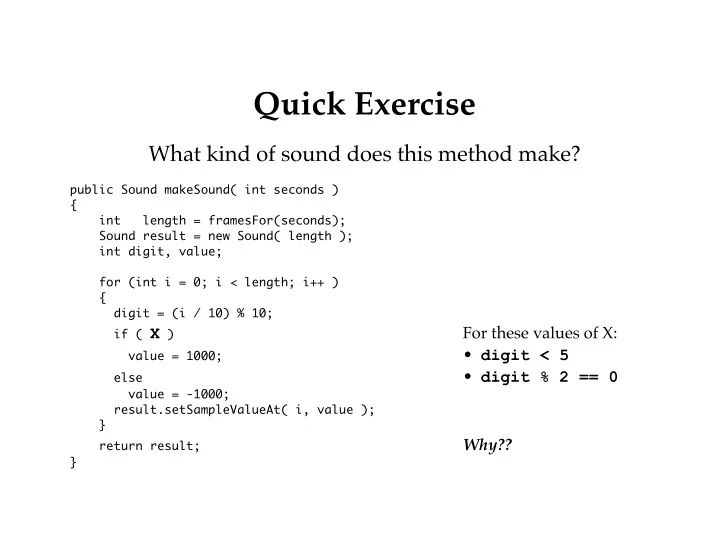
Quick Exercise

What kind of sound does this method make?

public Sound makeSound( int seconds ) { int length = framesFor(seconds); Sound result = new Sound( length ); int digit, value; for (int i = 0; i < length; i++ ) { digit = (i / 10) % 10; if ( X )

For these values of X:

value = 1000;

  • digit < 5

else

  • digit % 2 == 0

value = -1000; result.setSampleValueAt( i, value ); } return result;

Why??

}

slide-2
SLIDE 2

Objects and Classes

a description of a particular object a set of objects with with particular common behavior data: length, and representation sample values

slide-3
SLIDE 3

Alternative Method — Preferred

Methods that create sounds from scratch are usually made features of the class:

public static Sound makeSound( int seconds ) { int length = framesFor(seconds); Sound result = new Sound( length ); int digit, value; for (int i = 0; i < length; i++ ) { digit = (i / 10) % 10; if ( digit < 5 ) value = 1000; else value = -1000; result.setSampleValueAt( i, value ); } return result; }

slide-4
SLIDE 4

Musical Exercise

The sounds bassoon-c4.wav, -e4.wav, and -g4.wav all consist of 55125 samples. Write a method that creates a "blended chorded": where the notes overlap by 1/3.

(How big a result sound will you need?)

slide-5
SLIDE 5

Changing a Sound's Frequency

How can we recreate the top curve?

slide-6
SLIDE 6

Solution #2

slide-7
SLIDE 7

Solution #3

Rather than copy three-for-two, copy 22050-for-16000, using rounding to let the loop know when to repeat a sound sample.

slide-8
SLIDE 8

Upcoming Days

TUE Submit Homework 5. Read beginning of Chapter 10. WED Lab as usual — bring headphones Read rest of Chapter 10. TUE Start on Homework 6. Finish discussing Chapter 10.