Identifying individual usage patterns for an effective promotion - - PowerPoint PPT Presentation

identifying individual usage patterns for an effective
SMART_READER_LITE
LIVE PREVIEW

Identifying individual usage patterns for an effective promotion - - PowerPoint PPT Presentation

Identifying individual usage patterns for an effective promotion strategy Team Sheel Jaitley 61410271 Sunny Sapra 61410579 Amit Phatak 61410158 Biswajit Pattnaik 61410498 Sourav Paul - 61410391 Business problem Business


slide-1
SLIDE 1

Sheel Jaitley – 61410271 Sunny Sapra – 61410579 Amit Phatak – 61410158 Biswajit Pattnaik – 61410498 Sourav Paul - 61410391
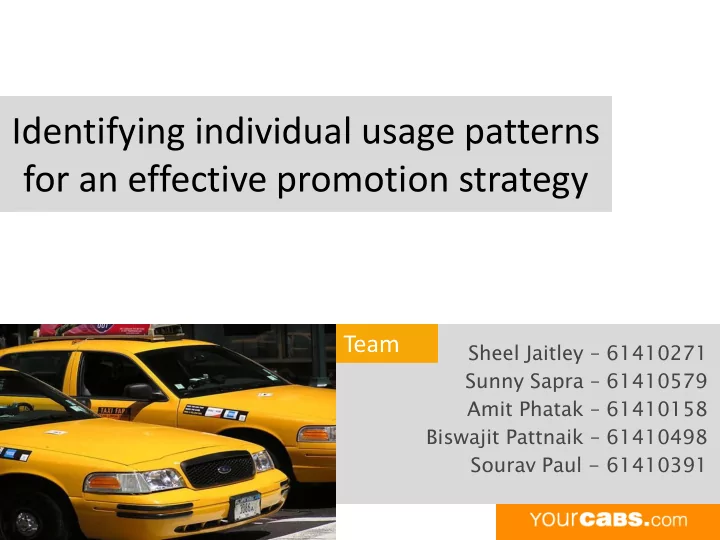
Identifying individual usage patterns for an effective promotion strategy

Team

slide-2
SLIDE 2

Business problem

  • Business problems analyzed

– Benchmark future revenue growth – Identify key customers to develop more effective promotional campaigns

  • Boundary conditions

– Business segment analyzed – Point to point travel type – Time period under analysis – July 2013 to November 2013

slide-3
SLIDE 3

Forecasting problem

  • Forecast usage pattern for each user using logistic

regression on a weekly basis

  • Each forecast indicates the user’s likelihood of

booking a cab the next week

  • Data Set used

– Number of weekly booking for each user – Latitude and longitude position – User Id

slide-4
SLIDE 4

Forecasting methodology

  • Data visualization
  • Data preparation
  • Model selection
  • Developing forecasting model
  • Performance evaluation
slide-5
SLIDE 5

Visualizing the Data Set

slide-6
SLIDE 6

Data preparation and selecting forecasting model

  • Filter data with correct to and from timing
  • Remove incorrect data

Data preparation

  • Linear regression

Model for revenue forecast

  • Logistic regression

Model for Usage forecast

slide-7
SLIDE 7

Model for revenue forecast

  • Predictors:

– Lag 1 to lag7 for number of daily booking

Forecasting model

  • Y= β0 + β2*Wt-1 + β2*Wt-2 +β2*Wt-2 …….β2*Wt-7
slide-8
SLIDE 8

Performance Evaluation

Residuals Actual vs Predicted vs Naive

slide-9
SLIDE 9

Forecasting weekly usage pattern for each user – single user model

  • Predictors:

– Number of booking per user in the week (W) – Lag 1 and lag 2 of weekly bookings of the particular user

Forecasting model

  • Logit(week=1) = β0 + β1*Wt-1 + β2*Wt-2
slide-10
SLIDE 10

Performance evaluation

Output for naïve forecast Output for logistic regression

Classification Confusion Matrix Predicted Class Actual Class 1 1 3 3 Error Report Class # Cases # Errors % Error 1 3 3 3 100 Overall 6 3 50 Classification Confusion Matrix Predicted Class Actual Class 1 1 1 2 2 1 Error Report Class # Cases # Errors % Error 1 3 2 66.67 3 2 66.67 Overall 6 4 66.67

slide-11
SLIDE 11

Forecasting weekly usage pattern for each user – single model for multiple users

  • Predictors:

– Number of booking per user in the week (Wn) – Lag 1 and lag 2 of weekly bookings per user

  • Interaction variable

– D1, D2 … Dn for n users

Forecasting model

  • Logit(week=1) = β0 + β1* D1*Wt-1 + β2* D1*Wt-2

+ β3* D2*Wt-1 …………… β2n* Dn*Wt-1

slide-12
SLIDE 12

Performance evaluation

Classification Confusion Matrix Predicted Class Actual Class 1 1 11 8 8 Error Report Class # Cases # Errors % Error 1 19 8 42.11 8 0.00 Overall 27 8 29.63

Output for naïve forecast Output for logistic regression

Classification Confusion Matrix Predicted Class Actual Class 1 1 6 4 13 4 Error Report Class # Cases # Errors % Error 1 10 4 40.00 17 13 76.47 Overall 27 17 62.96

slide-13
SLIDE 13

Performance evaluation