ICMAB ICMAB INSTITUT DE CINCIA DE INSTITUT DE CINCIA DE MATERIALS - - PowerPoint PPT Presentation

icmab icmab
SMART_READER_LITE
LIVE PREVIEW

ICMAB ICMAB INSTITUT DE CINCIA DE INSTITUT DE CINCIA DE MATERIALS - - PowerPoint PPT Presentation

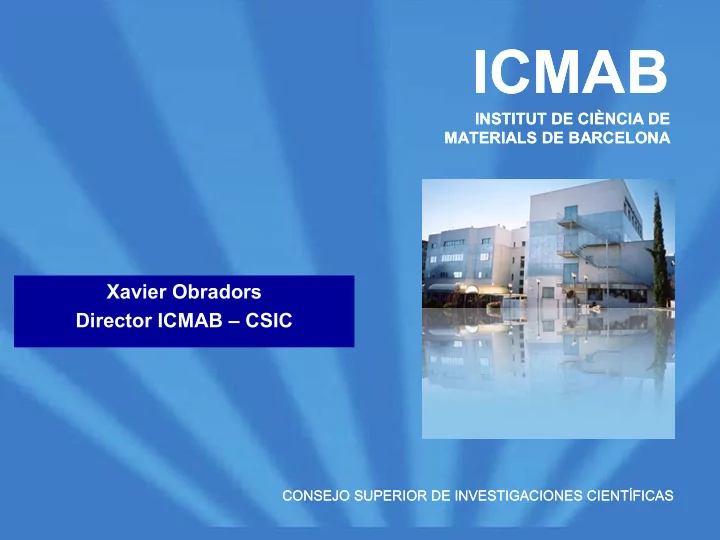
ICMAB ICMAB INSTITUT DE CINCIA DE INSTITUT DE CINCIA DE MATERIALS DE BARCELONA MATERIALS DE BARCELONA Xavier Obradors Director ICMAB CSIC CONSEJO SUPERIOR DE INVESTIGACIONES CIENTFICAS CONSEJO SUPERIOR DE INVESTIGACIONES


slide-1
SLIDE 1

ICMAB

INSTITUT DE CIÈNCIA DE MATERIALS DE BARCELONA

CONSEJO SUPERIOR DE INVESTIGACIONES CIENTÍFICAS

ICMAB

INSTITUT DE CIÈNCIA DE MATERIALS DE BARCELONA

CONSEJO SUPERIOR DE INVESTIGACIONES CIENTÍFICAS

Xavier Obradors Director ICMAB – CSIC

slide-2
SLIDE 2

ALBA SYNCHROTRON

Where are we?

Bellaterra campus (Univ. Aut. Barcelona, 20 km)

slide-3
SLIDE 3

ICMAB RESEARCH ACTIVITIES

slide-4
SLIDE 4
slide-5
SLIDE 5

Battery materials

2.0 2.5 3.0 3.5 4.0 4.5 200 150 100 50

E/V (vs Li)

Capacity (mAh/g)

  • Electrochem. Comm. 9, 708 (2007))

High T batteries

250ºC % O

nitrides

PCT application ES03/00249

  • J. Electrochem. Soc. 152(11), (2005)
  • Inorg. Chem. (submitted)

ALISTORE ERI

0,5 1 1,5 2 2,5 3 2 4 6 8 10 'x in Li xFe2O3' M M M M M Li2O matrix M M M M M Li2O matrix

MxOy amorphous MxOy

MxOy + 2y Li+ -> y Li2O + x M + 2y e-

New materials, alternative mechanisms

9.3 Å

β β-

  • NiOOH

NiOOH

9.3 Å

β β-

  • NiOOH

NiOOH

Journal of the American Chemical Society, 129, 5840 (2007) Journal of Materials Chemistry 16, 2925 (2006) β-Ni(OH)2

Correlation microstructure-electrochemical yield

a b

92 Å

a b

92 Å

b

92 Å

c b

14 Å

Energy Research

slide-6
SLIDE 6

Nitride materials with photocatalytical activity in the visible range

Advanced Functional Materials, 17, 3348 (2007)

Mesoporous nanostructured thin films

  • f TiO2-x-y

Nx (anatase) 1 2 3 4 5

300 350 400 450 500 550 600

Cut-off wavelength (nm) Rate of CO2 evolution for decomposition of acetaldehyde as a function of irradiation λ

  • ver N-doped CeO2 films

New nitrogen doped ceria (CeO2 ) with photocatalytical activity in the visible range

Chemistry of Materials, 2, 1682 (2008) A.Fuertes, A.B.Jorge. Pat. Esp. 200700482. 23- 02-2007.

N1s XPS as a function of the nitriding temperature in NH3

N bonded to Ti N bonded to Ce

Nitrogen doping of oxides decreases the band gap because of the lower electronegativity of N vs O, shifting the photocatalytical activity from the UV to the visible range

Rate of CO2 evolution (ppm/h.cm2 )

The mesostructure is kept until T=700 oC Solid solution CeO2-x-yNx up to 4.5 mol % N

Energy Research
slide-7
SLIDE 7

Hydrogen by Ethanol Reforming

Catalyst grown

  • n

cordierite substrate: Nanocomp-

  • sited

silica aerogel with cobalt nanoparticles (blue

in the idealized inset).

The catalytic device can be simply heated up to the reaction temperature (320-340ºC) under air, and then the ethanol is introduced for the generation of hydrogen. This has a strong potential for fuel cell technology as well as for on-board generation of hydrogen for mobile applications. The catalytic device can be easily operated and doesn’t require special care for shut down cycles, thus allowing interrupted and/or oscillating operation for real practical application. No activation and/or conditioning are required for operation.

Co-SiO2 aerogel-coated catalytic walls for the generation

  • f

hydrogen, M.Domínguez, E.Taboada, E.Molins, J.Llorca, Catalysis Today (2008) and CSIC- UPC patent (2007)

Energy Research

slide-8
SLIDE 8

Chemical solution approaches to self-assembled and nanocomposite superconducting films

Xavier Obradors

Institut de Ciència de Materials de Barcelona, CSIC, 08193 Bellaterra, Spain

Consolider Consolider

T.Puig, A. Pomar, A. Palau, F. Sandiumenge, S. Ricart, N. Mestres,

  • J. Gutiérrez, M. Gibert, A. Llordés, A. Carretero, C. Moreno, R.F. Luccas,
  • J. Zabaleta, F. Martínez, P. Abellán, N. Romà, A. Benedetti, J. Gázquez,
  • M. Coll, R. Vlad, X.Granados

HI PERCHEM

slide-9
SLIDE 9

POWER APPLICATIONS SUPERCONDUCTORS

20 40 60 80 0.01 0.1 1 10 100

B (T) B (T) T (K) T (K)

Magnets

FCL

Cables Transformers

NMR Research Accelerators, etc

Motors generators SMES

MRI

slide-10
SLIDE 10

Metallic substrate: RABiTS Ni, SS-IBAD thickness ~ 80 μm Buffer layers : CeO2 , YSZ, STO,… ~ 0.1 μm SC layer : YBCO ~ 1.0 μm Cap layer : Ag thickness ≈ 0.2 - 0.5 μm

COATED CONDUCTORS ARCHITECTURE

Nanostructure control on km length materials

slide-11
SLIDE 11

GOALS

  • The potentiality and richness of chemical solution methods for

growth of nanostructured films and coated conductors:

– A flexible, scalable and controllable bottom-up approach

  • Nanostructured YBCO films by chemical routes

– Interfacial nanostructured films – Nanocomposites – Ferromagnetic-superconductor nanostructured YBCO films

  • Methodology to analyze vortex pinning based on angular

dependent transport Jc measurements

YBCO Single crystal YBCO Single crystal

slide-12
SLIDE 12

APS : Artifical Pinning Structures

Current flow without dissipation Pinning of vortices by material defects FL = Jc x B = Fp → vfl = 0 J NEED of:

  • Manipulation, control and tuning of APS
  • Correlation of nanostructured films with Jc
  • Knowledge on superposition of APS and natural defects
  • More realistic theoretical pinning models considering complexity

Generation

  • f

APS

HOW ?

… by nanostructuration

The methodology must be versatile, scalable and low cost We choosed a chemical solution route

slide-13
SLIDE 13

Chemical Solution Deposition

… a versatile, scalable and low cost methodology for growth of nanostructured films

For YBCO films …

Low-cost methodology

High production rate

Scalable to large surfaces Versatile: nanostructuration

Spin-coating

  • n a substrate

Metal-organic TFA solution

Coated conductors

ω

Pirólisis Reacción Oxigenación PO 2, PH 2O Flujo de Gas dT1/dt T 1 T 3, t

  • dT 3/

T 2, t T(PH

2O)

PO 2, PH 2O

  • dT 2/dt

T dT2/dt Pyrolysis Growth Oxygenation PO2 , PH2O T 1 T 3 T 2 Gas Flow PO 2 , PH 2O T

Epitaxial layer

Gas Flow Pirólisis Reacción Oxigenación PO 2, PH 2O Flujo de Gas dT1/dt T 1 T 3, t

  • dT 3/

T 2, t T(PH

2O)

PO 2, PH 2O

  • dT 2/dt

T dT2/dt Pyrolysis Growth Oxygenation PO2 , PH2O T 1 T 3 T 2 Gas Flow PO 2 , PH 2O T

Epitaxial layer

Gas Flow

MOD process

slide-14
SLIDE 14

Phase and growth control

  • Intermediate phases: a-Y2 O3

,Y2 Cu2 O5 and CuO embedded in oxyfluorides (OF)

  • YBCO nucleates exclusively at the interface: island to layer growth

J.Gázquez et al, Chem Mat (2006)

Y long and winding road: TFA-Y / Ba1-x Yx F2 / a-Y2 O3 / Y2 Cu2 O5 / Ba1-x Yx (F,O)2-y / YBa2 Cu3 O7

Film quenched before growth

slide-15
SLIDE 15

Multilayers: Epitaxy and cap layer planarity

RHEED IFW-Dresden

RBS channeling χmin = 12 % (CeO2 ) χmin = 46 % (CZO)

400nm

rms: 0.8nm rms: 3 nm

RHEED CZO AFM Ce1-x [Gd(Zr)]x O2-y High energy (00l) facets

slide-16
SLIDE 16

25 50 75 100 2 4 6

% Flat CeO2 area Jc(MA/cm

2)

T=77K

nm 5 10 15 20 25 30 1 2 3 4 5 µm µm 0.5 1 1.5 2 2.5 3 3.5 4 4.5 5

Planarity

96,8 %

Growth of TFAYBCO on MOD CeO2 cap layers

2007 results

Highest critical current

TFAYBCO on MOD-CeO2

cap layers

Jc (77K)= 5.2 MA/cm2

25 50 75 100 2 4 6

% Flat CeO2 area Jc(MA/cm

2)

T=77K 1 2 3 4 5 1 2 3 4 Jc(MA/cm

2)

rms CeO2 (nm) T = 77K

rms rms roughness roughness is is too too rough rough Surface Surface planarity planarity is is more more useful useful

slide-17
SLIDE 17

Growth of TFAYBCO on MOD-cap metallic substrates

1 μm

49% YSZ

1 μm

76% CZO

Δφ (YBCO) =5º Δφ (YSZ) =9.5º

  • 8
  • 4

4 8 I (a.u.)

φ (deg) Δφ = 5º

YBCO (103)

Jc (77K)= 1.8 MA/cm2 MOD planarization High SC performances

Polycrystalline substrate/epitaxial multilayer

slide-18
SLIDE 18

J

Vortex pinning in MOD-YBCO films

Critical current optimization → at high fields (1- 5T) Correlation nanostructure and vortex pinning High quality epitaxial films Jc

sf(77K) ~

4 MA/cm2 Island based nucleation and growth mode → a-b plane defects promotion

  • Intergrowth
  • Stacking faults
  • in-plane partial

dislocations

Pinning defects of specific size and disposition

θ θ Point like defects Linear defects Planar defects

We need to identify and separate different vortex pinning contributions

slide-19
SLIDE 19

90 135 180 225 1E-6 1E-5 1E-4 1E-3 0.01 0.1 1

Jc(MA/cm

2)

θ (º)

T= 77K

MOD-YBCO, t ≈ 275 nm

θ θ c a

FL

θ

FL

θ

ANISOTROPIC defect contribution

Isotropic and anisotropic pinning defect contributions

ISOTROPIC defect contribution

Enable to separate ISOTROPIC and ANISOTROPIC defect pinning contributions

H//ab H//c

slide-20
SLIDE 20

/

) (

T T wk c c

e J T J

=

2

) / ( 3

) (

+

=

T T str c c

e J T J

Nelson et al, Phys. Rew. B 48 (1993) Blatter et al., Rev. Mod. Phys 66 (1994)

J.Gutierrez et al., Appl. Phys. Lett. 90 (2007)

Jc temperature dependence: Weak and strong pinning

r0 < ξ Weak pinning Strong correlated pinning

PLD-YBCO

slide-21
SLIDE 21

Pinning regime diagrams in standard TFA films for H//c

Weak-isotropic defects dominate at low T, strong-isotropic

defects at intermediate T and strong-anisotropic defects at high T

  • J. Gutierrez et al, APL 90, 162514 (2007)

275 nm YBCO-TFA films

20 40 60 80 2 4 6 8

0,2 0,4 0,6

20 40 60 80 2 4 6 8

Temperature (K)

μ0H (T)

Janis

c

/Jtotal

c

Hirr

0,8

20 40 60 80 2 4 6 8

0,5 0,5 0,3 0,7 0,3 Temperature (K)

μ0H (T)

Hirr

J

iso-str c

/J

total c

20 40 60 80 2 4 6 8

0.6 0.4 0.2

20 40 60 80 2 4 6 8

Temperature (K)

μ0H (T)

Hirr

J

Iso-wk c

/J

tot c

We have a tool to separate and quantify the three vortex pinning contributions

Iso-wk contribution Iso-str contribution Aniso-str contribution

T.Puig et al., SUST 21, 034008 (2008)

slide-22
SLIDE 22

Vortex pinning in nanostructured YBCO-TFA films

Interfacial nanostructured films: Nanocomposite films:

AIM: Identify and control pinning contributions induced in the different nanostructured YBCO films

YBCO Single crystal YBCO Single crystal Approach:

slide-23
SLIDE 23

Metal-organic precursors Spin-coating

  • n a substrate

Thermal treatment

600oC ≤ T ≤ 1000oC Atm: O2 , Ar-H2

Nanostructures: Chemical Solution Deposition

1x1 μm2 single crystal thermally treated

Tune of the equivalent deposited thickness through concentration

10-3mol/l ~20nm 10-1mol/l ~1nm complete layer

Use of very → dilute solutions

Surface energy Interface energy Elastic relaxation energy

Pentadionates, acetates, propionates in acetic acid, isopropanol and/or propionic acid Self-assembled nanoparticles

slide-24
SLIDE 24

5 μm 5 μm

Self-assembled nanostructures grown from chemical methods

Interfacial self-assembled nano- structured films

0,5 μm

La0.7 Sr0.3 Mn O3 thin film (La,Sr)Ox nanodots

0.2 m μ

Strain induced self-assembled Ce0.9Gd0.1O2-y nanowalls

  • M. Gibert et al., Adv. Mat. 19, 3937 (2007)

h ~ 8-10 nm h ~ 50 nm

Spontaneous nucleation of (La,Sr)OX nanoislands on LSMO

  • C. Moreno et al. Adv.Func.Mat. (2009)
slide-25
SLIDE 25

Nanodot and nanowires of Ce0.9 Gd0.1 O2-y

Highly anisotropic islands Isotropic islands

0,5 μm

O2

0,5 μm

Ar-H2

Growth atmosphere:

fine selection of interface energy

LAO (011) [1-10] CGO [100] [010] [001]

ξ

~ +5 %

ξ

~ -1 %

LAO (001) [110] CGO [100] [010] [-110]

ξ

~ -1 %

ξ

~ -1 %

(011) (100) (0-11)

(010) (001)

CGO nanowall

LAO

(111)

0,2 0,4 0 ,6 0,8 2 4 6 8

50nm

μm

345 nm

nm

0,1 0,2 0,3 2 4 6

nm

μm

~5 nm ~34 nm

slide-26
SLIDE 26

Interfacial oxide nanostructured films: Anisotropy of Jc (θ)

80 100 120 140 160 180 200 220 1E-6 1E-5 1E-4 1E-3 0.01 0.1 1

Standard CGO (La,Sr)Ox dots (La,Sr)Ox pyramids

Jc(MA/cm

2)

θ(º)

T=77K, μ0H=7T

  • J. Gutierrez et al., APL (2009)

c-axis anisotropic contribution is strongly increased Reduced anisotropic contribution for H//ab

Similar behavior obtained for all the different architectures → defects along the c-axis induced in the YBCO matrix by the interfacial particles

θ

2 4 6 8 1 10 100

CGO (La,Sr)Ox dots (La,Sr)Ox pyramids

Jc

anis nano/Jc anis st

μ0H//c (T)

77K

slide-27
SLIDE 27

50μm

4 tracks (20μm*100 μm) defined by lithography:

10μm YBCO/Ce0.9 Gd0.1 O2-y nanowalls

Track 1: full thickness 250nm Track 2: FIB milling down to 175 nm Track 3: FIB milling down to 130nm

Interfacial oxide nanostructured films: thickness dependence

µm 0.02 0.04 0.06 0.08 0.1 0.12 0.14 0.16 0.18 0.2 0.22 0.24 0.26 0.28 0.3 0.32 0.34 0.36 0.38 0.4 0.42 0.44 0.46 0.48 0.5 0.52 0.54 0.56
slide-28
SLIDE 28

90 135 180 225 1

250nm 170nm 130nm

Jc (MA/cm

2)

θ (deg)

μ0 H = 5T, T= 50K

Isotropic defects pinning contribution

90 135 180 225 0.0 0.1 0.2 0.3 0.4 0.5 0.6

250nm 170nm 130nm

Jc

  • anis. (MA/cm

2)

θ (deg)

Enhanced c-axis anisotropic contribution as thickness decreases

100 150 200 250 0.0 0.1 0.2 0.3 0.4

Jc

anis(MA/cm 2)

tickness (nm)

μ0H//c = 5T

T = 50K T = 65K T = 77K

Angular measurements

Pinning associated to defects induced by interfacial nano-particles is enhanced by reducing the YBCO thickness → Higher density of defects generated near the nano- structures

slide-29
SLIDE 29

In-situ YBCOTFA-BZO nanocomposites

  • J. Gutiérrez, A. Llordés et al., Nature Materials 6, 367 (2007)

STO YBCO BZO

Film thickness= 200 (20) nm

Modification of the (Y,Ba,Cu ) precursor solution by addition of Ba and Zr salts: BaZrO3 nanodots randomly embedded

(006) (005) (004) (003) (002) (110) YBCO BZO 2θ (deg.) 20 25 30 35 40 45 STO (001) (002) 2θ χ

BZO nanodots size : 10-20 nm Two populations of BZO coexist Epitaxial Non epitaxial YBCO

slide-30
SLIDE 30
  • J. Gutiérrez, A. Llordés et al., Nature Materials 6, 367 (2007)

STO YBCO BZO

Film thickness= 200 (20) nm

cube on cube epitaxial relationship with YBCO matrix Interfacial nanodots

YBCO BZO STO

(002)STO (002)BZO

Randomly

  • riented

(non-coherent with the matrix)

BZO YBCO

(101) (011) (-110) Zone axis [111] BZO

Bulk nanodots Modification of the (Y,Ba,Cu )TFA anhydrous precursor solution by addition of Ba and Zr salts

YBCOTFA-BZO nanocomposites

slide-31
SLIDE 31

In-situ YBCOTFA-Y2 O3 nanocomposite

(112)Y2O3

Y2 O3 YBCO Y2 O3 YBCO LAO Y2 O3 polycrystalline fraction is also present… BUT not identified by TEM

Epitaxial Y2 O3 at the substrate interface and in the bulk

(001)Y2 O3 // (001)YBCO [110]Y2 O3 // [100]YBCO ε=-2.7 %

Need

  • f

quantification

  • f

non-coherent (or random) fraction

Average size Y2 O3 : 20-25nm

Jc (1T, 77K)=0.5 MA/cm2 for 20 %mol Jc (1T, 77K)=0.3 MA/cm2 for 10 %mol

slide-32
SLIDE 32

Interfaces in nanocomposites

Can be divided, on the basis of their lattice matching, into three classes

Incoherent

Misfit dislocation

Semi-coherent

Lattice matching with strain relaxation

NO lattice matching NO orientation relationship Disordered structure

Based on an orientation relationship which is specified crystallographically in terms of a pair of planes and directions: { hkl} A / / { hkl} B with < uvw> A / / < uvw> B

Coherent

Perfect lattice matching at the interface plane

Interphase boundary

δ = (dA – dB )/ dA Interfacial energy γ (coherent)= γch Epitaxial interfaces γ (semi-coherent)= γch + γst Very little is known about the detailed structure

slide-33
SLIDE 33

Analogy interphase-grain boundaries

High angle grain boundary

Interphase boundary

Interphase boundary

High interfacial energy Nano-structural defects formation

  • Stacking faults
  • Chemical heterogeneities
  • Twinning
  • Dislocations
  • Point defects
  • Microstresses

Lattice strain (XRD)

slide-34
SLIDE 34

Enhanced pinning properties in SC nanocomposites are related to random Np

2 4 6 8 5 10 15 20

Fp (GN/m

3)

μ0H (T)

Fp = Jc x B

0,01 0,1 1 10 0,01 0,1 1 10

Jc (MA/cm

2)

μ0H (T)

10 mol.% BZO 7 mol.% BZO 20 mol.% Y2 O3 10 mol.% Y2 O3 Pure YBCO

Maximum pinning force is controlled by random Np

2 4 6 8 4 8 12 16 20

Fp

max

[random Np] mol%

The strained microstructure is very effiective to increase Jc at high magnetic fields (vortex pinning) Isotropic microstrain plays an important role in vortex pinning propeties

slide-35
SLIDE 35

5 10 15 20 2 4 6 8 BZO

γ eff

[nanodot] mol. %

Y2O3

Jc (θ) anisotropy is reduced in the nanocomposites

Vortex pinning is controlled by isotropic defects

90 135 180 225 1E-4 1E-3 0,01 0,1 1 77K, 5T

Jc(MA/cm

2)

θ(º) 10 mol.% BZO 7 mol.% BZO 20 mol.% Y2 O3 10 mol.% Y2 O3 Pure YBCO

5 10 15 20 2 4 6 8

γ eff

[random nanodot ] mol %

Random nanodots (isotropic microstrain) also control the effective anisotropy (γeff )

slide-36
SLIDE 36

0.3 0.2 0.1

20 40 60 80 2 4 6 8

Temperature (K) μ0H (T)

Hirr

Jiso-wk c /Jtot c

10% BZO

Pinning regime diagrams

20 40 60 80 2 4 6 8

0,1 0,2

20 40 60 80 2 4 6 8

Temperature (K)

μ0H (T)

Hirr

Janis

c

/Jtotal

c 20 40 60 80 2 4 6 8

0,2 0,4 0,6

20 40 60 80 2 4 6 8

Temperature (K)

μ0H (T)

Janis

c

/Jtotal

c

Hirr

20 40 60 80 2 4 6 8

0.7 0.9 0.9 0.7

20 40 60 80 2 4 6 8

0.8 Temperature (K)

μ0H (T)

0.8

J

iso-str c

/J

total c

Hirr

20 40 60 80 2 4 6 8

0,5 0,5 0,3 0,7 0,3 Temperature (K)

μ0H (T)

Hirr

J

iso-str c

/J

total c

20 40 60 80 2 4 6 8

0.6 0.4 0.2

20 40 60 80 2 4 6 8

Temperature (K)

μ0H (T)

Hirr

J

Iso-wk c

/J

tot c

0% BZO

First time, full pinning phase diagram is controlled by strong-isotropic defects

Iso-wk contribution Iso-str contribution Aniso-str contribution

20 40 60 80 2 4 6 8

0.7 0.9 0.9 0.7

20 40 60 80 2 4 6 8

0.8 Temperature (K)

μ0H (T)

0.8

J

iso-str c

/J

total c

Hirr

slide-37
SLIDE 37

Conclusions and Outlook

Chemical solution deposition is a versatile technique to

generate artificial pinning structures.

Complementariry with PLD? The methodology to analyze vortex pinning contributions

can be used for PLD nanocomposites.

I nterfacial nanostructures are successfully grown by CSD

and c-axis anisotropic defects are artificially introduced in YBCO films. Can be combined with PLD?

CSD nanocomposites are very promissing, vortex pinning is

controlled by strain generated by isotropic defects. Strain in

self-organized PLD nanorods? Magnetic nanostructures have been introduced in YBCO

films showing an enhancement of vortex pinning

We need to use the nanoscale imaging methods to

correlate vortex pinning with APC