The Specialist Committee on Azimuthing Podded Propulsion Report and - - PowerPoint PPT Presentation

the specialist committee on azimuthing podded propulsion
SMART_READER_LITE
LIVE PREVIEW

The Specialist Committee on Azimuthing Podded Propulsion Report and - - PowerPoint PPT Presentation

The Specialist Committee on Azimuthing Podded Propulsion Report and Recommendations Noriyuki Sasaki , National Maritime Research Institute = + + + R R R R R POD BODY STRUT INT LIFT ) 1 ( R BODY = 1 + k


slide-1
SLIDE 1

The Specialist Committee on Azimuthing Podded Propulsion Report and Recommendations

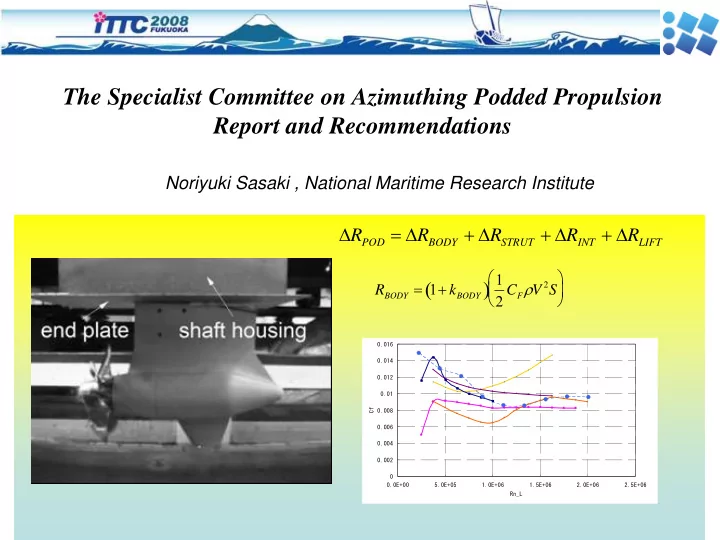
LIFT INT STRUT BODY POD

R R R R R Δ + Δ + Δ + Δ = Δ

RBODY = 1+ kBODY

( ) 1

2 CFρV 2S ⎛ ⎝ ⎜ ⎞ ⎠ ⎟

0.002 0.004 0.006 0.008 0.01 0.012 0.014 0.016 0.0E+00 5.0E+05 1.0E+06 1.5E+06 2.0E+06 2.5E+06 Rn_L Cf

Noriyuki Sasaki , National Maritime Research Institute

slide-2
SLIDE 2
  • Ir. Jaap H. Allema.

Maritime Research Institute Netherlands (MARIN), Wageningen, The Netherlands. Professor Mehmet Atlar. (Former Chairman) University of Newcastle, Newcastle-upon-Tyne, United Kingdom.

  • Dr. Se-Eun Kim.

Samsung Heavy Industries Co. Ltd., Daejeon, Korea. Dr.Valery Borusevich. Krylov Shipbuilding Research Institute (KSRI), St. Petersburg, Russia.

  • Dr. Antonio Sanchez-Caja.

VTT Industrial Systems, Espoo, Finland.

  • Dr. Francesco Salvatore.

Istituto Nazionale per Studied Esperienze di Architettura Navale (INSEAN), Roma, Professor Chen-Jun Yang (Secretary). Shanghai Jiao Tong University (SJTU), Shanghai, China.

  • Dr. Noriyuki Sasaki (Chairman).

National Maritime Research Institute (NMRI), Tokyo, Japan.

Membership

slide-3
SLIDE 3

Outline

1. General 2. Questionnaires 3. Review and update Procedure 7.5-02-03-01.3 4. Cavitation behaviour of podded propulsors with steering angles 5. Hydrodynamics of POD propulsion for ice applications 6. Technical Conclusions

slide-4
SLIDE 4
  • 1. General
slide-5
SLIDE 5

Meetings

(1) Tokyo, Japan, March 2006. (2) Brest, France, Octover 2006, in conjunction with the 2nd T-Pod Conference (3) St. Petersburg, Russia, June 2007 (4) Shanghai, China, March 2008. Tokyo(NMRI)

  • St. Petersburg(KSRI)
slide-6
SLIDE 6

1. Review and update Procedure 7.5-02-03-01.3 “Propulsion, Performance- Podded Propulsor Tests and Extrapolation”. Give special emphasis on how to scale housing drag and to the validation of full-scale propulsion prediction. 2. Continue the review of hydrodynamics of POD propulsion for special applications including fast ships, ice going ships (Liaise with the Ice committee) and special POD arrangements like Contra-rotating Propellers (CRP) and

  • hybrids. Include the practical application of computational methods to

prediction and scaling. 3. Review and analyse the cavitation behaviour

  • f podded propulsors. Emphasize

high pod angles and normal steering angles including dynamic behaviour. Include the practical application of computational methods to prediction and scaling.

Committee’s Tasks

slide-7
SLIDE 7

Task Distributions

TASKS MA NS JA AS SEK FS CJY VB Kawanami Kume Ohhashi Type of Instruments ○ ○ ◎ ○ ○ ○ ○ ○ Unit Thrust Mes. ○ ○ ◎ ○ ○ ○ ○ ○

  • Prop. Thrust Mes.

○ ○ ◎ ○ ○ ○ ○ ○

  • Prop. Torque Mes.

○ ○ ◎ ○ ○ ○ ○ ○ Idle Thrust Mes. ○ ○ ◎ ○ ○ ○ ○ ○ Idle Torque Mes. ○ ○ ◎ ○ ○ ○ ○ ○ Gap Effect ◎ ○ ○ ○ SFC at SPT ◎ ○ ○ ○ Driving System ◎ ○ ○ ○ Air Draw ◎ ○ ○ ○ DATA Prosessing ◎ ○ ○ ○ Others ○ ○ ○ ○ Propeller Base ◎ Unit Base ◎ Unit Thrust Correction ◎ ○ Wake Scaling ◎ ○ Sea Trial ○ ◎ ○ ○ ○ ○ ○ Monitoring ○ ◎ ○ ○ ○ ○ ○ Hybrid CRP ○ ◎ Crash Stop ◎ ○ Ice ◎ ○ Crabbing ◎ ○ Sea Keeping ◎ ○ Others ○ Simulation of R.T ◎ ○ ○ ○ Simulation of S.P.T. ◎ ○ ○ ○ Simulation of Full Scale ◎ ○ ○ ○ Maneuvering ◎ ○ ○ ○ Sea Keeping ◎ ○ ○ ○ Others ○ ○ ○ ○ CFD Application Powering Model Test Procedure Scaling Base Special Theme

slide-8
SLIDE 8

History of Podded Propulsion

FANTASY ELATION Uikku cruise ship ice breaker TEMPERA 2002 1995 1991 Queen Mary II double acting tanker 2005 2002 1993 electric propulsion HAMANASU TRITON HATAKAZE submarine, war ships, ice breaker, cruise ships

DAS SES FAST POD

slide-9
SLIDE 9

Combined pod and waterjet setup, Atlar et al (2006)

The hybrid system is composed of two steerable (wing) pod drives and two fixed (central) – booster – flush type water jets

slide-10
SLIDE 10

Contra-rotating Pod Propellers

2 shafts – 2 electrical motors Slender shaped pod

Super Eco Ship Project

slide-11
SLIDE 11

Pure CRP Pods (Mechanical Drive) on the Shiga Maru

Shige Maru is one of the ships delivered as “Super Eco Ship”. The Super Eco Ship project was led by Ministry of Land, Infrastructure and Transport and National Maritime Research Institute from 2001.

slide-12
SLIDE 12

Pump jet pod (PJP) unit ,Bellevre et al. (2006).

A comprehensive numerical and experimental design study was conducted for 2 cruise liner type pod units (13MW) for a 45000 GRT cruise liner using 2D-3D RANS

  • codes. Based upon this comparative study it was concluded that the propulsive

performance of PJP was 14% higher than the conventional tractor pod mainly due to its superior open water efficiency.

slide-13
SLIDE 13
  • 2. Questionnaires
slide-14
SLIDE 14

We sent following questionnaire to 40 organizations and received 20 replies.

25th ITTC Specialist Committee on Azimuthing Podded Propulsion Questionnaire on Model Test Procedure, Powering Method and CFD Computation Method for Podded Propulsion System Introduction

The task assigned by the 25th ITTC to this specialist committee is to develop and validate practical experimental and numerical prediction procedures for full scale performance of Azimuthing podded Propulsion System. As a first step toward accomplishing the task, the committee developed the following questionnaire to assess current practices in use by various

  • rganizations, including the ITTC member organizations. The analysis of the responses to the

questionnaire will be presented to the 26th ITTC conference as part of the final report of this specialist committee. The questionnaire consists of six(6) parts: (A) Propeller Open Water Test, (B) Podded Propeller Open Water Test, (C) Resistance & Self Propulsion Test, (D) Powering, (E) CFD application (F) Special theme. You do not have to complete all the sections or questions of the questionnaire. If you are not in a position to answer the questionnaire at all, then a null response would be appreciated. If that is the case, please fill in the Respondent’s Information only and return.

Please ease r return rn t the e co complete ted for form prefe eferably ably b befo fore re 25 25th/Sep ept./20 t./2006. fo for th r the co committee tee t to eval aluate uate th the r e res esults i in ti time

  • me. If yo

If you fai fail to mee to meet th the d e deadline ple please tr e try y to to ret return an anyw yway a at your your sui suitabl able t e time. e.

Respondent’s Information (Example) Name: Noriyuki Sasaki_______________________ Organization: National Maritime Research Institute Position: Group Leader of Propulsors Research Group Mailing Address: , Shinkawa, Mitaka-shi, Tokyo 181-0004 JAPAN_____________________________

  • Tel. No.:

+81 422 41 3505______________________ Fax No.: +81-422 41 3053____________________ E-Mail Address: sasaki@nmri.go.jp______________ Website: http://www.nmri.go.jp/

Nation Organazation CN SJTU CN DUT FI VTT IT INSEAN JP NMRI JP IHIMU JP MHI JP SHIME JP ASMB KR SSMB KR MOERI KR HMRI NL MARIN UK UNCL UK Quinetic GER HSVA POL CTO SW SSPA CA IOT CA MU

slide-15
SLIDE 15

Questions A series : Propeller Open Water Test for Pod Propulsion

A-1 What kind of experimental tank do you use?

  • A. Towing Tank
  • B. Circulation Water Channel (incl. Cavitation Tunnel)
  • C. Both
  • D. Others

10 2 4 A B C D

Towing Tank

A-7 What is the standard Reynolds Number (based on Dp) for the open water test?

  • A. We don’t have any standard for it
  • B. We have a standard Reynolds Number
  • C. We have two standards

4 9 1 A B C

We have standard Rn = ****** Experimental tank

slide-16
SLIDE 16

Questions A series : Propeller Open Water Test for Pod Propulsion

A-3 What is the diameter of propeller? 100 200 300 400 500 600 1 2 3 4 5 6 7 8 9 10 11 12 13 14 15 16 17 18 19 20 21 Dp [mm]

A-11 How much is the propeller immersion, Im? 50 100 150 200 250 1 2 3 4 5 6 7 8 9 10 11 12 13 14 15 16 17 18 19 20 21 Im/Dp [%]

Diameter immersion

slide-17
SLIDE 17

Survey Results of Gap Width

Questions B series : Pod Propeller Open Water Test

B-3 What is the propeller gap between boss and pod housing?

1 2 3 4 5 6 1 2 3 4 5 6 7 8 9 10 11 12 13 14 15 16 17 18 19 20 21 Width of Gap [mm]

slide-18
SLIDE 18

Survey Results on Propeller Immersion

Questions B series : Pod Propeller Open Water Test

B-11 How much is the propeller immersion, Im?

50 100 150 200 250 1 2 3 4 5 6 7 8 9 10 11 12 13 14 15 16 17 18 19 20 21 Im/Dp [%]

slide-19
SLIDE 19

C-1 How do you analyze self-propulsion test?

  • A. Conventional way (regards pod housing as an appendage)
  • B. Unit base (regards pod unit as the propulsor)
  • C. Both

2 11 6 A B C

Survey Results on Propulsion Analysis Methods for Pod Propulsion Ships

Questions C series : Pod Propeller Self Propulsion Test

regards pod unit as a propulsor

propulsor appendage

slide-20
SLIDE 20

Survey Results on Rn Correction Method

D-1 Do you assess the effect of Reynolds numbers on performance of Podded propulsor?

  • A. Yes
  • B. No

14 5 A B

Questions D series : Powering to full scale

D-1 If yes, what kind of correction method do you use for pod housing drag correction(s)?

  • A. Empirical
  • B. Semi-empirical
  • C. CFD-base
  • D. Others( )

1 7 3 3 A B C D

We assess the effect of Reynolds numbers

slide-21
SLIDE 21
  • 3. Review and update

Procedure 7.5-02-03-01.3

slide-22
SLIDE 22

Flow diagram for full scale power prediction from model test results of a vessel equipped with podded propulsion.

Pod unit open water test Pod unit open water test Pod housing drag correction Pod housing drag correction Powering In full scale Powering In full scale Self propulsion test Self propulsion test Resistance test Resistance test Propeller open water test Propeller open water test

High Rn Low Rn

Covering Area of Guideline

slide-23
SLIDE 23

Letter from ABB to ITTC (24th)

slide-24
SLIDE 24

ABB Round Robin Tests

+NMRI +SSMB

slide-25
SLIDE 25

Problems to be solved

  • Very few official data of full scale
  • Each model basin developed their own procedure
  • Pod maker complains about this chaotic condition
slide-26
SLIDE 26

Test Scheme

ABB Model Basin

model propeller Pod Drawing

Test Menu Pod Resistance Test

manufacture Pod Model

Propeller Open Water Test Pod Unit Open Water Test Full Scale Prediction

slide-27
SLIDE 27

Pod unit open water test Pod unit open water test Pod housing drag correction Pod housing drag correction Powering In full scale Powering In full scale Self propulsion test Self propulsion test Resistance test Resistance test Propeller open water test Propeller open water test

High Rn Low Rn

Covering Area of Guideline

Propeller open water test.

slide-28
SLIDE 28

Propeller open water test.

The procedure for open water tests of the propellers for a ship equipped with podded propulsors is basically the same as that of Procedure 7.5-02-03-02.1" Propeller open water tests", (ITTC, 2002b) although some typical aspects for propellers with strongly tapered hubs are not considered and these aspects are given in this section where necessary.

slide-29
SLIDE 29

7.5o Aft fairing Forward cap Hub

Cylindrical Hub Tapered Hub

Hub

Tapered Hub

slide-30
SLIDE 30

Propeller Open Water Wfficiency 0.4 0.45 0.5 0.55 0.6 0.65 0.7 0.75 0.1 0.2 0.3 0.4 0.5 0.6 Kt/J**2 ηo(Prop. Efficiency)

Propeller Open Water Efficiency with the Same Model Propeller

12%

working point

Main reasons: Reynolds number,Shaft Immersion, Boss Correction ?

mean (except top and bottom)=0.653

slide-31
SLIDE 31

Pod unit open water test Pod unit open water test Pod housing drag correction Pod housing drag correction Powering In full scale Powering In full scale Self propulsion test Self propulsion test Resistance test Resistance test Propeller open water test Propeller open water test

High Rn Low Rn

Covering Area of Guideline

Pod unit open water test.

slide-32
SLIDE 32

Principal dimensions of pod housing used in round robin testing programme, Veikonheimo (2006)

Principal dimensions of Pod Propulsor Length of Pod Body 0.4563 m Diameter of Pod Body 0.1135 m Height of Strut 0.1372 m Chord Length of Strut 0.2672 m Total Wetted Surface Area

  • f Pod

0.2129 m2

manufactured by Model Basin

Typical pod unit open water test setup

supplied by ABB

test scheme pod housing: manufactured according the same drawing supplied model propeller: supplied propeller cap and dummy boss : supplied

slide-33
SLIDE 33

Typical pod unit open water test setup ITTC Recommendation

The propeller shaft must be immersed at a minimum depth of 1.5 propeller diameters (1.5D), preferably 2D. It must also be emphasized that the top of the strut should also be well submerged during the test.

Propeller gap during experiments

Shaft housing: stream lined fairing End plate: to prevents vertical flow Strut gap: as small as possible Wedge: to prevent an uneven strut gap Propeller gap: 2-3 mm

slide-34
SLIDE 34

Pod unit open water test results with the same model

Pod Open Water Wfficiency 0.4 0.45 0.5 0.55 0.6 0.65 0.7 0.75 0.1 0.2 0.3 0.4 0.5 0.6 Kt/J**2 ηo(Pod. Efficiency)

15%

mean (except top and bottom)=0.620

slide-35
SLIDE 35

Pod unit open water test results with the same model

5 10 15 20 25 30 2 2.5 3 3.5 4 V(m/s) Tp,Tunit,Rpod(kgf)

Tp Tunit Rpod NMRI(red) is very close to orange however, components are different

slide-36
SLIDE 36

Pod unit open water test results with the same model

Comparison between POWT and Pod Unit OWT POD unit efficiency(Model) is lower than Propeller Open Water Efficiency

0.58 0.59 0.6 0.61 0.62 0.63 0.64 0.65 0.66 0.67 0.68 0.58 0.59 0.6 0.61 0.62 0.63 0.64 0.65 0.66 0.67 0.68 Propeller Open Water Efficiency Pod Open Water Efficiency

Central zone

slide-37
SLIDE 37

Pod unit open water test Pod unit open water test Pod housing drag correction Pod housing drag correction Powering /full scale Powering /full scale Self propulsion test Self propulsion test Resistance test Resistance test Propeller open water test Propeller open water test

High Rn Low Rn

Covering Area of Guideline

Pod Housing Drag Correction

slide-38
SLIDE 38

A summary of existing semi-empirical correction methods for pod housing drag (24th ITTC)

Establishment HSVA MARIN SSPA SUMITOM O Number of calculation zones 3(4) 3 3 3 Frictional Resistance calculation method Schoenherr ITTC 1957 ITTC 1957 ITTC 1957 Pressure Resistance calculation No (form factor) form factors form factors Strut- pod body interaction No No Yes Yes Inflow velocity components Axial only Axial only Axial only Axial only

Pod Housing Drag Correction

slide-39
SLIDE 39

LIFT INT STRUT BODY POD

R R R R R Δ + Δ + Δ + Δ = Δ

Pod Housing Drag Correction

  • There is no unique method to match existing model basins

( see the test results obtained by ABB round robin test)

  • Total balance of system accuracy is most important
  • The system should not be too complicated
  • The system should be examined by several means incl. CFD

Where, BBODY , RSTRUT , RINT and RLIFT are components of the resistance associated with pod body (nacelle), strut, pod body-strut interference and lift effect due to swirling flow action of the propeller, respectively.

slide-40
SLIDE 40

Pod Housing Drag Correction (RBODY )

RBODY = 1+ kBODY

( ) 1

2 CFρV 2S ⎛ ⎝ ⎜ ⎞ ⎠ ⎟

kBODY =1.5 D L ⎛ ⎝ ⎜ ⎞ ⎠ ⎟

3 2 + 7 D

L ⎛ ⎝ ⎜ ⎞ ⎠ ⎟

3

Where, S = Wetted surface Area (m2) L = Pod length (m) D = Pod diameter (m)

slide-41
SLIDE 41

Pod Housing Drag Correction (RSTRUT )

RSTRUT = 1+ kSTRUT

( ) 1

2 CFρV 2S ⎛ ⎝ ⎜ ⎞ ⎠ ⎟

( )

4

60 2

s s STRUT

k δ δ + =

Where, is the average thickness ratio of the strut and S is wetted surface area of the strut.

S

δ

slide-42
SLIDE 42

Pod Housing Drag Correction (RINT )

Where, troot is maximum thickness at strut root and Croot is chord length at the same section. CROUND is correction factor for various fairing and it varies from 0.6 to 1.0.

RINT = 1 2 ρV 2t 2 f troot Croot ⎛ ⎝ ⎜ ⎞ ⎠ ⎟

f troot Croot ⎛ ⎝ ⎜ ⎞ ⎠ ⎟ = CROUND 17 troot Croot ⎛ ⎝ ⎜ ⎞ ⎠ ⎟

2

− 0.05 ⎛ ⎝ ⎜ ⎜ ⎞ ⎠ ⎟ ⎟

slide-43
SLIDE 43

Pod Housing Drag Correction

6.3.3 Effect of propeller slip stream There are two expressions to predict the axial inflow velocity which is accelerated by a propeller given by Mewis (2001) and Holtrop (2001), respectively, as below: Where, VA and n are the advance speed of propeller and propeller shaft speed respectively, P is the average pitch of the propeller blades and CT is thrust coefficient defined by: Where, T = Propeller thrust AP = Propeller disc area

VINFLOW =VA 1+CT

( )

0.5 A INFLOW

V a nP a V ) 1 ( ) ( − + =

CT = T 0.5ρVA

2AP

slide-44
SLIDE 44

Pod unit open water test Pod unit open water test Pod housing drag correction Pod housing drag correction Powering In full scale Powering In full scale Self propulsion test Self propulsion test Resistance test Resistance test Propeller open water test Propeller open water test

High Rn Low Rn

Covering Area of Guideline

Pod Resistance test (additional)

Pod resistance test

slide-45
SLIDE 45

Pod resistance tests

199.0 350.0 360.0 三分力計 3KW ACモータ モータ固定台 ポッド延長筒 波よけストラットその1 波よけストラットその2 三分力計固定治具 高速艇用抵抗計測装置 ポッド固定治具&検力部 波よけの側面板 波よけの上面板 波よけの下面板 波よけの正面板 組み立て図(側面)

Investigate Reynolds Effect on Pod Resistance

Pod Resistance test (V=6m/s) at NMRI

slide-46
SLIDE 46

Comparison of the pod housing drag from predictions and test results from seven different model basin. Veikonheimo (2006)

0. 0.000 000 5. 5.000 000 10. 10.000 000 15. 15.000 000 20. 20.000 000 25. 25.000 000 30. 30.000 000 35. 35.000 000 40. 40.000 000 45. 45.000 000 50. 50.000 000 1 1 2 3 2 3 4 5 4 5 6 7 6 7 8

Pres esen ent M Met ethod

  • d(Turbule

lent)

Pod Advance Speed (m/s) Pod Unit Resistance (N)

Present M t Meth thod (Laminar ar/Transit itio ion) POD OWT

slide-47
SLIDE 47

0.000 0.002 0.004 0.006 0.008 0.010 0.012 0.014 0.016 5.0E+05 1.0E+06 1.5E+06 2.0E+06 2.5E+06 3.0E+06

Cd Cd

Comparison of pod resistance coefficients (CD) for the pod housing measured by seven model basins, Veikonheimo (2006).

frictional resistance coefficients no T.S with T.S

slide-48
SLIDE 48

Comparative analysis of pod housing drag predicted by the present and other methods

V= MODEL SCALE 3.25 m/s Rpod(N) R_body(N) R_strut(N) R_btmfin(N Rint_strut(NRint_bfin(N) ITTC 9.13 3.38 2.99 0.58 2.03 0.16 A 8.18 3.34 2.99 0.60 1.14 0.11 B 5.27 2.66 2.26 0.35 C 6.45 2.37 1.64 0.27 2.03 0.16 EXPmin. 8.17 EXPmax 13.38 Rpod R_body R_strut R_btmfin Rint_strut Rint_bfin ITTC 6.4% 2.4% 2.1% 0.4% 1.4% 0.1% A 5.7% 2.3% 2.1% 0.4% 0.8% 0.1% B 3.7% 1.9% 1.6% 0.2% 0.0% 0.0% C 4.5% 1.7% 1.1% 0.2% 1.4% 0.1% V= FULL SCALE 11.83 m/s Rpod(KN)R_body(KN R_strut(KN) R_btmfin(KN Rint_strut(KN Rint_bfin(KN ITTC 44.63 13.16 11.24 1.99 16.94 1.30 A 46.76 13.01 11.25 2.06 18.60 1.84 B 20.04 10.17 8.34 1.52 0.00 0.00 C 34.97 14.14 11.24 1.99 7.06 0.54 Rpod R_body R_strut R_btmfin Rint_strut Rint_bfin ITTC 3.8% 1.1% 1.0% 0.2% 1.5% 0.1% A 4.0% 1.1% 1.0% 0.2% 1.6% 0.2% B 1.7% 0.9% 0.7% 0.1% 0.0% 0.0% C 3.0% 1.2% 1.0% 0.2% 0.6% 0.0%

percentage to Tunit

0.01 0.02 0.03 0.04 0.05 0.06 0.07 0.08 ITTC A B C Exp(mean) 0.01 0.02 0.03 0.04 0.05 0.06 0.07 0.08 ITTC A B C Exp(mean)

?

model scale full scale

slide-49
SLIDE 49

Comparison of results from direct CFD and ITTC simplified method on pod housing drag calculations

Direct CFD ITTC simplified procedure Blades 100.0% 100.0% Strut+ uppermost body

  • 4.6%
  • 2.7%

Pod body

  • 2.9%
  • 2.9%

Fin

  • 0.2%
  • 0.5%

TOTAL(unit thrust) 92.4% 93.9%

This means that Pod open water efficiency is less than propeller open water efficiency by 6-8% at model scale

slide-50
SLIDE 50

0.58 0.59 0.6 0.61 0.62 0.63 0.64 0.65 0.66 0.67 0.68 0.58 0.59 0.6 0.61 0.62 0.63 0.64 0.65 0.66 0.67 0.68 Propeller Open Water Efficiency Pod Open Water Efficiency

Central zone

0.58 0.59 0.6 0.61 0.62 0.63 0.64 0.65 0.66 0.67 0.68 0.58 0.59 0.6 0.61 0.62 0.63 0.64 0.65 0.66 0.67 0.68 Propeller Open Water Efficiency Pod Open Water Efficiency

Central zone

present method

CFD

Comparison of results from direct CFD and ITTC simplified method on pod housing drag calculations (model scale)

slide-51
SLIDE 51

present method

CFD

Full Scale Prediction based on own procedure Veikonheimo(2006)

slide-52
SLIDE 52

Effect of using different scaling method with their own test data on full scale power

Propeller Open Water Efficiency 0.58 0.59 0.6 0.61 0.62 0.63 0.64 0.65 0.66 0.67 0.68 0.58 0.59 0.6 0.61 0.62 0.63 0.64 0.65 0.66 0.67 0.68 Pod Open Water Efficiency

Model scale >>>>> Full scale

ITTC

slide-53
SLIDE 53

0.54 0.56 0.58 0.6 0.62 0.64 0.66 0.68 0.7 POT(model) POD OWT(model)l POD OWT(Full Scale)

Effect of using different scaling method with their own test data on full scale power

summary

present method Efficiency at working point

slide-54
SLIDE 54

Pod unit open water test Pod unit open water test Pod housing drag correction Pod housing drag correction Powering In full scale Powering In full scale Self propulsion test Self propulsion test Resistance test Resistance test Propeller open water test Propeller open water test

High Rn Low Rn

Covering Area of Guideline

Self Propulsion Test.

slide-55
SLIDE 55

Conclusions of pod housing drag correction method

  • The most serious problem is a scatter of obtained model

test data

  • It seems that model basins have their own practical

methods

  • Present method can be used when tests are conducted

according to ITTC recommended procedure or similar

slide-56
SLIDE 56
  • 4. Cavitation behaviour of podded

propulsors with steering angles (incl. dynamic behaviour)

slide-57
SLIDE 57

Review of the experimental investigations

Pustoshny, A. V. and Kaprantsev, S. V., 2001, “Azipod propeller blade cavitation observations during ship manoeuvring”, 4th

  • Int. Symposium on Cavitation (CAV’2001), Pasadena, USA

Wang, D., Atlar, M. and Paterson, I., 2003, “Cavitation Observations, Hull Pressures and Noise Measurements with the OPTIPOD Supply Ship in Cavitation Tunnel”, Newcastle University Report, MT-2003-003. Heinke, H.J., 2004, “Investigation about the Forces and Moments at Podded Drives”, T-POD, 14-16 April, University of Newcastle, UK, p. 305-320 Stettler, J.W., 2004, “Steady and Unsteady Dynamics of an Azimuthing Podded Propulsor Related to Vehicle Maneuvring”, PhD Dissertation, Massachusetts Institute of Technology. Friesch, J., 2004, “Cavitation and Vibration Investigations For Podded Drives”, T-POD, 14-16 April, University of Newcastle, UK, p. 387-399. Sasaki.N. (2005) “ Chapter 7 Podded Propulsion System” JTTC 5th Propeller symposium, Tokyo,Japan Stettler, J.W., Hover, F.S., and Triantafyllou, M.S., 2005, “Investigating the Steady and Unsteady Maneuvering Dynamics

  • f an Azimuthing Podded Propulsor”, Trans. SNAME, p. 122-148

Bretschneider, H. and Koop, K.-H., 2005,“Cavitation Tests with Design Propellers for the FASTPOD Ropax Vessel”, HSVA Report, K 17/04. Johannsen, C. and Koop K-H., 2006, “Cavitation Tests for Two Fast Ferries with Pod-Drives Carried out in HSVA’s Large Cavitation Tunnel HYKAT”, 2nd T-POD Conference, Session 5, 3-5 October, University of Brest, France. Allenstrom, B. and Rosendhal, T., “Experience From Testing of Pod Units in SSPA’s Large Cavitation Tunnel”, 2nd T- POD Conference, Session 5, 3-5 October, University of Brest, France. Islam, M.F., Veitch, B., Akinturk, A., Bose, N. and Liu, P., 2007b, “Performance characteristics of a Podded Propulsor During Dynamics Azimthing”, 8th CMHSC, St John’s, Canada
slide-58
SLIDE 58

Effect of Toe angle on hull pressures, Friesch (2004)

slide-59
SLIDE 59

Effect of steering angle on hull fluctuating pressures, Johannsen & Koop (2006)

slide-60
SLIDE 60

Effect of steering angle on blade cavitation, Bretschneider & Koop (2005)

slide-61
SLIDE 61

FASTPOD Container ship Pod arrangement, Allenstrom and Rosendhal (2006)

Effect of flap angle on the cavitation inception and unit thrust Efficiency loss

slide-62
SLIDE 62

Comparison of propeller forces and moments at fixed (continuous line) and dynamically controlled pod angles (scattered points) Heinke (2004).

  • 6
  • 5
  • 4
  • 3
  • 2
  • 1

1 2 3 30 60 90 120 150 180 210 240 270 300 330 360 ψ [°] KTX, KTY [-] KTY KTX KTX KTY

slide-63
SLIDE 63

Sway force when pod undergoing a fast ramp change in azimuth angle from 0° to 60°, Stettler et al (2005)

slide-64
SLIDE 64

Longitudinal thrust coefficient on pod unit in static and dynamic azimuthing conditions, Islam et al (2007b)

slide-65
SLIDE 65

Comparison of predicted propeller thrust with experiments in steering conditions, Sasaki (2005)

Jδ = V * cosδ/nD = J0 * cosδ ….apparent J J's = Jδ + ⊿J …….. displacement effect by pod housing ⊿J = = C1 * J0 * |δ| (C1 =const. 0.3-0.5)

FN stem δ Tp T u Xu Yu Du

KTP

two operations

Jδ ⊿J

0.0 0.1 0.2 0.3 0.4 0.5 0.6 0.7 0.8

  • 100
  • 50

50 100 δ(deg.) Ktp J=0.9cal J=0.9exp

C1 =0.35 J0

Pod unit OWT(δ=0 deg.)

slide-66
SLIDE 66

Review of the numerical investigations

Krasilnikov, V., Ponkratov, D., Achkinadze, A. and Jia Ying, S., 2006, “Possibilities of a Viscous/Potential Coupled Method to Study Scale Effects on Open-Water Characteristics of Podded Propulsors, 2nd T-POD Conference, Session 7, 3-5 October, University of Brest, France. Deniset, F., Laurens, J.-M. and Romon, S., 2006, “Computation of the fluctuation pressure Distribution on the Pod Strut”, 2nd T-POD Conference, Session 7, 3-5 October, University of Brest, France. He M., Veitch B., Bose N., Bruce C. and Liu P., 2006, “Numerical Simulations of a Propeller Wake Impacting on a Strut”, CFD Journal, Vol. 15, No 1, April, p. 79-85. Kinnas, S.A., 2006, “Prediction of Performance and Design of Propulsors – Recent Advances and Applications”, 2nd T-POD Conference, Opening Session, 3-5 October, University of Brest, France. Guo, C-Y,Yang, C-J and Ma, N., 2008, “CFD Simulation For a Puller Type Podded Propulsor Operating at Helm Angles”, Private Communications with the 25th ITTC Specialist Committee for Azimuthing Podded Propulsion. Funeno, I.:”Hydrodynamic Development and Propeller Design Method of Azimuthing Podded Propulsion System”, 9th Symposium on Practical Design of Ships and Other Floating Structures (PRADS2004) , Volume 2,pp.888-893(2004)

slide-67
SLIDE 67

Model pod unit, Guo et al (2008)

slide-68
SLIDE 68

Comparison of computed and measured forces at helm angle of 45°

CT 0.94 1.18 2.33 KT /KT0 Exp. 1.812 1.765 1.556 CFD 1.761 1.601 1.346 KQ /KQ0 Exp. 1.711 1.665 1.463 CFD 1.465 1.424 1.252 KL /KT0 Exp. 0.403 0.366 0.211 CFD 0.567 0.455 0.298

slide-69
SLIDE 69

Pressure distribution and propeller shaft forces in oblique flow, Funeno, 2004

slide-70
SLIDE 70

Hydrodynamics of POD propulsion for ice applications

Double Acting Tanker Full Astern 12kts

slide-71
SLIDE 71

Loading comparison Sampson, et al. (2006b)

300 500 700 900 1100 1300 0.0E+ 00 2.0E-03 4.0E-03 6.0E-03 8.0E-03 Time (s) TH(N) Open Water sigma= 24 TH(N) blockage sigma= 24 TH(N) blockage sigma= 8

the effect of cavitation during propulsor ice interaction Time Series Thrust loading Data

slide-72
SLIDE 72

Ice trials of Cargo Container Ship ‘Norilsky Nickel’,Wilkman(2007)

MV Norilskiy Nickel has been designed to transport mining products from Dudinka (Yenisey River) to the market (Murmansk) independently without icebreaker support. The vessel is equipped with diesel electric propulsion with one 13MW podded azimuth thruster (Azipod). The design of the vessel follows the principles of Aker Arctic’s Double Acting Ship Concept, were the vessel is designed to be run ahead and astern in somewhat different conditions. Norilskiy Nickel has been designed to operate in level ice and pack ice to run both ahead and astern. In heavy ridges the vessel is designed to operate mainly running astern.

slide-73
SLIDE 73

MV Norilsk Nickel, Icebreaking capability Comparison in level ice, Ahead/Astern, P = 13 MW

0,0 0,5 1,0 1,5 2,0 2,5 3,0 3,5 4,0 4,5 5,0 5,5 0,00 0,10 0,20 0,30 0,40 0,50 0,60 0,70 0,80 0,90 1,00 1,10 1,20 1,30 1,40 1,50 1,60 1,70 1,80 1,90 2,00 Ice thickness (m) Ship speed (m/s) Astern Ahead

  • Poly. (Ahead)
  • Poly. (Astern)

Ice trials of Cargo Container Ship ‘Norilsky Nickel’,Wilkman(2007)

Voyage Route

Astern Ahead

slide-74
SLIDE 74
  • 5. Technical Conclusions
slide-75
SLIDE 75

Technical Conclusions

(1) Procedure of pod tests and extrapolation are established however, full scale data to evaluate this method will be needed. (2) A lot of complex system of pod propulsion such as CRP type and a hybrid type has appeared and they are not deeply studied so far because of lack of full scale data of such kinds of pod systems. (3) A pod performance at off design condition or manoeuvring condition is so important to affect on not only cavitation and vibration but also fuel

  • consumption. There are many papers mentioned above cavitation and

vibrations at pod steering conditions however, it is also important to design the pod from propulsive performance view point taking an efficiency loss at smaller helm angle (less than 10deg.). (4) CFD becomes very strong tool now to evaluate the scale effect of pod housing drag and extrapolation method.

slide-76
SLIDE 76

Thank you for your attention

slide-77
SLIDE 77

( a ) Smooth Aft h Aft Fairing Fairing (b) Knuck b) Knuckled d Aft Fairing Aft Fairing (c) ABB Cap c) ABB Cap Fi

  • Fig. 1 T
  • g. 1 Test

sted ed Caps Caps and Aft Fairin and Aft Fairings gs

NMRI M.P. No. Diameter DP [m] 0.2310 Boss Ratio xB 0.2975 Pitch Ratio p=H/DP 1.166 Expanded Area Ratio aE 0.669 Number of Blade Z 5 Turning Direction Right 631

Tabl ble 1 P e 1 Prin incipal cipal Dimens nsion of n of tes tested ed Prope

  • peller

r Mo Mode del

Propeller Cap and Aft Fairing

supplied by ABB

slide-78
SLIDE 78

B-6 Where is the location of the dynamometer for thrust and torque measurements for propeller?

  • A. Inside of the pod
  • B. Outside of the pod
  • C. Both cases

16 1 3 A B C

Questions B series : Pod Propeller Open Water Test

B-9 Do you develop strategies for prevention of air drawing?

  • A. Yes
  • B. No

7 10 A B

slide-79
SLIDE 79

Survey Results on CFD Application

E-1 What is the purpose of your CFD application to podded propulsor or to ships with podded propulsor?

  • A. Scaling

B Propulsor design C Propulsor-hull optimization

  • D. Other

7 7 9 7 A B C D

Questions E series : CFD Application

E-2 What kind of turbulence model do you introduce into your computational code?

  • A. Baldwin-Lomax
  • B. k-εtype or similar
  • C. Spalart-Allmaras or similar 1-eq.
  • D. LES ( iso or aniso )
  • E. DNS
  • F. Potential Theory
  • G. Other

2 9 3 3 4 A B C D E F G

slide-80
SLIDE 80

Shaft housing and end plate

slide-81
SLIDE 81

Strut gap and wedge

slide-82
SLIDE 82

Propeller gap during experiments

slide-83
SLIDE 83

Podded Propulsor Open Water Test

Problematic issues: Propeller-pod housing gap effect

  • First reported by (Mewis 2001) and only influences propeller thrust
  • Limited other studies reported in supporting (e.g. Holtrop & Rijsbergen

2004) and in conflicting nature (e.g. Ukon et al 2003)

0.1 0.2 0.3 0.4 0.5 0.6 0.7 0.8 0.5 1

Advance Coefficient, J ηo - Propeller 1.2 mm gap 2.2 mm gap 3.2 mm gap 4.2 mm gap

Fig 4: Open water characteristics of a puller- type pod based on thrust for different propeller gap widths (Holtrop & Rijsbergen 2004)

slide-84
SLIDE 84

Podded propulsor in open water test setup

slide-85
SLIDE 85

Pod Open W d Open Water ter Characteristi aracteristics cs J =Va/nD J =Va/nD Ktu Ktum Kq Kq m POD POD Open water test Open water test Tu Tu, T , Tp, , Q, n Q, n Fu Full Scale ll Scale Corr rrection ection K ts

ts = K

= K tu

tum +

+ ΔK t K q = K = K qt

qtm +

+ ΔK q K tus

tus = K

= K ts

ts +

+ ΔK tu

tu

POD POD re resist sist ance ance test test R pod

podm

Re Resist sistanc ance T Test st w/ w/o POD POD Vm, Vm,F n,R ,Rn, R , R

tm tm, tri

trim,sin ,sinkage ge Fu Full scale p ll scale pred ediction iction (Based (Based on IT

  • n ITTC 1

1957 l 57 line) ne) Ct Cts= s=(S (S

S+S

+S BK

BK )/S

)/S S)* )*[1+K]C [1+K]C

fs fs +ΔC f]+C

]+C w+C +C AA

AA

C f

f = 0.075/(10logR

= 0.075/(10logRn

  • 2)

2) 2 ΔCf=[105 Cf=[105*(k *(k

s/L)1/3

/L)1/3 -0.64]10 0.64]10 -3 C AA

AA =0.001

=0.001*A *A

T/S

/S S Analysis o Analysis of re resist sistance ance tes test (Based (Based on IT

  • n ITTC 1

1978 Cf 78 Cf line) ne) C f

f = 0.075/(10logR

= 0.075/(10logRn

  • 2)

2) 2 K : K : bas based ed on

  • n Pr

Proh

  • haska

f s m s meth thod

  • d

Cw= Cw= Ct Ctm -(1+ (1+K)Cfm K)Cfm Self Pr lf Prop

  • pulsion
  • n Fa

Factors ctors w tm

tm = 1

= 1 -Jtm

tm *D/V

*D/V m t = t = (T (T um

um +R

+R a-R tm

tm )/T

)/T um

um

ηr = r = K K qt

qtm /K

/K qm

qm

Self lf Pr Propulsion

  • pulsion Test

Test with POD th POD Vm, Vm, F F n, R , R a, T , T um

um , Q

, Q m , n, trim, , trim, sinkag age Fu Full Scale ll Scale Pre Prediction iction n s = ( = (1 -w ts

ts )*0.514

)*0.5144Vs/(J 4Vs/(J

TS TS D)

D) K tsu

tsu = K

= Kts + ΔTu/( Tu/( ρD 4n s 2) η o = K = K tus

tus /K

/K qts

qts *J

*J ts

ts /2

/2π PDS

DS (DH

(DHP) = = 2 2 πρ D 5n sK Qts

Qts /η R 10

10 -6 Full s Full scale corr cale correction ection ΔT u= R = R pod

podm α 3 3 - R pod pod

2.3.2 Test conditions After a resistance test of ship without a pod unit (same as a conventional propeller case), it is recommended that for ships fitted with podded propulsors, self-propulsion tests should be conducted with both the ship speed and the propulsor load varied independently. In addition to Skin Friction Correction of the hull surface, load correction due to pod housing drag correction() should be considered.

TU

K Δ 2.3.3 Test set up The self-propulsion test should preferably be carried out in the following manner: · The pod propellers are to be driven from the top

  • f the unit by an electric motor, through a belt

drive or a geared set of a horizontal and a vertical shafts. · Thrust and torque of the propeller are to be measured close to the propeller. Alternatively the electrical motor could be located inside the pod for direct driving provided that the testing facility has such device available. · The unit thrust is to be measured by means of an at least 2 component measuring frame at the intersection of the pod strut with the ship model, on which frame the motor is fitted.

slide-86
SLIDE 86

Questions D series : Powering to full scale

D-2 Do you take account wake scaling effect into powering?

  • A. Yes
  • B. No

14 5 A B D-2(a) Number of data sampled.

  • A. None
  • B. below 5
  • C. between 6 and 10
  • D. above 11

7 5 1 1 A B C D

Survey results on tested data of pod propulsor stored

None

slide-87
SLIDE 87

Principal dimensions of pod housing used in co-operative testing programme, Veikonheimo (2006)

Principal dimensions of Pod Propulsor Length of Pod Body 0.4563 m Diameter of Pod Body 0.1135 m Height of Strut 0.1372 m Chord Length of Strut 0.2672 m Total Wetted Surface Area of Pod 0.2129 m2

a drawing supplied by ABB

slide-88
SLIDE 88

Main data for the CFD study case

Model scale Full scale Propeller diameter 0.231 5.8 Propeller revolutions (rps) 16 2.33 Advance coefficient 0.88 0.88 Reynolds number (model) 1.29x⋅106 1.14⋅108

slide-89
SLIDE 89

How to use ITTC recommended procedure for powering

Tunit(90N)

Rpod=Tp-Tunit 10N

Tp(100N)

Calculation by ITTC method

Tunit(88N)

12N

Tp(100N)

Pod OWT based on ITTC procedure

Tunit(93KN)

7KN

Tp(100KN) Tunit(94KN)

Rpod=Tp-Tunit 6KN

Tp(100KN) Full scale Full scale

INT STRUT BODY POD

R R R R Δ + Δ + Δ = Δ

TU TP M TU TU

K K K K Δ + Δ + = ) (

4 2D

n R K

POD TU

ρ Δ = Δ

INT STRUT BODY POD

R R R R + + =

slide-90
SLIDE 90

Comparison of computed and measured forces at helm angle of 15°

CT 1 2 4 6 10 KT /KT0 Exp. 1.084 1.075 1.050 1.029 1.012 CFD 1.109 1.079 1.055 1.038 1.022 KQ /KQ0 Exp. 1.155 1.128 1.075 1.040 1.020 CFD 1.065 1.042 1.029 1.024 1.019 KL /KT0 Exp. 0.115 0.074 0.062 0.050 0.020 CFD 0.180 0.122 0.078 0.061 0.045

slide-91
SLIDE 91

NMRI M.P. No. Diameter DP [m] 0.2310 Boss Ratio xB 0.2975 Pitch Ratio p=H/DP 1.166 Expanded Area Ratio aE 0.669 Number of Blade Z 5 Turning Direction Right 631 Table 1 Principal Dimension of tested Propeller Model

Propeller Cap and Aft Fairing

supplied by ABB

slide-92
SLIDE 92

Comparison of predicted propeller thrust with experiments in steering conditions, Sasaki (2005)

0.0 0.1 0.2 0.3 0.4 0.5 0.6

  • 100
  • 50

50 100 δ(deg.) Ktp J=0.3cal J=0.3exp

0.1 0.2 0.3 0.4 0.5 0.6 0.7

  • 100
  • 50

50 100 δ(deg.) Ktp J=0.6cal J=0.6exp

0.0 0.1 0.2 0.3 0.4 0.5 0.6 0.7 0.8

  • 100
  • 50

50 100 δ(deg.) Ktp J=0.9cal J=0.9exp

  • 0.2

0.0 0.2 0.4 0.6 0.8 1.0 1.2

  • 100
  • 50

50 100 δ(deg.) Ktp J=1.2cal J=1.2exp

C1=0.35

slide-93
SLIDE 93

Evaluation by CFD approach

Tunit Rpod Ratio(Rpod/Tunit) Model scale(present) N 139.6 11.4 8.1% Full Scale(CFD) KN 1165.0 94.8 8.1% Full Scale(present) KN 1165.0 75.8 6.5% Ratio (presnt/CFD) 79.9%

Pressure distributions and streamlines on pod housing/strut surfaces at model and full scale Sanchez-Caja, et al. (2003)

slide-94
SLIDE 94

How to use ITTC recommended procedure for powering

Pod Open Water Test Pod Open Water Characteristics (model) Self Propulsion Test Pod Open Water Characteristics (Ship) Self Propulsion Factors Powering