Visions of the Future: Hybrid Electric Aircraft Propulsion Cheryl - - PowerPoint PPT Presentation

visions of the future hybrid electric aircraft propulsion
SMART_READER_LITE
LIVE PREVIEW

Visions of the Future: Hybrid Electric Aircraft Propulsion Cheryl - - PowerPoint PPT Presentation

https://ntrs.nasa.gov/search.jsp?R=20170002633 2017-08-28T07:32:56+00:00Z Visions of the Future: Hybrid Electric Aircraft Propulsion Cheryl Bowman AIAA Aircraft Electric/Hybrid-Electric Power & Propulsion Workshop, July 28, 2016 National


slide-1
SLIDE 1

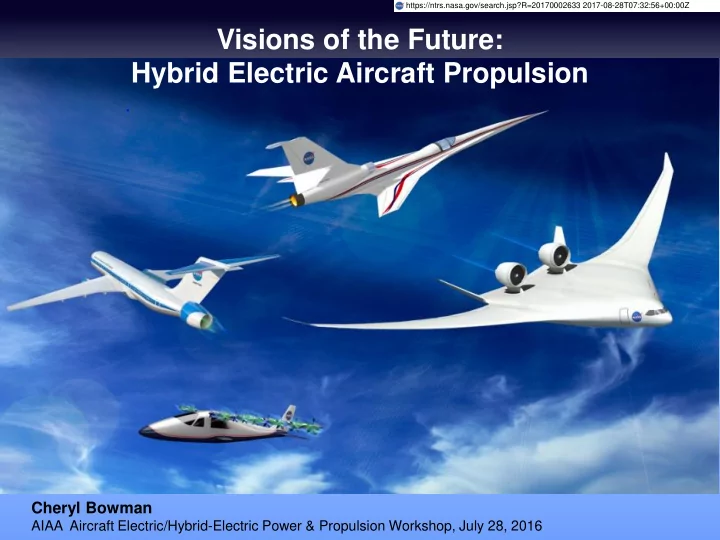
Visions of the Future: Hybrid Electric Aircraft Propulsion

Cheryl Bowman

AIAA Aircraft Electric/Hybrid-Electric Power & Propulsion Workshop, July 28, 2016

https://ntrs.nasa.gov/search.jsp?R=20170002633 2017-08-28T07:32:56+00:00Z
slide-2
SLIDE 2

National Aeronautics and Space Administration

www.nasa.gov

Outline

  • NASA’s Motivation for Electrified Aircraft Propulsion

Investment

  • Strategic Thrust 4: Transition to Low Carbon Propulsion
  • Hybrid and Electric Aircraft Propulsion Terminology
  • NASA’s Approach to Electrified Aircraft Propulsion
  • Convergent Aeronautics Solutions: for High Risk and High

Payoff

  • SCEPTOR/X-57: Near Term Flight Demonstration
  • Advanced Air Transport Technology: Long Term Aircraft

Investment for Electrified Propulsion

  • Summary
slide-3
SLIDE 3

National Aeronautics and Space Administration

www.nasa.gov

Electrified Aircraft Propulsion: Motivation

NASA Aeronautics Research Mission Directorate Mega Drivers Strategic Thrusts

slide-4
SLIDE 4

National Aeronautics and Space Administration

www.nasa.gov

Electrified Aircraft Propulsion: Motivation

2015 2025 2035

Introduction of Low-Carbon Fuels for Conventional Engines and Exploration of Alternative Propulsion Systems Initial Introduction of Alternative Propulsion Systems Introduction of Alternative Propulsion Systems to Aircraft of All Sizes

Strategic Thrusts Guide Investment Targets

The Low Carbon Challenge is to enable carbon-neutral growth in aircraft operations:

slide-5
SLIDE 5

National Aeronautics and Space Administration

www.nasa.gov

Electrified Aircraft Propulsion Terminology

  • Electrified Propulsion refers to the use of electric

power for aircraft propulsion

– Could be all or partially electric propulsion – Other aircraft development programs use the terms “More electric” or “All electric” as the use of electric power for secondary systems on aircraft such as control surfaces and wing de-icing

  • Hybrid Electric has two meanings in aircraft context

– One meaning is the use of two power sources, such as turbine engine and electric motor, to drive the fan (or propeller) on an aircraft—hybrid electric powertrain – Another meaning is the combination of more than one propulsive sources such as engines, turboelectric energy generation, fuel cells energy generation, or battery energy storage—hybrid electric prolusion

  • Turboelectric Propulsion refers to on-air generated electric

power for aircraft propulsion

– Turboelectric generation already provides electric power for secondary systems on aircraft – Fully turboelectric propulsion means that all turbine power goes to electricity – Partially turboelectric propulsion means a turbofan engine with some fraction of generated electric power going to propulsion

slide-6
SLIDE 6

National Aeronautics and Space Administration

www.nasa.gov

Baseline Aircraft with Podded Turbo-Fan

VEHICLE CONFIGURATION EXAMPLES

SCEPTOR 4 PAX X-Plane SUGAR VOLT 150 PAX Study STARC-ABL 150 PAX Study N3-X 300 PAX Turbo-Electric Current NRA 150 PAX Studies AATT 50 PAX STUDIES ECO-150 150 PAX Studies

Electrified Propulsion Vehicle Trade Space

slide-7
SLIDE 7

National Aeronautics and Space Administration

www.nasa.gov

Electrified Propulsion: NASA’s Approach

Build, Test, Mature Enabling Technologies and Knowledge Bases

slide-8
SLIDE 8

National Aeronautics and Space Administration

www.nasa.gov

Electrified Propulsion Development

Path:

  • Identify promising propulsion / vehicle configurations
  • Buy-down risk for crucial technologies in
  • Flight Control: new knobs in vehicle and subsystems
  • Power Conversion: electric machines & electronics
  • Power Control: vehicle electric grid management
  • Fundamental Enablers: materials and analysis
  • Demonstrate results in purpose-built flight

demonstration

Goal: Enable the paradigm shift to electric, hybrid electric, and

turboelectric propulsion for reductions in energy consumption, emissions, and noise

slide-9
SLIDE 9

National Aeronautics and Space Administration

www.nasa.gov

All Electric, Hybrid Electric, Distributed Propulsion

  • On Demand Mobility Focus
  • Small Plane Focused

Turbo Electric, Distributed Propulsion

  • Low Carbon Propulsion
  • Transport Class Focused

Enable New Aero Efficiencies Power Sharing Distributed Thrust Control Certification Trailblazing Energy & Cost Efficient, Short Range Aviation Enable New Aero Efficiencies High Efficiency Power Distribution Power Rich Optimization Non-flight Critical First Application

Multiple Paths to Carbon Reduction

Energy & Cost Efficient, Transport Aviation

slide-10
SLIDE 10

National Aeronautics and Space Administration

www.nasa.gov

Convergent Aeronautics Solutions Project

Aircraft Hybrid/Electric Propulsion Activities

  • M-SHELLS – Multifunctional Structures for High Energy Lightweight Load-

bearing Storage

– Integrates hybrid battery/supercaps into aircraft structure to increase effective specific power & specific energy – Converges advanced electrochemistries, microstructures, manufacturing, and nano-technologies

  • LION – Integrated Computational-Experimental Development of Li-Air

Batteries for Electric Aircraft

– Investigates “electrolyte engineering” concepts to enables Li-Air batteries with high practical energy densities, rechargeability and safety – Converges advances in predictive computation, material science, and fundamental chemistry

  • HVHEP – High Voltage Hybrid Electric Propulsion

– Variable-frequency AC, kV, power distribution with DFIM machines for multi-MWe DEP applications – Minimizes constituent weights of power electronics, TMS, and fault protection

  • Compact High Power Density Machine Enabled by Additive Manufacturing

– 2 to 3x increase in specific power of electric machines for DEP enabled by additive manufacturing – Compact, lightweight motor designs/topologies, integrated cooling, and multi-material systems/components.

  • DELIVER – Design Environment for Novel Vertical Lift Vehicles – cryo-

cooling HEP task

– Maximizing efficiency and power density of electronic components by cryogenic LNG-fuel cooling – Longer-range hybrid/electric UAS with reduced fuel-burn and emissions (CO2, sulfur, particulates)

  • FUELEAP – Fostering Ultra-Efficient, Low-Emitting Aviation Power

– GA aircraft / early-adopter application of JP-fueled SOFC power plant for clean, hybrid/electric architecture – Zero NOx electric power production at ~2x typical combustion efficiencies

  • SCEPTOR – Scalable Convergent Electric Propulsion Technology and Operations Research

– Seeks 5x reduction in cruise-energy-use by aerodynamic benefits of DEP & batteries in place of engines – DEP enables high efficiency wing & high performance wingtip motors for cruise

slide-11
SLIDE 11

National Aeronautics and Space Administration

www.nasa.gov

NASA SCEPTOR Primary Objective

  • Goal: 5x Lower Energy Use

(Comparative to Retrofit GA Baseline @ 150 knots)

  • Motor/controller/battery conversion

efficiency from 28% to 92% (3.3x)

  • Integration benefits of ~1.5x (2.0x

likely achievable with non-retrofit)

SCEPTOR X-57 Research Objectives

NASA SCEPTOR Secondary Objectives

  • 15 dB Lower community noise (with even lower true community annoyance).
  • Flight control redundancy, robustness, reliability, with improved ride quality.
  • Certification basis for DEP technologies.

NASA SCEPTOR Derivative Objectives

  • ~30% Lower Total Operating Cost (Comparative to Retrofit GA Baseline)
  • Zero In-flight Carbon Emissions
slide-12
SLIDE 12

National Aeronautics and Space Administration

www.nasa.gov

Highly Efficient Turbine Engines Power Systems Architectures Advanced Electrical Components Boundary-Layer Ingestion Systems Efficient, Low Noise Propulsors Integrated Vehicles and Concepts Evaluation

  • Adv. Air Transport Technology Project Investment
slide-13
SLIDE 13

National Aeronautics and Space Administration

www.nasa.gov

Objective Key performance parameters and threshold level requirements for gas turbine aircraft augmented with electrical powertrain Propulsion System Conceptual Design – Concepts for system interaction exploration Integrated Subsystems – Flight control methodology for distributed propulsion High Efficiency/Power Density Electric Machines – Step change in component performance Flight-weight Power System and Electronics – High voltage power electronics, transmission, protection, and management Enabling Materials – Insulation, Conductors, Magnetic Materials

Scrutinizing tube & wing architectures

  • Adv. Air Transport Technology Project Investment

Superconducting and ambient machines Revolutionary system testing Transitioning materials from lab to component

slide-14
SLIDE 14

National Aeronautics and Space Administration

www.nasa.gov

NASA Electrified Propulsion Takeaways

  • NASA Aeronautics Strategic Thrust 4 -Transition to Low-Carbon

Propulsion is supporting investment in alternative aircraft propulsion including electrified aircraft propulsion

  • The NASA vision includes transforming aviation via new propulsion

technologies integrated with airframes to

– increase aircraft functionality – reduce carbon emissions – improve operational efficiency and reduce noise

  • There are many possible Electrified Aircraft configurations
  • NASA investment includes vehicle concepts and technology to

support aircraft for

– Small to midsize aircraft to increase mobility provide a new paradigm – Commercial transport aircraft to impact the current large carbon producing market segment

slide-15
SLIDE 15

National Aeronautics and Space Administration

www.nasa.gov

Timeline of Machine Power Relevant to Aircraft Class

Superconducting Non-cryogenic

100 kW 1 MW 3 MW 10 MW 30 MW

PS–01758–1115

19 Seat

2 MW Total Propulsive Power

300 Seat

60 MW Total Propulsive Power

50-250 kW Electric Machines .1-1 MW Electric Machines

50 Seat Turboprop

3 MW Total Propulsive Power

.3-6 MW Electric Machines

150 Seat

22 MW Total Propulsive Power

1-11 MW Electric Machines 3 -30 MW Electric Machines

Largest Electrical Machine on Aircraft

50 Seat Jet

12 MW Total Propulsive Power

.3-6 MW Electric Machines

9 Seat

0.5 MW Total Propulsive Power

slide-16
SLIDE 16