
SLIDE 1
I N V I S I B L E WAT E R , V I S I B L E C R I S I S
M A N A G I N G I N D I A’ S G R O U N D WAT E R
www.rohininilekani.org
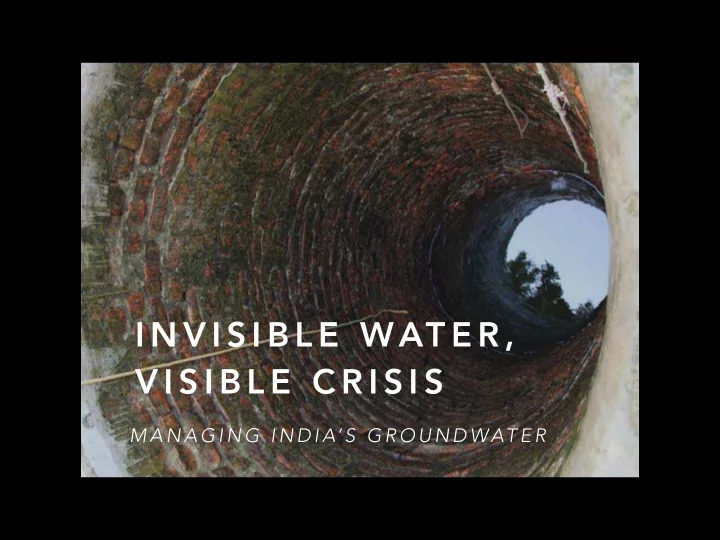
I N V I S I B L E WAT E R , V I S I B L E C R I S I S M A N A G I - - PowerPoint PPT Presentation
I N V I S I B L E WAT E R , V I S I B L E C R I S I S M A N A G I N G I N D I A S G R O U N D WAT E R www.rohininilekani.org India is a groundwater civilisation from historical times www.rohininilekani.org Today, India is the greatest
M A N A G I N G I N D I A’ S G R O U N D WAT E R
www.rohininilekani.org
www.rohininilekani.org
Source: Wade et al 2010, American Geophysical Union
www.rohininilekani.org
www.rohininilekani.org
Sources: India Today, 2015; T. Shah, 2009; Vijay Shankar et al 2011
www.rohininilekani.org
Sources: India Today, 2015; T. Shah, 2009; Vijay Shankar et al 2011
www.rohininilekani.org
Agriculture 80%
!!
Ecosystem Economics Rural Urban Agri Industry Drinking & Domestic Use
Competing Use & Users
Agriculture 80% Domestic 10% Industry 10%
Groundwater Uses
48%$ 90%$
Urban$$ Rural$
Drinking Water
Urban Rural
90% 45%
SOURCES: SHAH, 2007; CSE, 2012; DDWS, 2009; AGRICULTURE STATISTICS
www.rohininilekani.org
Source: www.indiawatertool.in, World Resources Institute, 2010
www.rohininilekani.org
www.rohininilekani.org
1882 EASEMENT ACT MODEL GW BILL 1970-2005, 2012 1996 CENTRAL GW AUTHORITY 1998, 2012 NATIONAL WATER POLICY
Right to land = right to groundwater beneath it Water placed in State List - regulated and controlled by states
1950 INDIAN CONSTITUTION
No statutory status; only nudge States to develop
have adopted these A template for State to adopt and devise legislation Set up after Supreme Court ruling under EPA 1986
www.rohininilekani.org
www.rohininilekani.org
INDIA’S HYDROGEOLOGICAL FORMATIONS
Source: COMMAN 2005; GSI (various years), ACWADAM (various publ.), CGWB (2012)
www.rohininilekani.org
A R G H YA M I S I N D I A’ S F I R S T A N D O N LY F O U N D AT I O N W H O L LY D E D I C AT E D T O WAT E R C O N S E R VAT I O N A N D M A N A G E M E N T
www.rohininilekani.org
W E F U N D A N D I M P L E M E N T P I O N E E R I N G W O R K I N S A F E A N D S U S TA I N A B L E G R O U N D WAT E R A N D S A N I TAT I O N , A N D A R E O N A M I S S I O N T O E N A B L E L I F E L I N E WAT E R T O T H E M O S T V U L N E R A B L E
www.rohininilekani.org
www.rohininilekani.org
Randullabad, MAHARASHTRA
contaminated groundwater
MAHARASHTRA
Randullabad
www.rohininilekani.org
D R O U G H T- P R O O F I N G T H R O U G H C O M M U N I T Y C O O P E R AT I O N O U R PA RT N E R : A C WA D A M
www.rohininilekani.org
shadow region
reduced drought resilience
www.rohininilekani.org
mapping of aquifers
formed
wells agreed
diversified
www.rohininilekani.org
in three years
90-130%
enhanced
www.rohininilekani.org
managed as a resource belonging to the community, not individuals
long-term through an understanding of science
interventions
www.rohininilekani.org
Thrissur District, KERALA
Thrissur
drinking water sources
dug wells
KERALA
Thrissur
www.rohininilekani.org
W H E N I T R A I N S , I T S T O R E S O U R PA RT N E R : M A Z H A P O L I M A
www.rohininilekani.org
dependent on wells for lifeline water
nitrate contamination
tankers in summers
www.rohininilekani.org
53 GPs
from roofs to wells
reduce contamination
20-80
290,000 over 5 years
www.rohininilekani.org
water levels
summers
tankers in summers dropped
www.rohininilekani.org
district made the solution go viral
wide program Jalsuraksha
USD 1.5million
become a solution for coastal areas
www.rohininilekani.org
Vishakhpatnam
MOUNTAIN AQUIFERS & SPRINGS
Narsipatnam, ANDHRA PRADESH
Narsipatnam
ANDHRA PRADESH
www.rohininilekani.org
B R I N G I N G M O U N TA I N S P R I N G S T O H O M E S T E A D S O U R PA RT N E R : V J N N S
www.rohininilekani.org
elevation high
women and girls
www.rohininilekani.org
labour
community stand posts through gravity
households
www.rohininilekani.org
10,000; cost per household USD 80
zero energy
and girl children
250,000 over 5 years
www.rohininilekani.org
Resource Centre working with 10 field partners
ready for implementation
mountain/springs areas
springs - Meghalaya, Sikkim
www.rohininilekani.org
Rapar, Kutch District, GUJARAT
Vishakhpatnam
Rapar
GUJARAT
MIXED TYPES
extensive
www.rohininilekani.org
N O WAT E R D I S T R E S S , N O M I G R AT I O N
O U R PA RT N E R : S A M E RT H
www.rohininilekani.org
230mm
shortages
communities
safety net limited
www.rohininilekani.org
understand aquifers
formed and functioning
plans developed
accessed to implement plans
check dams built
www.rohininilekani.org
secure
cattle secured
yield
reduced by 60%
83,000
www.rohininilekani.org
scale for other parts of the district
being piloted among tribal communities in Chattisgarh
among marginalised communities to access government safety net schemes
www.rohininilekani.org
Medak
TELANGANA
Medak District, TELANGANA
contaminated groundwater
www.rohininilekani.org
P O O L I N G & S H A R I N G G R O U N D WAT E R F O R A G R I C U LT U R E
O U R PA RT N E R : WA S S A N
www.rohininilekani.org
600-1000mm
dependent on GW
enabling water intense crops
www.rohininilekani.org
without bore wells form collective
and aquifer mapping
agreed
pipe network
implemented
www.rohininilekani.org
three years
energy costs saved
and productivity increased upto 240%
cultivation decreased by 20%
www.rohininilekani.org
recognised as best practice by Indira Jala Pradha scheme
State for expansion of integrated watershed/ groundwater management
pooling as a solution in agriculture
www.rohininilekani.org
Vishakhpatnam
HIMACHAL PRADESH, MADHYA PRADESH, BIHAR
MADHYA PRADESH BIHAR HIMACHAL PRADESH
WATER QUALITY (Pan India) Bacteriological Nitrates, Iron, Fluoride, Arsenic
www.rohininilekani.org
F R O M M O U N TA I N S P R I N G S T O F L O O D P L A I N S
O U R PA RT N E R S : P S I & M PA ; W Q N E T W O R K S
www.rohininilekani.org
bacteriological contamination
agreed through community participation
fencing achieved
through social fencing and botanic filtration
PSI
www.rohininilekani.org
wells due to geogenic causes
government unsuccessful
problem enhanced through hydrogeology
drinking purposes and managed by community
PSI
www.rohininilekani.org
Bihar contaminated by arsenic and/or iron
dug wells show lower prevalence of arsenic compared to borewells
contamination mitigated by matka filters
MPA
www.rohininilekani.org
immediate problem
imperative to mitigate poor water quality
practices and capacities is central
in a shorter timeframe
Arghyam for Fluoride and Arsenic
www.rohininilekani.org
Bhuj, Kutch District, GUJARAT
Vishakhpatnam
Bhuj
GUJARAT
MIXED TYPES
extensive
www.rohininilekani.org
WAT E R WA R R I O R S I N T H E C I T Y
O U R PA RT N E R : A C T
www.rohininilekani.org
cities
100,000 in a decade
span of three weeks - 320mm
lost of run-off per year
needs
strata being piloted.
www.rohininilekani.org
supply to the slum functional
increased GW levels
distribution network established
community standposts
www.rohininilekani.org
an issue at its low lying
intervention
drainage put in within colony
contributed 10% of costs
www.rohininilekani.org
structures in urban centres
for a cause
incorporating participatory urban watershed into new schemes
www.rohininilekani.org
COMMON POOL RESOURCE
RESOURCE - AQUIFER BASED
COMMUNITIES
ALL - PRINCIPLES SCALABLE, SOLUTIONS REPLICABLE
www.rohininilekani.org
FRAMEWORK TO ENSURE EQUITY AND ACCESS
ALLOCATED FUNDS REACH COMMUNITIES
CAPACITY DEVELOPMENT
CONTEXTUAL SOLUTIONS
www.rohininilekani.org
What lessons can we draw for our groundwater security in the 21st century? Can community-driven, science-based solutions that are contextual, flexible and responsive, make invisible groundwater visible? How can the State steer this paradigm shift?
www.rohininilekani.org
THROUGH SCIENCE AND SUSTAINED PRACTICE
NETWORKS, PLATFORMS AND PARTNERSHIPS TO EXTEND REACH
ACCESS TO SAFE WATER & SANITATION FOR ALL, WITH GOVERNMENT AND OTHER DONORS
www.rohininilekani.org
A N O F F E R I N G
www.rohininilekani.org
S A F E S U S TA I N A B L E WAT E R F O R A L L
A L L P H O T O G R A P H S I N T H E P R E S E N TA T I O N C O U R T E S Y A R G H YA M , PA R T N E R S , I N D I A WA T E R P O R TA L
www.rohininilekani.org