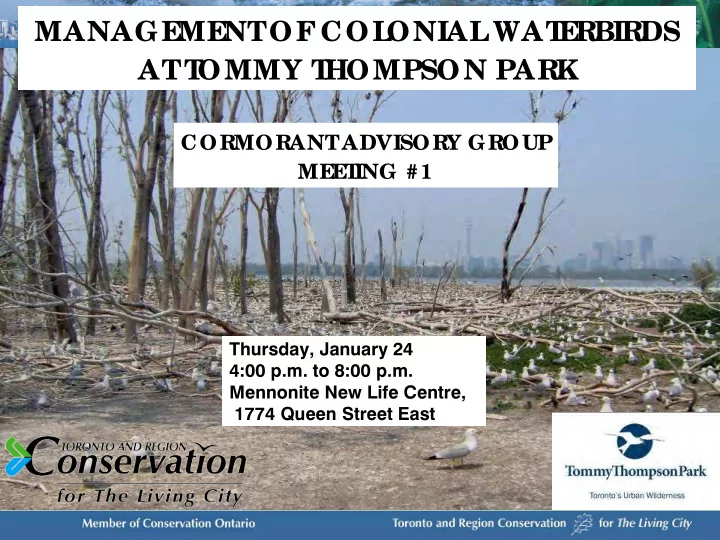
MANAGE ME NT OF COL ONIAL WAT E RBIRDS AT T OMMY T - - PowerPoint PPT Presentation
MANAGE ME NT OF COL ONIAL WAT E RBIRDS AT T OMMY T HOMPSON PARK CORMORANT ADVISORY GROUP ME E T ING #1 Thursday, January 24 4:00 p.m. to 8:00 p.m. Mennonite New Life Centre, 1774 Queen Street East OBJECTIVES Investigate
- Investigate need for management of cormorant
populations at TTP
- Evaluate management options (including “do nothing”),
based on the best available scientific information
- If required, identify a proposed management approach
- Involve key stakeholders through an advisory group
- Consult with other stakeholders and the public using an
- pen and inclusive process
- Ensure provision of accurate and balanced information to
the public, media and policy makers
OBJECTIVES
MANDATE
- Provide input and advice
- Ensure that all perspectives are considered
- Provide linkages with other stakeholders
ACTIVITIES
- Identify values and interests associated with TTP
- Discuss existing conditions, concerns and need for
management
- Discuss strategies to address concerns
- Help to evaluate any management options
- Help to plan and attend the public meeting
- Advise TRCA on recommended management plan, if
appropriate
- If management actions are recommended, provide advice on
implementation
ADVISORY GROUP
ADVISORY GROUP MEMBERSHIP
TRCA Restoration Services Federal/Provincial Canadian Wildlife Service Transport Canada Toronto Port Authority Ontario Ministry of Natural Resources City of Toronto Parks, Forestry and Recreation Public Health Academia York University University of Toronto University of Minnesota Interest Groups Friends of the Spit Toronto Ornithological Club Ontario Nature Aquatic Park Sailing Club Outer Harbour Sailing Federation Local Enhancement and Appreciation of Forests (LEAF) Toronto Island Residents Cormorant Defenders International: Animal Alliance of Canada Zoocheck Canada Inc. Canadians for Snow Geese
PROPOSED TIMELINE
Advisory Group Meeting #1 Thursday January 24
- Values and interests
- Conditions and concerns
- Need for management
- Strategies to address concerns
Advisory Group Meeting #2 Tuesday February 19
- Evaluate management options
- Propose alternative approaches
Public Meeting Tuesday April 1 or Thursday April 3
- Present existing conditions, concerns
and alternative management approaches
- Provide feedback on alternative
approaches
- Develop consensus on preferred
approach if possible Advisory Group Meeting #3 Tuesday April 15 or Thursday April 17
- Review public response
- Formulate management plan, if any
TRCA Watershed Management Board Tbd
- Present report for Authority action
Advisory Group Meeting #4 Tbd
- Review implementation workplan, if any
Tommy Thompson Park
Public Urban Wilderness
- Construction of the Leslie Street Spit began in 1959
- Dispose of rubble and fill from the construction
industry
- Expand port related facilities
- Create opportunities for dredged material disposal
Master Plan (1989) and Addendum (1992)
The goals of the Master Plan are to:
- To conserve and manage the natural resources
and environmentally significant areas;
- To provide a unique, water-oriented open space
which will assist in meeting regional needs;
- To develop public awareness regarding the
significance of the Lake Ontario waterfront and Tommy Thompson Park.
Tom
- mmy T
y Thom homps pson P Park ark
Toron
- nto
- and
d Regi gion
- n CA
Ont ntario Mini nistry of
- f
Natur ural al Resour
- urces
es
471 ha MNR / TPA 224 ha Tommy Thompson Park 247 ha
City of Toront nto
Tommy Thompson Park 2007 Interim Management
- Open to the public weekends and holidays
- Shuttle Van Service from May to October
- Volunteer Naturalist from May to October
- Aquatic Park Sailing Club
- Habitat and wildlife management
Appr
- ximate ly 250,000 pe ople visit T
T P annually
Rollers 9% Cyclists
45% Walkers 36%
Joggers
10%
Interim Management Program
ESA
Local and Regional Context
E SA 130 E SA 120
- Toronto’s only Important Bird Area –globally
significant
- 7 Species of Colonial Nesting Waterbirds
The largest colony of Double-crested Cormorants in the Great Lakes Largest colony of Black-crowned Night- Herons in Canada!
- Concentration area for migratory bird
species.
- Significant overwintering area for waterfowl.
Double - c r e ste d Cor mor ant Caspian T e r n Ring- bille d Gulls Common T e r n Blac k- c r
- wne d
Night- He r
- n
7,241 56,000 876 He r r ing Gulls 30 fe w 376
Ne sting Pa irs of Colonia l Wa te rbirds a t T T P 2007
Wildlife
L ake Ontar io and T
- mmy T
hompson Par k Cor mor ant c olonie s
Toronto
ONTARIO
Hamilton Ontario
N
L ake Ontar io Cor mor ant c olonie s, 2007
L ake Ontar io
L ake Ontar io c or mor ant ne sts, 1979- 2007.
5 10 15 20 25 1979 1982 1985 1988 1991 1994 1997 2000 2003 2006
Toronto Harbour Other Lake Ontario colonies
Nests (thousands) Year
Source: CWS unpublished data and TRCA
5,000 10,000 15,000 20,000 25,000 30,000 1979 1981 1983 1985 1987 1989 1991 1993 1995 1997 1999 2001 2003 2005 2007
Year
Number of nests
LAKE ONTARIO western basin central basin eastern basin
L ake Ontar io c or mor ant ne sts by L ake basin, 1979- 2007.
C D B A
Ne st Count Sur ve ys
- Detailed nest surveys have been
completed since 1990
- All nests are identified (DCCO,
BCNH, GREG) and counted
- All trees are tagged and surveyed
by GPS
- Each tagged tree is checked
annually
Ne sts Numbe r s of DCCO and BCNH at T
- mmy T
hompson
1000 2000 3000 4000 5000 6000 7000 8000
1980 1982 1984 1986 1988 1990 1992 1994 1996 1998 2000 2002 2004 2006
DCCO BCNH
1993
Ne sts Numbe r s of DCCO and BCNH at T
- mmy T
hompson
1000 2000 3000 4000 5000 6000 7000 8000
1980 1982 1984 1986 1988 1990 1992 1994 1996 1998 2000 2002 2004 2006
DCCO BCNH
1993
Ne sts Numbe r s of DCCO and BCNH at T
- mmy T
hompson
1000 2000 3000 4000 5000 6000 7000 8000
1980 1982 1984 1986 1988 1990 1992 1994 1996 1998 2000 2002 2004 2006
DCCO BCNH
1999
Ne sts Numbe r s of DCCO and BCNH at T
- mmy T
hompson
1000 2000 3000 4000 5000 6000 7000 8000
1980 1982 1984 1986 1988 1990 1992 1994 1996 1998 2000 2002 2004 2006
DCCO BCNH
1999
Ne sts Numbe r s of DCCO and BCNH at T
- mmy T
hompson
1000 2000 3000 4000 5000 6000 7000 8000
1980 1982 1984 1986 1988 1990 1992 1994 1996 1998 2000 2002 2004 2006
DCCO BCNH
2002
Ne sts Numbe r s of DCCO and BCNH at T
- mmy T
hompson
1000 2000 3000 4000 5000 6000 7000 8000
1980 1982 1984 1986 1988 1990 1992 1994 1996 1998 2000 2002 2004 2006
DCCO BCNH
2002
Ne sts Numbe r s of DCCO and BCNH at T
- mmy T
hompson
1000 2000 3000 4000 5000 6000 7000 8000
1980 1982 1984 1986 1988 1990 1992 1994 1996 1998 2000 2002 2004 2006
DCCO BCNH
2006
Ne sts Numbe r s of DCCO and BCNH at T
- mmy T
hompson
1000 2000 3000 4000 5000 6000 7000 8000
1980 1982 1984 1986 1988 1990 1992 1994 1996 1998 2000 2002 2004 2006
DCCO BCNH
2006
1998 1999 2000 2001 2002 2003 2004 2005 2006 2007 A 436 695 933 907 730 779 557 311 228 101 B 1307 1814 2071 3138 1844 1582 1241 1763 1535 1139 B ground 344 *990 809 872 868 1302 C 30 281 625 633 2439 2728 3494 4699 Total 1743 2509 3034 4510 3543 3942 5855 5674 6125 7241
- Pe ninsula A 42, and Pe ninsula B 948
DCCO Ne st Numbe r s 1998 to 2007
Monitoring – T re e He a lth Surve ys
- trees are individually
inspected
- Health data is mapped in
Arcview and compiled with nesting data
T he Change in T r e e He alth be twe e n 1996 and 2006
1996 2006
L ive T r e e s (1 and 2 r ating) De ad or Dying T r e e s (4 and 5 r ating)
DCCO BCNH TOTAL 200 400 600 800 1000 1200 1400 1600 1800 1997 1999 2001 2003 2005 2007 2009 Year Number of Trees containing Nests
T r e e s Ne ste d in pe r Ye ar
Figure 1: Figure 1: Summary of the number of TRCA trees containing nests Source TRCA Data produced by University of Toronto (Eric Davies, Michelle Thomas, Mart Gross)
n = 3599
2 4 6 8 10 12 14 16 18 20
DCCO alone No nests BCNH & GREG BCNH & DCCO BCNH alone
NESTING BIRD SPECIES ON FOILED TREES INDEX OF RACCOON ACTIVITY
F ig ure 1. An inde x o f ra c c o o n a c tivity fo r fo ile d tre e s
Gail S. F r ase r & Ke r r e sha Khan F ac ulty of E nvir
- nme ntal Studie s, Yor
k Unive r sity, Blac k- c r
- wne d Night He r
- n r
e se ar c h on Pe ninsula C, T
- mmy T
hompson Par k,
Total Forest Cover At TTP 37.3 Ha
Forest Cover Lost
- r in Decline
9.0 Ha 25%
- f the total
forest area
De fore sta tion on Pe ninsula A from 1990 to 2007
De fore sta tion a nd E rosion on Pe ninsula B from 1990 to 2006
F
- re st De c line on Pe ninsula C
2007
Re c e nt Pa rtne re d Re se a rc h Proje c ts a t T T P
Canadian Wildlife Se r vic e (E nvir
- nme nt Canada):
- E
mbr yonic Via bility (HE RG) – Dr . Cr a ig He be r t
- Str
e ss r e sponse s a nd Vite llog e nin Pr
- duc tion (HE
RG) – Dr . L a ir d Shutt
- Ne ur
- log ic a l Impa ir
me nt (HE RG) - Doug Cr ump
- Annua l E
g g Conta mina nts Montior ing (HE RG) – Dr . Chip We se loh
National Wate r Re se ar c h Institute (E nvir
- nme nt Canada):
- Mic r
- bia l Sour
c e T r a c king to De te r mine F e c a l Pollution (a ll c olonia ls) – Dr . T
- m
E dg e
Wr ight State Unive r sity, Ohio
- Immune F
unc tion (HE RG) – Dr . Ke ith Gr a sma n
Unive r sity of Gue lph:
- We st Nile vir
us, Avia n Influe nza vir us a nd Ne wc a stle Dise a se (RBGU) – Dr . Sha r
- n
Ca lvin
Unive r sity of Ne w Br unswic k:
- Inse c t biodive r
sity (golde nr
- d he r
bivor e s) – Gr aham Cox (M.Sc . Stude nt) and Ste phe n B. He ar d (Assoc iate Pr
- fe ssor
)
Pa st Ma na g e me nt E fforts
- Sc ar
e T ac tic s inc luding:
- L
ase r
- Walk- thr
- ugh
- Pyr
- te c hnic s
- Ne sting platfor
ms built on pe ninsula A
- Gr
- und Ne st E
nhanc e me nt
- Inac tive ne st Re moval
- T
r e e s be ing lost and the r e is no r e ge ne r ation
- Ve ge tation biodive r
sity diminishe d
- Shor
e line e r
- sion inc r
e asing
- Othe r
c olonial spe c ie s impac ts
- Migr
ator y Songbir ds stopove r and ne sting
- Public Use of the par
k
– ~250,000 use r
s/ ye ar and inc r e asing
- T
- r
- nto City Ce ntr
e Air por t c onc e r ns
- Wate r
quality and e sthe tic c onc e r ns
Whe r e ar e we now?
T
- mmy T
hompson Par k Conte xt
- TTP is ecologically significant at a local, regional, and
global scale
- T
T P is in T
- r
- nto – the lar
ge st c ity in Canada e xtr e me ly high le ve l of public use s and distur banc e
- Man-made landform
urban influences compromises natural function
- TTP supports a variety
- f recreation users
Pote ntial Obje c tive s
- Increase public awareness and knowledge of
colonial waterbirds
- Limit further forest canopy loss
- Maintain park biodiversity
- Reduce shoreline erosion
- Prevent cormorant expansion to Peninsula D
- Investigate potential threat to public health and