MANAGE ME NT OF COL ONIAL WAT E RBIRDS AT T OMMY T - - PowerPoint PPT Presentation

manage me nt of col onial wat e rbirds at t ommy t
SMART_READER_LITE
LIVE PREVIEW

MANAGE ME NT OF COL ONIAL WAT E RBIRDS AT T OMMY T - - PowerPoint PPT Presentation

MANAGE ME NT OF COL ONIAL WAT E RBIRDS AT T OMMY T HOMPSON PARK CORMORANT ADVISORY GROUP ME E T ING #5 www.tr c a.on.c a/ c or mor ants Wednesday, February 4, 2009 6:30 p.m. to 8:30 p.m. Mennonite New Life Centre, 1774 Queen


slide-1
SLIDE 1

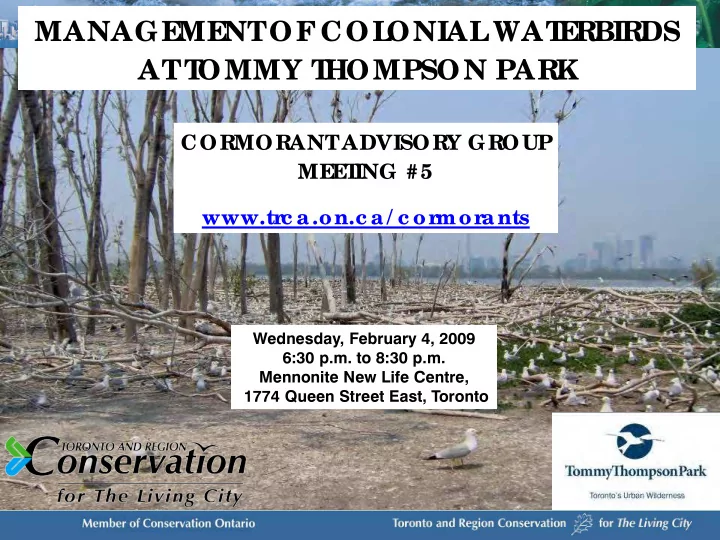
MANAGE ME NT OF COL ONIAL WAT E RBIRDS AT T OMMY T HOMPSON PARK

CORMORANT ADVISORY GROUP ME E T ING #5 www.tr c a.on.c a/ c or mor ants

Wednesday, February 4, 2009 6:30 p.m. to 8:30 p.m. Mennonite New Life Centre, 1774 Queen Street East, Toronto

slide-2
SLIDE 2

CORMORANT ADVISORY GROUP MEETING #5

Wednesday February 4, 2009 6:30 p.m. to 8:30 p.m.

AGENDA 6:35pm Welcome and Introductions Review of Draft Meeting # 4 Notes Suzanne Barrett 6:45pm Review Additional 2008 Data Ralph Toninger 7:00pm Proposed Strategic Approach for 2009

  • Discussion

Ralph Toninger All 8:30pm Wrap-up and next steps Suzanne Barrett

slide-3
SLIDE 3

OBJECTIVES

  • Increase public knowledge, awareness, and appreciation of

colonial waterbirds

  • Deter cormorant expansion to Peninsula D
  • Limit further loss of tree canopy on Peninsulas A, B and C
  • Continue research on colonial waterbirds in an urban wilderness

context GOAL To achieve a balance between the continued existence of a healthy, thriving cormorant colony and the other ecological, educational, scientific and recreational values of Tommy Thompson Park

slide-4
SLIDE 4

Double - c r e ste d Cor mor ant Caspian T e r n Ring- bille d Gulls Common T e r n Blac k- c r

  • wne d

Night- He r

  • n

7,038 30,000 566 He r r ing Gulls 30 ~310

Ne sting Pa irs of Colonia l Wa te rbirds a t T T P 2008

Gr e at E gr e t 6

slide-5
SLIDE 5
  • Pe ninsula A =42, and Pe ninsula B =948

DCCO Ne st Numbe rs 1998 to 2008

1998 1999 2000 2001 2002 2003 2004 2005 2006 2007 2008 A 436 695 933 907 730 779 557 311 228 101 49 B 1307 1814 2071 3138 1844 1582 1241 1763 1535 1139 1074 B ground 344 990* 809 872 868 1302 1009 C 30 281 625 633 2439 2728 3494 4699 4906 Total 1743 2509 3034 4510 3543 3942 5855 5674 6125 7241 7038

slide-6
SLIDE 6

BCNH Ne st Numbe r s 1980 to 2008

200 400 600 800 1000 1200 1400

1980 1982 1984 1986 1988 1990 1992 1994 1996 1998 2000 2002 2004 2006 2008

BCNH

slide-7
SLIDE 7

BCNH numbers by Peninsula

1998 1999 2000 2001 2002 2003 2004 2005 2006 2007 2008 A B 15 163 255 278 270 145 147 86 C 803 988 1235 758 1040 904 601 610 504 769 480 Total 818 988 1235 758 1223 1159 879 880 649 916 566

slide-8
SLIDE 8

T T P Ne sts Numbe r s by Pe ninsula

1000 2000 3000 4000 5000 6000 7000 8000

1990 1992 1994 1996 1998 2000 2002 2004 2006 2008

DCCO Pe n A Pe n B Pe n C Gr

  • und

C D B A

slide-9
SLIDE 9

Ne sts Numbe r s of DCCO and BCNH at T

  • mmy T

hompson

1000 2000 3000 4000 5000 6000 7000 8000

1980 1982 1984 1986 1988 1990 1992 1994 1996 1998 2000 2002 2004 2006 2008

DCCO BCNH

1993

slide-10
SLIDE 10

Ne sts Numbe r s of DCCO and BCNH at T

  • mmy T

hompson

1000 2000 3000 4000 5000 6000 7000 8000

1980 1982 1984 1986 1988 1990 1992 1994 1996 1998 2000 2002 2004 2006 2008

DCCO BCNH

1999

slide-11
SLIDE 11

Ne sts Numbe r s of DCCO and BCNH at T

  • mmy T

hompson

1000 2000 3000 4000 5000 6000 7000 8000

1980 1982 1984 1986 1988 1990 1992 1994 1996 1998 2000 2002 2004 2006 2008

DCCO BCNH

2002

slide-12
SLIDE 12

Ne sts Numbe r s of DCCO and BCNH at T

  • mmy T

hompson

1000 2000 3000 4000 5000 6000 7000 8000

1980 1982 1984 1986 1988 1990 1992 1994 1996 1998 2000 2002 2004 2006 2008

DCCO BCNH

2006

slide-13
SLIDE 13

Ne sts Numbe r s of DCCO and BCNH at T

  • mmy T

hompson

1000 2000 3000 4000 5000 6000 7000 8000

1980 1982 1984 1986 1988 1990 1992 1994 1996 1998 2000 2002 2004 2006 2008

DCCO BCNH

2008

slide-14
SLIDE 14

A B C Grand Total DCCO 4 178 847 1029 BCNH 50 203 253 BOTH 12 73 85 TOTAL 4 240 1123 1367

Numbe r of tre e s with ne sts

slide-15
SLIDE 15

T he Change in T r e e He alth be twe e n 1996 and 2006

1996 2006

L ive T r e e s De ad or Dying T r e e s

slide-16
SLIDE 16

2006 2008

T he Change in T r e e He alth be twe e n 2006 and 2008

slide-17
SLIDE 17

Strategic Approach 2008

Pe ninsula A Pe ninsula B Pe ninsula C Pe ninsula D Pr e - Ne sting De te r r e nts

*

Post- Br e e ding De te r r e nts

* *

E nhanc e d Gr

  • und

Ne sting

* *

Re stor ation

* * * *

E xpe r ime ntal E gg Oiling

*

slide-18
SLIDE 18

Proposed Strategic Approach 2009

Pe ninsula A Pe ninsula B Pe ninsula C Pe ninsula D Pr e - Ne sting De te r r e nts

* * *

Post- Br e e ding De te r r e nts

* *

E nhanc e d Gr

  • und

Ne sting

* *

Re stor ation

* * * *

E xpe r ime ntal E gg Oiling (follow- up on ne st atte ndanc e only)

*

slide-19
SLIDE 19

Cormorant Conservation Zones

slide-20
SLIDE 20

Pre - Ne sting De te rre nts

  • Least intrusive methods favoured
  • Techniques will escalate if necessary
  • Caution around BCNHs and GREGs

De te r r e nt T e c hnique s

  • Human Pr

e se nc e

  • Public use
  • Staff ac tivitie s
  • Ar

tific ial Pr e dator s

  • Noise make r

s

  • Staff c ontr
  • lle d
  • Automatic de vic e s
slide-21
SLIDE 21

Pre - Ne sting De te rre nts Rationale

  • Deter cormorants from nesting in trees at the base of

Peninsula B and on Peninsulas C and D using the least intrusive methods Constraints

  • Non-target species disturbance (BCNH, GREG)

Methods

  • Human presence at irregular intervals throughout the day
  • Other methods to be used only if necessary
  • artificial predators
  • noise makers
  • Use of deterrents to be reduced or stopped if non-target

disturbance is observed

slide-22
SLIDE 22

Post- Bre e ding De te rre nts

  • Least intrusive methods favoured
  • Techniques will escalate if necessary

De te r r e nt T e c hnique s

  • Human Pr

e se nc e

  • Public use
  • Staff ac tivitie s
  • Ar

tific ial Pr e dator s

  • Noise make r

s

  • Staff c ontr
  • lle d
  • Automatic de vic e s
slide-23
SLIDE 23

Post- Bre e ding De te rre nts Rationale

  • Deter cormorants from roosting in trees on Peninsulas C

and D using the least intrusive methods Constraints

  • Non-target species disturbance

Methods

  • Human presence at irregular intervals throughout the day
  • Other methods to be used only if necessary
  • artificial predators
  • noise makers
  • Use of deterrents to be reduced or stopped if non-target

disturbance is observed

slide-24
SLIDE 24

De te rre nt E sc a la tion

Human Pr e se nc e Human Pr e se nc e

wa ving a rms, c la pping , whistling

Human Pr e se nc e

running , sho uting

Human Pr e se nc e

Ca rrying po le s & wa ving po le s witho ut tre e c o nta c t

Human Pr e se nc e

Ca rrying po le s & mo ving lo w b ra nc he s, ta pping o n tre e s

Ar tific ial Pr e dator s

Ra pto rs, sc a re c ro ws, ra c c o o ns, c o yo te s

Ne st Re moval

Re mo va l o f ne w ne st ma te ria ls *Will no t to b e do ne if e g g s a re pre se nt

  • r c o rmo ra nts do no t le a ve the ne st

Noise Make r s

Ra pto rs, sc a re c ro ws, ra c c o o ns, c o yo te s
slide-25
SLIDE 25

Restoration

Re stor ation T e c hnique s

  • Soil ame ndme nts
  • T

r e e & shr ub planting

  • He r

bac e ous planting/ se e ding

  • Plant te nding until

e stablishe d

  • Pr
  • te c tion fr
  • m

he r bivor y, loafing

slide-26
SLIDE 26

Re stora tion Rationale

  • Re-vegetate former nesting locations to improve overall

habitat and provide future colonial waterbird habitat

  • Enhance existing forest communities to provide habitat for

BCNH and other wildlife

  • Improve forest understory as a more significant barrier to

colonial waterbird nesting sites Constraints

  • Soil quality and quantity
  • Loafing waterbirds, herbivory

Methods

  • Soil amendments
  • Tree and shrub planting
  • Herbaceous planting or seeding
slide-27
SLIDE 27

Pe ninsula A Re stora tion

Soil augmentation & nodal plantings of site appropriate species:

  • Willow species
  • Red-osier dogwood
  • Speckled alder
  • Poplar species
  • Herbaceous species
  • Others?
slide-28
SLIDE 28

Pe ninsula B Re stora tion

Soil augmentation & nodal plantings of site appropriate species:

  • Willow species
  • Red-osier dogwood
  • Speckled alder
  • Herbaceous species
  • Others?
slide-29
SLIDE 29

Pe ninsula C Re stora tion

Nodal plantings of site appropriate species:

  • Willow species
  • Red-osier dogwood
  • Hackberry
  • Poplar species
  • Herbaceous species
  • Others?
slide-30
SLIDE 30

Enhanced Ground Nesting

E nhanc e me nt T e c hnique s

  • Add str

uc tur e

  • Pr
  • vide ne st building

mate r ials

  • De c oys
  • Minimize distur

banc e

slide-31
SLIDE 31

E nha nc e d Ground Ne sting

E nhanc e me nt T e c hnique s

  • Plac e me nt of str

uc tur e

  • Wood stake s
  • L
  • w lying falle n logs
  • T

ir e s

  • Plac e me nt of ne st

mate r ials

  • F

alle n tr e e ne sts

  • Str

aw

  • Small woody mate r

ial

  • De c oys
  • Minimize distur

banc e s

  • Pr
  • te c tion fr
  • m pr

e dator s? (r ac c oons)

slide-32
SLIDE 32

2008_g r_ne st_c o lo ny.jpg

Ground Nests at TTP 2008

slide-33
SLIDE 33

PENINSULA A - 2009 GROUND NEST ENHANCEMENTS

York University study area Stakes with nest material and decoys Added natural structure with nest material

Presqu’ile Provincial Park Peninsula B

slide-34
SLIDE 34

Tires

PENINSULA B - 2009 GROUND NEST ENHANCEMENTS

Added natural structure with nest material

Peninsula B

Current Ground Nesting Colony

Peninsula B

slide-35
SLIDE 35

Ground Nest Enhancements at TTP

slide-36
SLIDE 36

www.birdresearchnw.org

slide-37
SLIDE 37

Successful Ground Nest Enhancements

slide-38
SLIDE 38

Ne xt Ste ps

  • Autho rity Me e ting Ma rc h 27, 2009
  • F

uture Adviso ry Gro up c o nsulta tio n (twic e ye a rly: fa ll & winte r)

slide-39
SLIDE 39

T ha nk you!