CORMORANT S AT T OMMY T HOMPSON PARK Thursday, April 3, 2008 - - PowerPoint PPT Presentation

cormorant s at t ommy t hompson park
SMART_READER_LITE
LIVE PREVIEW

CORMORANT S AT T OMMY T HOMPSON PARK Thursday, April 3, 2008 - - PowerPoint PPT Presentation

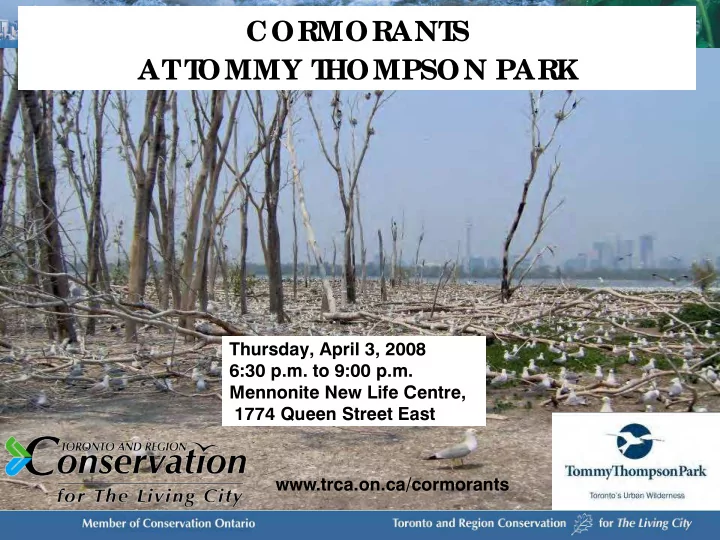
CORMORANT S AT T OMMY T HOMPSON PARK Thursday, April 3, 2008 6:30 p.m. to 9:00 p.m. Mennonite New Life Centre, 1774 Queen Street East www.trca.on.ca/cormorants HOMPSON PARK CORMORANT S AT T OMMY T T hur sday, Apr il 3, 2008 , 6:30


slide-1
SLIDE 1

Thursday, April 3, 2008 6:30 p.m. to 9:00 p.m. Mennonite New Life Centre, 1774 Queen Street East

CORMORANT S AT T OMMY T HOMPSON PARK

www.trca.on.ca/cormorants
slide-2
SLIDE 2

CORMORANT S AT T OMMY T HOMPSON PARK

T hur sday, Apr il 3, 2008, 6:30 p.m. to 9:00 p.m. Me nnonite Ne w L ife Ce ntr e , 1774 Que e n Str e e t E ast, T

  • r
  • nto

6:30 pm Register and view displays 7:00 pm Welcome Councillor Fletcher Adele Freeman, Director, Watershed Management, TRCA 7:10 pm Agenda review Overview of process Suzanne Barrett, Facilitator 7:20 pm Tommy Thompson Park overview Gord MacPherson, Manager, Restoration & Environmental Monitoring Projects, TRCA 7.35 pm Colonial waterbirds in the Great Lakes Chip Weseloh, Wildlife Biologist, Canadian Wildlife Service 7:50 pm Cormorants at TTP Ralph Toninger, Senior Project Manager, TRCA 8:10 pm Round-table discussions

  • Goal and objectives
  • Potential methods
  • Application of methods

All 8:50 pm Summary and next steps Suzanne Barrett 9:00 pm Adjourn

slide-3
SLIDE 3

OBJECTIVES

  • a. Increase public knowledge and awareness of colonial waterbirds
  • b. Prevent cormorant expansion to Peninsula D
  • c. Limit further loss of tree canopy on Peninsulas A, B and C
  • d. Continue research on colonial waterbirds in an urban wilderness context

PROPOSE D GOAL AND OBJE CT IVE S F OR CORMORANT ST RAT E GY

GOAL

Achieve a balance between the continued existence of a healthy, thriving cormorant colony and the other ecological, educational, scientific and recreational values of Tommy Thompson Park

slide-4
SLIDE 4

Interest Groups Aquatic Park Sailing Club Cormorant Defenders International: Animal Alliance of Canada Zoocheck Canada Inc. Canadians for Snow Geese Earthroots Friends of the Spit Local Enhancement and Appreciation of Forests (LEAF) Ontario Nature Ontario Society for the Prevention of Cruelty to Animals Outer Harbour Sailing Federation Toronto Island Residents Toronto Ornithological Club TRCA Restoration Services Federal/Provincial Canadian Wildlife Service Ontario Ministry of Natural Resources Toronto Port Authority Transport Canada City of Toronto Parks, Forestry and Recreation Public Health Academia University of Toronto York University

CORMORANT ADVISORY GROUP

slide-5
SLIDE 5

PROCESS FOR CORMORANT STRATEGY TIMELINE

Advisory Group Meeting #1 January 24, 2008

  • Identify values and interests associated

with TTP

  • Discuss existing conditions and concerns
  • Review proposed list of management
  • ptions (including “do nothing”)

Advisory Group Meeting #2 February 19, 2008

  • Evaluate management options
  • Discuss alternative management

approaches Public Meeting April 3, 2008

  • Present existing conditions, concerns and

alternative management approaches

  • Provide feedback

Advisory Group Meeting #3 April 23, 2008

  • Review public response
  • Formulate management plan

TRCA Authority Board April 25,2008 May 23, 2008

  • Present report for Authority action

Spring Bird Festival May 10, 2008

  • Tour of Waterbird Colonies

Advisory Group Meeting #4 tbd

  • Review implementation workplan

All reports and meeting notes will be posted on the TRCA website at www.trca.on.ca/cormorants

slide-6
SLIDE 6

Tommy Thompson Park

Public Urban Wilderness

slide-7
SLIDE 7

WILD IN THE CITY

  • Wildness in Urban Setting ********
  • Urban Natural Park****
  • A wild place that developed despite obstacles
  • Humans are part of biodiversity
  • Hidden gem
  • Out of city experience in the city

CITY ENVIRONMENT

  • Safe environment for planes
  • Symbol of hope and regeneration
  • Demonstrates re-use of waste material
  • Place that won’t be developed
  • Identity for city

ECOLOGICAL VALUES

  • Opportunity for North American biodiversity****
  • Space for natural processes**
  • Sanctuary for all wildlife**
  • Ecological center of organization*
  • Intrinsic value of nature
  • Nature preservation
  • Corridor
  • Rich ecosystem taken over by nature
  • Important Bird Area (IBA)
  • Place where DCCO are not harassed
  • Provincial biodiversity

RESEARCH

  • Laboratory for ecological studies*
  • Colonization laboratory
  • Ecological research
  • Train next generation of biologists
  • Intellectual challenge
  • Data on DCCO colony

RECREATION & TOURISM

  • Recreation opportunity**
  • Views of City*
  • Protection for Outer Harbour recreation activities*
  • Share the love of wilderness
  • Green
  • Open
  • Solutions to creating a green space model
  • Exploration of evolving nature
  • Part of chain of waterfront parks
  • One of the largest natural parks in Toronto
  • Exercise and health
  • We should be ‘lake people’
  • A place to meet neighbors
  • Public accessibility
  • Solitude and quiet
  • Tourism opportunity

EDUCATION

  • Education****
  • Experience natural processes
  • Turn on kids to career interests
  • International case study
slide-8
SLIDE 8
  • Construction of the Leslie Street Spit began in 1959
  • Dispose of rubble and fill from the construction

industry

  • Expand port related facilities
  • Create opportunities for dredged material disposal
slide-9
SLIDE 9

Master Plan (1989) and Addendum (1992)

The goals of the Master Plan are to:

  • To conserve and manage the natural resources

and environmentally significant areas;

  • To provide a unique, water-oriented open space

which will assist in meeting regional needs;

  • To develop public awareness regarding the

significance of the Lake Ontario waterfront and Tommy Thompson Park.

slide-10
SLIDE 10

Tom

  • mmy T

y Thom homps pson P Park ark

Toron

  • nto
  • and

d Regi gion

  • n CA

Ont ntario Mini nistry of

  • f

Natur ural al Resour

  • urces

es

471 ha MNR / TPA 224 ha Tommy Thompson Park 247 ha

City of Toront nto

slide-11
SLIDE 11

Tommy Thompson Park 2007 Interim Management

  • Open to the public weekends and holidays
  • Shuttle Van Service from May to October
  • Volunteer Naturalist from May to October
  • Aquatic Park Sailing Club
  • Habitat and wildlife management
slide-12
SLIDE 12

Appr

  • ximate ly 250,000 pe ople visit T

T P annually

Rollers 9% Cyclists

45% Walkers 36%

Joggers

10%

Interim Management Program

slide-13
SLIDE 13

Tommy Thompson Park Portlands Don River Watershed Toronto Islands

The ecological health of the shoreline and adjacent watersheds are closely connected and dependant on Tommy Thompson Park

slide-14
SLIDE 14

ESA

Local and Regional Context

E SA 130 E SA 120

slide-15
SLIDE 15
  • Toronto’s only Important Bird Area –globally

significant

  • 7 Species of Colonial Nesting Waterbirds

The largest colony of Double-crested Cormorants in the Great Lakes Largest colony of Black-crowned Night- Herons in Canada!

  • Concentration area for migratory bird

species.

  • Significant overwintering area for waterfowl.
slide-16
SLIDE 16

Double - c r e ste d Cor mor ant Caspian T e r n Ring- bille d Gulls Common T e r n Blac k- c r

  • wne d

Night- He r

  • n

7,241 56,000 876 He r r ing Gulls 30 fe w 376

Ne sting Pa irs of Colonia l Wa te rbirds a t T T P 2007

Gr e at E gr e t 5

slide-17
SLIDE 17

Embayment D Park User Experience

slide-18
SLIDE 18

Tommy Thompson Park Bird Research Station (TTPBRS)

  • 1 of 25 Canadian Migration Monitoring

Network (CMMN-RCSM) Stations

  • In 2007 staff & volunteers raised just

under $30,000

  • Since 2003 over 100 volunteers have

contributed more than 16,000 hours to TTP programs

  • Since 2003 more than 30,000 birds have

been banded

slide-19
SLIDE 19

Winged Migration Education Program

“I loved watching the birds and learned the great things about

  • nature. I took some pictures

and I will never forget the memory of the beautiful birds.” Grade 6 student

  • Winged Migration is a

teaches youth about bird migration and the natural world

  • In 2007, 1363 students

visited TTP

  • Funding provided by the

TD Friends of the Environment Foundation, and Imperial Oil Foundation.

slide-20
SLIDE 20

Wildlife

slide-21
SLIDE 21
  • TTP is ecologically significant at a local, regional,

national and global scale

  • TTP is in the largest city in Canada
  • Man-made landform
  • Urban influences compromise natural functions
  • TTP supports a large number and variety of

recreation users

Summing Up

slide-22
SLIDE 22

T

  • mmy T

hompson Par k Cor mor ant Colonie s

slide-23
SLIDE 23

C D B A

slide-24
SLIDE 24

Ne st Count Sur ve ys

  • Detailed nest surveys have been

completed since 1990

  • All nests are identified (DCCO,

BCNH, GREG) and counted

  • All trees are tagged and surveyed

by GPS

  • Each tagged tree is checked

annually

slide-25
SLIDE 25

Ne sts Numbe r s of DCCO and BCNH at T

  • mmy T

hompson

1000 2000 3000 4000 5000 6000 7000 8000

1980 1982 1984 1986 1988 1990 1992 1994 1996 1998 2000 2002 2004 2006

DCCO BCNH

1993

slide-26
SLIDE 26

Ne sts Numbe r s of DCCO and BCNH at T

  • mmy T

hompson

1000 2000 3000 4000 5000 6000 7000 8000

1980 1982 1984 1986 1988 1990 1992 1994 1996 1998 2000 2002 2004 2006

DCCO BCNH

1993

slide-27
SLIDE 27

Ne sts Numbe r s of DCCO and BCNH at T

  • mmy T

hompson

1000 2000 3000 4000 5000 6000 7000 8000

1980 1982 1984 1986 1988 1990 1992 1994 1996 1998 2000 2002 2004 2006

DCCO BCNH

1999

slide-28
SLIDE 28

Ne sts Numbe r s of DCCO and BCNH at T

  • mmy T

hompson

1000 2000 3000 4000 5000 6000 7000 8000

1980 1982 1984 1986 1988 1990 1992 1994 1996 1998 2000 2002 2004 2006

DCCO BCNH

1999

slide-29
SLIDE 29

Ne sts Numbe r s of DCCO and BCNH at T

  • mmy T

hompson

1000 2000 3000 4000 5000 6000 7000 8000

1980 1982 1984 1986 1988 1990 1992 1994 1996 1998 2000 2002 2004 2006

DCCO BCNH

2002

slide-30
SLIDE 30

Ne sts Numbe r s of DCCO and BCNH at T

  • mmy T

hompson

1000 2000 3000 4000 5000 6000 7000 8000

1980 1982 1984 1986 1988 1990 1992 1994 1996 1998 2000 2002 2004 2006

DCCO BCNH

2002

slide-31
SLIDE 31

Ne sts Numbe r s of DCCO and BCNH at T

  • mmy T

hompson

1000 2000 3000 4000 5000 6000 7000 8000

1980 1982 1984 1986 1988 1990 1992 1994 1996 1998 2000 2002 2004 2006

DCCO BCNH

2006

slide-32
SLIDE 32

Ne sts Numbe r s of DCCO and BCNH at T

  • mmy T

hompson

1000 2000 3000 4000 5000 6000 7000 8000

1980 1982 1984 1986 1988 1990 1992 1994 1996 1998 2000 2002 2004 2006

DCCO BCNH

2006

slide-33
SLIDE 33

Ne sts Numbe r s by Pe ninsula

1000 2000 3000 4000 5000 6000 7000 8000

1990 1992 1994 1996 1998 2000 2002 2004 2006

DCCO Pe n A Pe n B Pe n C Gr

  • und

C D B A

slide-34
SLIDE 34

T he Change in T r e e He alth be twe e n 1996 and 2006

1996 2006

L ive T r e e s De ad or Dying T r e e s

slide-35
SLIDE 35

De fore sta tion on Pe ninsula A from 1990 to 2007

slide-36
SLIDE 36
slide-37
SLIDE 37
slide-38
SLIDE 38

T r e e Canopy at T T P Base d on 2006 E c ologic al L and Classific ation Data

Ha TTP land area 151 TTP forest area 37 Future Forest 4

24% of T T P is F

  • r

e ste d

slide-39
SLIDE 39

Forest Cover Lost

  • r in Decline

9.0 Ha 24%

  • f the total

forest area at TTP is in decline

slide-40
SLIDE 40

At the current rate of DCCO growth an additional 1 Ha of forest would be colonized by 2010

slide-41
SLIDE 41

Pote ntial Obje c tive s

  • a. Increase public knowledge and awareness of

colonial waterbirds

  • b. Prevent cormorant expansion to Peninsula D

c. Limit further loss of tree canopy on Peninsulas A, B and C

  • d. Continue research on colonial waterbirds in

an urban wilderness context

slide-42
SLIDE 42
  • Pub lic Me e ting
  • T

RCA We b site

  • Annua l Spring Bird F

e stiva l Ma y 10, 2008

  • I

nte rpre tive Sig na g e

  • Vie wing Blinds a nd Pla tfo rms
  • T
  • urs a nd Sc ho o l Gro ups
  • a. Increase public awareness and

knowledge of colonial waterbirds

slide-43
SLIDE 43
  • b. Prevent Cormorant

Expansion to Peninsula D

  • Pr
  • te c t E

xisting and Planne d Use s

  • Maintain and E

nhanc e Re se ar c h and E duc ation Oppor tunitie s

  • Pr
  • vide Ur

ban Wilde r ne ss E xpe r ie nc e for Par k Use r s

slide-44
SLIDE 44
  • c. Limit further forest canopy loss on the peninsulas
  • Other species
  • City and Waterfront targets
  • Migratory stop over
  • Aesthetics
  • Diversity of experience

for users

slide-45
SLIDE 45
  • d. Continue research on colonial waterbirds in

an urban wilderness context

  • Support partnerships between TRCA and local naturalist groups, universities

and government agencies

  • Play a significant role in local and regional research
  • Suppor

t the e xisting T

  • mmy T

hompson Par k Bir d Re se ar c h Station (T T PBRS)

slide-46
SLIDE 46

1.Do nothing

  • 2. Pre-nesting deterrents
  • 3. Post-breeding deterrents
  • 4. Enhanced ground nesting
  • 5. Egg oiling
  • 6. Habitat restoration

Pr

  • pose d T

e c hnique s

slide-47
SLIDE 47

Do nothing

  • Not a default, but a chosen management option
  • Continue monitoring, research, and education

activities

  • Scale

– Entire area – Targeted areas

slide-48
SLIDE 48

Deterrents

Pr e - ne sting and Post Br e e ding

  • Human Pr

e se nc e

  • Public use
  • Staff ac tivitie s
  • Ar

tific ial Pr e dator s / te c hnologic al de vic e s

  • Noise make r

s

  • Staff c ontr
  • lle d
  • Automatic de vic e s
slide-49
SLIDE 49

Pr e - ne sting de te r r e nts

  • me tho d to disc o ura g e c o rmo ra nts

fro m ne sting in a spe c ific a re a

Post- br e e ding de te r r e nts

  • me tho d to disc o ura g e c o rmo ra nts

fro m lo a fing o r ro o sting in a spe c ific a re a

slide-50
SLIDE 50

E nc our age Gr

  • und Ne sting
  • Create artificial structures that:
  • Are attractive for nesting pairs
  • decoys
  • recordings
  • Provide protection from the

environment and predators

slide-51
SLIDE 51

E gg Oiling

Ground Nesting Tree Nesting

Application of a non-toxic, food grade oil to eggs within 8-10 days of laying to prevent hatching

slide-52
SLIDE 52

Revegetation and Habitat Restoration in Impacted Areas

  • Plant nodes in strategic areas
  • Soil amendment and seeding in specific areas
slide-53
SLIDE 53

Propose d Stra te g ic Approa c h

D C B A

slide-54
SLIDE 54

Propose d Stra te g ic Approa c h

Pe ninsula A Pe ninsula B Pe ninsula C Pe ninsula D Pre -ne sting De te rre nts

* *

Po st-Bre e ding De te rre nts

* * * *

E nha nc e d Gro und Ne sting

* *

E g g Oiling

* * *

Re sto ra tio n

* * * *

slide-55
SLIDE 55

T ha nk you!

slide-56
SLIDE 56

Disc ussion Que stions

  • 1. Go a l
  • 2. Ob je c tive s
  • 3. Me tho ds
  • 4. Applic a tio n o f Me tho ds