MANAGEMENT OF COLONIAL WATERBIRDS AT TOMMY THOMPSON PARK CORMORANT - - PowerPoint PPT Presentation

management of colonial waterbirds at tommy thompson park
SMART_READER_LITE
LIVE PREVIEW

MANAGEMENT OF COLONIAL WATERBIRDS AT TOMMY THOMPSON PARK CORMORANT - - PowerPoint PPT Presentation

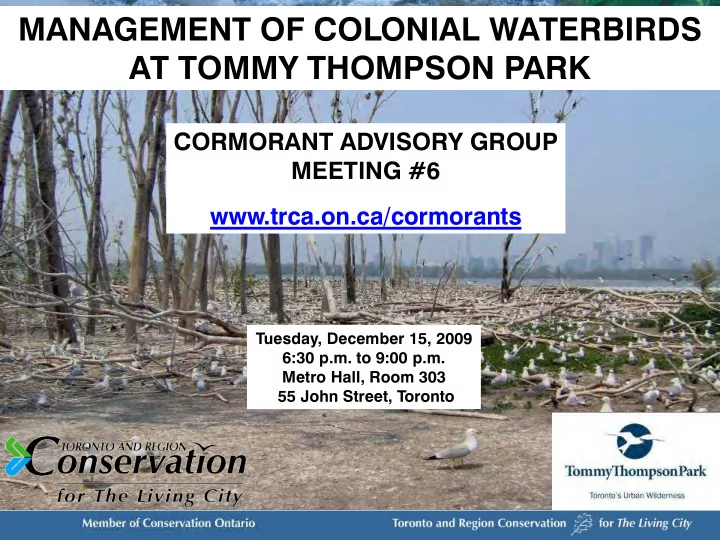
MANAGEMENT OF COLONIAL WATERBIRDS AT TOMMY THOMPSON PARK CORMORANT ADVISORY GROUP MEETING #6 www.trca.on.ca/cormorants Tuesday, December 15, 2009 6:30 p.m. to 9:00 p.m. Metro Hall, Room 303 55 John Street, Toronto CORMORANT ADVISORY GROUP

slide-1
SLIDE 1

MANAGEMENT OF COLONIAL WATERBIRDS AT TOMMY THOMPSON PARK

CORMORANT ADVISORY GROUP MEETING #6 www.trca.on.ca/cormorants

Tuesday, December 15, 2009 6:30 p.m. to 9:00 p.m. Metro Hall, Room 303 55 John Street, Toronto

slide-2
SLIDE 2

CORMORANT ADVISORY GROUP MEETING #6

Tuesday December 15, 2009 6:30 p.m. to 9:00 p.m.

AGENDA

6:35pm Welcome and Introductions Review of Previous Meetings Ralph Toninger 7:00pm Review 2009 colonial waterbird data and 2009 cormorant management strategy Ralph Toninger 7:40pm Update on York University studies Gail Fraser 8:00pm Next Steps

  • Completion of the 2009 Cormorant

Management Strategy

  • Moving into 2010

Ralph Toninger 8:55pm Wrap-up and next meeting Ralph Toninger

slide-3
SLIDE 3

PROCESS – DOUBLE-CRESTED CORMORANTS AT TOMMY THOMPSON PARK

  • November 2007: TRCA embarked on a process to involve

stakeholders and public in assessing need for management of cormorant populations

  • Goal: to achieve a balance between the continued

existence of a healthy, thriving cormorant colony and the

  • ther ecological, educational, scientific and recreational

values of Tommy Thompson Park

slide-4
SLIDE 4

OBJECTIVES

  • Increase public knowledge, awareness, and appreciation of colonial

waterbirds

  • Deter cormorant expansion to Peninsula D
  • Limit further loss of tree canopy on Peninsulas A, B and C
  • Continue research on colonial waterbirds in an urban wilderness

context

GOAL To achieve a balance between the continued existence of a healthy, thriving cormorant colony and the other ecological, educational, scientific and recreational values of Tommy Thompson Park

slide-5
SLIDE 5

Advisory Group Meeting #1 January 24

  • Values and interests of TTP
  • Conditions and concerns of DCCO colony
  • Need for management
  • Strategies to address concerns

Advisory Group Meeting #2 February 19

  • Evaluate management options
  • Propose alternative approaches

Cormorant Webpage launched March 3

  • Includes background materials, Advisory Group meeting

notes and presentations, Public Meeting workbook and meeting notes, relevant links Public Meeting April 3

  • Advertised in Toronto Star, The Mirror, TRCA website, TTP

information board, TRCA distribution lists, some Advisory Group member websites

  • Canada Newswire press release, Global TV coverage
  • Presentations, facilitated round table discussion,

individual workbooks for commenting Advisory Group Meeting #3 April 23

  • Review public response
  • Discuss 2008 strategy

TTP Spring Bird Festival May 10

  • Guided tours of cormorant colony
  • Public survey on TTP cormorants

Authority Board May 23

  • Present 2008 strategy for Authority action

Advisory Group Meeting #4 Dec10

  • Review 2008 strategy and preliminary research results

Public Consultation Summary 2008

slide-6
SLIDE 6

Advisory Group Meeting #5 February 4

  • Develop the 2009 Strategy

TRCA Authority Meeting March 27

  • Present the 2009 Strategy for TRCA Authority action

TTP Spring Bird Festival May 23

  • Guided tours of cormorant colony
  • Public survey on TTP cormorants

Advisory Group Meeting #6 December 15

  • Review the 2009 population data and monitoring

program

  • Review 2009 strategy and preliminary research results
  • Being discussions on a strategic approach for 2010

Public Consultation Summary 2009

slide-7
SLIDE 7

Strategic Approach 2009

Peninsula A Peninsula B Peninsula C Peninsula D Pre-nesting Deterrents

* * *

Post-Breeding Deterrents

* *

Enhanced Ground Nesting

* *

Restoration

* * * *

Experimental Egg Oiling Follow Up

*

slide-8
SLIDE 8

Double - c r e ste d Cor mor ant 7564 ne sts Gr e at E gr e t 7 ne sts Ring- bille d Gull 30,000 ne sts Common T e r n 354 ne sts Blac k- c r

  • wne d

Night- He r

  • n

<50 ne sts He r r ing Gull <20 ne sts

Colonial Waterbirds of Tommy Thompson Park, 2009

slide-9
SLIDE 9
  • Pe ninsula A =42, and Pe ninsula B =948

DCCO Ne st Numbe rs 1998 to 2009

1998 1999 2000 2001 2002 2003 2004 2005 2006 2007 2008 2009 A 436 695 933 909 730 779 557 311 228 101 49 22 B 1307 1814 2071 3048 1844 1582 1241 1763 1535 1072 1050 917 B ground 344 990* 809 872 868 1302 1009 1957 C 30 282 625 633 2439 2728 3494 4584 4906 4668 Total 1743 2509 3034 4237 3543 3942 5046 5674 6125 7059 6717 7564

slide-10
SLIDE 10

TTP Nests Numbers by Peninsula

7564

1000 2000 3000 4000 5000 6000 7000 8000

1990 1992 1994 1996 1998 2000 2002 2004 2006 2008

DCCO Pe n A Pe n B Pe n C Gr

  • und

C B A

slide-11
SLIDE 11

BCNH numbers by Peninsula

1998 1999 2000 2001 2002 2003 2004 2005 2006 2007 2008 2009

A B 15 163 255 278 270 145 146 81 38 C 803 988 1235 762 1040 904 601 610 504 730 455 579 Total 818 988 1235 762 1203 1159 879 880 649 876 536 617

Note : Pe ak c ount c onduc te d on May 27- June 2 L ar ge sc ale abandonme nt oc c ur r e d on be twe e n June 15- 30

slide-12
SLIDE 12

BCNH Ne st Numbe r s 1980 to 2009

200 400 600 800 1000 1200 1400

1980 1982 1984 1986 1988 1990 1992 1994 1996 1998 2000 2002 2004 2006 2008

slide-13
SLIDE 13

BCNH Ne st Numbe r s 1980 to 2009

200 400 600 800 1000 1200 1400

1980 1982 1984 1986 1988 1990 1992 1994 1996 1998 2000 2002 2004 2006 2008

BCNH

slide-14
SLIDE 14

7564 ~<50

1000 2000 3000 4000 5000 6000 7000 8000

1980 1982 1984 1986 1988 1990 1992 1994 1996 1998 2000 2002 2004 2006 2008

DCCO BCNH

Nests Numbers of DCCO and BCNH at Tommy Thompson

1999

slide-15
SLIDE 15

7564 ~<50

1000 2000 3000 4000 5000 6000 7000 8000

1980 1982 1984 1986 1988 1990 1992 1994 1996 1998 2000 2002 2004 2006 2008

DCCO BCNH

Nests Numbers of DCCO and BCNH at Tommy Thompson

2002

slide-16
SLIDE 16

7564 ~<50

1000 2000 3000 4000 5000 6000 7000 8000

1980 1982 1984 1986 1988 1990 1992 1994 1996 1998 2000 2002 2004 2006 2008

DCCO BCNH

Nests Numbers of DCCO and BCNH at Tommy Thompson

2006

slide-17
SLIDE 17

Nests Numbers of DCCO and BCNH at Tommy Thompson

7564 ~<50

1000 2000 3000 4000 5000 6000 7000 8000

1980 1982 1984 1986 1988 1990 1992 1994 1996 1998 2000 2002 2004 2006 2008

DCCO BCNH

2009

slide-18
SLIDE 18

2009

The Change in Tree Health between 2006 and 2009

2006

L ive T r e e s T r e e in De c line De ad or Dying T r e e s

slide-19
SLIDE 19

Proposed Strategic Approach 2009

Peninsula A Peninsula B Peninsula C Peninsula D Pre-Nesting Deterrents

* * *

Post-Breeding Deterrents

* *

Enhanced Ground Nesting

* *

Restoration

* * * *

Experimental Egg Oiling (follow-up on nest attendance only)

*

slide-20
SLIDE 20

Cormorant Conservation Zones

Conservation Zone

slide-21
SLIDE 21

Restoration Planting on Peninsula A

slide-22
SLIDE 22

Regulatory Signage to keep park users out of the colonies

slide-23
SLIDE 23

Enhanced Ground Nesting

  • Add structure
  • Provide nest building

materials

  • Decoys
  • Minimize disturbance
slide-24
SLIDE 24

2008_g r_ne st_c o lo ny.jpg

Ground Nests at TTP 2008

1074 tree nests

  • ver 1.3 Ha

=0.1 nests/m2 1009 ground nests

  • ver 600m2

= 1.7 nests/m2

slide-25
SLIDE 25

PENINSULA A - 2009 GROUND NEST ENHANCEMENTS

York University study area Stakes with nest material and decoys Added natural structure with nest material

slide-26
SLIDE 26

Peninsula B Ground Nest Colony

slide-27
SLIDE 27

Peninsula B Ground Nest Colony

slide-28
SLIDE 28

Peninsula B Ground Nest Enhancement

slide-29
SLIDE 29
slide-30
SLIDE 30

Peninsula A: woody debris for ground nest enhancement

slide-31
SLIDE 31

Peninsula A: woody debris ground nest enhancement

slide-32
SLIDE 32

Peninsula A: stakes & nesting material

slide-33
SLIDE 33

Peninsula A: York University study area

slide-34
SLIDE 34

Researcher access tunnel and blind on Peninsulas A & B

slide-35
SLIDE 35

Peninsula A: stakes and tires with nesting material

slide-36
SLIDE 36

Peninsula A: stakes and tires with nesting material

slide-37
SLIDE 37

Peninsula A: ground nest enhancements

slide-38
SLIDE 38

DCCO decoy in tire with RBGU eggs

DCCO Decoy

slide-39
SLIDE 39

Peninsula A Ground Nest Enhancements

slide-40
SLIDE 40

Live DCCO in the ground nest enhancement area on Peninsula A

slide-41
SLIDE 41

Pre-Nesting Deterrents

  • Least intrusive methods favoured
  • Techniques will escalate if necessary
  • Caution around other nesting species
  • Human Presence
  • Public use
  • Staff activities
  • Artificial Predators
  • Noisemakers
  • Staff controlled
  • Automatic devices

Deterrent Locations

slide-42
SLIDE 42

Pre-Nesting Deterrents - 2009

  • Deterrents took place April 14 - June 12
  • Active Deterrents from April 14 - May 25
  • Successful in preventing nesting at “tip”,

but not from larger area

slide-43
SLIDE 43

Monitoring Locations

  • 74 person hours spring 2009
  • 28 minute average session
  • pre-deterrent
  • active-deterrent
  • post-deterrent
slide-44
SLIDE 44

Deterrent Escalation

Human Presence Human Presence waving arms, clapping, whistling Human Presence running, shouting Human Presence Carrying poles & waving poles without tree contact Human Presence Carrying poles & moving low branches, tapping on trees Artificial Predators Raptors, scarecrows, raccoons, coyotes Inactive Nest Removal Removal of new nest materials *Will not to be done if eggs are present

  • r cormorants do not leave the nest

Noise Makers Raptors, scarecrows, raccoons, coyotes

April 14 April 15 April 15 April 16 April 16 April 16 April 23

slide-45
SLIDE 45

Removal of inactive nest materials

slide-46
SLIDE 46

Artificial Predators

  • Hawk Kite -
slide-47
SLIDE 47

Artificial Predators

  • Owl Decoy -
slide-48
SLIDE 48

Artificial Predators

  • Scarecrows -
slide-49
SLIDE 49

Post-Breeding Deterrents

  • Least intrusive methods favoured
  • Techniques will escalate if necessary
  • Human Presence
  • Public use
  • Staff activities
  • Artificial Predators
  • Noisemakers
  • Staff controlled
  • Automatic devices
slide-50
SLIDE 50

Restoration

  • Soil amendments
  • Tree & shrub planting
  • Herbaceous

planting/seeding

  • Plant tending until

established

  • Protection from herbivory,

loafing

slide-51
SLIDE 51
  • Prevented Expansion onto Peninsula D
  • Ground nests increased by 94% from 2008 (from 14% to 26%)

No nesting on Peninsula A Prospecting ?

  • Number of trees used increase however tree nests decreased
  • Large scale abandonment by BCNH

2009 Season Summary

slide-52
SLIDE 52

Enhanced Ground Nesting Predator exclusion Address BCNH Abandonment Escalate Nesting Deterrents Active Nest Removal

Where are We Going

slide-53
SLIDE 53

Thank you!

Gail Fraser Chip Weseloh Dave Moore Ann Gray John Almond Patrick Hubert Leslie Coates Wayne Reeves John Carley Lynne Freeman Mark Carabetta Cathryn MacFarlane Paul Scott Glenn Coady Liz White Julie Woodyer