Surveys of the Pels Fishing Owl Scotopelia peli population in the - - PowerPoint PPT Presentation

surveys of the pel s fishing owl scotopelia peli
SMART_READER_LITE
LIVE PREVIEW

Surveys of the Pels Fishing Owl Scotopelia peli population in the - - PowerPoint PPT Presentation

Surveys of the Pels Fishing Owl Scotopelia peli population in the Kruger National Park Andr Botha & Scott Ronaldson Manager: Birds of Prey Programme Endangered Wildlife Trust Pels Fishing Owl Scotopelia peli Very large, earless


slide-1
SLIDE 1

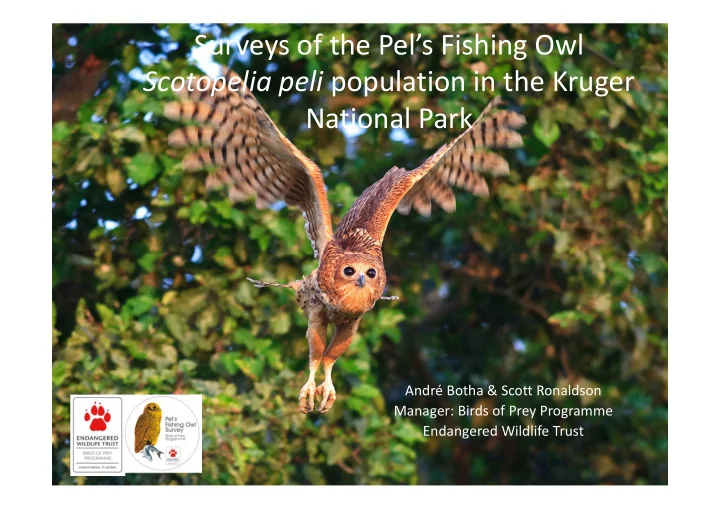
Surveys of the Pel’s Fishing Owl Scotopelia peli population in the Kruger National Park

André Botha & Scott Ronaldson Manager: Birds of Prey Programme Endangered Wildlife Trust
slide-2
SLIDE 2

Pel’s Fishing Owl Scotopelia peli

  • Very large, earless owl
  • Un-feathered legs with

spicules on feet

  • 55cm tall
  • Wingspan 153cm
  • Weight 1.8-2.4kg
  • ♀ slightly larger and

paler than ♂

  • Cavity-nesters
slide-3
SLIDE 3

Critical Habitat Requirements

  • Perennial water
  • Substantial riparian

vegetation

– Cover – Hunting perches

  • Sufficient prey base
  • Territorial and

sedentary

slide-4
SLIDE 4

Status in South Africa

  • Vulnerable (Barnes, 2000)
  • Small, localised populations
  • Mostly restricted to

protected areas

  • Estimate between 120-150

birds

  • Likely decline of 20%

expected between 2000- 2010

slide-5
SLIDE 5

Why a Survey?

  • Brooke (1984) & Barnes (2000) – estimates
  • Last KNP surveys

– Luvhuvhu - Kemp & Ronaldson 1991-1996 – Olifants – Begg 1992-1994

  • No detailed surveys outside of KNP
  • Considerable changes in rivers & PFO habitats since

1995

slide-6
SLIDE 6

Survey-area: Luvhuvhu-river

slide-7
SLIDE 7
slide-8
SLIDE 8

Survey-area: Olifants river

slide-9
SLIDE 9
slide-10
SLIDE 10

Methods

  • Consultation with previous researchers
  • Literature study
  • 2 Teams on either side of river
  • Walk bank covering areas of riparian vegetation
  • Make observations of PFO and other species
  • Record what is found on CyberTracker &

Dictaphone

slide-11
SLIDE 11
slide-12
SLIDE 12
slide-13
SLIDE 13
slide-14
SLIDE 14
slide-15
SLIDE 15
slide-16
SLIDE 16
slide-17
SLIDE 17

Results: Luvhuvhu-river 2007-2009

  • Av. 9 individual birds per

survey

  • Av. 25 spots with

positive signs

  • 1 Confirmed nesting site

in 2008

  • 3 Potential nesting spots
  • Estimate 6-7 occupied

breeding territories

  • 15 African Fish Eagles
  • No significant difference

from 1990’s surveys

slide-18
SLIDE 18
slide-19
SLIDE 19

Luvhuvhu-survey: 2010

slide-20
SLIDE 20

Luvhuvhu-survey: 2010

? ? ? ? ? ? ?

slide-21
SLIDE 21

Olifants: 1992 Survey Results (Begg)

slide-22
SLIDE 22

Olifants: 2010 Survey Results

slide-23
SLIDE 23

PFO: Olifants Survey Results – 2007 to 2010

5 10 15 20 25 Begg 1992 Begg 1993 Begg 1994 2007 2008 2009 2010

Number of Birds

60%+ decline in birds seen from 1992-94 surveys

slide-24
SLIDE 24

AFE: Olifants Survey Results – 2007 to 2010

5 10 15 20 25 Begg 1992 Begg 1993 Begg 1994 2007 2008 2009 2010

No of Birds

50% decline in birds seen from 1992- 1994 surveys

slide-25
SLIDE 25

Other birds surveyed: 2007-2010

Species Recorded in 1992 survey (Begg, unpubl.) Total birds 2007 Total birds 2008 Total birds 2009 Total birds 2010

White-crowned Lapwing 104 67 97 67 78 Goliath Heron 28 30 13 17 5 Black Stork 3 1 1 Great White Egret 8 2 2 Little Egret No count 3 3 African Spoonbill 8 5 Saddlebilled Stork 5 7 8 4 4 Giant Kingfisher No count 7 4 4 4

slide-26
SLIDE 26

Conclusions: Olifants River

  • Considerable decline in occupied sites and

population of Pel’s Fishing Owl

  • African Fish Eagle shows a similar decline
  • Relatively low numbers of other piscivorous

species

  • River has been abandoned or is largely

avoided by a range of species

slide-27
SLIDE 27

Future plans

  • Expand to cover entire SA range
  • Expand Olifants-study to Limpopo TFCA and

beyond Massingir-dam

  • Obtain a more accurate estimate of

population size

  • Update conservation status of species
  • Critical habitat variables
  • Assess negative impacts
  • Consider possible management interventions
slide-28
SLIDE 28
slide-29
SLIDE 29
slide-30
SLIDE 30

Factors contributing to decline

slide-31
SLIDE 31

Other KNP Rivers

  • Sabie

– 2 Sites – 2 Casual

  • bservations
  • Crocodile

– 1 Site – Timfenene- confluence

slide-32
SLIDE 32

Participants/Support

Louis Olivier, Steven Whitfield, Richard Sowry, Sandra Basson, Don English, Rodney Landela, Evans Mkansi, Oupa Modirwa, Rendani Nethengwe, Thomas Mbokota, Andrew Desmet, Andrew Deacon, Daniel Chavalala, Pafuri-, Phalaborwa-, Olifants- & Houtboschrand Field Rangers, Alan Kemp, Meg Kemp, Lucy Kemp, Keith Begg, Corrie van Wyk, Stewart Rogers, Ashraf Sayed, Anthony Marx, Rosemarie Marx, Frank la Grange, Quentin Swanevelder, Sharon & Dave Thomson, Dave Parsons, Paul Funston, Cobus Bester, Foeta Krige, Johan Nel, Andre Agenbag, Ben van Zijl, Brenda Daly, Graeme Wilson, Claudia Hodgkinson, Walter Jubber, Alison Janicke, Leigh Potter, Johann Botha, Alti Fouche, Thea Botha, Tim Horak, Beense Visser, Hendri Combrinck, Kevin Ravno, Renier Balt, Brenden Pienaar, Colin Rowles, Matt Pretorius, Wendy Collinson, Warren Ozorio, Staff at Wilderness Safaris Pafuri Camp

slide-33
SLIDE 33