The Protg OWL Plugin Holger Knublauch Stanford University July 07 - - PowerPoint PPT Presentation

the prot g owl plugin
SMART_READER_LITE
LIVE PREVIEW

The Protg OWL Plugin Holger Knublauch Stanford University July 07 - - PowerPoint PPT Presentation

The Protg OWL Plugin Holger Knublauch Stanford University July 07 2004 Overview The Semantic Web and OWL OWL in the Protg Community The OWL Plugin Future Directions The Semantic Web Shared ontologies help to exchange data and


slide-1
SLIDE 1

The Protégé OWL Plugin

Holger Knublauch

Stanford University

July 07 2004
slide-2
SLIDE 2

Overview

The Semantic Web and OWL OWL in the Protégé Community The OWL Plugin Future Directions

slide-3
SLIDE 3

The Semantic Web

Shared ontologies help to exchange data and meaning between web-based services

(Image by Jim Hendler)

slide-4
SLIDE 4

OWL

  • Web Ontology Language
  • Official W3C Standard since Feb 2004
  • A Web Language: Based on RDF(S)
  • An Ontology Language: Based on logic
slide-5
SLIDE 5

OWL Overview

Individuals

  • Property values

Classes

  • Subclass relationships
  • Disjoint classes

Properties

  • Characteristics (transitive, inverse)
  • Range and Domain

OWL for data exchange OWL for knowledge sharing Class Descriptions

  • Restrictions
  • Logical expressions
slide-6
SLIDE 6

Example Semantic Web

OWL Metadata (Individuals) OWL Metadata (Individuals) OWL Metadata (Individuals) OWL Metadata (Individuals)

Tourism Ontology

Web Services

Destination Accomodation Activity

slide-7
SLIDE 7

Description Logics

  • Classes can be defined using logical

expressions about their members. Restrictions Logical Expressions

– allValuesFrom unionOf – someValuesFrom intersectionOf – hasValue complementOf – minCardinality – maxCardinality

Enumerations

– cardinality {red green blue}

slide-8
SLIDE 8

Description Logics Example

  • Asserted definitions:

– “National parks provide hiking trails” – “Hiking is a sport” – “Those destinations with sporting facilities are backpacker’s destinations”

  • Automatically inferred:

– National parks are backpacker’s destinations

slide-9
SLIDE 9

Class Descriptions: Why?

  • Make knowledge sharable with

machines

  • Make explicit intentions and modeling

decisions (comparable to test cases)

  • Make sure that individuals fulfill

conditions

  • Tool-supported reasoning

– Classification of classes and individuals – Consistency Checking

slide-10
SLIDE 10

Protégé OWL Community

Stanford: OWL Plugin NCI, NLM: Main funding Manchester: CO-ODE tools

slide-11
SLIDE 11

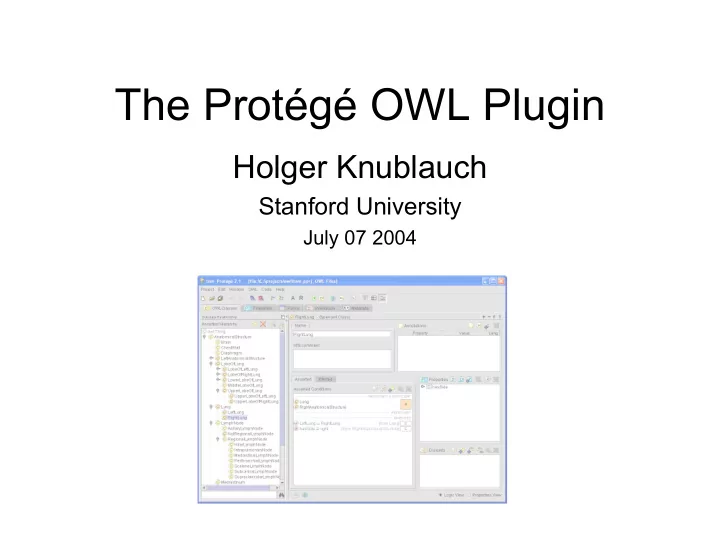
OWL Plugin

  • Large Protégé Plugin (>560 classes)
  • Extends base system with

– OWL language capabilities (metamodel, files) – Custom-tailored user interface – Access to description logic reasoners – Code generators etc

  • Many features are native to OWL
  • Backwards compatible where possible
slide-12
SLIDE 12

OWL Plugin Architecture

Protégé API

(Classes, properties, individuals, etc.)

Protégé GUI

(Tabs, Widgets, Menus)

DB Storage Protégé Core System Protégé OWL API

(Logical class definitions, restrictions, etc.)

Protégé OWL GUI

(Expression Editor, Conditions Widget, etc.)

OWL File Storage Jena API

(Parsing, Reasoning)

OWL Plugin OWL Extension APIs

(SWRL, OWL-S, etc.)

OWL GUI Plugins

(SWRL Editors, ezOWL, OWLViz, Wizards, etc.)

slide-13
SLIDE 13

Logic View

slide-14
SLIDE 14

Prose Generation

slide-15
SLIDE 15

Properties View

slide-16
SLIDE 16

Classification

slide-17
SLIDE 17

Consistency Checking

slide-18
SLIDE 18

TODO Lists

slide-19
SLIDE 19

Ontology Tests

slide-20
SLIDE 20

Individuals

slide-21
SLIDE 21

RDF(S) Editing

  • OWL extends RDF, OWL Plugin can edit RDF
  • Select Language Profile RDF(S)
slide-22
SLIDE 22

Code Generators

  • Create Java classes to easier access

OWL ontologies

– Jena Schema generator – Kazuki interfaces

  • Better integration into other software

development activities

slide-23
SLIDE 23

Extending the OWL Plugin

slide-24
SLIDE 24

Other OWL Plugins

OWLViz (Manchester) ezOWL (Korea)

Under Development:

  • OWL-S
  • SWRL
  • Semantic Debugging
  • Joseki (Jena Database)

OWLWizards (Manchester)

slide-25
SLIDE 25

Integrating Web Services

  • Arbitrary extensions can benefit from the

Protégé infrastructure as a platform

Web Resource Database

Web Service

slide-26
SLIDE 26

OWL Benefits

  • OWL is the W3C ontology standard
  • Interoperable with RDF and XML
  • Growing community and tool support
  • OWL has formal semantics and built-in

reasoning support

  • Semantics support maintenance of large
  • ntologies / knowledge models
slide-27
SLIDE 27

Protégé OWL Benefits

  • A de facto standard tool in the OWL world
  • Growing number of plugins / adaptations
  • Custom-tailored Open-Source API
  • Online support
  • Robust platform
  • Compatibility with Jena
  • Scalable (Database backend)
slide-28
SLIDE 28

OWL Risks

  • Steep learning curve

– Difficult syntax – Difficult semantics (→ OWL Tutorial)

  • Semantic Web hype /

Lack of real-world example applications

  • Chicken-and-egg problem of Semantic

Web

slide-29
SLIDE 29

Getting Started

slide-30
SLIDE 30

OWL Tutorial (Manchester)

http://www.co-ode.org/resources/

slide-31
SLIDE 31

Outlook

  • OWL will remain a focus at Stanford

– Simpler user interface – Better Workflow/Versioning support – Optimized access to reasoners (RACER) – Numeric range restrictions – Access to UML/Model Driven Architecture

  • More plugins will be available
  • Collaborations?