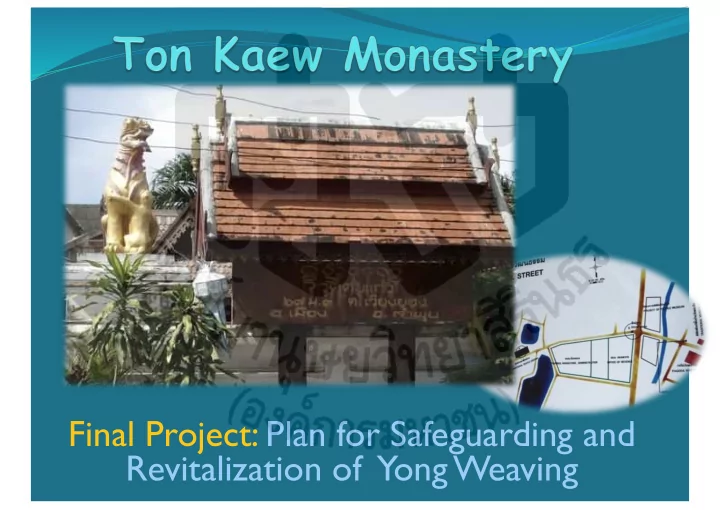
Final Project: Plan for Safeguarding and Revitalization of Yong - - PowerPoint PPT Presentation
Final Project: Plan for Safeguarding and Revitalization of Yong Weaving Wat Ton Kaew Background Wat Ton Kaew monastery is the heart of one group of Yong community : the place to learn the traditions, culture and history of the Yong.
Wat Ton Kaew
Background
Wat Ton Kaew monastery is the heart of one group of
Yong community : the place to learn the traditions, culture and history of the Yong.
This community of “Yong” migrated from “Mueang Yong”
in Shan State southern of Myanmar about 204 years ago..
Who launched the museum?
The Abbot :
Phrakru Paisanteerakhun Museum established since 1987
To preserve the objects that were
used in the community in the old days.
For monks, novices, local community
and visitors.
Background of
the Ton Kaew weavers’ group
11 years ago, two weavers (Mae Bualay and
Mae Bunchum) approached the Abbot asking for help to establish the weaving group.
The aims of the weaving group are threefold: 1)To get an additional source of income for the weavers 2) To sustain and preserve the disappearing knowledge and
skills associated with Yong weaving
3) To foster a sense of community among the elderly weavers.
At this time, the Abbot was already collecting Yong fabric.
The museum’s challenges?
The Abbot is responsible for all aspects of the
monastery’s management, including all festivals, activities and management of the museum.
Abbot’s role in the museum:
- Manager
- Collector of objects
- Curator
- Funding
Wat Ton Kaew
Yong Weaving
as ICH:
The origin of the Yong weaving : the Abbot confirms that
the weaving skills and methods came with them when the Yong moved to Lamphun from Myanmar.
Weaving is considered an important aspect of Yong ethnic
identity.
Weaving was the daily practise of most Yong women in
the past.
The Abbot and weavers are concerned about
transmission of weaving to the next generation.
This ICH was selected by the Abbot and Khun Manu, vice
president of the Ton Kaew community.
What to document
Life Histories:
1) Abbot (Prakru Phaisan Thirakul) 2) The weavers in Ton Kaew (Mrs. Bualai, Mrs. Phuang Thong, Mrs Mayoury,
- Mrs. Boonchum , Mr Boonchum, Mrs Mayouri, Mrs. Poungthong, Miss Pensi
3) Designer (Mr. Mr.Tanad Sitthichai) 4) Another weaver who weaves in her house (Ms.SangWan Wangsam). 5)School teachers 6) Niece of the owner of an old textile factory (Ms. Nipharat Chusakul, Phongphan factory).
Appropriate media
Video camera
Content: the interview of Sangwan, the textile production, protector spirit site, weaver interview, abbot and weaving, the interview of abbot and the vice president, monks’ pray, the photo of Lamphun Beauty Queen, the coffee shop.
Digital camera :50 photos
Content: abbot, weavers, monastery, team work, traditional Yong house, the photo of Lamphun Beauty Queen. Written narratives of life histories and biographies of weavers, abbot, designer and textile factories.
Appropriate media
Audio recorder
Interviews on abbot, the weavers in the weaving center, the weaver who weave in her house, the weaving pattern designer.
Written Narratives
Exhibition plan for Textile Museum:
Content and Themes:
The history of the Yong migration and
resettlement at Baan Wiang Yong (map showing migration from Myanmar)
The origin and development of Yong textile
pattern (yok dauk)
History of Yong weavers in Lamphun textile
factories (including highlight about Beauty Queen sponsorship)
Exhibition plan for Textile Museum
History of revitalization of Yong textiles
by Abbot at Wat Ton Kaew
Profiles of Abbot, weavers and designer in the
Wiang Yong community (including photographs)
Transfer textile collection and yok dauk textiles
from the old building to the new building (2nd floor)
The weaving process (including photographs) Textile looms relocated to space under the house Establish new museum shop selling locally
produced textiles
Community and Student Involvement in Textile Exhibit Set-up
In the set-up of the new exhibit, students and
local community residents can be invited to conduct an inventory and do research on the textile collection at Wat Ton Kaew.
Findings from their research can be used for a
registry of textiles and rewriting textile labels for new museum.
Community and Student Involvement in Textile Exhibit Set-up
In the exhibit set-up, students and residents could
be involved in the cleaning and preservation process (under the guidance of a textile conservation specialist invited from the palace)
Involve students and local residents in the design
- f exhibit and museum shop displays using locally
available materials (bamboo, coconut shell, pottery, photographs)
Educational Activities linked to new Textile Museum
Link the school curriculum to the exhibit and the
weaving process (mathematics and weaving, learning by doing)
Let the student design new products using textiles Student weaving competition for demonstrating weaving
skills
Students newsletter about their activities in Wat Ton
Kaew
Museum Outreach
Create the website both Thai and English languages with
information about Yong history, Wat Ton Kaew history and Weaving workshop
English Brochure about the weaving activities and the
museums (Content already produced—need to design brochure)
Monthly newsletter about news of community Set up the photo archive
Museum Networking
The Abbot sponsor all the community activities (weaving,
school activities, rituals)
Good partnerships with local schools and other community
- rganisations.
He works with an expert weaving
designer (Mr.Tanad Sittichai).
Activities of monastery are also
financed by community donors.
Museum Networking Recommendations
Promotion of Ton Kaew textiles through regional and
national exhibitions (i.e.OTOP Ministry of Industry).
Participation in textile contests (Suun Silapachip—Centre
- f Support Foundation).
Active participation in regional and national textile
networks.
Establish networks
with regional higher academic institutions and national museums.
Conclusions and Recommendations:
Core Strengths:
The Ton Kaew community has a very strong sense of
community solidarity centered on the figure of the Abbot.
The community also has a strong sense of Yong identity
linked to the tradition of weaving. They have been able to build upon this sense of identity to establish the weaving
- group. Their skill in weaving has been widely recognized.
Their monastery, weaving group and museum is located
near the Hariphunchai Monastery and the OTOP Khuamung bridge.
Their location draws both local and international visitors.
Conclusions and Recommendations
Broadening local and regional interest in the Yong weaving
through a range of innovative activities (contests, school activities, newsletters, digital archive)
Develop a new marketing approach for Yong textiles
(Ministry of Industry, Department of Industrial Promotion)
Build on the strong community bonds to strengthen
participation of the younger generation in the safeguarding of Yong weaving process
Establish community and education programs that take
forward the main themes of exhibition
Thank you
- Ms. Saengchan Traikasem
- Mr. Xueli Chen
- Ms. Panida Thothong
- Mr. Tashi Tobgay
Sarynya Panita Sarawasee Marilena Alivizatou Alexandra Denes