I have nothing to disclose Developmental Disabilities: Update for - - PowerPoint PPT Presentation

i have nothing to disclose
SMART_READER_LITE
LIVE PREVIEW

I have nothing to disclose Developmental Disabilities: Update for - - PowerPoint PPT Presentation

3/6/2015 A Retrospective Look At 40 Years of FASD: How Did We Get Here From Where We Started I have nothing to disclose Developmental Disabilities: Update for Professionals March 6, 2015 Kenneth Lyons Jones, M.D. Professor of Pediatrics


slide-1
SLIDE 1

3/6/2015 1

A Retrospective Look At 40 Years of FASD: How Did We Get Here From Where We Started

Kenneth Lyons Jones, M.D. Professor of Pediatrics University of California, San Diego School of Medicine La Jolla, CA

Developmental Disabilities: Update for Professionals March 6, 2015

I have nothing to disclose

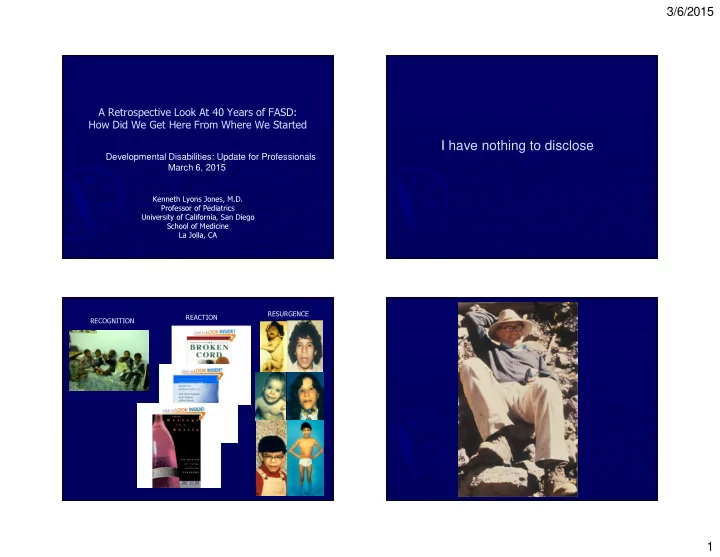
RECOGNITION REACTION RESURGENCE

slide-2
SLIDE 2

3/6/2015 2

Fetal Alcohol Syndrome

► Growth

Prenatal Growth Deficiency Postnatal Growth Deficiency Microcephaly

► Performance

Developmental Delay Fine Motor Dysfunction

► Face

Short Palpebral Fissures Long, Smooth Philtrum Thin Vermilion Border

slide-3
SLIDE 3

3/6/2015 3 Mental, Motor, and Social Development

1 2 3 4 5 6 7 8 Chronological age (mo.) Motor age estimate (mo.) Mental age (mo.) I.Q. or M.D.I. Social quotient (mo.)

14 … 10 59 … 3 2 2 83 … 57 31 44 75 … 46 30 26 57 30 18 …. 11 … … 40 30 32 79 36 48 27 34 70 35 34 21 19 <50 23

Jones,Kl, Smith DW, Ulleland CN, Streissguth AP: Pattern of malformation in offspring of chronic alcoholic mothers. The Lancet 1:1267, 1973

RECOGNITION REACTION RESURGENCE Reactions to Recognition oF Fetal Alcohol Syndrome Social Problem

(Armstrong and Able. Alcohol and Alcoholism35:276, 2000)

Moral Panic

(Armstrong and Able. Alcohol and Alcoholism 35:276, 2000)

Rigorously delineated Recognizable Pattern of Human Malformation and Neurobehavioral Deficits Activities rise to a level in which some one or some group attributes harm to those activities, calls on the gov’t to stop them and can convince

  • thers of that view

Alleged breakdown in public morality, a heightened level of public concern, a distortion of etiology. Disbelief

slide-4
SLIDE 4

3/6/2015 4

1960s 1981-1989 1973

FAS RECOGNIZED

1996

IOM REPORT

1970s-1980s

1850s 1980 REACTION

When the moon is in the Seventh House and Jupiter aligns with Mars Then peace shall guide the planets. And love will steer the stars. This is the dawning of the age of Aquarius… Harmony and understanding Sympathy and trust abounding No more forces of derision Golden living dreams of vision Mystic crystal revelations And the mind’s true liberation

1960s 1981-1989 1973

FAS RECOGNIZED

1996

IOM REPORT

1970s-1980s

1850s 1980 REACTION

Determination that a Social Problem Exists Depends on the Interaction of Two Factors

  • 1. Credibility of Claims-makers:
  • In case of MADD, the credibility of the claims makers is

unquestionable - the death of a child at the hands of drunk drivers. However, children had been dying at the hands of drunk drivers for years

  • 2. Historical Context within which Claims are being made:
  • MADD was in agreement with the morality of the post-Woodstock era, the

policy, ideologies and social-control strategies of the Reagan administration, the new temperance movement, and the resurgent right. * MADDs beginnings lie in victim’s rights movements which seek punishment of criminals. * The name of the organization ends with “drunk drivers” rather than “driving” * The name MADD conjures up moral anger * The organization was based on individual responsibility for one’s actions

Reinarman, Craig: The social construction of an alcohol problem: The case of mothers against drunk drivers and social control in the 1980s. Theory and Society 17: 91-120, 1988.

slide-5
SLIDE 5

3/6/2015 5

Determination that a Social Problem Exists Depends on the Interaction of Two Factors

  • 1. Credibility of Claims-makers:
  • In case of FAS, the credibility of the claims-maker is also unquestionable - a baby

with birth defects and mental retardation whose mother drank heavily during her pregnancy. However evidence had been available for years indicating that drinking alcohol during pregnancy led to serious problems in fetal development and nothing had come of it.

  • 2. Historical Context within which Claims are being made:
  • FAS was also in agreement with the morality of the post-Woodstock era, the

policy, ideologies and social-control strategies of the Reagan administration, the new temperance movement, and the resurgent right. * MADDs beginnings lie in victim’s rights movements which seek punishment of criminals. * The name of the organization ends with “drunk drivers” rather than “driving” * The name MADD conjures up moral anger * The organization was based on individual responsibility for one’s actions

Reinarman, Craig: The social construction of an alcohol problem: The case of mothers against drunk drivers and social control in the 1980s. Theory and Society 17: 91-120, 1988.

Lemoine et al.: Les enfants des parents alcoholiques: Anomalies observees a propos de 127 cases. L’Ouest Medical. 8:476, 1968.

“I thank you very much for the two publications which you sent to me on the subject of malformation and anomalies which you have discovered in infants of alcoholic mothers.” “I am sending you a photocopy of the publication which I gave in 1968 at the Society of Pediatrics of the West, and also the bibliography of the thesis of my student Borteyrut on the subject” “Your publications have very much interested me because they point out exactly the same anomalies which we observed in Nantes in a number of cases: in regard to their facies, their undergrowth, and the existence of malformations, particularly of the soft palate, the heart and the bones. But these facts are again presently barely admitted by my colleagues in France, which very much astonishes

  • me. I know well that I live in an area that is unhappily very affected by alcoholism.

Kindest personal regards”

  • P. Lemoine

Determination that a Social Problem Exists Depends on the Interaction of Two Factors

  • 1. Credibility of Claims-makers:
  • In case of FAS, the credibility of the claims-maker is also unquestionable - a baby

with birth defects and mental retardation whose mother drank heavily during her pregnancy. However evidence had been available for years indicating that drinking alcohol during pregnancy led to serious problems in fetal development

  • 2. Historical Context within which Claims are being made:
  • FAS was also in agreement with the morality of the post-Woodstock era, the

policy, ideologies and social-control strategies of the Reagan administration, the new temperance movement, and the resurgent right. * The recognition of FAS also occurred during the time of the victims rights movements which seek punishment of criminals, in this case the alcohol consuming mother. * Unfortunately that approach not only does not help the alcohol consuming mother but it does not help the real victim, the affected child.

Reinarman, Craig: The social construction of an alcohol problem: The case of mothers against drunk drivers and social control in the 1980s. Theory and Society 17: 91-120, 1988.

Whiskey Firm Wins Birth Defects Case : Jim Beam Not Required to Warn of Pregnancy Risks, Jury Finds May 18, 1989|From Times Wire Services SEATTLE — A federal jury on Wednesday cleared Jim Beam Brands

  • Co. of negligence for not stating on its

whiskey labels that alcohol consumption by pregnant women could cause birth defects in their children. Harold and Candance Thorp of Seattle were seeking about $4 million in damages for lifetime assistance for their son, Michael, 4, whose retardation, physical deformities and

  • ther problems were blamed on

fetal alcohol syndrome
slide-6
SLIDE 6

3/6/2015 6

RECOGNITION REACTION RESURGENCE

1960s 1981-1989 1973

FAS RECOGNIZED

1996

IOM REPORT

1970s-1980s

1850s 1980 REACTION

IOM works outside the Federal Government to provide unbiased, evidence-based and authoritative information and advice concerning health and science policy to policy-makers, professional leaders in every sector of society and the public at large.

FASD Phenotype Institute of Medicine 1996

  • 1. FAS with confirmed maternal alcohol exposure.
  • A. Confirmed maternal alcohol exposure
  • B. Characteristic facial anomalies including short palpebral fissures and

abnormalities of premaxillary zone.

  • C. Growth retardation
  • D. CNS neuro-developmental anomalies
  • 2. FAS without confirmed maternal alcohol exposure.
  • 3. Partial FAS with confirmed maternal alcohol exposure
  • 4. Alcohol-related birth defects (ARBD)
  • 5. Alcohol-related neuro-developmental disorder (ARND)

Resurgence

slide-7
SLIDE 7

3/6/2015 7 Alcohol Related Neurodevelopmental Disorder

► Evidence of CNS neurodevelopmental abnormalities, as in any

  • ne of the following
  • decreased cranial size at birth
  • structural brain abnormalities (e.g. microcephaly,

partial or complete agenesis of the corpus callosum, cerebellar hypoplasia)

  • neurological hard or soft signs, such as impaired fine

motor skills, neurosensory hearing loss. Poor tandem gait, poor eye-hand coordination.

and/or

Alcohol Related Neurodevelopmental Disorder (continued)

► Evidence of a complex pattern of behavior or cognitive

abnormalities that are inconsistent with developmental level and cannot be explained by familial background or environment alone, such as learning difficulties ; deficits in school performance; poor impulse control; problems in social perception; deficits in higher level receptive and expressive language; poor capacity for abstraction or metacognition; specific deficits in mathematical skills; or problems in memory, attention or judgment.

Looking at the broader spectrum of FAS and ARND

Population-based study in Seattle, WA measured rate of FAS at 3.1 per 1,000 but full spectrum of FASD was measured to be 9.1 per 1,000 or 3-9 x greater than rates of FAS alone. The combined rate of FAS and ARND was thus almost

  • ne in every 100 livebirths.

Sampson et al Teratology; 56:317-26 (1997)

Questions to be Answered Regarding the Prenatal Effects of Alcohol as of March 2015

Definition of ARND Critical timing of exposure in humans ► Successful prevention strategy ► Successful intervention strategy ► Effect of low to moderate alcohol exposure ► Genetic factors ► Nutritional factors

slide-8
SLIDE 8

3/6/2015 8 Alcohol Related Neurodevelopmental Disorder

  • A new clarifying term, Neurobehavioral Disorder

Associated with Prenatal Alcohol Exposure (ND- PAE), intended to encompass the full range of neurodevelopmental disabilities that can be associated with prenatal exposure to alcohol, has been included in the DSM-5.

  • Although not a specific category, ND-PAE can be found

under “Other Specified Neurodevelopmental Disorders (315.8) and can be coded as such in a patient’s record.

  • The specific developmental disabilities are specified in the

appendix of the DSM-5. Neurobehavioral Disorder Associated with Prenatal Alcohol Exposure: Proposed Criteria

  • 1. More than minimal exposure to alcohol during gestation, including prior to

pregnancy recognition.

  • 2. Impaired neurocognitive functioning
  • 3. Impaired self-regulation
  • 4. Impairment in adaptive functioning
  • 5. Onset of the disorder occurs in childhood
  • 6. There is clinically significant distress or impairment in social, academic,
  • ccupational, or other important areas of function
  • 7. Disorder should not be better explained by direct physiological effects

associated with the following:

  • 1. Postnatal use of substance
  • 2. A general medical condition
  • 3. A genetic condition
  • 4. Another known teratogen

Does Neurobehavioral Disorder Associated with Prenatal Alcohol Exposure (ND-PAE) = Alcohol Related Neurodevelopmental Disorder (ARND)?

Almost but not Completely ARND does not yet have agreed upon criteria whereas

ND-PAE does.

Whereas a diagnosis of ND-PAE can be given in the

presence or absence of physical features, ARND is only given if there are no physical features.

Questions to be Answered Regarding the Prenatal Effects of Alcohol as of March 2015

Definition of ARND Critical timing of exposure in humans ► Successful prevention strategy ► Successful intervention strategy ► Effect of low to moderate alcohol exposure ► Genetic factors ► Nutritional factors

slide-9
SLIDE 9

3/6/2015 9

Timing of Exposure in Humans

Timing of Exposure in Mouse=GD7

  • 992 children prenatally exposed to alcohol were prospectively collected

through the California Teratogen Information Service.

  • Patterns of timing of alcohol exposure in relation to features of FAS were

examined

  • Physical examinations were performed blindly by one examiner
  • Patterns of drinking evaluated by drinks per day, number of binges, and

maximum number of drinks

  • Timing of exposure was evaluated as follows:
  • 0 to 6 weeks post conception
  • 6 to 12 weeks post conception
  • 2nd trimester
  • 3rd trimester

Feldman H et al.: Prenatal alcohol exposure patterns and alcohol related birth defects and growth deficiencies Alcohol Clin Exp Res 36:670-676, 2012.

Strongest effects were in the second 6 weeks post-conception

(43-84 days) for the following: Smooth philtrum Thin vermillion Microcephaly Reduced birth weight.

Strongest effects in first 6 weeks post-conception for reduced

birth length

Short PF were not significantly associated with any pattern or

timing of alcohol consumption, but approached significance for the maximum number of drinks consumed on 1 occasion during 6 to 12 weeks gestation.

Timing of Exposure in Humans

Possible Explanations for Disparity Between HUMAN and MOUSE Critical Timing

  • Possible Explanations
  • 1. The earliest gestational window of 0 to 6 weeks in this study

included the first 2 weeks post-conception (all or none period). Due to misclassification of embryonic exposure during the 0 to 6 week period, the estimate of the effect could have been biased

  • 2. We included only live births. Infants exposed during weeks 0 to 6 who

would have exhibited physical features could well have been spontaneously aborted.

  • Alternatively it could be that the critical period for development of some of

the facial features in humans is the 6 to 12 weeks window

Feldman H et al.: Prenatal alcohol exposure patterns and alcohol related birth defects and growth deficiencies Alcohol Clin Exp Res 36:670-676, 2012.

Questions to be Answered Regarding the Prenatal Effects of Alcohol as of March 2015

Definition of ARND Critical timing of exposure in humans ► Successful prevention strategy ► Successful intervention strategy ► Effect of low to moderate alcohol exposure ► Genetic factors ► Nutritional factors

slide-10
SLIDE 10

3/6/2015 10

Edmonton, Alberto, Canada September 23 – September 25, 2013

Alcohol Use In U.S. Women Strategies for Reduction of Risky Alcohol Use In U.S. Women

► Surgeon General’s warning ► Warning labels on cans and bottles and warning

signs in bars and where alcohol is sold

► Brief intervention/motivational interviewing ► Project Choices ► Pregnancy test dispenser ► Make people aware

Alcohol consumption while you are pregnant is a definite no-no in modern society — but what if you didn’t realize you were expecting? If you’re in the vicinity of this Minnesota bar, there’s no excuse: Pub 500 of Mankato, MN has installed a pregnancy test vending machine so you can get your results before ordering a drink

Minnesota bar offers pregnancy test vending machine

slide-11
SLIDE 11

3/6/2015 11

Strategies for Reduction of Risky Alcohol Use In U.S. Women

► Surgeon General’s warning ► Warning labels on cans and bottles and warning

signs in bars and where alcohol is sold

► Brief intervention/motivational interviewing ► Project Choices ► Pregnancy test dispenser ► Make people aware

Questions to be Answered Regarding the Prenatal Effects of Alcohol as of March 2015

Definition of ARND Critical timing of exposure in humans ► Successful prevention strategy ► Successful intervention strategy ► Effect of low to moderate alcohol exposure ► Genetic factors ► Nutritional factors

Nutritional Intervention for Children with FASD

►Animal studies have suggested that giving

choline supplements in alcohol-affected pups helps improve learning and memory

►Two trials in children from 3 years to ~10

years old ongoing to test the benefit of choline supplements in children with an FASD – will be completed within a year Institute for Fetal Alcohol Spectrum Disorders Discovery (IFASDD)

► Southern California Initiative

  • Dedicated multidisciplinary diagnostic clinic and Follow-

up Program focusing on needs of the child and family

  • Screening of special populations
  • Parent Support Group – NOFAS Chapter
  • Community education and training
slide-12
SLIDE 12

3/6/2015 12

Screening in a Special Population

► Pilot project initiated August, 2013 in collaboration with

County Probation Department and Public Defenders in San Diego

Screening offered to children admitted to Juvenlle Hall

whose families consent

► Physical features and neurobehavioral screening (Flanker

Inhibitory Control and the Attention, Dimensional Change Card Sort and Picture Sequence Memory Test) upon first entrance into system

Institute for Fetal Alcohol Spectrum Disorders Discovery (IFASDD)

► Southern California Initiative

  • Dedicated multidisciplinary diagnostic clinic and Follow-

up Program focusing on needs of the child and family

  • Screening of special populations
  • Parent Support Group – NOFAS Chapter
  • Community education and training

Questions to be Answered Regarding the Prenatal Effects of Alcohol as of March 2015

Definition of ARND Critical timing of exposure in humans ► Successful prevention strategy ► Successful intervention strategy ► Effect of low to moderate alcohol exposure ► Genetic factors ► Nutritional factors

Studies Showing Effects of Low to Moderate Alcohol Consumption in Early Pregnancy

► Danish National Birth Cohort Avon Longitudinal Study of Parents and Children UK Millennium Cohort

  • Norwegian Mother and Child Cohort

The Mater-University of Queensland Study of Pregnancy Western Australia Pregnancy Cohort

slide-13
SLIDE 13

3/6/2015 13

Variable Effects of Low to Moderate Alcohol Consumption in Early Pregnancy

► Most of the studies have shown no consistent negative effects of low to

moderate alcohol intake in early pregnancy on the following:

  • Socioemotional difficulties
  • Behavioral problems
  • Mental health problems
  • Attention and learning
  • Executive functioning

► Many studies have shown that low to moderate alcohol intake is associated

with an increase in child’s IQ relative to non-drinking.

► Gender differences in child mental health in some studies of low to moderate

prenatal alcohol exposure with girls at higher risk than boys.

Limitations

► Retrospective recall of drinking during pregnancy.

  • Documentation of alcohol consumption at 9 months

Patterns of drinking and peak blood alcohol levels play a key role in

determining risk.

  • 4 drinks on an occasion is higher risk than one drink per day for 4

days

Levels of drinking vary with social factors.

  • With light drinking it might not be the drink but who is drinking.

Light drinking associated with older, better educated, non- smokers from higher income households

Genetic factors Sapil K: Commentary: Light drinking in pregnancy: Can a glass or two hurt? International Journal of Epidemiology

38:140, 2009

Questions to be Answered Regarding the Prenatal Effects of Alcohol as of March 2015

Definition of ARND Critical timing of exposure in humans ► Successful prevention strategy ► Successful intervention strategy ► Effect of low to moderate alcohol exposure ► Genetic factors ► Nutritional factors

Metabolism of ETOH

ALDH

acetaldehyde dehydrogenase

ADH

alcohol dehydrogenase Alcohol Acetaldehyde Acetate

NAD NADH NAD NADH

slide-14
SLIDE 14

3/6/2015 14 Genetic Polymorphisms: Impact on the Risk of FAS in Humans

► ADH unlike ALDH has a number of polymorphisms.

The isoenzymes which are encoded by those polymorphisms have differing ability to metabolize alcohol.

► Because some ADH encoded isoenzymes have

significant differences in their kinetic properties, it has been suggested that some ADH alleles have a greater impact on the rate of alcohol metabolism.

ADH Polymorphisms that Impact Risk fo FASD

► ADH1A – Expressed in 1st trimester of fetal life. Less

active later in gestation

ADH1B – Active in liver from 2nd trimester and gradually

increases in activity

ADH4 – Expressed in the liver from 2nd trimester.

Important at intoxicating levels

ADH7 – Expressed in the stomach mucosa. Acts early to

metabolize alcohol before it reaches the blood.

Genetic Variation and Offspring IQ Score

► The following 3 genetic variants in alcohol metabolizing genes

were associated in children with decreased IQ at age 8.

  • Rare alleles at ADH1A rs2866151 and rs975833
  • A rare allele at ADH1B rs4147536
  • A rare allele at ADH7 rs284779

The effect was seen only in the offspring of mothers who drank

moderately (1 to 6 units of alcohol per week)

► When the mother’s genotype was entered into the model, ADH4

rs4148884 was also associated with her child’s IQ at age 8

Genetic Polymorphisms: Impact on the Risk

  • f FAS in Humans

Hypothesis: Because the heightened metabolic activity of some ADH alleles result in higher levels of the noxious and unpleasant metabolic intermediate, acetaldehyde, women possessing these alleles drink less and thereby do not attain as high a blood alcohol concentration, reducing the risk

  • f FAS.

Conversely, women who carry genetic variants that decrease metabolic activity result in lower levels of acetaldehyde leading to increased drinking and they thereby attain a higher blood alcohol level , increasing the risk of FAS. It is assumed that these variants of ADH1A, ADH1B and ADH7 are associated with slow metabolism of alcohol.

slide-15
SLIDE 15

3/6/2015 15

Questions to be Answered Regarding the Prenatal Effects of Alcohol as of March 2015

Definition of ARND Critical timing of exposure in humans ► Successful prevention strategy ► Successful intervention strategy ► Effect of low to moderate alcohol exposure ► Genetic factors ► Nutritional factors

Russia/Ukraine CIFASD Clinical Project

Chambers CD, Coles C, Kable J Jones K, Keene C

Prospective cohort study involving 300 moderate to heavily

exposed pregnant women recruited from Ladies Consultation Prenatal Care Centers and 300 low/unexposed comparison women

Specific Aim 1

► Measure incidence and spectrum of alcohol-related birth

  • utcomes in relation to specific dose and timing of alcohol:

Standardized repeated in-person maternal interviews; supplemented by biomarkers of exposure Standardized physical examinations by specially trained neonatologists/geneticists Neurobehavioral testing at 6 m and 12 m with BSID II; infant stimulus response testing at 6 m

Specific Aim 2

► Assess contribution of nutritional status and effect of

nutritional intervention trial initiated in mid-pregnancy Blood samples taken at enrollment and third trimester - evaluated for vitamin and mineral status Multivitamin/mineral supplement provided for 50% of sample upon enrollment Additional choline supplement provided to 25% of sample upon enrollment

slide-16
SLIDE 16

3/6/2015 16

Specific Aim 2: Results

Specific maternal micronutrient levels in pregnancy vary by maternal dose of alcohol. Specific maternal micronutrient levels in pregnancy are significantly correlated with cardinal facial features and growth in alcohol exposed/affected children. A MVM intervention initiated mid-gestation appears in preliminary analysis to have a protective effect on some alcohol-associated neurocognitive performance measures and growth in infants in the first year of life.

RECOGNITION REACTION RESURGENCE

Neurobehavioral Disorder Associated with Prenatal Alcohol Exposure Proposed Criteria

  • A. More than minimal exposure to alcohol during gestation, including prior to pregnancy

recognition.

  • B. Impaired neurocognitive functioning as manifested by one or more of the following:
  • 1. IQ≤70
  • 2. Impaired executive function
  • 3. Impaired learning
  • 4. Memory impairment
  • 5. impaired visual-spatial reasoning
  • C. Impaired self-regulation as manifest by one or more of the following:
  • 1. Impairment of mood or behavioral regulation
  • 2. Attention deficit
  • 3. Impairment in impulse control

Neurobehavioral Disorder Associated With Prenatal Alcohol Exposure Proposed Criteria (continued)

  • D. Impairment in adaptive functioning as manifested by 2 or more of following, one of which

must be (1) or (2).

  • 1. Communication deficit
  • 2. Impairment in social communication and interaction
  • 3. Impairment in day living skills

4 Impairment in motor skills

  • E. Onset of the disorder occurs in childhood
  • F. There is clinically significant distress or impairment in social, academic, occupational, or
  • ther important areas of functioning.
  • G. Disorder not better explained by direct physiological effects associated with the following:
  • 1. Postnatal use of a substance
  • 2. A general medical condition
  • 3. A genetic condition
  • 4. Another known teratogen
slide-17
SLIDE 17

3/6/2015 17

Neurobehavioral Disorder Associated With Prenatal Alcohol Exposure Proposed Criteria (continued)

  • D. Impairment in adaptive functioning as manifested by 2 or more of following, one of which

must be (1) or (2).

  • 1. Communication deficit
  • 2. Impairment in social communication and interaction
  • 3. Impairment in day living skills

4 Impairment in motor skills

  • E. Onset of the disorder occurs in childhood
  • F. There is clinically significant distress or impairment in social, academic, occupational, or
  • ther important areas of functioning.
  • G. Disorder not better explained by direct physiological effects associated with the following:
  • 1. Postnatal use of a substance
  • 2. A general medical condition
  • 3. A genetic condition
  • 4. Another known teratogen

Questions to be Answered Regarding the Prenatal Effects of Alcohol as of July 2014

Definition of ARND Critical timing of exposure in humans ► Successful prevention strategy ► Successful intervention strategy ► Effect of low to moderate alcohol exposure ► Genetic factors ► Nutritional factors