Background Data Pediatric Obesity PHIS (Pediatric Health - - PDF document

background data
SMART_READER_LITE
LIVE PREVIEW

Background Data Pediatric Obesity PHIS (Pediatric Health - - PDF document

12/11/2012 Procedure Utilization in Obese American Children I have nothing to disclose I have nothing to disclose Nicole Steber, MD, PGY2 Nathan Fleming, MD, Kristin Hendrix, PH.D., Jean Molleston, MD, Stephen Downs, MD, William Bennett Jr.,


slide-1
SLIDE 1

12/11/2012 1

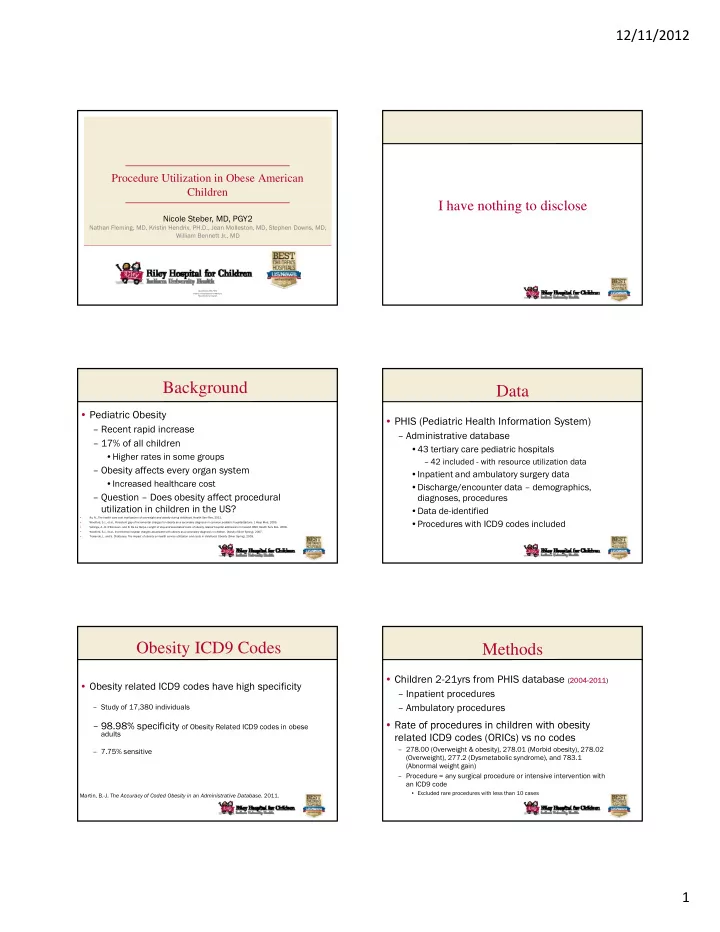
Procedure Utilization in Obese American Children

Nicole Steber, MD, PGY2 Indiana University School of Medicine Riley Children’s Hospital

Nicole Steber, MD, PGY2

Nathan Fleming, MD, Kristin Hendrix, PH.D., Jean Molleston, MD, Stephen Downs, MD, William Bennett Jr., MD

I have nothing to disclose I have nothing to disclose

Background

  • Pediatric Obesity

– Recent rapid increase – 17% of all children

  • Higher rates in some groups

– Obesity affects every organ system

  • Increased healthcare cost

– Question – Does obesity affect procedural utilization in children in the US?

  • Au, N., The health care cost implications of overweight and obesity during childhood. Health Serv Res, 2012.
  • Woolford, S.J., et al., Persistent gap of incremental charges for obesity as a secondary diagnosis in common pediatric hospitalizations. J Hosp Med, 2009.
  • Vellinga, A., D. O'Donovan, and D. De La Harpe, Length of stay and associated costs of obesity related hospital admissions in Ireland. BMC Health Serv Res, 2008.
  • Woolford, S.J., et al., Incremental hospital charges associated with obesity as a secondary diagnosis in children. Obesity (Silver Spring), 2007.
  • Trasande, L. and S. Chatterjee, The impact of obesity on health service utilization and costs in childhood. Obesity (Silver Spring), 2009.

Data

  • PHIS (Pediatric Health Information System)

– Administrative database

  • 43 tertiary care pediatric hospitals

– 42 included - with resource utilization data

  • Inpatient and ambulatory surgery data
  • Discharge/encounter data – demographics,

diagnoses, procedures

  • Data de-identified
  • Procedures with ICD9 codes included

Obesity ICD9 Codes

  • Obesity related ICD9 codes have high specificity

– Study of 17,380 individuals

98 98% ifi it – 98.98% specificity of Obesity Related ICD9 codes in obese

adults – 7.75% sensitive

Martin, B.-J. The Accuracy of Coded Obesity in an Administrative Database. 2011.

Methods

  • Children 2-21yrs from PHIS database (2004-

2004-20 2011)

– Inpatient procedures – Ambulatory procedures

  • Rate of procedures in children with obesity
  • Rate of procedures in children with obesity

related ICD9 codes (ORICs) vs no codes

– 278.00 (Overweight & obesity), 278.01 (Morbid obesity), 278.02 (Overweight), 277.2 (Dysmetabolic syndrome), and 783.1 (Abnormal weight gain) – Procedure = any surgical procedure or intensive intervention with an ICD9 code

  • Excluded rare procedures with less than 10 cases
slide-2
SLIDE 2

12/11/2012 2

Methods

  • Odds ratio of procedure in obesity coded vs not obesity code
  • Two sample Z-test for statistical significance (α = 0.05)
  • Bonferroni Correction
  • = α/n (number of comparisons)
  • Corrects for multiple corrections
  • Stringent statistical significance

Demographics

Ambul Ambulatory no not coded

  • ded
  • b
  • bese

ese Ambul Ambulatory code coded obese se In Inpat patient Not c Not coded d

  • b
  • bese

ese In Inpat patient t code coded obese se Number of cases 2,112,004 26,313 1,418,319 31,651 Mean Age 10 5 10 7 10 5 10 9 Mean Age (yrs) 10.5 10.7 10.5 10.9 Median Age (yrs) 8.9 11 11.7 10.2 13 13.6 Number of males 1,197,844 57% 13,805 52% 770,953 54% 15,755 50%

Demographics - Race

Ambul Ambulatory no ob no obese codes ese codes Ambul Ambulatory code coded ob d obese ese In Inpat patient t no ob no obese code ese code In Inpat patient code coded ob d obese ese Number of cases 2,112,004 26,313 1,418,319 31,651 White 1,450,833 69% 16,069 61% 926,512 65% 16,999 54% Black 297,681 14% 5,192 20% 20% 250,753 18% 8,474 27 27% Asian 42606 2% 313 1% 32058 2% 359 1% Other race 320,884 15% 4,739 18% 208,996 15% 5,819 18%

Demographics - Insurance

Ambul Ambulatory no ob no obesity esity codes codes Ambul Ambulatory code coded ob d obese ese In Inpat patient no ob no obesity esity codes codes In Inpat patient t code coded obese se Number of cases 2,112,004 26,313 1,418,319 31,651 Insurance Type Private 602,403 29% 7,467 28% 279,212 20% 5,431 17% Medicaid 491,888 23% 23% 9,508 36% 36% 325,653 23% 23% 10,714 34% 34% Other Insurance 153,165 7% 1,620 6% 83,681 6% 2,153 7% Unknown Insurance 826,251 39% 7,647 29% 701,338 49% 12,838 41%

Results

  • 3,588,287 total procedures included

– 1,449,970 inpatient procedures

  • 31,651 with obesity related ICD9 codes (2.2%)

– 2,138,317 ambulatory procedures

  • 26,313 with obesity related ICD9 codes (1.2%)

– 17% of all children in US obese (2010)

Ogden, C.L., et al., Prevalence of obesity and trends in body mass index among US children and adolescents, 1999-2010. JAMA, 2012. 307 307(5): p. 483-90.

Ambulatory Procedures

Lower rate in ORICs Lower rate in ORICs Higher rate in ORICs Higher rate in ORICs

slide-3
SLIDE 3

12/11/2012 3

Inpatient Procedures

Lower rate in ORICs Lower rate in ORICs Higher rate in ORICs Higher rate in ORICs

Inpatient Cost

Procedu

  • cedure

Odds R dds Ratio tio Dif iffere renc nce in in OR ORIC IC vs non-O non-ORIC ($/patient/e atient/encount ncounter er) T&A 6.66 $2,765.33 CPAP 3.49 $182.24 Lap cholecystectomy 3.89 $1,919.69 p y y Physical Therapy 1.73 $1,541.21 Spinal tap 1.4 $1,447.22 Lapscp appendectomy 0.55 $1,813.02 Int fix w/o red femur 2.75

  • $1,457.36

ORIC = Obesity Related ICD9 Code

Ambulatory Cost

Pr Proced

  • cedure

Odds Ra Ratio tio Dif iffere renc nce in in ORIC ORIC vs vs non-O non-ORIC IC ($/patient/e atient/encount ncounter er ) T & A 1.73 $125.39 EGD w/ biopsy 1.37 $333.69 Cl d li bi 10 4 $113 04 Closed liver biopsy 10.4

  • $113.04

Colonoscopy 1.37 $251.71 Sigmoidoscopy 1.55 $478.91 Rmvl impl dev tib/fib 2.67 $19.51 Myringotomy 0.04

  • $176.42

Int fix w/o red femur 5.18

  • $181.63

Crown application 0.54 $959.67 Pilonidal cyst exc. 3.86

  • $13.98

ORIC = Obesity Related ICD9 Code

Summary

  • Increased rate of some procedures in children

with obesity related ICD9 codes

– 6 inpatient procedures

  • T&A
  • CPAP
  • laparoscopic cholecystectomy
  • Internal fixation without reduction of femur
  • spinal tap
  • physical therapy

Summary

  • 8 ambulatory procedures increased in children with
  • besity related ICD9 codes

– T&A – EGD – liver biopsy – colonoscopy – sigmoidoscopy – tib/fib device removal – internal fixation without reduction of femur – pilonidal cyst excision

  • Why are children with obesity related ICD9 codes

undergoing more scopes?

Summary

  • Children with obesity related ICD9 codes are

undergoing certain procedures at a higher rate with increased cost.

slide-4
SLIDE 4

12/11/2012 4

Summary

  • Increased rates of some non-obesity related

procedures in children with obesity related ICD9 codes including:

– EGD – Sigmoidoscopy – Colonoscopy

Further Research Needed

  • Need to look at rates of procedures in obese

using BMI

  • How to improve obesity diagnosis
  • Research why there is a cost difference

Questions ?

References

1. Barlow, S.E., Expert committee recommendations regarding the prevention, assessment, and treatment of child and adolescent overweight and obesity: summary report. Pediatrics, 2007. 120 Su 120 Supp ppl 4: p. S164-92. 2. Ogden, C.L., et al., Prevalence of obesity and trends in body mass index among US children and adolescents, 1999-

  • 2010. JAMA, 2012. 307

307(5): p. 483-90. 3. Wijlaars, L.P., et al., Socioeconomic status and weight gain in early infancy. Int J Obes (Lond), 2011. 35 35(7): p. 963-70. 4. Tait, A.R., et al., Incidence and risk factors for perioperative adverse respiratory events in children who are obese. Anesthesiology, 2008. 108 108(3): p. 375-80. 5. Wick, E.C., et al., Surgical site infections and cost in obese patients undergoing colorectal surgery. Arch Surg, 2011. 146 146(9): p. 1068-72. 6. Balentine, C.J., et al., Waist circumference predicts increased complications in rectal cancer surgery. J Gastrointest Surg, 2010. 14 14(11): p. 1669-79. 7. Walid, M.S., M. Sanoufa, and J.S. Robinson, The effect of age and body mass index on cost of spinal surgery. J Clin Ne rosci 2011 18 18(4) p 489 93 Neurosci, 2011. 18 18(4): p. 489-93. 8. Warrender, W.J., O.L. Brown, and J.A. Abboud, Outcomes of arthroscopic rotator cuff repairs in obese patients. J Shoulder Elbow Surg, 2011. 20 20(6): p. 961-7. 9. Petrella, F., et al., The impact of preoperative body mass index on respiratory complications after pneumonectomy for non-small-cell lung cancer. Results from a series of 154 consecutive standard pneumonectomies. Eur J Cardiothorac Surg, 2011. 39 39(5): p. 738-44. 10. Chen, C.L., et al., The impact of obesity on breast surgery complications. Plast Reconstr Surg, 2011. 128 128(5): p. 395e- 402e. 11. Deugarte, D.A., et al., Obesity does not impact outcomes for appendicitis. Am Surg, 2012. 78 78(2): p. 254-7. 12. Senker, W., et al., Perioperative morbidity and complications in minimal access surgery techniques in obese patients with degenerative lumbar disease. Eur Spine J, 2011. 20 20(7): p. 1182-7. 13. Geppert, B., C. Lonnerfors, and J. Persson, Robot-assisted laparoscopic hysterectomy in obese and morbidly obese women: surgical technique and comparison with open surgery. Acta Obstet Gynecol Scand, 2011. 90 90(11): p. 1210-7. 14. Canedo, J., et al., Laparoscopic surgery for inflammatory bowel disease: does weight matter? Surg Endosc, 2010. 24 24(6): p. 1274-9. 15. El-Metainy, S., et al., Incidence of perioperative adverse events in obese children undergoing elective general surgery. Br J Anaesth, 2011. 106 106(3): p. 359-63.

References

16. Olutoye, O.A., M.F. Watcha, and D.B. Andropoulos, Pediatric obesity: observed impact in the ambulatory surgery setting. J Natl Med Assoc, 2011. 103 103(1): p. 27-30. 17. Rudnick, E.F., et al., Prevalence and ethnicity of sleep-disordered breathing and obesity in children. Otolaryngol Head Neck Surg,

  • 2007. 137

137(6): p. 878-82. 18. Garey, C.L., et al., Laparoscopic cholecystectomy in obese and non-obese children. J Surg Res, 2010. 163 163(2): p. 299-302. 19. Martin, B.-J. The Accuracy of Coded Obesity in an Administrative Database. 2011. 20. Stephens, M.B., Coding and obesity: room to grow. J Am Board Fam Med, 2011. 24 24(3): p. 329-30. 21. Ogden, C.L., et al., Prevalence of high body mass index in US children and adolescents, 2007-2008. JAMA, 2010. 303 303(3): p. 242-9. 22. Song, K.S., et al., Epidemiology and demographics of slipped capital femoral epiphysis in Korea: a multicenter study by the Korean Pediatric Orthopedic Society. J Pediatr Orthop, 2009. 29 29(7): p. 683-6. 23. Shine, N.P., et al., Adenotonsillectomy for obstructive sleep apnea in obese children: effects on respiratory parameters and clinical

  • utcome. Arch Otolaryngol Head Neck Surg, 2006. 132

132(10): p. 1123-7. 24. Ziebarth, K., et al., Clinical Stability of Slipped Capital Femoral Epiphysis does not Correlate with Intraoperative Stability. Clin Orthop Relat Res 2012 470 470(8): p 2274 9 Relat Res,

  • 2012. 470

470(8): p. 2274-9. 25. Benson, E.C., et al., A new look at the incidence of slipped capital femoral epiphysis in new Mexico. J Pediatr Orthop, 2008. 28 28(5):

  • p. 529-33.

26. Nguyen, A.R., et al., Slipped capital femoral epiphysis: rising rates with obesity and aboriginality in South Australia. J Bone Joint Surg Br, 2011. 93 93 (10): p. 1416-23. 27. Marcus, C.L., et al., Use of nasal continuous positive airway pressure as treatment of childhood obstructive sleep apnea. J Pediatr,

  • 1995. 127

127(1): p. 88-94. 28. Poffenberger, C.M., et al., Cholelithiasis and its complications in children and adolescents: update and case discussion. Pediatr Emerg Care, 2012. 28 28(1): p. 68-76; quiz 77-8. 29. Li, V.K., et al., Symptomatic gallstones after sleeve gastrectomy. Surg Endosc, 2009. 23 23(11): p. 2488-92. 30. Arda, I.S., et al., High body mass index as a possible risk factor for pilonidal sinus disease in adolescents. World J Surg, 2005. 29 29(4): p. 469-71. 31. Blanco, F.C., A.D. Sandler, and E.P. Nadler, Increased Incidence of Perforated Appendicitis in Children With Obesity. Clin Pediatr (Phila), 2012. 32. Choi, J.C., et al., Morbid obesity is associated with increased resource utilization in coronary artery bypass grafting. Ann Thorac Surg, 2012. 94 94(1):

  • p. 23-8.

33. Cooper, L., Postoperative complications after thoracic surgery in the morbidly obese patient. Anesthesiol Res Pract, 2011. 2011 2011: p. 865634. 34. Hirose, K., et al., Pay for obesity? Pay-for-performance metrics neglect increased complication rates and cost for obese patients. J Gastrointest Surg, 2011. 15 15(7): p. 1128-35. 35. Bolenz, C., et al., The influence of body mass index on the cost of radical prostatectomy for prostate cancer. BJU Int, 2010. 106 106(8):

  • p. 1188-93.

Demographics with p values