+ = hypotenuse CB 2 2 2 a b c opposite side AB = = = - - PDF document

hypotenuse cb 2 2 2 a b c opposite side ab tan tan
SMART_READER_LITE
LIVE PREVIEW

+ = hypotenuse CB 2 2 2 a b c opposite side AB = = = - - PDF document

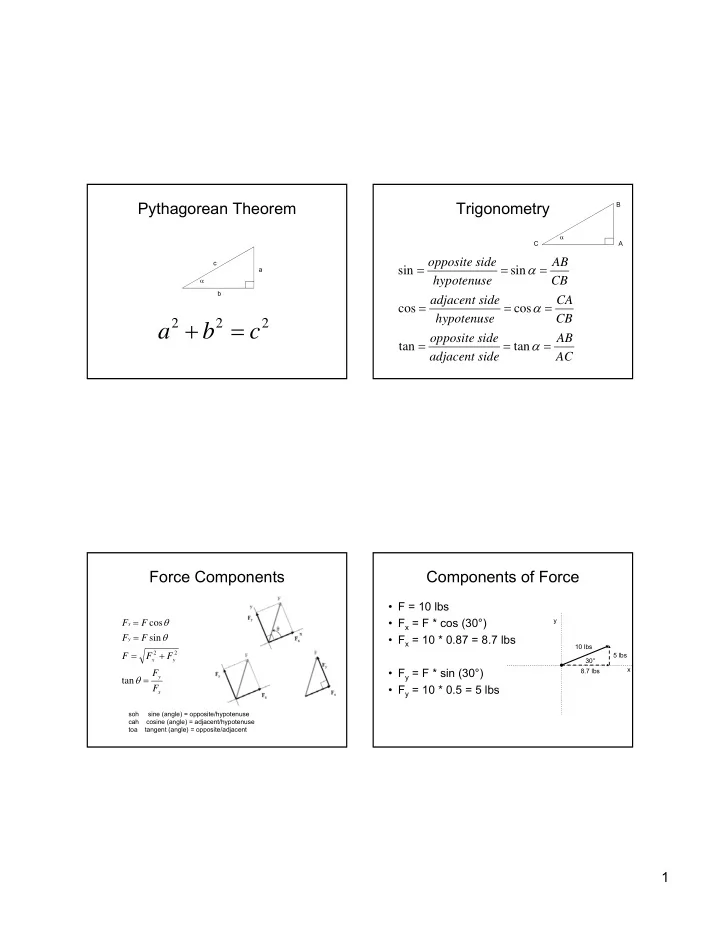
Pythagorean Theorem Trigonometry B C A opposite side AB c = = = sin sin a hypotenuse CB b adjacent side CA = = = cos cos + = hypotenuse CB 2 2 2 a b c opposite side AB = = = tan tan


slide-1
SLIDE 1

1

Pythagorean Theorem

α a b c

2 2 2

c b a = +

Trigonometry

α A

AC AB side adjacent side

  • pposite

CB CA hypotenuse side adjacent CB AB hypotenuse side

  • pposite

= = = = = = = = = α α α tan tan cos cos sin sin

B C

Force Components

x y y x y x

F F F F F F F F F = + = = = θ θ θ tan sin cos

2 2

soh sine (angle) = opposite/hypotenuse cah cosine (angle) = adjacent/hypotenuse toa tangent (angle) = opposite/adjacent

Components of Force

  • F = 10 lbs
  • Fx = F * cos (30°)
  • Fx = 10 * 0.87 = 8.7 lbs
  • Fy = F * sin (30°)
  • Fy = 10 * 0.5 = 5 lbs

10 lbs 30° 8.7 lbs 5 lbs x y

slide-2
SLIDE 2

2 Components of Force Similar Triangles

  • Find Fx

Find Fy

  • Hypotenuse

– Use pythagorean theorem – √(32 +42) = 5

lbs F F F F

y y y y

16 5 5 5 20 4 5 20 4 20 5 4 = = = = * * * *

20 lbs

3 4

x y

lbs F F F F

x x x x

12 5 5 5 20 3 5 20 3 20 5 3 = = = = * * * *

How can we tell if forces are balanced?

  • The x and y components cancel

What is the balancing force?

  • 10 lb force

– Fx = 10 * cos (30°) = -8.7 lbs – Fy = 10 * sin (30°) = 5 lbs

  • 20 lb force

– Fx = 3*20/7.6 = 8 lbs – Fy = 7*20/7.6= 18.4 lbs

  • Combine components

– X: -8.7 + 8 = 0.7 lbs – Y: 5 + 18.4 = 23.4 lbs

  • Negative of these components represent balancing force

– X = -0.7 lbs, y = -23.4 lbs – Resultant = √(.72 + 23.42) = 23.4 lbs – Angle: tan-1(-23.4/-0.7) = 88° in third quadrant

20 lbs

3 7

x y 30° 10 lbs 88° 23 lbs

Translational Equilibrium

  • In order to be in translational equilibrium, the

total forces of the object must be zero.

  • Set the horizontal and vertical components of

the forces to zero.

∑ ∑

= =

y x

F F

slide-3
SLIDE 3

3 Rotational Equilibrium Torque or Moment

  • In order to be in rotational equilibrium, the

total torques acting on an object must be zero.

d F M

  • r

d F M

  • r

⋅ = ⋅ = = =

∑ ∑

τ τ

Pole Vaulter

The pole vaulter is holding pole so that it does not rotate and does not move. It is in equilibrium.

c.g. 2 ft. FG= 5 lbs FR FL pivot 6 ft.

  • Find the forces FL and FR.

Pole vaulter – con’t

= + = + =

net G G L L net G L net

F r F r τ τ τ τ τ

= + + =

net G R L net

F F F F F

Rotation = 0 Translation = 0

Pole vaulter – con’t

lbs F lb ft F ft

L L G L net

15 5 6 2 = − ⋅ + ⋅ = + = τ τ τ

lbs F lbs F lbs F F F F

R R G R L net

10 5 15 − = − + = + + =

c.g. 2 ft. FG= 5 lbs FL=15 lbs pivot 6 ft. FR=10 lbs

slide-4
SLIDE 4

4

Think – Pair - Share

  • What exerts more pressure (in pounds per square inch)

when walking: a 100 lb woman in high heels or a 6,000 lb elephant in bare feet?

  • [At the moment when only the heel rests on the ground.]
  • Stiletto heels have an area of about 1/16 of a square

inch.

  • Elephants, unlike humans, walk with two feet on the

ground at a time.

  • Each foot is about 40 square inches.
  • Pressure
  • Woman’s heels
  • Elephant’s feet
  • The heels exert more pressure!

Answer

psi in lbs P psi in lbs in lbs P A F P 75 40 2 6000 1600 1600 16 1 100

2 2 2

= ⋅ = = = = =

Equations

Strain Stress E Strain E Stress = ⋅ =

  • E is the modulus of elasticity
  • Units of pressure (N/m2 or psi)

L L Stress E Strain Stress E L L Strain Δ = = Δ =

Stress and Strain – example 1

  • How far can you stretch a 20 ft steel cable before

it snaps?

  • E for steel is 2*1011 N/m2
  • Ultimate tensile strength for steel is 5.2*108 N/m2

inches ft m m ft L E Stress L L L L Stress L L Stress Strain Stress E 6 . 05 . N 10 2 N 10 2 . 5 * 20 * *

2 11 2 8

= = ⋅ ⋅ = Δ = Δ Δ = Δ = =

slide-5
SLIDE 5

5

Middle Third Rule

  • Must stay within the “middle third” of the block to

prevent the opposite side from going into tension

– this is the important MIDDLE THIRD RULE.

  • Why is it important?

– Because bricks/stone/etc are much stronger in compression than in tension; need to keep them in compression or they can break!

  • To get around this problem

– reinforce concrete with a steel bar – the steel can take the tension when the concrete can’t.

  • We’ll go over this in more detail in Chapter 8.

Cables

Principal Elements for practical suspension systems

  • Vertical supports or towers
  • Main cables
  • Anchorages
  • Stabilizers

Vertical Supports or Towers

  • Provide essential reactions that keep the

cable system above the ground

  • May be simple vertical or sloping piers or

masts, diagonal struts, or a wall.

  • Ideally, the axes of the supports should

bisect the angle between the cables that pass over them

slide-6
SLIDE 6

6

Main Cables

  • Primary tensile elements
  • Carry roof with a minimum of material
  • Steel used in cable structures has

breaking stresses that exceed 200,000 psi

Anchorages

  • Because the cables are not vertical only,

horizontal force resistance is required.

  • In suspension bridges, the massive

concrete abutments provide the horizontal reaction force

Stabilizers

  • Lightweight roof or bridge systems are

susceptible to pronounced undulation or fluttering when acted upon by wind forces.

  • Cables resist load through tension.
  • The destructive force is vibration or flutter

Cables with a Single Concentrated Load

( ) ( )

' 4 . 12 ' 3 ' 12

2 2

= +

12 3

x y

T T =

W C B A T T Ty Tx Tx Ty l h

l = 24’ h = 3’

3’ 12’

[ ]

2 2 W T W T F

y y y

= = − =

W W T T

y x

2 2 3 12 3 12 = ⎟ ⎠ ⎞ ⎜ ⎝ ⎛ = =