The 21st International Computing and Combinatorics Conference - - PowerPoint PPT Presentation

the 21st international computing and combinatorics
SMART_READER_LITE
LIVE PREVIEW

The 21st International Computing and Combinatorics Conference - - PowerPoint PPT Presentation

Introduction Formulation Algorithm Analysis Future work The 21st International Computing and Combinatorics Conference (COCOON15) will be held in Beijing, China, during August 4-6, 2015. Special issue: Algorithmica Theoretical Computer


slide-1
SLIDE 1

. . . . . .

Introduction Formulation Algorithm Analysis Future work
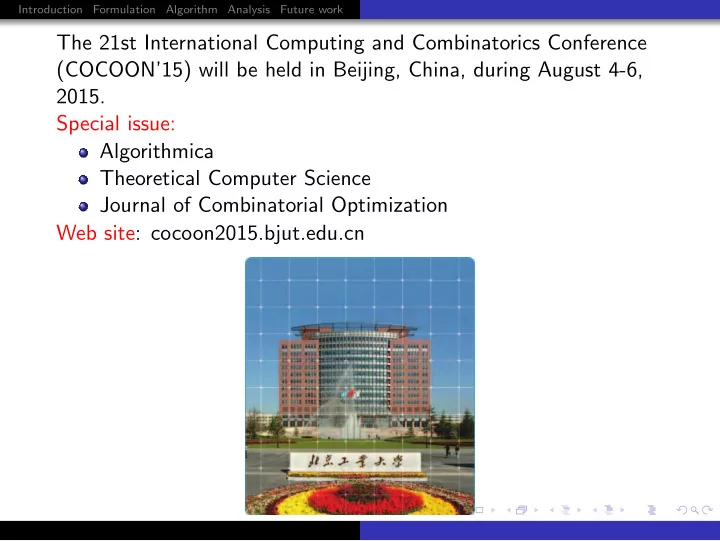
The 21st International Computing and Combinatorics Conference (COCOON’15) will be held in Beijing, China, during August 4-6, 2015. Special issue: Algorithmica Theoretical Computer Science Journal of Combinatorial Optimization Web site: cocoon2015.bjut.edu.cn

slide-2
SLIDE 2

. . . . . .

Introduction Formulation Algorithm Analysis Future work

Important date: Submission Deadline: February 15, 2015 Notification of acceptance: April 5, 2015 Camera Ready: April 25, 2015 Conference Dates: August 4-6, 2015

slide-3
SLIDE 3

. . . . . .

Introduction Formulation Algorithm Analysis Future work

. . . . . . .

A complex semidefinite programming rounding approximation algorithm for the balanced Max-3-Uncut problem

Dachuan Xu (Joint work with Chenchen Wu, Donglei Du, and Wen-qing Xu) Email: xudc@bjut.edu.cn

Beijing University of Technology

September 2014, Peking University

Balanced Max-3-Uncut

slide-4
SLIDE 4

. . . . . .

Introduction Formulation Algorithm Analysis Future work

. . Outline

. ..

1

Introduction . .. . .. . .. . ..

Balanced Max-3-Uncut

slide-5
SLIDE 5

. . . . . .

Introduction Formulation Algorithm Analysis Future work

. . Outline

. ..

1

Introduction . ..

2

Formulation . .. . .. . ..

Balanced Max-3-Uncut

slide-6
SLIDE 6

. . . . . .

Introduction Formulation Algorithm Analysis Future work

. . Outline

. ..

1

Introduction . ..

2

Formulation . ..

3

Algorithm . .. . ..

Balanced Max-3-Uncut

slide-7
SLIDE 7

. . . . . .

Introduction Formulation Algorithm Analysis Future work

. . Outline

. ..

1

Introduction . ..

2

Formulation . ..

3

Algorithm . ..

4

Analysis . ..

Balanced Max-3-Uncut

slide-8
SLIDE 8

. . . . . .

Introduction Formulation Algorithm Analysis Future work

. . Outline

. ..

1

Introduction . ..

2

Formulation . ..

3

Algorithm . ..

4

Analysis . ..

5

Future work

Balanced Max-3-Uncut

slide-9
SLIDE 9

. . . . . .

Introduction Formulation Algorithm Analysis Future work

. . Introduction

Graph Partition Problem

The most famous problem is Max Cut.

Max Cut

Balanced Max-3-Uncut

slide-10
SLIDE 10

. . . . . .

Introduction Formulation Algorithm Analysis Future work

. . Introduction

Graph Partition Problem

The most famous problem is Max Cut. There are also some other variant problems of Max Cut problem:

Max Bisection(balanced version of Max-Cut): adding equal cardinality constraint Max- n

2 -Uncut: balanced version and calculating the weight

not in the cut. · · ·

Balanced Max-3-Uncut

slide-11
SLIDE 11

. . . . . .

Introduction Formulation Algorithm Analysis Future work

. . Introduction

We study the balanced Max-3-Uncut. Problem description Given a weighted graph G = (V, E)(Assume |V | is a multiple

  • f 3)

weight function w : E → R+ Goal: partition V into three subsets S1, S2, and S3 with equal cardinality such that the total weight of the edges from the same subsets is maximized

Balanced Max-3-UnCut

Balanced Max-3-Uncut

slide-12
SLIDE 12

. . . . . .

Introduction Formulation Algorithm Analysis Future work

. . Introduction

Methods

Approximation algorithm(attractive algorithm with bounded solution) linear program → Semidefinite program The real space R → The complex space C

Results

Based on the complex semdefinite programming rounding technique, we proposed a 0.3456-approximation algorithm for the balanced Max-3-Uncut.

Balanced Max-3-Uncut

slide-13
SLIDE 13

. . . . . .

Introduction Formulation Algorithm Analysis Future work

. . Introduction

Literature review

Based on semidefinite programming in R

Goemans and Williamson(J. ACM, 1995) for the Max-Cut: 0.87856, semidefinite programming rounding using randomly hyperplane; Frieze and Jerrum(Algorithmica, 2006) for the Max-Bisection: 0.6514, semidefinite programming rounding + greedy swapping; Austin et al. (SODA, 2013) for the Max-Bisection: 0.8776, semidefinite programming hierarchies rounding.(Best until now) Halperin and Zwick(Random Structures and Algorithms, 2002) for the Balanced Max-2-Uncut: 0.6436, semidefinite programming rounding using randomly hyperplane. Wu et al.(J Combin Opt, 2013) for the Balanced Max-2-Uncut: 0.8776, semidefinite programming rounding using randomly hyperplane.

Balanced Max-3-Uncut

slide-14
SLIDE 14

. . . . . .

Introduction Formulation Algorithm Analysis Future work

. . Introduction

Literature review

Based on semidefinite programming in C

Goemans and Williamson(J. Comput. Syst. Sci., 2004) for the Max-3-Cut: ( 7

12 3 4π2 arccos2(−1/4) − ϵ

) ≈ (0.8360 − ϵ), for any given ϵ > 0, complex semidefinite programming rounding. Ling (COCOA, 2009) for Max-3-Section: 0.6733, complex semidefinite programming rounding + greedy swapping.

Balanced Max-3-Uncut

slide-15
SLIDE 15

. . . . . .

Introduction Formulation Algorithm Analysis Future work

. . Formulation

The Balanced Max-3-Uncut can be described by max

(S1, S2, S3) ∈ P(V ) |S1| = |S2| = |S3|

i,j∈S1

wij + ∑

i,j∈S2

wij + ∑

i,j∈S3

wij, where

P(V ) := {(S1, S2, S3) : S1 ∪ S2 ∪ S3 = V, and Sk ∩ Sl = ∅ for all k ̸= l}

Balanced Max-3-Uncut

slide-16
SLIDE 16

. . . . . .

Introduction Formulation Algorithm Analysis Future work

. . Formulation

Max − Cut x2 = 1(−1, 1) Balaced Max − 3 − Uncut x3 = 1(1, ω = e− 2

3 πi, ω2)

max 1 3 ∑

i<j

wij(1 + yi · yj + yj · yi)

  • s. t.

i∈V

yi = 0, yi ∈ {1, ω, ω2}, ∀i ∈ V.

1 ω

2

ω

Introduction the variable yi ∈ {1, ω, ω2} for each i ∈ V .

Balanced Max-3-Uncut

slide-17
SLIDE 17

. . . . . .

Introduction Formulation Algorithm Analysis Future work

. . Formulation

Relaxation: yi ∈ C → vi ∈ Cn, ∥ vi ∥= 1 Tighter relaxation: Since yi ∈ {1, ω, ω2} for all i ∈ V , we must have yi · yj + yj · yi ≥ −1, ∀i, j ∈ V, ω · (yi · yj) + ω2 · (yj · yi) ≥ −1, ∀i, j ∈ V, ω2 · (yi · yj) + ω · (yj · yi) ≥ −1, ∀i, j ∈ V, which can be rewritten as Re(yi · yj) ≥ −1 2, ∀i, j ∈ V, Re(ω · (yi · yj)) ≥ −1 2, ∀i, j ∈ V, Re(ω2 · (yi · yj)) ≥ −1 2, ∀i, j ∈ V.

Balanced Max-3-Uncut

slide-18
SLIDE 18

. . . . . .

Introduction Formulation Algorithm Analysis Future work

. . Formulation

By adding the above extra inequalities into the above program, we get the complex semidefinite programming relaxations as follows.

max 1 3 ∑

i<j

wij(1 + vi · vj + vj · vi)

  • s. t.

Re(vi · vj) ≥ −1 2, ∀i, j ∈ V, Re(ω · (vi · vj)) ≥ −1 2, ∀i, j ∈ V, (2.1) Re(ω2 · (vi · vj)) ≥ −1 2, ∀i, j ∈ V, ∑

i,j

vi · vj = 0, ∥ vi ∥= 1, ∀i ∈ V, vi ∈ Cn, ∀i ∈ V.

Balanced Max-3-Uncut

slide-19
SLIDE 19

. . . . . .

Introduction Formulation Algorithm Analysis Future work

. . Algorithm

Step 1 Solve complex semidefinite programming Solve the (2.1) to obtain an optimal solution {vi}, leading to a complex semidefinite matrix V := (vi · vj). Step 2 Generate random complex variable For a given parameter θ ∈ [0, 1], choose a random vector ξ ∼ N(0, θV + (1 − θ)I), where I is the n × n identity matrix. Step 3 Obtain solution for the Max-3-Uncut ˆ yi =    1, Arg(ξi) ∈ [0, 2

3π);

ω, Arg(ξi) ∈ [ 2

3π, 4 3π);

ω2, Arg(ξi) ∈ [ 4

3π, 2π).

Let S1 := {i : ˆ yi = 1}, S2 := {i : ˆ yi = ω}, and S3 := {i : ˆ yi = ω2}.

Balanced Max-3-Uncut

slide-20
SLIDE 20

. . . . . .

Introduction Formulation Algorithm Analysis Future work

. . Algorithm

Step 4 Swap greedy to obtain solution for the balanced Max-3-Uncut

Assume, without loss of generality, |S1| ≥ |S2| ≥ |S3|. Initialize ˆ Sℓ = Sℓ (ℓ = 1, 2, 3). Denote the final partition with equal cardinality as ˜ S1, ˜ S2, and ˜ S3. Case 4.1. If |S1| ≥ |S2| ≥ n

3 ≥ |S3|, then iteratively, perform

the following operations (i)-(ii) until | ˆ Sℓ| = n

3 for

each ℓ = 1, 2: (i) Sort the vertices in ˆ Sℓ such that δ(i1) ≥ . . . ≥ δ(i| ˆ

Sℓ|) where δ(i) = ∑ i′∈ ˆ Sℓ wi′i

(i ∈ ˆ Sℓ). (ii) Move the point i| ˆ

Sℓ| from ˆ

Sℓ to ˆ S3; namely, ˆ Sℓ = ˆ Sℓ\{i| ˆ

S1|}, and ˆ

S3 = ˆ S3 ∪ { i| ˆ

Sℓ|

} . Case 4.2. Operate similarly for the case of |S1| ≥ n

3 ≥ |S2| ≥ |S3|.

Balanced Max-3-Uncut

slide-21
SLIDE 21

. . . . . .

Introduction Formulation Algorithm Analysis Future work

. . Algorithm

Balanced Max-3-Uncut

slide-22
SLIDE 22

. . . . . .

Introduction Formulation Algorithm Analysis Future work

. . Analysis

First, we define z(γ) := W(S1, S2, S3) W ∗ + γ C C∗ , where

W(S1, S2, S3) is the weight of the partition is S1, S2, S3. W ∗ is the optimal solution of the complex semidefinite relaxation of the Max-3-Uncut. C = |S1||S2| + |S1||S3| + |S2||S3|. C∗ = n2

3 .

µ(x) =

C C∗ , where x =

( S1

n , S2 n , S3 n

) .

Balanced Max-3-Uncut

slide-23
SLIDE 23

. . . . . .

Introduction Formulation Algorithm Analysis Future work

If the following hold, we can estimate the approximation ratio. E [

W(S1,S2,S3) W ∗

] ≥ α(θ), which estimates the ratio of weight between the solution before swapping process and the optimal solution. E [ C

C∗

] ≥ β(θ), which estimate the ratio of cardinality between the solution before swapping process and the optimal solution.

W( ˜ S1, ˜ S2, ˜ S3) W ∗

≥ r(x) W(S1,S2,S3)

W ∗

which estimate the ratio between the weight of the solution before the swapping process and the solution after the swapping process. Thus z(γ) is a balance between the weight and the cardinality.

Balanced Max-3-Uncut

slide-24
SLIDE 24

. . . . . .

Introduction Formulation Algorithm Analysis Future work

. . Analysis

Denote µ(x) =

C C∗ , where x =

( S1

n , S2 n , S3 n

) . z(γ) := W(S1, S2, S3) W ∗ + γ C C∗ ⇒ W( ˜ S1, ˜ S2, ˜ S3) W ∗ ≥ r(x)W(S1, S2, S3) W ∗ ≥ r(x) ( α(θ) + γβ(θ) − γ C C∗ ) = r(x) (α(θ) + γβ(θ) − γµ(x)) .

Balanced Max-3-Uncut

slide-25
SLIDE 25

. . . . . .

Introduction Formulation Algorithm Analysis Future work

. . Analysis

Denote R(x; θ, γ) = r(x)(α(θ) + γβ(θ) − γµ(x)). Thus, the approximation ratio is max

γ,θ min x∈∆ R(x; θ, γ),

where ∆ =      x = (x1, x2, x3)

  • 3

i=1

xi = 1 x1 ≥ x2 ≥ x3 ≥ 0      .

Balanced Max-3-Uncut

slide-26
SLIDE 26

. . . . . .

Introduction Formulation Algorithm Analysis Future work

. . Analysis

Next, we need to analyze the three inequalities, give the close form

  • f α(θ), β(θ) and r(x).

Balanced Max-3-Uncut

slide-27
SLIDE 27

. . . . . .

Introduction Formulation Algorithm Analysis Future work

. . α(θ)

Note that α(θ) = E[W(S1,S2,S3)]

W ∗

. E [W(S1, S2, S3)] = 1 3 ∑

i<j

wij (1 + 2ReE[ˆ yi · ˆ yj]) ≥ 1 3 ∑

i<j

wij (1 + 2Re(vi · vj)) 1 + 2ReE[ˆ yi · ˆ yj] 1 + 2Re(vi · vj) = W ∗ ( min

{vi} satisfies the constraints of SDP relaxation

1 + 2ReE[ˆ yi · ˆ yj] 1 + 2Re(vi · vj) ) , then, we need to give the expected value of ˆ yi · ˆ yj if we need to estimate α(θ).

Balanced Max-3-Uncut

slide-28
SLIDE 28

. . . . . .

Introduction Formulation Algorithm Analysis Future work

. . α(θ)

By Goemans and Williamson (J. Comput. Syst. Sci. 2004) and Zhang and Huang (SIAM J. Optim. 2006), we have the following lemma which estimates the expected value of the real part of the feasible solution obtained by the algorithm. . Lemma . . . . . . . . The real part of the expected value of ˆ yi · ˆ yj is 9 8π2 [ arccos2 (−Re(θvi · vj)) − 1 2 arccos2(−Re(ω · (θvi · vj))) −1 2 arccos2(−Re(ω2 · (θvi · vj))) ] .

Balanced Max-3-Uncut

slide-29
SLIDE 29

. . . . . .

Introduction Formulation Algorithm Analysis Future work

. . α(θ)

Thus, we can obtain the value of α(θ).

. Lemma . . . . . . . .

For a given θ ∈ [0, 1], the ratio of the expected weight of (S1, S2, S3) and W ∗ is no less than α(θ), where α(θ) is

min g(θ, z1, z2)

  • s. t.

− 1 2 ≤ z1 ≤ 1, − 1 2 ≤ − 1 2 z1 + √ 3 2 z2 ≤ 1, − 1 2 ≤ − 1 2 z1 − √ 3 2 z2 ≤ 1, z2

1 + z2 2 ≤ 1.

In the above,

g(θ, z1, z2) := 1 1 + 2z1 { 1 + 9 4π2 [ arccos2(−θz1) − 1 2 arccos2 ( 1 2 θz1 − √ 3 2 θz2 ) − 1 2 arccos2 ( 1 2 θz1 + √ 3 2 θz2 )]} . Balanced Max-3-Uncut

slide-30
SLIDE 30

. . . . . .

Introduction Formulation Algorithm Analysis Future work

. . β(θ)

Note that β(θ) = |S1||S2|+|S2||S3|+|S1||S3|

n2/3

. By Ling(COCOCA’09), we can obtain that . Lemma . . . . . . . . f(x) :=

9 8π2

( arccos2(−x) − arccos2 ( 1

2x

)) . c(θ) := min

− 1

2 ≤x≤1

f(θ)−f(θx) 1−x

. β(θ) := ( 1 − 1

n

) (1 − f(θ) + c(θ)).

Balanced Max-3-Uncut

slide-31
SLIDE 31

. . . . . .

Introduction Formulation Algorithm Analysis Future work

. . r(x)

Note W( ˜

S1, ˜ S2, ˜ S3) W ∗

≥ r(x) W(S1,S2,S3)

W ∗

. By the swapping process, we need to consider two cases of |S2| ≥ n

3 and |S2| < n 3 .

. Lemma . . . . . . . .

When |S1| ≥ |S2| ≥ n

3 ≥ |S3|, we have

W ( ˜ S1, ˜ S2, ˜ S3 ) W(S1, S2, S3) ≥ 1 81x2

1x2 2

, where x = (x1, x2, x3) = (

|S1| n , |S2| n , |S3| n

) .

Balanced Max-3-Uncut

slide-32
SLIDE 32

. . . . . .

Introduction Formulation Algorithm Analysis Future work

. . r(x)

Note W( ˜

S1, ˜ S2, ˜ S3) W ∗

≥ r(x) W(S1,S2,S3)

W ∗

. By the swapping process, we need to consider two cases of |S2| ≥ n

3 and |S2| < n 3 .

. Lemma . . . . . . . .

When |S1| ≥ n

3 ≥ |S2| ≥ |S3|, we have

W ( ˜ S1, ˜ S2, ˜ S3 ) W(S1, S2, S3) ≥ 1 9x2

1

, where x = (x1, x2, x3) = (

|S1| n , |S2| n , |S3| n

) .

Balanced Max-3-Uncut

slide-33
SLIDE 33

. . . . . .

Introduction Formulation Algorithm Analysis Future work

. . r(x)

Then, we have r(x) :=      1 81x2

1x2 2

, if x2 ≥ 1 3; 1 9x2

1

, if x2 < 1 3.

Balanced Max-3-Uncut

slide-34
SLIDE 34

. . . . . .

Introduction Formulation Algorithm Analysis Future work

. . Analysis

Note that R(x; θ, γ) := r(x)(α(θ) + γβ(θ) − γµ(x)).

R1(θ, γ) := 27 256 γ4     1 + √ 1 − 8(α(θ)+γβ(θ))

α(θ) + γβ(θ)    

3 (

1 − 3 √ 1 − 8(α(θ) + γβ(θ)) 9γ ) .

R2(θ, γ) := γ α(θ) + γβ(θ) − γ 4(α(θ) + γβ(θ)) − 3γ .

Setting θ := 0.3115 and γ = 12.1855, then, we obtain the approximation ratio is 0.3456. In this case, α(θ) = 0.4521 and β(θ) = 0.9952.

Balanced Max-3-Uncut

slide-35
SLIDE 35

. . . . . .

Introduction Formulation Algorithm Analysis Future work

. . Future work

A tighter bound for r(x). Complex semidefinite hierarchies relaxation and its corresponding rounding technique.

Balanced Max-3-Uncut

slide-36
SLIDE 36

. . . . . .

Introduction Formulation Algorithm Analysis Future work

Thank you!

Balanced Max-3-Uncut