Configuration spaces: combinatorics, topology, and physics Triangle - - PowerPoint PPT Presentation

configuration spaces combinatorics topology and physics
SMART_READER_LITE
LIVE PREVIEW

Configuration spaces: combinatorics, topology, and physics Triangle - - PowerPoint PPT Presentation

Configuration spaces: combinatorics, topology, and physics Triangle lectures in combinatorics Wake Forest University Matthew Kahle (OSU) Configuration spaces February 9, 2013 Configuration space The configuration space of n labelled points in

slide-1
SLIDE 1

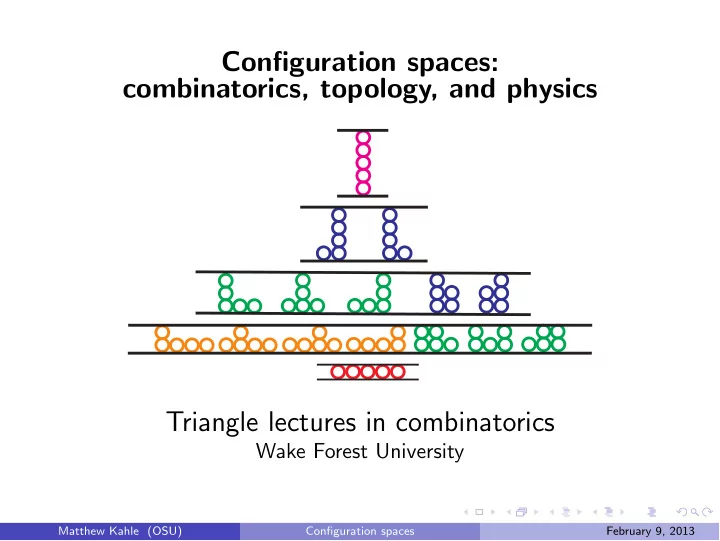
Configuration spaces: combinatorics, topology, and physics Triangle lectures in combinatorics

Wake Forest University

Matthew Kahle (OSU) Configuration spaces February 9, 2013

slide-2
SLIDE 2

Configuration space

The configuration space of n labelled points in the plane C(n) is defined as follows.

Definition

C(n) = {(x1, x2, . . . , xn) | xi 2 R2, xi 6= xj} ✓ R2n

Matthew Kahle (OSU) Configuration spaces February 9, 2013

slide-3
SLIDE 3

Configuration space

C(n) is an open manifold, and its topology is well understood. For example the Poincar´ e polynomial is given by: β0 + β1t + β2t2 + · · · = (1 + t)(1 + 2t) . . . (1 + (n 1)t).

Matthew Kahle (OSU) Configuration spaces February 9, 2013

slide-4
SLIDE 4

Configuration space

C(n) is an open manifold, and its topology is well understood. For example the Poincar´ e polynomial is given by: β0 + β1t + β2t2 + · · · = (1 + t)(1 + 2t) . . . (1 + (n 1)t). Here βi denotes the dimension of ith homology — roughly speaking, βi counts the number of i-dimensional holes.

Matthew Kahle (OSU) Configuration spaces February 9, 2013

slide-5
SLIDE 5

Configuration space

Our main interest is the topology of configuration space when the points have some thickness.

Matthew Kahle (OSU) Configuration spaces February 9, 2013

slide-6
SLIDE 6

Configuration space

Our main interest is the topology of configuration space when the points have some thickness.

Definition

Let C(n, r) denote the configuration space of all possible arrangements of n nonoverlapping disks of radius r in some fixed bounded region R ⇢ R2. I.e. C(n, r) = {(x1, x2, . . . , xn) | d(xi, xj) 2r, d(xi, ∂R) r}

Matthew Kahle (OSU) Configuration spaces February 9, 2013

slide-7
SLIDE 7

Configuration space

Our main interest is the topology of configuration space when the points have some thickness.

Definition

Let C(n, r) denote the configuration space of all possible arrangements of n nonoverlapping disks of radius r in some fixed bounded region R ⇢ R2. I.e. C(n, r) = {(x1, x2, . . . , xn) | d(xi, xj) 2r, d(xi, ∂R) r} This can be thought of as the phase space for a hard spheres gas, so it is

  • f intrinsic interest in physics.

Matthew Kahle (OSU) Configuration spaces February 9, 2013

slide-8
SLIDE 8

So it seems quite natural to study the topology of C(n, r).

Matthew Kahle (OSU) Configuration spaces February 9, 2013

slide-9
SLIDE 9

So it seems quite natural to study the topology of C(n, r). “We know very, very little about the topology of the set of configurations: for fixed n, what are useful bounds on r for the space to be connected? What are the Betti numbers? Of course, for r small this set is connected but very little else is known. ” — Persi Diaconis, 2008

Matthew Kahle (OSU) Configuration spaces February 9, 2013

slide-10
SLIDE 10

Configuration space

Here is an alternate definition of configuration space.

Matthew Kahle (OSU) Configuration spaces February 9, 2013

slide-11
SLIDE 11

Configuration space

Here is an alternate definition of configuration space. For n distinct points {x1, x2, . . . , xn} in a region R let F(x1, x2, . . . , xn) = min ({d(xi, xj)/2} [ {d(xi, ∂R)}) , where ∂R is the boundary of R.

Matthew Kahle (OSU) Configuration spaces February 9, 2013

slide-12
SLIDE 12

Configuration space

Here is an alternate definition of configuration space. For n distinct points {x1, x2, . . . , xn} in a region R let F(x1, x2, . . . , xn) = min ({d(xi, xj)/2} [ {d(xi, ∂R)}) , where ∂R is the boundary of R. Then C(n, r) = F 1[r, 1).

Matthew Kahle (OSU) Configuration spaces February 9, 2013

slide-13
SLIDE 13

Configuration space

Here is an alternate definition of configuration space. For n distinct points {x1, x2, . . . , xn} in a region R let F(x1, x2, . . . , xn) = min ({d(xi, xj)/2} [ {d(xi, ∂R)}) , where ∂R is the boundary of R. Then C(n, r) = F 1[r, 1). This suggests a Morse-theoretic approach.

Matthew Kahle (OSU) Configuration spaces February 9, 2013

slide-14
SLIDE 14

Morse theory

“Every mathematician has a secret weapon. Mine is Morse theory.” — Raoul Bott

Matthew Kahle (OSU) Configuration spaces February 9, 2013

slide-15
SLIDE 15

Morse theory

f

A smooth function on a torus

Matthew Kahle (OSU) Configuration spaces February 9, 2013

slide-16
SLIDE 16

Morse theory

f

Critical points

Matthew Kahle (OSU) Configuration spaces February 9, 2013

slide-17
SLIDE 17

Morse theory

f

β0 = 1

Matthew Kahle (OSU) Configuration spaces February 9, 2013

slide-18
SLIDE 18

Morse theory

f

β0 = 1, β1 = 1

Matthew Kahle (OSU) Configuration spaces February 9, 2013

slide-19
SLIDE 19

Morse theory

f

β0 = 1, β1 = 2

Matthew Kahle (OSU) Configuration spaces February 9, 2013

slide-20
SLIDE 20

Morse theory

f

β0 = 1, β1 = 2, β2 = 1

Matthew Kahle (OSU) Configuration spaces February 9, 2013

slide-21
SLIDE 21

Topology only changes at critical points

Theorem (Morse?)

Let f : M ! R be a smooth function on a compact manifold M with isolated non-degenerate critical points. If f 1[r, r0] contains no critical points then f 1(1, r) ⇠ f 1(1, r0). (Here ⇠ indicates homotopy equivalence.)

Matthew Kahle (OSU) Configuration spaces February 9, 2013

slide-22
SLIDE 22

Mechanically-balanced configurations

We say that a configuration of disks is mechanically-balanced if there exist non-negative (and not all zero) weights cij on the edges of the contact graph so that X

j

cij(xi xj) = 0 at every point i.

Matthew Kahle (OSU) Configuration spaces February 9, 2013

slide-23
SLIDE 23

Mechanically-balanced configurations

We say that a configuration of disks is mechanically-balanced if there exist non-negative (and not all zero) weights cij on the edges of the contact graph so that X

j

cij(xi xj) = 0 at every point i.

Matthew Kahle (OSU) Configuration spaces February 9, 2013

slide-24
SLIDE 24

Characterization of critical points

Theorem

(Baryshnikov, Bubenik, K.) Let F(x1, x2, . . . , xn) = min ({d(xi, xj)/2} [ {d(xi, ∂R)}) . If F 1[r, r0] contains no mechanically-balanced configurations of disks then C(n, r) ⇠ C(n, r0).

Matthew Kahle (OSU) Configuration spaces February 9, 2013

slide-25
SLIDE 25

Characterization of critical points

Theorem

(Baryshnikov, Bubenik, K.) Let F(x1, x2, . . . , xn) = min ({d(xi, xj)/2} [ {d(xi, ∂R)}) . If F 1[r, r0] contains no mechanically-balanced configurations of disks then C(n, r) ⇠ C(n, r0). (See “Min-type Morse theory for configuration spaces of hard spheres”, arXiv:1108.3061, International Mathematics Resarch Notices, 2013.)

Matthew Kahle (OSU) Configuration spaces February 9, 2013

slide-26
SLIDE 26

A computational approach

(See “Computational topology for configuration spaces of hard disks,

  • Phys. Rev. E, Jan. 2012, joint with Gunnar Carlsson, Jackson Gorham,

and Jeremy Mason.)

Matthew Kahle (OSU) Configuration spaces February 9, 2013

slide-27
SLIDE 27

Three disks in a square: critical points

Matthew Kahle (OSU) Configuration spaces February 9, 2013

slide-28
SLIDE 28

Three disks in a square: topology

disk radius r homotopy type of C(3, r) 0.25433 < r empty 0.25000 < r  0.25433 24 points 0.20711 < r  0.25000 2 circles 0.16667 < r  0.20711 wedge of 13 circles r  0.16667 C(3)

Matthew Kahle (OSU) Configuration spaces February 9, 2013

slide-29
SLIDE 29

Four disks in a square: critical points

Matthew Kahle (OSU) Configuration spaces February 9, 2013

slide-30
SLIDE 30

Four disks in a square: Betti numbers

radius 0.25000 0.20711 0.19231 0.18705 0.18470 0.16667 0.16019 0.12500 β3 6 β2 5 53 11 β1 6 97 193 97 6 6 6 β0 24 6 1 1 1 1 1 1

Matthew Kahle (OSU) Configuration spaces February 9, 2013

slide-31
SLIDE 31

Five disks in a square: nondegenerate critical points

0.1000 0.1464 0.1306 0.1250 0.1667 0.1686 0.1686 0.1479 0.1602 0.1667 0.1667 0.1681 0.1705 0.1942 0.1692 0.1871 0.1693 0.2071 0.1964 0.1705

Matthew Kahle (OSU) Configuration spaces February 9, 2013

slide-32
SLIDE 32

Five disks in a square: degenerate critical points

Matthew Kahle (OSU) Configuration spaces February 9, 2013

slide-33
SLIDE 33

Five disks in a square: histogram of nondegenerate critical points

0.10 0.13 0.16 0.19 0.22 radius critical points

Matthew Kahle (OSU) Configuration spaces February 9, 2013

slide-34
SLIDE 34

Five disks in a square: Betti numbers for r > 0.1686

radius 0.2071 0.1964 0.1942 0.1871 0.1705 0.1705 0.1693 0.1692 β1 24 841 841 1321 1801 2761 β0 120 600 144 1 481 481 1 1

Matthew Kahle (OSU) Configuration spaces February 9, 2013

slide-35
SLIDE 35

Hard disks in a strip

(Joint work with Robert MacPherson.) Let C(n, w) denote the configuration space of n disks in an infinite strip w disks wide.

Matthew Kahle (OSU) Configuration spaces February 9, 2013

slide-36
SLIDE 36

Hard disks in a strip: asymptotic results for βj(n)

Theorem (K. and MacPherson)

Fix the width w 2 and degree j 1, and let the number of disks n ! 1.

1 If j < w 2 then βj grows polynomially with n. In particular

lim

n!1

log βj log n = 2j.

Matthew Kahle (OSU) Configuration spaces February 9, 2013

slide-37
SLIDE 37

Hard disks in a strip: asymptotic results for βj(n)

Theorem (K. and MacPherson)

Fix the width w 2 and degree j 1, and let the number of disks n ! 1.

1 If j < w 2 then βj grows polynomially with n. In particular

lim

n!1

log βj log n = 2j.

2 If j w 2 then βj grows exponentially with n. In particular

lim

n!1

log βj n = log ✓ j w 1 ⌫ + 1 ◆ . (Preprint in preparation.)

Matthew Kahle (OSU) Configuration spaces February 9, 2013

slide-38
SLIDE 38

Hard disks in a strip: asymptotic results for βj(n)

= stable regime w j 1 2 3 4 5 6 7 8 9 10 1 2 3 4 5 6 7 8 9 10 n! 2n 3n 4n 5n 6n 7n 8n 9n 10n 2n 2n 3n 3n 4n 4n 5n 5n 2n 2n 2n 3n 3n 3n 4n 2n 2n 2n 2n 3n 3n 2n 2n 2n 2n 2n 2n 2n 2n 2n 2n 2n 2n 2n 2n 2n

Matthew Kahle (OSU) Configuration spaces February 9, 2013

slide-39
SLIDE 39

Hard disks in a strip: a cell structure

1 2 3 1 3 2 2 1 3 2 3 1 3 1 2 3 2 1 1 2 3 1 3 2 2 1 3 2 3 1 3 1 2 3 2 1 1 2 3 1 3 2 2 1 3 2 3 1 3 1 2 3 2 1 1 2 3 1 3 2 2 1 3 2 3 1 3 1 2 3 2 1

Matthew Kahle (OSU) Configuration spaces February 9, 2013

slide-40
SLIDE 40

Hard disks in a strip: a cell structure

Matthew Kahle (OSU) Configuration spaces February 9, 2013

slide-41
SLIDE 41

Upper bounds

The cell structure gives upper bounds on the Betti numbers, via discrete Morse theory.

Matthew Kahle (OSU) Configuration spaces February 9, 2013

slide-42
SLIDE 42

Upper bounds

The cell structure gives upper bounds on the Betti numbers, via discrete Morse theory. The “discrete gradient vector field” is built algorithmically.

Matthew Kahle (OSU) Configuration spaces February 9, 2013

slide-43
SLIDE 43

Upper bounds

The cell structure gives upper bounds on the Betti numbers, via discrete Morse theory. The “discrete gradient vector field” is built algorithmically. If every disk in column ci has a smaller label then the top disk in column ci+1 and the total height of the two columns is  w, then one can potentially stack column ci on top of column ci+1.

Matthew Kahle (OSU) Configuration spaces February 9, 2013

slide-44
SLIDE 44

Upper bounds

The cell structure gives upper bounds on the Betti numbers, via discrete Morse theory. The “discrete gradient vector field” is built algorithmically. If every disk in column ci has a smaller label then the top disk in column ci+1 and the total height of the two columns is  w, then one can potentially stack column ci on top of column ci+1. We match 0-cells to 1-cells, 1-cells to 2-cells, etc., always stacking the leftmost column allowable. (And only matching cells which are not already from below!)

Matthew Kahle (OSU) Configuration spaces February 9, 2013

slide-45
SLIDE 45

Upper bounds

The cell structure gives upper bounds on the Betti numbers, via discrete Morse theory. The “discrete gradient vector field” is built algorithmically. If every disk in column ci has a smaller label then the top disk in column ci+1 and the total height of the two columns is  w, then one can potentially stack column ci on top of column ci+1. We match 0-cells to 1-cells, 1-cells to 2-cells, etc., always stacking the leftmost column allowable. (And only matching cells which are not already from below!) Checking that this discrete vector field is well-defined and gradient involves some delicate combinatorics...

Matthew Kahle (OSU) Configuration spaces February 9, 2013

slide-46
SLIDE 46

Upper bounds

In particular which cells get matched depends the width of the strip w.

2 1 3 4 , 2 1 3 4 versus 2 1 3 4 , 2 1 3 4

Matthew Kahle (OSU) Configuration spaces February 9, 2013

slide-47
SLIDE 47

Lower bounds

The essentially matching lower bounds comes from geometric arguments — namely finding submanifolds which represent nontrivial (and linearly independent) homology classes...

Matthew Kahle (OSU) Configuration spaces February 9, 2013

slide-48
SLIDE 48

Open questions

1 Describe the asymptotics of the Betti numbers βk as n ! 1, for your

favorite compact region R. Statistical unimodality of Betti numbers? Concentration of homology in a small number of degrees?

Matthew Kahle (OSU) Configuration spaces February 9, 2013

slide-49
SLIDE 49

Open questions

1 Describe the asymptotics of the Betti numbers βk as n ! 1, for your

favorite compact region R. Statistical unimodality of Betti numbers? Concentration of homology in a small number of degrees?

2 What is the threshold for connectivity r = r(n) as n ! 1? Matthew Kahle (OSU) Configuration spaces February 9, 2013

slide-50
SLIDE 50

Open questions

1 Describe the asymptotics of the Betti numbers βk as n ! 1, for your

favorite compact region R. Statistical unimodality of Betti numbers? Concentration of homology in a small number of degrees?

2 What is the threshold for connectivity r = r(n) as n ! 1? 3 Geometric questions — diameter, etc.? Matthew Kahle (OSU) Configuration spaces February 9, 2013

slide-51
SLIDE 51

Open questions

1 Describe the asymptotics of the Betti numbers βk as n ! 1, for your

favorite compact region R. Statistical unimodality of Betti numbers? Concentration of homology in a small number of degrees?

2 What is the threshold for connectivity r = r(n) as n ! 1? 3 Geometric questions — diameter, etc.? 4 Understanding statistical-mechanical phase transitions topologically. Matthew Kahle (OSU) Configuration spaces February 9, 2013

slide-52
SLIDE 52

Acknowledgements

Thanks to my collaborators Yuliy Baryshnikov, Peter Bubenik, Gunnar Carlsson, Jackson Gorham, Jeremy Mason, and Robert MacPherson. Thanks especially to Persi Diaconis for suggesting looking at configuration spaces of hard spheres topologically. Past support: Stanford (2007–10), IAS (2010–11) Current support: Ohio State University (2011–), Alfred P. Sloan Foundation (2012–), DARPA young faculty award (2012–)

Matthew Kahle (OSU) Configuration spaces February 9, 2013