Hypergeometric Series and Gaussian Hypergeometric Functions - - PowerPoint PPT Presentation

hypergeometric series and gaussian hypergeometric
SMART_READER_LITE
LIVE PREVIEW

Hypergeometric Series and Gaussian Hypergeometric Functions - - PowerPoint PPT Presentation

Hypergeometric Series and Gaussian Hypergeometric Functions Fang-Ting Tu , joint with Alyson Deines, Jenny Fuselier, Ling Long, Holly Swisher a Women in Numbers 3 project National Center for Theoretical Sciences, Taiwan Mini-workshop at LSU on


slide-1
SLIDE 1

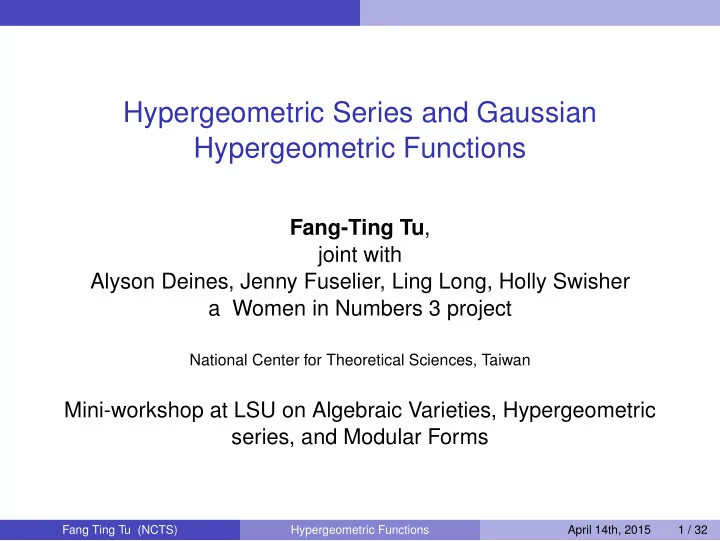
Hypergeometric Series and Gaussian Hypergeometric Functions

Fang-Ting Tu, joint with Alyson Deines, Jenny Fuselier, Ling Long, Holly Swisher a Women in Numbers 3 project

National Center for Theoretical Sciences, Taiwan

Mini-workshop at LSU on Algebraic Varieties, Hypergeometric series, and Modular Forms

Fang Ting Tu (NCTS) Hypergeometric Functions April 14th, 2015 1 / 32

slide-2
SLIDE 2

Introduction

2F1-Hypergeometric Series/Functoins

2F1-Hypergeometric Series

  • Let a, b, c ∈ R. The hypergeometric function 2F1
  • a

b c; z

  • is

defined by

2F1

  • a

b c; z

  • =

  • n=0

(a)n(b)n (c)nn! zn, where (a)n = a(a + 1) . . . (a + n − 1) is the Pochhammer symbol.

  • Euler’s integral representation of the 2F1 with c > b > 0

2F1

  • a, b

c ; λ

  • =

1 B(b, c − b) 1 xb−1(1 − x)c−b−1(1 − λx)−adx, where B(a, b) = 1 xa−1(1 − x)b−1dx = Γ(a)Γ(b) Γ(a + b) is the Beta function.

Fang Ting Tu (NCTS) Hypergeometric Functions April 14th, 2015 2 / 32

slide-3
SLIDE 3

Introduction

2F1-Hypergeometric Series/Functoins

Hypergeometric Functions over Finite Fields

Let q = ps be a prime power. Let F×

q denote the group of multiplicative

characters on F×

q . Extend χ ∈

q to Fq by setting χ(0) = 0.

Gaussian Hypergeometric Function. (Greene, 1984) Let λ ∈ Fq,

and A, B, C ∈ F×

q .

  • 2F1

A B C ; λ

  • q

:= ε(λ)BC(−1) q

  • x∈Fq

B(x)BC(1 − x)A(1 − λx), where ε is the trivial character.

  • 2F1

A B C ; λ

  • q

:= q q − 1

  • χ∈

q

Aχ χ Bχ Cχ

  • χ(λ),

where A B

  • := B(−1)

q J(A, B) is the normalized Jacobi sum of A, B.

Fang Ting Tu (NCTS) Hypergeometric Functions April 14th, 2015 3 / 32

slide-4
SLIDE 4

Introduction

2F1-Hypergeometric Series/Functoins

Legendre Family

For λ = 0, 1, let Eλ : y2 = x(x − 1)(x − λ) be the elliptic curve in Legendre normal form.

  • The periods of the Legendre family of elliptic curves are

Ω(Eλ) = ∞

1

dx

  • x(x − 1)(x − λ)
  • If 0 < λ < 1, then

2F1

1

2 1 2

1; λ

  • = Ω(Eλ)

π . If λ ∈ Q, and Eλ has good reduction at prime p, we can express #Eλ(Fp) in terms of Gaussian hypergeometric functions.

Fang Ting Tu (NCTS) Hypergeometric Functions April 14th, 2015 4 / 32

slide-5
SLIDE 5

Introduction

2F1-Hypergeometric Series/Functoins

Legendre Family over Finite Fields

Legendre family of elliptic curves over Fp:

  • Eλ : y2 = x(x − 1)(x − λ)

Trace of Frobenius: ap(λ) = p + 1 − # Eλ(Fp), λ = 0, 1

Koike 1992.

If p is an odd prime, then p 2F1

  • η2

η2 ε ; λ

  • p

= −η2(−1)ap(λ), λ = 0, 1, where ε is the trivial character and η2 is the quadratic character.

Fang Ting Tu (NCTS) Hypergeometric Functions April 14th, 2015 5 / 32

slide-6
SLIDE 6

Introduction

2F1-Hypergeometric Series/Functoins

Eλ : y2 = x(x − 1)(x − λ), λ ∈ Q − {0, 1}.

  • If 0 < λ < 1, then

2F1

1

2 1 2

1; λ

  • = Ω(Eλ)

π = Ω(Eλ) Γ( 1

2)2 .

  • If p is an odd prime with ordp(λ(λ − 1)) = 0, then

2F1

  • η2

η2 ε ; λ

  • p

= − ap (λ) pη2(−1) = −ap (λ) g(η2)2 .

  • If λ = 1

2, p ≡ 1 mod 4, we have

√ 2 2π Ω(Eλ) = Re 1/4 1/2

  • ,

−η2(2) 2p ap(λ) = Re η4 η2

  • ,

where η4 is a character of order 4.

Fang Ting Tu (NCTS) Hypergeometric Functions April 14th, 2015 6 / 32

slide-7
SLIDE 7

Introduction

2F1-Hypergeometric Series/Functoins

For m ∈ Z+, define the truncated 2F1-hypergeometric series by

2F1

  • a

b c ; λ

  • m

:=

m

  • k=0

(a)k(b)k (ck)k! λk. When ap(λ) is not divisible by p, Dwork shows that fp(λ) := lim

s→∞ 2F1

1

2 1 2

1 ; ˆ λ

  • ps−1
  • 2F1

1

2 1 2

1 ; ˆ λ

  • ps−1−1

is the unit root of T 2 − ap(λ)T + p, where ˆ λ is the image of λ under the Teichmüller character.

  • Example. When λ = −1, p ≡ 1 (mod 4),
  • −ap(−1) = p · 2F1

η2 η2 ε ; −1

  • p

= J(η4, η2) + J(η4, η2).

  • fp(λ) =

Γp( 1

2)Γp( 1 4)

Γp( 3

4)

, where Γp(·) is the p-adic Gamma function.

Fang Ting Tu (NCTS) Hypergeometric Functions April 14th, 2015 7 / 32

slide-8
SLIDE 8

Introduction

2F1-Hypergeometric Series/Functoins

Motivations

hypergeometric series ← → periods Gaussian hypergeometric series ← → Golais representations truncated hypergeometric series ← → unit roots Motivation Investigate the relationships among hypergeometric series, truncated hypergeometric series, and Gaussian hypergeometric functions through some families of hypergeometric algebraic varieties.

  • yN = xi(1 − x)j(1 − λx)k
  • yn = (x1x2 · · · xn−1)n−1(1 − x1) · · · (1 − xn−1)(x1 − λx2x3 · · · xn−1)

Fang Ting Tu (NCTS) Hypergeometric Functions April 14th, 2015 8 / 32

slide-9
SLIDE 9

Introduction

2F1-Hypergeometric Series/Functoins

Generalized Legendre Curves

Let N ≥ 2, and i, j, k be natural numbers with 1 ≤ i, j, k < N. For the smooth model Xλ of the curve Cλ : yN = xi(1 − x)j(1 − λx)k, λ ∈ Q − {0, 1}

  • a period can be chosen as

P(λ) = B

  • 1 − i

N , 1 − j N

  • 2F1

k

N N−i N 2N−i−j N

; λ

  • ,
  • Let η ∈

q be a character of order N. Then

#Xλ(Fq)” = ”1 + q + q

N−1

  • m=1

ηmj(−1) 2F1 η−km ηim ηm(i+j) ; λ

  • q

.

Fang Ting Tu (NCTS) Hypergeometric Functions April 14th, 2015 9 / 32

slide-10
SLIDE 10

Main Results Generalized Hypergeometric Series/Functions

Generalized Hypergeometric Series/Functions

  • For a positive integer n, and αi, βi ∈ C with βi ∈ Z−, the

hypergeometric series n+1Fn is defined by

n+1Fn

  • α0

α1 . . . αn β1 . . . βn ; λ

  • :=

  • k=0

(α0)k (1)k

n

  • i=1

(αi)k (βi)k · λk where (a)0 := 1, (1)k = k!, and (a)k := a(a + 1) · · · (a + k − 1).

  • If n is a positive integer, and Ai, Bi ∈

q , then n+1Fn

A0 A1 . . . An B1 . . . Bn; λ

  • q

:= q q − 1

  • χ∈

q

A0χ χ

  • n
  • i=1

Aiχ Biχ

  • χ(λ).

Fang Ting Tu (NCTS) Hypergeometric Functions April 14th, 2015 10 / 32

slide-11
SLIDE 11

Main Results Generalized Hypergeometric Series/Functions

Euler’s Integral Formulae

When Re(βr) > Re(αr) > 0,

n+1Fn

  • α0

α1 . . . αn β1 . . . βn ; λ

  • =

Γ(βn) Γ(αn)Γ(βn − αn) 1 xαn−1(1−x)βn−αn−1 nFn−1

  • α0

α1 . . . αn−1 β1 . . . βn−1 ; λx

  • dx

For characters A0, A1, . . . , An, B1, . . . , Bn in F×

q , n+1Fn

A0, A1, . . . , An B1, . . . , Bn; λ

  • q

= AnBn(−1) q ·

  • x

An(x)AnBn(1−x)·nFn−1 A0, A1, . . . , An−1 B1, . . . , Bn−1; λx

  • q

.

Fang Ting Tu (NCTS) Hypergeometric Functions April 14th, 2015 11 / 32

slide-12
SLIDE 12

Main Results Generalized Hypergeometric Series/Functions

Higher Dimensional Analogues of Legendre Curves

Cn,λ : yn = (x1x2 · · · xn−1)n−1(1−x1) · · · (1−xn−1)(x1−λx2x3 · · · xn−1)

  • C2,λ are known as Legendre curves.
  • Up to a scalar multiple, nFn−1

j

n j n

· · ·

j n

1 · · · 1 ; λ

  • for any

1 ≤ j ≤ n − 1, when convergent, can be realized as a period of Cn,λ. Theorem (Deines, Long, Fuselier, Swisher, T.) Let q = pe ≡ 1 (mod n) be a prime power. Let ηn be a primitive order n character and ε the trivial multiplicative character in F×

q . Then

#Cn,λ(Fq) = 1 + qn−1 + qn−1

n−1

  • i=1

nFn−1

ηi

n,

ηi

n,

· · · , ηi

n,

ε, · · · , ε, ; λ

  • q

.

Fang Ting Tu (NCTS) Hypergeometric Functions April 14th, 2015 12 / 32

slide-13
SLIDE 13

Main Results Generalized Hypergeometric Series/Functions

Local L-functions of C3,1 and C4,1

Theorem (Deines, Long, Fuselier, Swisher, T.) Let η2, η3, and η4 denote characters of order 2, 3, or 4, respectively, in

q .

  • Let q ≡ 1 (mod 3) be a prime power. Then

q2 · 3F2 η3, η3, η3 ε, ε ; 1

  • q

= J(η3, η3)2 − J(η2

3, η2 3).

  • Let q ≡ 1 (mod 4) be a prime power. Then

q3· 4F3 η4, η4, η4, η4 ε, ε, ε ; 1

  • q

= J(η4, η2)3+qJ(η4, η2)−J(η4, η2)2.

Fang Ting Tu (NCTS) Hypergeometric Functions April 14th, 2015 13 / 32

slide-14
SLIDE 14

Main Results Generalized Hypergeometric Series/Functions

Ahlgren-Ono. For any odd prime p,

p3 · 4F3 η2

4,

η2

4,

η2

4,

η2

4

ε, ε, ε ; 1

  • p

= −a(p) − p, where a(p) is the pth coefficient of the weight-4 Hecke eigenform η(2z)4η(4z)4, with η(z) being the Dedekind eta function. The factor of ZC4,1 corresponding to y2 = (x1x2x3)3(1 − x1)(1 − x2)(1 − x3)(x1 − x2x3) is ZCold

4,1(T, p) = (1 − a(p)T + p3T 2)(1 − pT)

(1 − T)(1 − p3T) .

Fang Ting Tu (NCTS) Hypergeometric Functions April 14th, 2015 14 / 32

slide-15
SLIDE 15

Main Results Generalized Hypergeometric Series/Functions

  • q3· 4F3

η4, η4, η4, η4 ε, ε, ε ; 1

  • q

= J(η4, η2)3+qJ(η4, η2)−J(η4, η2)2

  • Hasse-Davenport relation.

Let F be a finite field and Fs an extension field over F of degree s. If χ = ε ∈ F × and χs = χ ◦ NFs/F a character of Fs. Then (−g(χ))s = −g(χs). The factor corresponding to new part is (1 + (β3

p + β 3 p)T + p3T 2) (1 + (βp + βp)pT + p3T 2)

(1 − (β2

p + β 2 p)T + p2T 2),

where βp = J(η4, η2).

Fang Ting Tu (NCTS) Hypergeometric Functions April 14th, 2015 15 / 32

slide-16
SLIDE 16

Main Results Generalized Hypergeometric Series/Functions

Galois Representation corresponding to ZCnew

4,1 (T, p)

The Jacobi sum J(η4, η2) can be viewed as the Hecke (or Grössencharacter) character ψ of GQ(

√ −1), which is corresponding to

the elliptic curve with complex multiplication which has conductor 64. By class field theory, ψ corresponds to a character χ of GQ(

√ −1). For

each Frobenius class Frobq ∈ GQ(

√ −1) with q ≡ 1 (mod 4),

−q3 ·

  • i=1,3

4F3

ηi

4,

ηi

4,

η4i, ηi

4

ε, ε, ε ; 1

  • q

coincides with the trace of Frobp under the 6-dimensional semisimple representation ρ := IndGQ

GQ(√−1)

  • χ3 ⊕ (χ2 ⊗ χ) ⊕ χ2

.

Fang Ting Tu (NCTS) Hypergeometric Functions April 14th, 2015 16 / 32

slide-17
SLIDE 17

Main Results Truncated Hypergeometric Series

For m ∈ Z+, define

n+1Fn

  • α0

α1 . . . αn β1 . . . βn ; λ

  • m

:=

m

  • k=0

(α0)k (1)k

n

  • i=1

(αi)k (βi)k · λk. Theorem (Deines, Long, Fuselier, Swisher, T.) For each prime p ≡ 1 (mod 4),

4F3

1

4 1 4 1 4 1 4

1 1 1 ; 1

  • p−1

≡ (−1)

p−1 4 Γp

1 2

  • Γp

1 4 6 (mod p4).

Kilbourn.

4F3

1

2 1 2 1 2 1 2

1 1 1 ; 1

  • p−1

≡ a(p) (mod p3).

Fang Ting Tu (NCTS) Hypergeometric Functions April 14th, 2015 17 / 32

slide-18
SLIDE 18

Main Results Truncated Hypergeometric Series

  • Lemma. Let r, n, j be positive integers with 1 ≤ j < n. Let p ≡ 1

(mod n) be prime and ηn ∈ F×

p such that ηn(x) ≡ xj(p−1)/n (mod p) for

each x ∈ Fp. Then, pr−1 · rFr−1 ηn, ηn, · · · , ηn ε, · · · , ε ; x

  • p

≡ (−1)r+1 · rFr−1 n−j

n n−j n

· · ·

n−j n

1 · · · 1 ; 1 x

  • (p−1)( n−j

n )

+ (−1)r+1+ (p−1)

n

jr

x(p−1) n−j

n − x p−1 n j

(mod p); We have similar result for pr−1 · rFr−1 ηn, ηn, · · · , ηn ε, · · · , ε ; x

  • p

Fang Ting Tu (NCTS) Hypergeometric Functions April 14th, 2015 18 / 32

slide-19
SLIDE 19

Main Results Truncated Hypergeometric Series

Theorem (Deines, Long, Fuselier, Swisher, T.) For n ≥ 3, and p ≡ 1 (mod n) prime,

nFn−1

n−1

n n−1 n

. . .

n−1 n

1 . . . 1 ; 1

  • p−1

=

p−1

  • k=0

1−n

n

k n (−1)kn ≡ −Γp 1 n n (mod p2).

Conjecture.

Let n ≥ 3 be a positive integer, and p be prime such that p ≡ 1 (mod n). Then

nFn−1

n−1

n n−1 n

. . .

n−1 n

1 . . . 1 ; 1

  • p−1

≡ −Γp 1 n n (mod p3).

Fang Ting Tu (NCTS) Hypergeometric Functions April 14th, 2015 19 / 32

slide-20
SLIDE 20

Ideas and Proofs Gross-Koblitz Formula

p-adic Gamma Functions

Assume p is an odd prime.

  • Morita. The p-adic Gamma function Γp : Zp −

→ Z×

p is the unique

continuous function characterized by Γp(n) = (−1)n

  • 0<i<n,p∤i

i, n ∈ Z+, and Γp(x) = lim

n→x Γp(n), x ∈ Zp.

Proposition.

  • Γp(0) = 1
  • Γp(x + 1)/Γp(x) = −x unless x ∈ pZp in which case the quotient

takes value −1.

  • Γp(x)Γp(1 − x) = (−1)a0(x) where a0(x) ∈ {1, . . . , p} with

a0(x) ≡ x mod p.

Fang Ting Tu (NCTS) Hypergeometric Functions April 14th, 2015 20 / 32

slide-21
SLIDE 21

Ideas and Proofs Gross-Koblitz Formula

Gross-Koblitz Formula

Proposition.

  • Given p > 11, there exist G1(x), G2(x) ∈ Zp such that for any

m ∈ Zp, Γp(x + mp) ≡ Γp(x)

  • 1 + G1(x)mp + G2(x)(mp)2

2

  • (mod p3).
  • G1(x) = G1(1 − x) and G2(x) + G2(1 − x) = 2G1(x)2.

Gross-Koblitz Formula. Let ϕ : F×

p → Z× p be the Teichmüller

character such that ϕ(x) ≡ x (mod p). Then g

  • ϕ−j

= −πj

pΓp

  • j

p − 1

  • ,

where 0 ≤ j ≤ p − 2, and πp ∈ Cp is a root of xp−1 + p = 0.

Fang Ting Tu (NCTS) Hypergeometric Functions April 14th, 2015 21 / 32

slide-22
SLIDE 22

Ideas and Proofs Gross-Koblitz Formula

Example.

p · 2F1 η2, η2 ε ; −1

  • p

≡ −Γp 1

2

  • Γp

1

4

  • Γp

3

4

  • (mod p).

Proof. By the relations p· 2F1 η2, η2 ε ; −1

  • p

= J(η4, η2)+J(η4, η2) = g(η2)

  • g(η4)2 + g(η4)2

g(η4)g(η4) , using the Gross-Koblitz formula, we see that p · 2F1 η2, η2 ε ; −1

  • p

= −π

p−1 2

p

Γp 1

2

3 p−1

2

p

Γp 3

4

2 + π

p−1 2

p

Γp 1

4

2) πp−1

p

Γp 1

4

  • Γp

3

4

  • = −Γp

1

2

  • (−pΓp

3

4

2 + Γp 1

4

2) Γp 1

4

  • Γp

3

4

  • .

Fang Ting Tu (NCTS) Hypergeometric Functions April 14th, 2015 22 / 32

slide-23
SLIDE 23

Ideas and Proofs Proofs of Some Results

  • Proposition. For any prime p ≡ 1 (mod 4),

2F1

1

2 1 2

1 ; −1

  • p−1

2

≡ − Γp( 1

4)

Γp( 1

2)Γp( 3 4)

(mod p2).

  • Ideas. For any x1, x2, y ∈ Zp, we have

2F1

1

2 + x1p 1 2 + x2p

1 + yp ; −1

  • p−1

2

≡ 2F1 1

2 1 2

1 ; −1

  • p−1

2

+ (x1 + x2)Ap − yBp (mod p2) with A =

p−1 2

  • k=0
  • ( 1

2)2 k

k!2

  • · (−1)k2H(2)

k , and B =

p−1 2

  • k=0
  • ( 1

2)2 k

k!2

  • (−1)kHk,

where H(2)

k

:=

k

  • j=1

1 2j − 1 and Hk :=

k

  • j=1

1 j are harmonic sums.

Fang Ting Tu (NCTS) Hypergeometric Functions April 14th, 2015 23 / 32

slide-24
SLIDE 24

Ideas and Proofs Proofs of Some Results

Ideas.

  • 2F1
  • a

b a − b + 1 ; −1

  • = Γ(a−b+1)Γ(a/2+1)

Γ(a+1)Γ(a/2−b+1) = (a+1)−b (a/2+1)−b

  • When b = 1−p

2 , 2F1

1

2 1 2

1 ; −1

  • p−1

2

+ (x1 + x2)Ap − (x1 − x2)Bp ≡ 3

2 + x1p

  • −b

5

4 + x1p 2

  • −b

(mod p2), a quotient of Γp-values.

  • Γp(α + mp) ≡ Γp(α)[1 + G1(α)mp] (mod p2), and

G1(α) = G1(1 − α).

Fang Ting Tu (NCTS) Hypergeometric Functions April 14th, 2015 24 / 32

slide-25
SLIDE 25

Ideas and Proofs Proofs of Some Results

  • Example. If we let x1 = 1

2, x2 = − 1 2, ( b = 1−p 2 ), we have

3

2 + x1p

  • −b

5

4 + x1p 2

  • −b

=

  • 3+p

2

  • p−1

2

  • 5+p

4

  • p−1

2

= − Γp(p)Γp( 1

4 + p 4)

Γp( 1

2 + p 2)Γp( 3 4 + 3p 4 )

. Thus, − Γp(p)Γp( 1

4 + p 4)

Γp( 1

2 + p 2)Γp( 3 4 + 3p 4 )

≡ − Γp( 1

4)

Γp( 1

2)Γp( 3 4)

  • 1 + G1(0)p − G1

1 2 p 2 − G1 1 4 p 2

  • (mod p2),

2F1

1

2 1 2

1 ; −1

  • p−1

2

− Bp ≡ − Γp( 1

4)

Γp( 1

2)Γp( 3 4)

  • 1 + G1(0)p − G1

1 2 p 2 − G1 1 4 p 2

  • (mod p2).

Fang Ting Tu (NCTS) Hypergeometric Functions April 14th, 2015 25 / 32

slide-26
SLIDE 26

Ideas and Proofs Proofs of Some Results

Theorem.

n+1Fn

n−1

n n−1 n

. . .

n−1 n

1 . . . 1 ; 1

  • p−1

≡ −Γp 1 n n (mod p2).

  • Idea. Use the special case of Karlsson–Minton formula:

n+1Fn

  • 1 − p

1 + m + yp 1 + m · · · 1 + m 1 + yp 1 · · · 1 ; 1

  • = (−1)p−1(p − 1)!

(1 + yp)m(m!)n−1 = (p − 1)! (1 + yp)m(m!)n−1 .

Fang Ting Tu (NCTS) Hypergeometric Functions April 14th, 2015 26 / 32

slide-27
SLIDE 27

Ideas and Proofs Proofs of Some Results

  • Theorem. For each prime p ≡ 1 (mod 4),

4F3

1

4 1 4 1 4 1 4

1 1 1 ; 1

  • p−1

≡ (−1)

p−1 4 Γp

1 2

  • Γp

1 4 6 (mod p4).

Dougall.

7F6

  • a

a/2 + 1 b c d e −m a/2 1 + a − b 1 + a − c 1 + a − d 1 + a − e 1 + a + m ; 1

  • = (1 + a)m(1 + a − b − c)m(1 + a − b − d)m(1 + a − c − d)m

(1 + a − b)m(1 + a − c)m(1 + a − d)m(1 + a − b − c − d)m . Put a = 1/4, b = 5/8, c = 1/8, d = (1 + pu)/4, e = (1 + (1 − u)p)/4, m = (p − 1)/4).

Fang Ting Tu (NCTS) Hypergeometric Functions April 14th, 2015 27 / 32

slide-28
SLIDE 28

Ideas and Proofs Proofs of Some Results

  • Theorem. For each prime p ≡ 1 (mod 5),

5F4

2

5 2 5 2 5 2 5 2 5

1 1 1 1 ; 1

  • p−1

≡ − Γp 1 5 5 Γp 2 5 5 (mod p4).

Conjecture.

5F4

2

5 2 5 2 5 2 5 2 5

1 1 1 1 ; 1

  • p−1

?

≡ −Γp 1 5 5 Γp 2 5 5 (mod p5).

Fang Ting Tu (NCTS) Hypergeometric Functions April 14th, 2015 28 / 32

slide-29
SLIDE 29

Ideas and Proofs Proofs of Some Results

  • Theorem. Let q ≡ 1 (mod 4) be a prime power. Then

q3 · 4F3 η4, η4, η4, η4 ε, ε, ε ; 1

  • q

= J(η4, η2)3 + qJ(η4, η2) − J(η4, η2)2.

  • McCarthy. For characters A0, A1, . . . , An, B1, . . . , Bn in

q , we define n+1Fn

A0, A1, . . . , An B1, . . . , Bn; x ∗

q

:= 1 q − 1

  • χ∈

q

n

  • i=0

g(Aiχ) g(Ai)

n

  • j=1

g(Bjχ) g(Bj) g(χ)χ(−1)n+1χ(x). If A0 = ε and Ai = Bi for each 1 ≤ i ≤ n, then

n+1Fn

A0, A1, . . . , An B1, . . . , Bn; x

  • q

= n

  • i=1

Ai Bi

  • n+1Fn

A0, A1, . . . , An B1, . . . , Bn; x ∗

q

.

Fang Ting Tu (NCTS) Hypergeometric Functions April 14th, 2015 29 / 32

slide-30
SLIDE 30

Ideas and Proofs Proofs of Some Results

  • McCarthy. For A, B, C, D, E ∈

q such that, when A is a square,

A = ε, B = ε, B2 = A, CD = A, CE = A, DE = A, and CDE = A,

5F4

A, B, C, D, E AB, AC, AD AE; 1 ∗

q

= g(A)g(ADE)g(ACD)g(ACE) g(AC)g(AD)g(AE)g(ACDE)

  • R2=A

4F3

RB, C, D, E R ACDE, AB; 1 ∗

q

+ g(ADE)g(ACD)g(ACE)q g(C)g(D)g(E)g(AC)g(AD)g(AE)

2F1

A, B AB; −1 ∗

q

  • Whipple. If one of 1 + 1

2a − b, c, d, e is a negative integer, then

5F4

  • a

b c d e 1 + a − b 1 + a − c 1 + a − d 1 + a − e ; 1

  • =

Γ(1 + a − c)Γ(1 + a − d)Γ(1 + a − e)Γ(1 + a − c − d − e) Γ(1 + a)Γ(1 + a − d − e)Γ(1 + a − c − d)Γ(1 + a − c − e) · 4F3

  • 1 + 1

2 a − b

c d e 1 + 1

2 a

c + d + e − a 1 + a − b ; 1

  • .

Fang Ting Tu (NCTS) Hypergeometric Functions April 14th, 2015 30 / 32

slide-31
SLIDE 31

Ideas and Proofs Proofs of Some Results

Lemma.

  • Let q = pe ≡ 1 (mod 8) be a prime power, and η8 a character of
  • rder 8 in

q with η2 8 = η4 . Then

q4 · 4F3 η4, η4, η4, η4 ε, ε, ε ; 1

  • q

= J(η8, η8)4 − q · 5F4 η4, η4, η4, η4, η8 ε, ε, ε, η8; 1 ∗

q

.

  • Let q = pe ≡ 1 (mod 8) be a prime power. Then

5F4

η4, η4, η4, η4, η8 ε, ε, ε, η8; 1 ∗

q

= J(η8, η8)4 q − qJ(η4, η2) − J(η2, η4)3 + J(η2, η4)2.

Fang Ting Tu (NCTS) Hypergeometric Functions April 14th, 2015 31 / 32

slide-32
SLIDE 32

Observations

Some Conjectures

  • For any integer n > 1 and prime p ≡ 1 (mod n),

3F2

1

n 1 n n−1 n

1 1 ; 1

  • p−1

≡ ap(fn(z)) (mod p2), where ap(fn(z)) is the pth coefficient of fn(z) =

n

  • E1(z)n−1E2(z)

when expanded in terms of the local uniformizer e2πiz/5n, and E1(z) and E2(z) are two explicit level 5 weight-3 noncongruence Eisenstein series with coefficients in Z.

  • For an integer n > 2, and any prime p ≡ 1 (mod n),

p−1

  • k=0
  • k!p

1

n + 1

  • k

n ≡

p−1

  • k= (p−1)

n

  • k!p

1

n + 1

  • k

n

?

≡ −Γp 1 n n (mod p3).

Fang Ting Tu (NCTS) Hypergeometric Functions April 14th, 2015 32 / 32