
Inference in Bayesian networks
Chapter 14.4–5
Chapter 14.4–5 1Outline
♦ Exact inference by enumeration ♦ Exact inference by variable elimination ♦ Approximate inference by stochastic simulation ♦ Approximate inference by Markov chain Monte Carlo
Chapter 14.4–5 2Inference tasks
Simple queries: compute posterior marginal P(Xi|E = e) e.g., P(NoGas|Gauge = empty, Lights = on, Starts = false) Conjunctive queries: P(Xi, Xj|E = e) = P(Xi|E = e)P(Xj|Xi, E = e) Optimal decisions: decision networks include utility information; probabilistic inference required for P(outcome|action, evidence) Value of information: which evidence to seek next? Sensitivity analysis: which probability values are most critical? Explanation: why do I need a new starter motor?
Chapter 14.4–5 3Inference by enumeration
Slightly intelligent way to sum out variables from the joint without actually constructing its explicit representation Simple query on the burglary network:
B E J A M
P(B|j, m) = P(B, j, m)/P(j, m) = αP(B, j, m) = α Σe Σa P(B, e, a, j, m) Rewrite full joint entries using product of CPT entries: P(B|j, m) = α Σe Σa P(B)P(e)P(a|B, e)P(j|a)P(m|a) = αP(B) Σe P(e) Σa P(a|B, e)P(j|a)P(m|a) Recursive depth-first enumeration: O(n) space, O(dn) time
Chapter 14.4–5 4Enumeration algorithm
function Enumeration-Ask(X,e,bn) returns a distribution over X inputs: X, the query variable e, observed values for variables E bn, a Bayesian network with variables {X} ∪ E ∪ Y Q(X ) ← a distribution over X, initially empty for each value xi of X do extend e with value xi for X Q(xi) ← Enumerate-All(Vars[bn],e) return Normalize(Q(X )) function Enumerate-All(vars,e) returns a real number if Empty?(vars) then return 1.0 Y ← First(vars) if Y has value y in e then return P(y | Pa(Y )) × Enumerate-All(Rest(vars),e) else return
- y P(y | Pa(Y )) × Enumerate-All(Rest(vars),ey)
where ey is e extended with Y = y
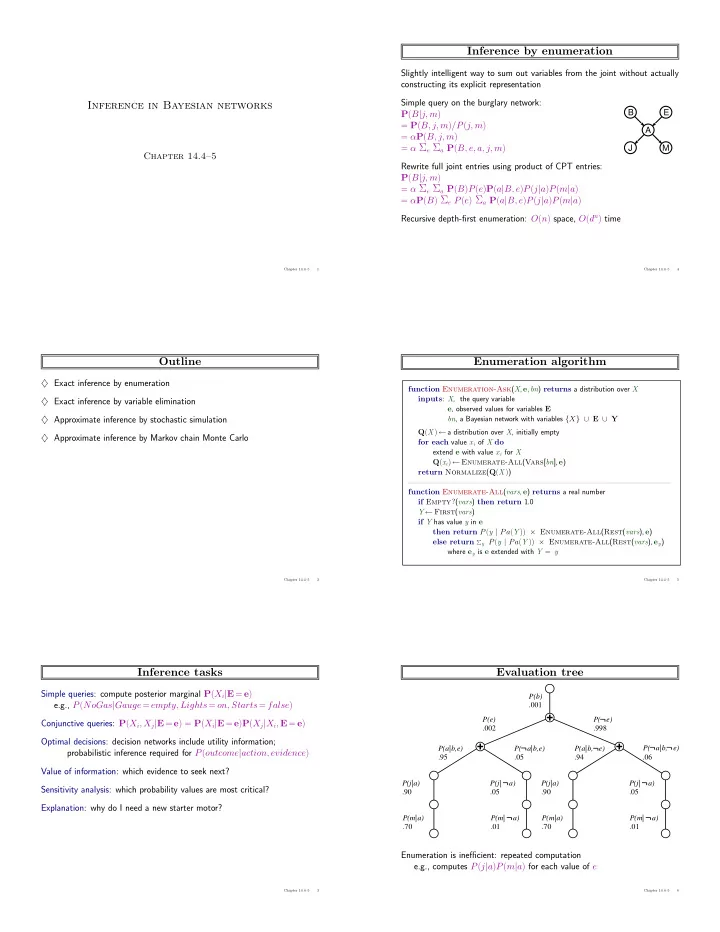
Chapter 14.4–5 5Evaluation tree
P(j|a) .90 P(m|a) .70 .01 P(m| a) .05 P(j| a) P(j|a) .90 P(m|a) .70 .01 P(m| a) .05 P(j| a) P(b) .001 P(e) .002 P( e) .998 P(a|b,e) .95 .06 P( a|b, e) .05 P( a|b,e) .94 P(a|b, e)
Enumeration is inefficient: repeated computation e.g., computes P(j|a)P(m|a) for each value of e
Chapter 14.4–5 6