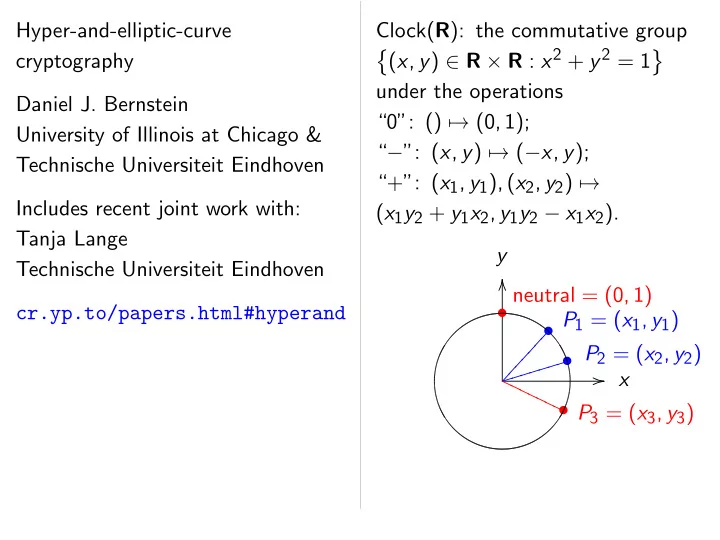
SLIDE 1 Hyper-and-elliptic-curve cryptography Daniel J. Bernstein University of Illinois at Chicago & Technische Universiteit Eindhoven Includes recent joint work with: Tanja Lange Technische Universiteit Eindhoven cr.yp.to/papers.html#hyperand Clock(R): the commutative group ˘ (x; y) ∈ R × R : x2 + y2 = 1 ¯ under the operations “0”: () → (0; 1); “−”: (x; y) → (−x; y); “+”: (x1; y1); (x2; y2) → (x1y2 + y1x2; y1y2 − x1x2). y x
- neutral = (0; 1)
- P1 = (x1; y1)
- ✂
✂ ✂ ✂ ✂ ✂ ✂ P2 = (x2; y2)
✐ ✐ ✐ ✐ ✐ ✐ P3 = (x3; y3)
P P P P P P
SLIDE 2 er-and-elliptic-curve cryptography
University of Illinois at Chicago & echnische Universiteit Eindhoven Includes recent joint work with: Lange echnische Universiteit Eindhoven cr.yp.to/papers.html#hyperand Clock(R): the commutative group ˘ (x; y) ∈ R × R : x2 + y2 = 1 ¯ under the operations “0”: () → (0; 1); “−”: (x; y) → (−x; y); “+”: (x1; y1); (x2; y2) → (x1y2 + y1x2; y1y2 − x1x2). y x
- neutral = (0; 1)
- P1 = (x1; y1)
- ✂
✂ ✂ ✂ ✂ ✂ ✂ P2 = (x2; y2)
✐ ✐ ✐ ✐ ✐ ✐ P3 = (x3; y3)
P P P P P P More clo “A parametrize t → (sin is a group inducing
SLIDE 3 er-and-elliptic-curve Bernstein Illinois at Chicago & Universiteit Eindhoven joint work with: Universiteit Eindhoven cr.yp.to/papers.html#hyperand Clock(R): the commutative group ˘ (x; y) ∈ R × R : x2 + y2 = 1 ¯ under the operations “0”: () → (0; 1); “−”: (x; y) → (−x; y); “+”: (x1; y1); (x2; y2) → (x1y2 + y1x2; y1y2 − x1x2). y x
- neutral = (0; 1)
- P1 = (x1; y1)
- ✂
✂ ✂ ✂ ✂ ✂ ✂ P2 = (x2; y2)
✐ ✐ ✐ ✐ ✐ ✐ P3 = (x3; y3)
P P P P P P More clock perspectives: “A parametrized clo t → (sin t; cos t) is a group hom R inducing R=2ıZ , ։
SLIDE 4 Chicago & Eindhoven with: Eindhoven cr.yp.to/papers.html#hyperand Clock(R): the commutative group ˘ (x; y) ∈ R × R : x2 + y2 = 1 ¯ under the operations “0”: () → (0; 1); “−”: (x; y) → (−x; y); “+”: (x1; y1); (x2; y2) → (x1y2 + y1x2; y1y2 − x1x2). y x
- neutral = (0; 1)
- P1 = (x1; y1)
- ✂
✂ ✂ ✂ ✂ ✂ ✂ P2 = (x2; y2)
✐ ✐ ✐ ✐ ✐ ✐ P3 = (x3; y3)
P P P P P P More clock perspectives: “A parametrized clock”: t → (sin t; cos t) is a group hom R ։ Clock(R inducing R=2ıZ , ։ Clock(R
SLIDE 5 Clock(R): the commutative group ˘ (x; y) ∈ R × R : x2 + y2 = 1 ¯ under the operations “0”: () → (0; 1); “−”: (x; y) → (−x; y); “+”: (x1; y1); (x2; y2) → (x1y2 + y1x2; y1y2 − x1x2). y x
- neutral = (0; 1)
- P1 = (x1; y1)
- ✂
✂ ✂ ✂ ✂ ✂ ✂ P2 = (x2; y2)
✐ ✐ ✐ ✐ ✐ ✐ P3 = (x3; y3)
P P P P P P More clock perspectives: “A parametrized clock”: t → (sin t; cos t) is a group hom R ։ Clock(R) inducing R=2ıZ , ։ Clock(R).
SLIDE 6 Clock(R): the commutative group ˘ (x; y) ∈ R × R : x2 + y2 = 1 ¯ under the operations “0”: () → (0; 1); “−”: (x; y) → (−x; y); “+”: (x1; y1); (x2; y2) → (x1y2 + y1x2; y1y2 − x1x2). y x
- neutral = (0; 1)
- P1 = (x1; y1)
- ✂
✂ ✂ ✂ ✂ ✂ ✂ P2 = (x2; y2)
✐ ✐ ✐ ✐ ✐ ✐ P3 = (x3; y3)
P P P P P P More clock perspectives: “A parametrized clock”: t → (sin t; cos t) is a group hom R ։ Clock(R) inducing R=2ıZ , ։ Clock(R). “Complex numbers of norm 1”: {u ∈ C : uu = 1} is a group under 1; u → u; u1; u2 → u1u2. (x; y) → y + ix is a group hom Clock(R) , ։ {u ∈ C : uu = 1}.
SLIDE 7 Clock(R): the commutative group ˘ (x; y) ∈ R × R : x2 + y2 = 1 ¯ under the operations “0”: () → (0; 1); “−”: (x; y) → (−x; y); “+”: (x1; y1); (x2; y2) → (x1y2 + y1x2; y1y2 − x1x2). y x
- neutral = (0; 1)
- P1 = (x1; y1)
- ✂
✂ ✂ ✂ ✂ ✂ ✂ P2 = (x2; y2)
✐ ✐ ✐ ✐ ✐ ✐ P3 = (x3; y3)
P P P P P P More clock perspectives: “A parametrized clock”: t → (sin t; cos t) is a group hom R ։ Clock(R) inducing R=2ıZ , ։ Clock(R). “Complex numbers of norm 1”: {u ∈ C : uu = 1} is a group under 1; u → u; u1; u2 → u1u2. (x; y) → y + ix is a group hom Clock(R) , ։ {u ∈ C : uu = 1}. “2-dimensional rotations”: (x; y) → “ y
x −x y
” is a group hom Clock(R) , ։ SO2(R).
SLIDE 8 R): the commutative group ) ∈ R × R : x2 + y2 = 1 ¯ the operations () → (0; 1); (x; y) → (−x; y); (x1; y1); (x2; y2) → + y1x2; y1y2 − x1x2). y x
- neutral = (0; 1)
- P1 = (x1; y1)
- ✂
✂ ✂ ✂ ✂ ✂ ✂ P2 = (x2; y2)
✐ ✐ ✐ ✐ ✐ ✐ P3 = (x3; y3)
P P P P P P More clock perspectives: “A parametrized clock”: t → (sin t; cos t) is a group hom R ։ Clock(R) inducing R=2ıZ , ։ Clock(R). “Complex numbers of norm 1”: {u ∈ C : uu = 1} is a group under 1; u → u; u1; u2 → u1u2. (x; y) → y + ix is a group hom Clock(R) , ։ {u ∈ C : uu = 1}. “2-dimensional rotations”: (x; y) → “ y
x −x y
” is a group hom Clock(R) , ։ SO2(R). Clocks over Clock(F7 ˘ (x; y) ∈ Group op · · · · · · · Diagram −3; −2; −
SLIDE 9 commutative group : x2 + y2 = 1 ¯ erations 1); −x; y);
2; y2) →
y2 − x1x2). x
P1 = (x1; y1)
✂ P2 = (x2; y2)
✐ ✐ ✐ P3 = (x3; y3)
P P More clock perspectives: “A parametrized clock”: t → (sin t; cos t) is a group hom R ։ Clock(R) inducing R=2ıZ , ։ Clock(R). “Complex numbers of norm 1”: {u ∈ C : uu = 1} is a group under 1; u → u; u1; u2 → u1u2. (x; y) → y + ix is a group hom Clock(R) , ։ {u ∈ C : uu = 1}. “2-dimensional rotations”: (x; y) → “ y
x −x y
” is a group hom Clock(R) , ։ SO2(R). Clocks over finite fields Clock(F7) = ˘ (x; y) ∈ F7 × F7 Group operations as · · · · · · · · · · · · · · · · · · · · · · · · · · · ·
−3; −2; −1; 0; 1; 2;
SLIDE 10 commutative group = 1 ¯ ). x (0; 1) (x1; y1) = (x2; y2) (x3; y3) More clock perspectives: “A parametrized clock”: t → (sin t; cos t) is a group hom R ։ Clock(R) inducing R=2ıZ , ։ Clock(R). “Complex numbers of norm 1”: {u ∈ C : uu = 1} is a group under 1; u → u; u1; u2 → u1u2. (x; y) → y + ix is a group hom Clock(R) , ։ {u ∈ C : uu = 1}. “2-dimensional rotations”: (x; y) → “ y
x −x y
” is a group hom Clock(R) , ։ SO2(R). Clocks over finite fields Clock(F7) = ˘ (x; y) ∈ F7 × F7 : x2 + y2 Group operations as before. · · · · · · · · · · · · · · · · · · · · · · · · · · · · · · · · · · · · · · · · · · · · · · · · ·
−3; −2; −1; 0; 1; 2; 3.
SLIDE 11 More clock perspectives: “A parametrized clock”: t → (sin t; cos t) is a group hom R ։ Clock(R) inducing R=2ıZ , ։ Clock(R). “Complex numbers of norm 1”: {u ∈ C : uu = 1} is a group under 1; u → u; u1; u2 → u1u2. (x; y) → y + ix is a group hom Clock(R) , ։ {u ∈ C : uu = 1}. “2-dimensional rotations”: (x; y) → “ y
x −x y
” is a group hom Clock(R) , ։ SO2(R). Clocks over finite fields Clock(F7) = ˘ (x; y) ∈ F7 × F7 : x2 + y2 = 1 ¯ . Group operations as before. · · · · · · · · · · · · · · · · · · · · · · · · · · · · · · · · · · · · · · · · · · · · · · · · ·
−3; −2; −1; 0; 1; 2; 3.
SLIDE 12 clock perspectives: rametrized clock”: (sin t; cos t) group hom R ։ Clock(R) inducing R=2ıZ , ։ Clock(R). “Complex numbers of norm 1”: : uu = 1} is a group under u; u1; u2 → u1u2. → y + ix is a group hom R) , ։ {u ∈ C : uu = 1}. “2-dimensional rotations”: → “ y
x −x y
” is a hom Clock(R) , ։ SO2(R). Clocks over finite fields Clock(F7) = ˘ (x; y) ∈ F7 × F7 : x2 + y2 = 1 ¯ . Group operations as before. · · · · · · · · · · · · · · · · · · · · · · · · · · · · · · · · · · · · · · · · · · · · · · · · ·
−3; −2; −1; 0; 1; 2; 3. Larger exa Examples in Clock( 2(1000; 2)
SLIDE 13 rspectives: clock”: R ։ Clock(R) , ։ Clock(R). ers of norm 1”: } is a group under → u1u2. is a group hom ∈ C : uu = 1}. rotations”: ” is a ck(R) , ։ SO2(R). Clocks over finite fields Clock(F7) = ˘ (x; y) ∈ F7 × F7 : x2 + y2 = 1 ¯ . Group operations as before. · · · · · · · · · · · · · · · · · · · · · · · · · · · · · · · · · · · · · · · · · · · · · · · · ·
−3; −2; −1; 0; 1; 2; 3. Larger example: Clo Examples of addition in Clock(F1000003): 2(1000; 2) = (4000
SLIDE 14 ck(R) ck(R). rm 1”: p under hom 1}. SO2(R). Clocks over finite fields Clock(F7) = ˘ (x; y) ∈ F7 × F7 : x2 + y2 = 1 ¯ . Group operations as before. · · · · · · · · · · · · · · · · · · · · · · · · · · · · · · · · · · · · · · · · · · · · · · · · ·
−3; −2; −1; 0; 1; 2; 3. Larger example: Clock(F1000003 Examples of addition in Clock(F1000003): 2(1000; 2) = (4000; 7).
SLIDE 15 Clocks over finite fields Clock(F7) = ˘ (x; y) ∈ F7 × F7 : x2 + y2 = 1 ¯ . Group operations as before. · · · · · · · · · · · · · · · · · · · · · · · · · · · · · · · · · · · · · · · · · · · · · · · · ·
−3; −2; −1; 0; 1; 2; 3. Larger example: Clock(F1000003). Examples of addition in Clock(F1000003): 2(1000; 2) = (4000; 7).
SLIDE 16 Clocks over finite fields Clock(F7) = ˘ (x; y) ∈ F7 × F7 : x2 + y2 = 1 ¯ . Group operations as before. · · · · · · · · · · · · · · · · · · · · · · · · · · · · · · · · · · · · · · · · · · · · · · · · ·
−3; −2; −1; 0; 1; 2; 3. Larger example: Clock(F1000003). Examples of addition in Clock(F1000003): 2(1000; 2) = (4000; 7). 4(1000; 2) = (56000; 97).
SLIDE 17 Clocks over finite fields Clock(F7) = ˘ (x; y) ∈ F7 × F7 : x2 + y2 = 1 ¯ . Group operations as before. · · · · · · · · · · · · · · · · · · · · · · · · · · · · · · · · · · · · · · · · · · · · · · · · ·
−3; −2; −1; 0; 1; 2; 3. Larger example: Clock(F1000003). Examples of addition in Clock(F1000003): 2(1000; 2) = (4000; 7). 4(1000; 2) = (56000; 97). 8(1000; 2) = (863970; 18817).
SLIDE 18 Clocks over finite fields Clock(F7) = ˘ (x; y) ∈ F7 × F7 : x2 + y2 = 1 ¯ . Group operations as before. · · · · · · · · · · · · · · · · · · · · · · · · · · · · · · · · · · · · · · · · · · · · · · · · ·
−3; −2; −1; 0; 1; 2; 3. Larger example: Clock(F1000003). Examples of addition in Clock(F1000003): 2(1000; 2) = (4000; 7). 4(1000; 2) = (56000; 97). 8(1000; 2) = (863970; 18817). 16(1000; 2) = (549438; 156853).
SLIDE 19 Clocks over finite fields Clock(F7) = ˘ (x; y) ∈ F7 × F7 : x2 + y2 = 1 ¯ . Group operations as before. · · · · · · · · · · · · · · · · · · · · · · · · · · · · · · · · · · · · · · · · · · · · · · · · ·
−3; −2; −1; 0; 1; 2; 3. Larger example: Clock(F1000003). Examples of addition in Clock(F1000003): 2(1000; 2) = (4000; 7). 4(1000; 2) = (56000; 97). 8(1000; 2) = (863970; 18817). 16(1000; 2) = (549438; 156853). 17(1000; 2) = (951405; 877356).
SLIDE 20 Clocks over finite fields Clock(F7) = ˘ (x; y) ∈ F7 × F7 : x2 + y2 = 1 ¯ . Group operations as before. · · · · · · · · · · · · · · · · · · · · · · · · · · · · · · · · · · · · · · · · · · · · · · · · ·
−3; −2; −1; 0; 1; 2; 3. Larger example: Clock(F1000003). Examples of addition in Clock(F1000003): 2(1000; 2) = (4000; 7). 4(1000; 2) = (56000; 97). 8(1000; 2) = (863970; 18817). 16(1000; 2) = (549438; 156853). 17(1000; 2) = (951405; 877356). “Scalar multiplication” maps Z × Clock(Fq) → Clock(Fq) by n; P → nP. We’ll build cryptography from scalar multiplication.
SLIDE 21
F7) = ) ∈ F7 × F7 : x2 + y2 = 1 ¯ .
· · · · · · · · · · · · · · · · · · · · · · · · · · · · · · · · · · · · · · · · · · · · · · · · ·
2; −1; 0; 1; 2; 3. Larger example: Clock(F1000003). Examples of addition in Clock(F1000003): 2(1000; 2) = (4000; 7). 4(1000; 2) = (56000; 97). 8(1000; 2) = (863970; 18817). 16(1000; 2) = (549438; 156853). 17(1000; 2) = (951405; 877356). “Scalar multiplication” maps Z × Clock(Fq) → Clock(Fq) by n; P → nP. We’ll build cryptography from scalar multiplication. A fast metho take 0 if negate ( double (n add P to else subtract
SLIDE 22 ite fields
7 : x2 + y2 = 1
¯ . erations as before. · · · · · · · · · · · · · · · · · · · · · · · · · · · ·
; 2; 3. Larger example: Clock(F1000003). Examples of addition in Clock(F1000003): 2(1000; 2) = (4000; 7). 4(1000; 2) = (56000; 97). 8(1000; 2) = (863970; 18817). 16(1000; 2) = (549438; 156853). 17(1000; 2) = (951405; 877356). “Scalar multiplication” maps Z × Clock(Fq) → Clock(Fq) by n; P → nP. We’ll build cryptography from scalar multiplication. A fast method to compute take 0 if n = 0; negate (−n)P if n double (n=2)P if n add P to (n − 1)P else subtract P from
SLIDE 23
2 = 1
¯ . e. · · · · · · · Larger example: Clock(F1000003). Examples of addition in Clock(F1000003): 2(1000; 2) = (4000; 7). 4(1000; 2) = (56000; 97). 8(1000; 2) = (863970; 18817). 16(1000; 2) = (549438; 156853). 17(1000; 2) = (951405; 877356). “Scalar multiplication” maps Z × Clock(Fq) → Clock(Fq) by n; P → nP. We’ll build cryptography from scalar multiplication. A fast method to compute n take 0 if n = 0; negate (−n)P if n < 0; double (n=2)P if n ∈ 2Z; add P to (n − 1)P if n − 1 ∈ else subtract P from (n + 1)
SLIDE 24
Larger example: Clock(F1000003). Examples of addition in Clock(F1000003): 2(1000; 2) = (4000; 7). 4(1000; 2) = (56000; 97). 8(1000; 2) = (863970; 18817). 16(1000; 2) = (549438; 156853). 17(1000; 2) = (951405; 877356). “Scalar multiplication” maps Z × Clock(Fq) → Clock(Fq) by n; P → nP. We’ll build cryptography from scalar multiplication. A fast method to compute nP: take 0 if n = 0; negate (−n)P if n < 0; double (n=2)P if n ∈ 2Z; add P to (n − 1)P if n − 1 ∈ 4Z; else subtract P from (n + 1)P.
SLIDE 25
Larger example: Clock(F1000003). Examples of addition in Clock(F1000003): 2(1000; 2) = (4000; 7). 4(1000; 2) = (56000; 97). 8(1000; 2) = (863970; 18817). 16(1000; 2) = (549438; 156853). 17(1000; 2) = (951405; 877356). “Scalar multiplication” maps Z × Clock(Fq) → Clock(Fq) by n; P → nP. We’ll build cryptography from scalar multiplication. A fast method to compute nP: take 0 if n = 0; negate (−n)P if n < 0; double (n=2)P if n ∈ 2Z; add P to (n − 1)P if n − 1 ∈ 4Z; else subtract P from (n + 1)P. But figuring out n given P and nP is much more difficult. 30 clock additions produce n(1000; 2) = (947472; 736284) for some 6-digit n. Can you figure out n?
SLIDE 26 example: Clock(F1000003). Examples of addition ck(F1000003): ; 2) = (4000; 7). ; 2) = (56000; 97). ; 2) = (863970; 18817). 16(1000; 2) = (549438; 156853). 17(1000; 2) = (951405; 877356). r multiplication” maps Clock(Fq) → Clock(Fq) → nP. build cryptography scalar multiplication. A fast method to compute nP: take 0 if n = 0; negate (−n)P if n < 0; double (n=2)P if n ∈ 2Z; add P to (n − 1)P if n − 1 ∈ 4Z; else subtract P from (n + 1)P. But figuring out n given P and nP is much more difficult. 30 clock additions produce n(1000; 2) = (947472; 736284) for some 6-digit n. Can you figure out n? Clock cryptography Standardize and (x; y
Alice cho Computes Bob cho Computes Alice computes Bob computes They use to encrypt
SLIDE 27 Clock(F1000003). addition
1000003):
(4000; 7). (56000; 97). (863970; 18817). (549438; 156853). (951405; 877356). multiplication” maps Clock(Fq) cryptography multiplication. A fast method to compute nP: take 0 if n = 0; negate (−n)P if n < 0; double (n=2)P if n ∈ 2Z; add P to (n − 1)P if n − 1 ∈ 4Z; else subtract P from (n + 1)P. But figuring out n given P and nP is much more difficult. 30 clock additions produce n(1000; 2) = (947472; 736284) for some 6-digit n. Can you figure out n? Clock cryptography Standardize odd prime and (x; y) ∈ Clock(
Alice chooses big secret Computes her public Bob chooses big secret Computes his public Alice computes a(b Bob computes b(a They use this shared to encrypt with “AES-GCM”
SLIDE 28 1000003).
18817). 156853). 877356). maps
q)
A fast method to compute nP: take 0 if n = 0; negate (−n)P if n < 0; double (n=2)P if n ∈ 2Z; add P to (n − 1)P if n − 1 ∈ 4Z; else subtract P from (n + 1)P. But figuring out n given P and nP is much more difficult. 30 clock additions produce n(1000; 2) = (947472; 736284) for some 6-digit n. Can you figure out n? Clock cryptography Standardize odd prime power and (x; y) ∈ Clock(Fq)
Alice chooses big secret a. Computes her public key a(x Bob chooses big secret b. Computes his public key b(x Alice computes a(b(x; y)). Bob computes b(a(x; y)). They use this shared secret to encrypt with “AES-GCM”
SLIDE 29 A fast method to compute nP: take 0 if n = 0; negate (−n)P if n < 0; double (n=2)P if n ∈ 2Z; add P to (n − 1)P if n − 1 ∈ 4Z; else subtract P from (n + 1)P. But figuring out n given P and nP is much more difficult. 30 clock additions produce n(1000; 2) = (947472; 736284) for some 6-digit n. Can you figure out n? Clock cryptography Standardize odd prime power q and (x; y) ∈ Clock(Fq)
Alice chooses big secret a. Computes her public key a(x; y). Bob chooses big secret b. Computes his public key b(x; y). Alice computes a(b(x; y)). Bob computes b(a(x; y)). They use this shared secret to encrypt with “AES-GCM” etc.
SLIDE 30 method to compute nP: if n = 0; (−n)P if n < 0; (n=2)P if n ∈ 2Z; to (n − 1)P if n − 1 ∈ 4Z; subtract P from (n + 1)P. figuring out n P and nP much more difficult. ck additions produce ; 2) = (947472; 736284)
- me 6-digit n.
- u figure out n?
Clock cryptography Standardize odd prime power q and (x; y) ∈ Clock(Fq)
Alice chooses big secret a. Computes her public key a(x; y). Bob chooses big secret b. Computes his public key b(x; y). Alice computes a(b(x; y)). Bob computes b(a(x; y)). They use this shared secret to encrypt with “AES-GCM” etc. Alice’s secret
public a(x; {Alice; Bob shared ab(x
SLIDE 31 to compute nP: n < 0; if n ∈ 2Z; 1)P if n − 1 ∈ 4Z; from (n + 1)P. n difficult. additions produce (947472; 736284) n.
Clock cryptography Standardize odd prime power q and (x; y) ∈ Clock(Fq)
Alice chooses big secret a. Computes her public key a(x; y). Bob chooses big secret b. Computes his public key b(x; y). Alice computes a(b(x; y)). Bob computes b(a(x; y)). They use this shared secret to encrypt with “AES-GCM” etc. Alice’s secret key a
public key a(x; y) ▲ ▲ ▲ ▲ ▲ ▲ rrrr {Alice; Bob}’s shared secret ab(x; y) =
SLIDE 32 nP: 1 ∈ 4Z; 1)P. duce 736284) Clock cryptography Standardize odd prime power q and (x; y) ∈ Clock(Fq)
Alice chooses big secret a. Computes her public key a(x; y). Bob chooses big secret b. Computes his public key b(x; y). Alice computes a(b(x; y)). Bob computes b(a(x; y)). They use this shared secret to encrypt with “AES-GCM” etc. Alice’s secret key a
secret k
public key a(x; y)
▲ ▲ ▲ ▲ ▲ ▲ Bob’s public b(x; y rrrrrrr {Alice; Bob}’s shared secret ab(x; y) = {Bob; Alice shared s ba(x;
SLIDE 33 Clock cryptography Standardize odd prime power q and (x; y) ∈ Clock(Fq)
Alice chooses big secret a. Computes her public key a(x; y). Bob chooses big secret b. Computes his public key b(x; y). Alice computes a(b(x; y)). Bob computes b(a(x; y)). They use this shared secret to encrypt with “AES-GCM” etc. Alice’s secret key a
secret key b
public key a(x; y)
▲ ▲ ▲ ▲ ▲ ▲ Bob’s public key b(x; y) rrrrrrr {Alice; Bob}’s shared secret ab(x; y) = {Bob; Alice}’s shared secret ba(x; y)
SLIDE 34 Clock cryptography Standardize odd prime power q and (x; y) ∈ Clock(Fq)
Alice chooses big secret a. Computes her public key a(x; y). Bob chooses big secret b. Computes his public key b(x; y). Alice computes a(b(x; y)). Bob computes b(a(x; y)). They use this shared secret to encrypt with “AES-GCM” etc. Alice’s secret key a
secret key b
public key a(x; y)
▲ ▲ ▲ ▲ ▲ ▲ Bob’s public key b(x; y) rrrrrrr {Alice; Bob}’s shared secret ab(x; y) = {Bob; Alice}’s shared secret ba(x; y) Need surprisingly large q to avoid state-of-the-art attacks. Recommendation: q > 21500. Better: Switch to elliptic curves.
SLIDE 35 cryptography Standardize odd prime power q ; y) ∈ Clock(Fq) rge prime order. chooses big secret a. Computes her public key a(x; y). chooses big secret b. Computes his public key b(x; y). computes a(b(x; y)). computes b(a(x; y)). use this shared secret encrypt with “AES-GCM” etc. Alice’s secret key a
secret key b
public key a(x; y)
▲ ▲ ▲ ▲ ▲ ▲ Bob’s public key b(x; y) rrrrrrr {Alice; Bob}’s shared secret ab(x; y) = {Bob; Alice}’s shared secret ba(x; y) Need surprisingly large q to avoid state-of-the-art attacks. Recommendation: q > 21500. Better: Switch to elliptic curves. Addition x2 + y2 Sum of ( ((x1y2+y (y1y2−x
SLIDE 36 cryptography prime power q ck(Fq) rder. big secret a. public key a(x; y). secret b. public key b(x; y). a(b(x; y)). (a(x; y)). shared secret “AES-GCM” etc. Alice’s secret key a
secret key b
public key a(x; y)
▲ ▲ ▲ ▲ ▲ ▲ Bob’s public key b(x; y) rrrrrrr {Alice; Bob}’s shared secret ab(x; y) = {Bob; Alice}’s shared secret ba(x; y) Need surprisingly large q to avoid state-of-the-art attacks. Recommendation: q > 21500. Better: Switch to elliptic curves. Addition on an elliptic y
☞ ☞ ☞ ❢ ❢ ❢ ❢ ❬ ❬ ❬ ❬ x2 + y2 = 1 − 30x Sum of (x1; y1) and ((x1y2+y1x2)=(1− (y1y2−x1x2)=(1+30
SLIDE 37 wer q . (x; y). (x; y). )). cret “AES-GCM” etc. Alice’s secret key a
secret key b
public key a(x; y)
▲ ▲ ▲ ▲ ▲ ▲ Bob’s public key b(x; y) rrrrrrr {Alice; Bob}’s shared secret ab(x; y) = {Bob; Alice}’s shared secret ba(x; y) Need surprisingly large q to avoid state-of-the-art attacks. Recommendation: q > 21500. Better: Switch to elliptic curves. Addition on an elliptic curve y x
- neutral = (0;
- P1 = (x1; y
- ☞
☞ ☞ ☞ P2 = (x
❢ ❢ ❢ ❢ P3 = (
❬ ❬ ❬ ❬ ❬ x2 + y2 = 1 − 30x2y2. Sum of (x1; y1) and (x2; y2) ((x1y2+y1x2)=(1−30x1x2y1y (y1y2−x1x2)=(1+30x1x2y1y
SLIDE 38 Alice’s secret key a
secret key b
public key a(x; y)
▲ ▲ ▲ ▲ ▲ ▲ Bob’s public key b(x; y) rrrrrrr {Alice; Bob}’s shared secret ab(x; y) = {Bob; Alice}’s shared secret ba(x; y) Need surprisingly large q to avoid state-of-the-art attacks. Recommendation: q > 21500. Better: Switch to elliptic curves. Addition on an elliptic curve y x
- neutral = (0; 1)
- P1 = (x1; y1)
- ☞
☞ ☞ ☞ P2 = (x2; y2)
❢ ❢ ❢ ❢ P3 = (x3; y3)
❬ ❬ ❬ ❬ ❬ x2 + y2 = 1 − 30x2y2. Sum of (x1; y1) and (x2; y2) is ((x1y2+y1x2)=(1−30x1x2y1y2), (y1y2−x1x2)=(1+30x1x2y1y2)).
SLIDE 39 Alice’s secret key a
secret key b
public key x; y)
▲ ▲ ▲ ▲ ▲ ▲ Bob’s public key b(x; y) rrrrrrr Alice; Bob}’s red secret (x; y) = {Bob; Alice}’s shared secret ba(x; y) surprisingly large q avoid state-of-the-art attacks. Recommendation: q > 21500. Better: Switch to elliptic curves. Addition on an elliptic curve y x
- neutral = (0; 1)
- P1 = (x1; y1)
- ☞
☞ ☞ ☞ P2 = (x2; y2)
❢ ❢ ❢ ❢ P3 = (x3; y3)
❬ ❬ ❬ ❬ ❬ x2 + y2 = 1 − 30x2y2. Sum of (x1; y1) and (x2; y2) is ((x1y2+y1x2)=(1−30x1x2y1y2), (y1y2−x1x2)=(1+30x1x2y1y2)). The clock x2 + y2 Sum of ( (x1y2 + y y1y2 − x
SLIDE 40 Bob’s secret key b
▲ ▲ Bob’s public key b(x; y) rrrr = {Bob; Alice}’s shared secret ba(x; y) risingly large q state-of-the-art attacks. Recommendation: q > 21500. to elliptic curves. Addition on an elliptic curve y x
- neutral = (0; 1)
- P1 = (x1; y1)
- ☞
☞ ☞ ☞ P2 = (x2; y2)
❢ ❢ ❢ ❢ P3 = (x3; y3)
❬ ❬ ❬ ❬ ❬ x2 + y2 = 1 − 30x2y2. Sum of (x1; y1) and (x2; y2) is ((x1y2+y1x2)=(1−30x1x2y1y2), (y1y2−x1x2)=(1+30x1x2y1y2)). The clock again, fo y
✂ ✂ ✂ ✂ ✂ ✐ ✐ ✐ ✐ ✐ P P P P P x2 + y2 = 1. Sum of (x1; y1) and (x1y2 + y1x2, y1y2 − x1x2).
SLIDE 41 Bob’s secret key b
public key ; y) Alice}’s secret x; y) attacks.
1500.
curves. Addition on an elliptic curve y x
- neutral = (0; 1)
- P1 = (x1; y1)
- ☞
☞ ☞ ☞ P2 = (x2; y2)
❢ ❢ ❢ ❢ P3 = (x3; y3)
❬ ❬ ❬ ❬ ❬ x2 + y2 = 1 − 30x2y2. Sum of (x1; y1) and (x2; y2) is ((x1y2+y1x2)=(1−30x1x2y1y2), (y1y2−x1x2)=(1+30x1x2y1y2)). The clock again, for comparison: y x
✂ ✂ ✂ ✂ ✂ ✂ P2 =
✐ ✐ ✐ ✐ ✐ ✐ P3 = (
P P P P P P x2 + y2 = 1. Sum of (x1; y1) and (x2; y2) (x1y2 + y1x2, y1y2 − x1x2).
SLIDE 42 Addition on an elliptic curve y x
- neutral = (0; 1)
- P1 = (x1; y1)
- ☞
☞ ☞ ☞ P2 = (x2; y2)
❢ ❢ ❢ ❢ P3 = (x3; y3)
❬ ❬ ❬ ❬ ❬ x2 + y2 = 1 − 30x2y2. Sum of (x1; y1) and (x2; y2) is ((x1y2+y1x2)=(1−30x1x2y1y2), (y1y2−x1x2)=(1+30x1x2y1y2)). The clock again, for comparison: y x
- neutral = (0; 1)
- P1 = (x1; y1)
- ✂
✂ ✂ ✂ ✂ ✂ ✂ P2 = (x2; y2)
✐ ✐ ✐ ✐ ✐ ✐ P3 = (x3; y3)
P P P P P P x2 + y2 = 1. Sum of (x1; y1) and (x2; y2) is (x1y2 + y1x2, y1y2 − x1x2).
SLIDE 43 Addition on an elliptic curve y x
- neutral = (0; 1)
- P1 = (x1; y1)
- ☞
☞ ☞ ☞ P2 = (x2; y2)
❢ ❢ ❢ ❢ P3 = (x3; y3)
❬ ❬ ❬ ❬ ❬
2 = 1 − 30x2y2.
- f (x1; y1) and (x2; y2) is
+y1x2)=(1−30x1x2y1y2), −x1x2)=(1+30x1x2y1y2)). The clock again, for comparison: y x
- neutral = (0; 1)
- P1 = (x1; y1)
- ✂
✂ ✂ ✂ ✂ ✂ ✂ P2 = (x2; y2)
✐ ✐ ✐ ✐ ✐ ✐ P3 = (x3; y3)
P P P P P P x2 + y2 = 1. Sum of (x1; y1) and (x2; y2) is (x1y2 + y1x2, y1y2 − x1x2). More elliptic Choose an Choose a {(x; y) ∈ x2 + is a “complete “The Edw (x1; y1) + where x3 = x1 1 + y3 = y1 1 −
SLIDE 44 elliptic curve x
P1 = (x1; y1)
❢ P3 = (x3; y3)
❬ ❬ 30x2y2. and (x2; y2) is −30x1x2y1y2), (1+30x1x2y1y2)). The clock again, for comparison: y x
- neutral = (0; 1)
- P1 = (x1; y1)
- ✂
✂ ✂ ✂ ✂ ✂ ✂ P2 = (x2; y2)
✐ ✐ ✐ ✐ ✐ ✐ P3 = (x3; y3)
P P P P P P x2 + y2 = 1. Sum of (x1; y1) and (x2; y2) is (x1y2 + y1x2, y1y2 − x1x2). More elliptic curves Choose an odd prime Choose a non-squa {(x; y) ∈ Fq × Fq x2 + y2 = 1 + is a “complete Edw “The Edwards addition (x1; y1) + (x2; y2) = where x3 = x1y2 + y1x2 1 + dx1x2y1y y3 = y1y2 − x1x2 1 − dx1x2y1y
SLIDE 45 curve x (0; 1) ; y1) (x2; y2) (x3; y3) ) is
1y2), 1y2)).
The clock again, for comparison: y x
- neutral = (0; 1)
- P1 = (x1; y1)
- ✂
✂ ✂ ✂ ✂ ✂ ✂ P2 = (x2; y2)
✐ ✐ ✐ ✐ ✐ ✐ P3 = (x3; y3)
P P P P P P x2 + y2 = 1. Sum of (x1; y1) and (x2; y2) is (x1y2 + y1x2, y1y2 − x1x2). More elliptic curves Choose an odd prime power Choose a non-square d ∈ Fq {(x; y) ∈ Fq × Fq : x2 + y2 = 1 + dx2y2} is a “complete Edwards curve”. “The Edwards addition law”: (x1; y1) + (x2; y2) = (x3; y3) where x3 = x1y2 + y1x2 1 + dx1x2y1y2 , y3 = y1y2 − x1x2 1 − dx1x2y1y2 .
SLIDE 46 The clock again, for comparison: y x
- neutral = (0; 1)
- P1 = (x1; y1)
- ✂
✂ ✂ ✂ ✂ ✂ ✂ P2 = (x2; y2)
✐ ✐ ✐ ✐ ✐ ✐ P3 = (x3; y3)
P P P P P P x2 + y2 = 1. Sum of (x1; y1) and (x2; y2) is (x1y2 + y1x2, y1y2 − x1x2). More elliptic curves Choose an odd prime power q. Choose a non-square d ∈ Fq. {(x; y) ∈ Fq × Fq : x2 + y2 = 1 + dx2y2} is a “complete Edwards curve”. “The Edwards addition law”: (x1; y1) + (x2; y2) = (x3; y3) where x3 = x1y2 + y1x2 1 + dx1x2y1y2 , y3 = y1y2 − x1x2 1 − dx1x2y1y2 .
SLIDE 47 clock again, for comparison: y x
- neutral = (0; 1)
- P1 = (x1; y1)
- ✂
✂ ✂ ✂ ✂ ✂ ✂ P2 = (x2; y2)
✐ ✐ ✐ ✐ ✐ ✐ P3 = (x3; y3)
P P P P P P
2 = 1.
- f (x1; y1) and (x2; y2) is
+ y1x2, − x1x2). More elliptic curves Choose an odd prime power q. Choose a non-square d ∈ Fq. {(x; y) ∈ Fq × Fq : x2 + y2 = 1 + dx2y2} is a “complete Edwards curve”. “The Edwards addition law”: (x1; y1) + (x2; y2) = (x3; y3) where x3 = x1y2 + y1x2 1 + dx1x2y1y2 , y3 = y1y2 − x1x2 1 − dx1x2y1y2 . “What if
SLIDE 48 again, for comparison: x
P1 = (x1; y1)
✂ P2 = (x2; y2)
✐ ✐ ✐ P3 = (x3; y3)
P P and (x2; y2) is More elliptic curves Choose an odd prime power q. Choose a non-square d ∈ Fq. {(x; y) ∈ Fq × Fq : x2 + y2 = 1 + dx2y2} is a “complete Edwards curve”. “The Edwards addition law”: (x1; y1) + (x2; y2) = (x3; y3) where x3 = x1y2 + y1x2 1 + dx1x2y1y2 , y3 = y1y2 − x1x2 1 − dx1x2y1y2 . “What if denominato
SLIDE 49
comparison: x (0; 1) (x1; y1) = (x2; y2) (x3; y3) ) is More elliptic curves Choose an odd prime power q. Choose a non-square d ∈ Fq. {(x; y) ∈ Fq × Fq : x2 + y2 = 1 + dx2y2} is a “complete Edwards curve”. “The Edwards addition law”: (x1; y1) + (x2; y2) = (x3; y3) where x3 = x1y2 + y1x2 1 + dx1x2y1y2 , y3 = y1y2 − x1x2 1 − dx1x2y1y2 . “What if denominators are 0?”
SLIDE 50
More elliptic curves Choose an odd prime power q. Choose a non-square d ∈ Fq. {(x; y) ∈ Fq × Fq : x2 + y2 = 1 + dx2y2} is a “complete Edwards curve”. “The Edwards addition law”: (x1; y1) + (x2; y2) = (x3; y3) where x3 = x1y2 + y1x2 1 + dx1x2y1y2 , y3 = y1y2 − x1x2 1 − dx1x2y1y2 . “What if denominators are 0?”
SLIDE 51
More elliptic curves Choose an odd prime power q. Choose a non-square d ∈ Fq. {(x; y) ∈ Fq × Fq : x2 + y2 = 1 + dx2y2} is a “complete Edwards curve”. “The Edwards addition law”: (x1; y1) + (x2; y2) = (x3; y3) where x3 = x1y2 + y1x2 1 + dx1x2y1y2 , y3 = y1y2 − x1x2 1 − dx1x2y1y2 . “What if denominators are 0?” Answer: They aren’t! If x2
1 + y2 1 = 1 + dx2 1y2 1
and x2
2 + y2 2 = 1 + dx2 2y2 2
then dx1x2y1y2 can’t be ±1.
SLIDE 52
More elliptic curves Choose an odd prime power q. Choose a non-square d ∈ Fq. {(x; y) ∈ Fq × Fq : x2 + y2 = 1 + dx2y2} is a “complete Edwards curve”. “The Edwards addition law”: (x1; y1) + (x2; y2) = (x3; y3) where x3 = x1y2 + y1x2 1 + dx1x2y1y2 , y3 = y1y2 − x1x2 1 − dx1x2y1y2 . “What if denominators are 0?” Answer: They aren’t! If x2
1 + y2 1 = 1 + dx2 1y2 1
and x2
2 + y2 2 = 1 + dx2 2y2 2
then dx1x2y1y2 can’t be ±1. Main steps in proof: If (dx1x2y1y2)2 = 1 then curve equation implies (x1 + dx1x2y1y2y1)2 = dx2
1y2 1 (x2 + y2)2.
Conclude that d is a square. But d is not a square! Q.E.D.
SLIDE 53 elliptic curves
- se an odd prime power q.
- se a non-square d ∈ Fq.
) ∈ Fq × Fq : + y2 = 1 + dx2y2} “complete Edwards curve”. Edwards addition law”: ) + (x2; y2) = (x3; y3) x1y2 + y1x2 + dx1x2y1y2 , y1y2 − x1x2 − dx1x2y1y2 . “What if denominators are 0?” Answer: They aren’t! If x2
1 + y2 1 = 1 + dx2 1y2 1
and x2
2 + y2 2 = 1 + dx2 2y2 2
then dx1x2y1y2 can’t be ±1. Main steps in proof: If (dx1x2y1y2)2 = 1 then curve equation implies (x1 + dx1x2y1y2y1)2 = dx2
1y2 1 (x2 + y2)2.
Conclude that d is a square. But d is not a square! Q.E.D. “Doesn’t standard e.g. “Every is linear.” e.g. “Theo cardinalit
two.” (1995
SLIDE 54 curves rime power q. non-square d ∈ Fq.
q :
1 + dx2y2} Edwards curve”. addition law”: ) = (x3; y3) x2
1y2
, x2
1y2
. “What if denominators are 0?” Answer: They aren’t! If x2
1 + y2 1 = 1 + dx2 1y2 1
and x2
2 + y2 2 = 1 + dx2 2y2 2
then dx1x2y1y2 can’t be ±1. Main steps in proof: If (dx1x2y1y2)2 = 1 then curve equation implies (x1 + dx1x2y1y2y1)2 = dx2
1y2 1 (x2 + y2)2.
Conclude that d is a square. But d is not a square! Q.E.D. “Doesn’t this contr standard structure e.g. “Every affine algeb is linear.” e.g. “Theorem 1. cardinality of a complete
two.” (1995 Bosma–Lenstra)
SLIDE 55 er q. Fq. } curve”. w”: ) “What if denominators are 0?” Answer: They aren’t! If x2
1 + y2 1 = 1 + dx2 1y2 1
and x2
2 + y2 2 = 1 + dx2 2y2 2
then dx1x2y1y2 can’t be ±1. Main steps in proof: If (dx1x2y1y2)2 = 1 then curve equation implies (x1 + dx1x2y1y2y1)2 = dx2
1y2 1 (x2 + y2)2.
Conclude that d is a square. But d is not a square! Q.E.D. “Doesn’t this contradict standard structure theorems?” e.g. “Every affine algebraic group is linear.” e.g. “Theorem 1. The smallest cardinality of a complete system
- f addition laws on E equals
two.” (1995 Bosma–Lenstra)
SLIDE 56 “What if denominators are 0?” Answer: They aren’t! If x2
1 + y2 1 = 1 + dx2 1y2 1
and x2
2 + y2 2 = 1 + dx2 2y2 2
then dx1x2y1y2 can’t be ±1. Main steps in proof: If (dx1x2y1y2)2 = 1 then curve equation implies (x1 + dx1x2y1y2y1)2 = dx2
1y2 1 (x2 + y2)2.
Conclude that d is a square. But d is not a square! Q.E.D. “Doesn’t this contradict standard structure theorems?” e.g. “Every affine algebraic group is linear.” e.g. “Theorem 1. The smallest cardinality of a complete system
- f addition laws on E equals
two.” (1995 Bosma–Lenstra)
SLIDE 57 “What if denominators are 0?” Answer: They aren’t! If x2
1 + y2 1 = 1 + dx2 1y2 1
and x2
2 + y2 2 = 1 + dx2 2y2 2
then dx1x2y1y2 can’t be ±1. Main steps in proof: If (dx1x2y1y2)2 = 1 then curve equation implies (x1 + dx1x2y1y2y1)2 = dx2
1y2 1 (x2 + y2)2.
Conclude that d is a square. But d is not a square! Q.E.D. “Doesn’t this contradict standard structure theorems?” e.g. “Every affine algebraic group is linear.” e.g. “Theorem 1. The smallest cardinality of a complete system
- f addition laws on E equals
two.” (1995 Bosma–Lenstra) The way out: Don’t confuse geometry with arithmetic. The Edwards addition law is complete for Fq, not Fq( √ d).
SLIDE 58 “What if denominators are 0?” er: They aren’t! y2
1 = 1 + dx2 1y2 1
+ y2
2 = 1 + dx2 2y2 2
x1x2y1y2 can’t be ±1. steps in proof: x2y1y2)2 = 1 then equation implies dx1x2y1y2y1)2 = (x2 + y2)2. Conclude that d is a square. is not a square! Q.E.D. “Doesn’t this contradict standard structure theorems?” e.g. “Every affine algebraic group is linear.” e.g. “Theorem 1. The smallest cardinality of a complete system
- f addition laws on E equals
two.” (1995 Bosma–Lenstra) The way out: Don’t confuse geometry with arithmetic. The Edwards addition law is complete for Fq, not Fq( √ d). Safe, conservative Choose p Choose d this is non-squa Use x2 +
SLIDE 59 inators are 0?” ren’t! dx2
1y2 1
+ dx2
2y2 2
can’t be ±1. roof: = 1 then implies y1)2 = . is a square. square! Q.E.D. “Doesn’t this contradict standard structure theorems?” e.g. “Every affine algebraic group is linear.” e.g. “Theorem 1. The smallest cardinality of a complete system
- f addition laws on E equals
two.” (1995 Bosma–Lenstra) The way out: Don’t confuse geometry with arithmetic. The Edwards addition law is complete for Fq, not Fq( √ d). Safe, conservative Choose prime q = Choose d = 121665 this is non-square Use x2 + y2 = 1 +
SLIDE 60 0?” 1. re. Q.E.D. “Doesn’t this contradict standard structure theorems?” e.g. “Every affine algebraic group is linear.” e.g. “Theorem 1. The smallest cardinality of a complete system
- f addition laws on E equals
two.” (1995 Bosma–Lenstra) The way out: Don’t confuse geometry with arithmetic. The Edwards addition law is complete for Fq, not Fq( √ d). Safe, conservative crypto: Choose prime q = 2255 − 19. Choose d = 121665=121666; this is non-square in Fq. Use x2 + y2 = 1 + dx2y2.
SLIDE 61 “Doesn’t this contradict standard structure theorems?” e.g. “Every affine algebraic group is linear.” e.g. “Theorem 1. The smallest cardinality of a complete system
- f addition laws on E equals
two.” (1995 Bosma–Lenstra) The way out: Don’t confuse geometry with arithmetic. The Edwards addition law is complete for Fq, not Fq( √ d). Safe, conservative crypto: Choose prime q = 2255 − 19. Choose d = 121665=121666; this is non-square in Fq. Use x2 + y2 = 1 + dx2y2.
SLIDE 62 “Doesn’t this contradict standard structure theorems?” e.g. “Every affine algebraic group is linear.” e.g. “Theorem 1. The smallest cardinality of a complete system
- f addition laws on E equals
two.” (1995 Bosma–Lenstra) The way out: Don’t confuse geometry with arithmetic. The Edwards addition law is complete for Fq, not Fq( √ d). Safe, conservative crypto: Choose prime q = 2255 − 19. Choose d = 121665=121666; this is non-square in Fq. Use x2 + y2 = 1 + dx2y2. Rest of this talk will switch to square q.
SLIDE 63 “Doesn’t this contradict standard structure theorems?” e.g. “Every affine algebraic group is linear.” e.g. “Theorem 1. The smallest cardinality of a complete system
- f addition laws on E equals
two.” (1995 Bosma–Lenstra) The way out: Don’t confuse geometry with arithmetic. The Edwards addition law is complete for Fq, not Fq( √ d). Safe, conservative crypto: Choose prime q = 2255 − 19. Choose d = 121665=121666; this is non-square in Fq. Use x2 + y2 = 1 + dx2y2. Rest of this talk will switch to square q. Disadvantage: Maybe attacker can exploit nontrivial subfield of Fq.
SLIDE 64 “Doesn’t this contradict standard structure theorems?” e.g. “Every affine algebraic group is linear.” e.g. “Theorem 1. The smallest cardinality of a complete system
- f addition laws on E equals
two.” (1995 Bosma–Lenstra) The way out: Don’t confuse geometry with arithmetic. The Edwards addition law is complete for Fq, not Fq( √ d). Safe, conservative crypto: Choose prime q = 2255 − 19. Choose d = 121665=121666; this is non-square in Fq. Use x2 + y2 = 1 + dx2y2. Rest of this talk will switch to square q. Disadvantage: Maybe attacker can exploit nontrivial subfield of Fq. Advantage: Will speed up scalar mult.
SLIDE 65 esn’t this contradict rd structure theorems?” “Every affine algebraic group r.” “Theorem 1. The smallest rdinality of a complete system addition laws on E equals (1995 Bosma–Lenstra) ay out: Don’t confuse geometry with arithmetic. Edwards addition law is complete for Fq, not Fq( √ d). Safe, conservative crypto: Choose prime q = 2255 − 19. Choose d = 121665=121666; this is non-square in Fq. Use x2 + y2 = 1 + dx2y2. Rest of this talk will switch to square q. Disadvantage: Maybe attacker can exploit nontrivial subfield of Fq. Advantage: Will speed up scalar mult. A class group Fix prime e.g. p = Define C ‹t(t − 1)(
with specified Define J surface defined ‹t(t − 1)( − ( mod t2 + in variables
SLIDE 66
structure theorems?” affine algebraic group
complete system
Bosma–Lenstra) Don’t confuse rithmetic. addition law is , not Fq( √ d). Safe, conservative crypto: Choose prime q = 2255 − 19. Choose d = 121665=121666; this is non-square in Fq. Use x2 + y2 = 1 + dx2y2. Rest of this talk will switch to square q. Disadvantage: Maybe attacker can exploit nontrivial subfield of Fq. Advantage: Will speed up scalar mult. A class group of a Fix prime p ∈ 3 + e.g. p = 2127 − 309. Define C as the curve ‹t(t − 1)(t − 10)(t
with specified point Define J as “Jac C surface defined by ‹t(t − 1)(t − 10)(t − (v1t + v0)2 mod t2 + u1t + u0 in variables (u0; u1
SLIDE 67 rems?” raic group smallest system equals Bosma–Lenstra) confuse is d). Safe, conservative crypto: Choose prime q = 2255 − 19. Choose d = 121665=121666; this is non-square in Fq. Use x2 + y2 = 1 + dx2y2. Rest of this talk will switch to square q. Disadvantage: Maybe attacker can exploit nontrivial subfield of Fq. Advantage: Will speed up scalar mult. A class group of a quadratic Fix prime p ∈ 3 + 4Z with p e.g. p = 2127 − 309. Define C as the curve y2 = ‹t(t − 1)(t − 10)(t − 5=8)(t
- ver Fp where ‹ = −2=3554,
with specified point ∞. Define J as “Jac C”: surface defined by equation ‹t(t − 1)(t − 10)(t − 5=8)(t − (v1t + v0)2 mod t2 + u1t + u0 = 0 in variables (u0; u1; v0; v1).
SLIDE 68 Safe, conservative crypto: Choose prime q = 2255 − 19. Choose d = 121665=121666; this is non-square in Fq. Use x2 + y2 = 1 + dx2y2. Rest of this talk will switch to square q. Disadvantage: Maybe attacker can exploit nontrivial subfield of Fq. Advantage: Will speed up scalar mult. A class group of a quadratic field Fix prime p ∈ 3 + 4Z with p ≥ 19. e.g. p = 2127 − 309. Define C as the curve y2 = ‹t(t − 1)(t − 10)(t − 5=8)(t − 25)
- ver Fp where ‹ = −2=3554,
with specified point ∞. Define J as “Jac C”: surface defined by equation ‹t(t − 1)(t − 10)(t − 5=8)(t − 25) − (v1t + v0)2 mod t2 + u1t + u0 = 0 in variables (u0; u1; v0; v1).
SLIDE 69 conservative crypto:
- se prime q = 2255 − 19.
- se d = 121665=121666;
non-square in Fq. + y2 = 1 + dx2y2.
switch to square q. Disadvantage: attacker can exploit nontrivial subfield of Fq. Advantage: eed up scalar mult. A class group of a quadratic field Fix prime p ∈ 3 + 4Z with p ≥ 19. e.g. p = 2127 − 309. Define C as the curve y2 = ‹t(t − 1)(t − 10)(t − 5=8)(t − 25)
- ver Fp where ‹ = −2=3554,
with specified point ∞. Define J as “Jac C”: surface defined by equation ‹t(t − 1)(t − 10)(t − 5=8)(t − 25) − (v1t + v0)2 mod t2 + u1t + u0 = 0 in variables (u0; u1; v0; v1). View J p handling Define rational 0; −; + making J is an “Ab Rationally taking ∞ J is a “C J is initial: maps uniquely any C-Ab
SLIDE 70 conservative crypto: = 2255 − 19. 121665=121666; re in Fq. + dx2y2. square q. can exploit subfield of Fq. scalar mult. A class group of a quadratic field Fix prime p ∈ 3 + 4Z with p ≥ 19. e.g. p = 2127 − 309. Define C as the curve y2 = ‹t(t − 1)(t − 10)(t − 5=8)(t − 25)
- ver Fp where ‹ = −2=3554,
with specified point ∞. Define J as “Jac C”: surface defined by equation ‹t(t − 1)(t − 10)(t − 5=8)(t − 25) − (v1t + v0)2 mod t2 + u1t + u0 = 0 in variables (u0; u1; v0; v1). View J projectively handling ∞ carefully Define rational operations 0; −; + making J a J is an “Abelian va Rationally map C taking ∞ to 0. J is a “C-Abelian J is initial: maps uniquely to any C-Abelian variet
SLIDE 71 19. 121666; . exploit A class group of a quadratic field Fix prime p ∈ 3 + 4Z with p ≥ 19. e.g. p = 2127 − 309. Define C as the curve y2 = ‹t(t − 1)(t − 10)(t − 5=8)(t − 25)
- ver Fp where ‹ = −2=3554,
with specified point ∞. Define J as “Jac C”: surface defined by equation ‹t(t − 1)(t − 10)(t − 5=8)(t − 25) − (v1t + v0)2 mod t2 + u1t + u0 = 0 in variables (u0; u1; v0; v1). View J projectively, handling ∞ carefully. Define rational operations 0; −; + making J a group. J is an “Abelian variety”. Rationally map C to J, taking ∞ to 0. J is a “C-Abelian variety”. J is initial: maps uniquely to any C-Abelian variety.
SLIDE 72 A class group of a quadratic field Fix prime p ∈ 3 + 4Z with p ≥ 19. e.g. p = 2127 − 309. Define C as the curve y2 = ‹t(t − 1)(t − 10)(t − 5=8)(t − 25)
- ver Fp where ‹ = −2=3554,
with specified point ∞. Define J as “Jac C”: surface defined by equation ‹t(t − 1)(t − 10)(t − 5=8)(t − 25) − (v1t + v0)2 mod t2 + u1t + u0 = 0 in variables (u0; u1; v0; v1). View J projectively, handling ∞ carefully. Define rational operations 0; −; + making J a group. J is an “Abelian variety”. Rationally map C to J, taking ∞ to 0. J is a “C-Abelian variety”. J is initial: maps uniquely to any C-Abelian variety.
SLIDE 73 class group of a quadratic field rime p ∈ 3 + 4Z with p ≥ 19. = 2127 − 309. C as the curve y2 = 1)(t − 10)(t − 5=8)(t − 25)
p where ‹ = −2=3554,
specified point ∞. J as “Jac C”: surface defined by equation 1)(t − 10)(t − 5=8)(t − 25) (v1t + v0)2
2 + u1t + u0 = 0
riables (u0; u1; v0; v1). View J projectively, handling ∞ carefully. Define rational operations 0; −; + making J a group. J is an “Abelian variety”. Rationally map C to J, taking ∞ to 0. J is a “C-Abelian variety”. J is initial: maps uniquely to any C-Abelian variety. Kummer J has co supporting
given P3 (1986 Chudnovsky–Chudnovsky 2006 Gaudry) Linear combinations 1; u0; u1; x = 16u 5u2
1 − 1215000
175u1−1250, wrong fo always use
SLIDE 74 a quadratic field + 4Z with p ≥ 19. 309. curve y2 = 10)(t − 5=8)(t − 25) = −2=3554,
C”: y equation 10)(t − 5=8)(t − 25) )2 u0 = 0 u1; v0; v1). View J projectively, handling ∞ carefully. Define rational operations 0; −; + making J a group. J is an “Abelian variety”. Rationally map C to J, taking ∞ to 0. J is a “C-Abelian variety”. J is initial: maps uniquely to any C-Abelian variety. Kummer coordinates J has coordinates supporting very fas
given P3 and P2 and (1986 Chudnovsky–Chudnovsky 2006 Gaudry) Linear combinations 1; u0; u1; u2
0; u0u1; u
x = 16u0u2
1 − 8u2
5u2
1 − 1215000v0v
175u1−1250, etc. wrong formulas in always use a computer!
SLIDE 75 quadratic field p ≥ 19. 8)(t − 25) 54, equation 8)(t − 25) ). View J projectively, handling ∞ carefully. Define rational operations 0; −; + making J a group. J is an “Abelian variety”. Rationally map C to J, taking ∞ to 0. J is a “C-Abelian variety”. J is initial: maps uniquely to any C-Abelian variety. Kummer coordinates J has coordinates (x : y : z : supporting very fast computation
- f P5 = P3 + P2 and P4 = 2
given P3 and P2 and P1 = P (1986 Chudnovsky–Chudnovsky 2006 Gaudry) Linear combinations of 1; u0; u1; u2
0; u0u1; u2 1; u0u2 1; v
x = 16u0u2
1 − 8u2 0 + 573u0u
5u2
1 − 1215000v0v1 + 2460u
175u1−1250, etc. Warning: wrong formulas in literature; always use a computer!
SLIDE 76 View J projectively, handling ∞ carefully. Define rational operations 0; −; + making J a group. J is an “Abelian variety”. Rationally map C to J, taking ∞ to 0. J is a “C-Abelian variety”. J is initial: maps uniquely to any C-Abelian variety. Kummer coordinates J has coordinates (x : y : z : t) supporting very fast computation
- f P5 = P3 + P2 and P4 = 2P2
given P3 and P2 and P1 = P3−P2. (1986 Chudnovsky–Chudnovsky, 2006 Gaudry) Linear combinations of 1; u0; u1; u2
0; u0u1; u2 1; u0u2 1; v0v1:
x = 16u0u2
1 − 8u2 0 + 573u0u1 −
5u2
1 − 1215000v0v1 + 2460u0 −
175u1−1250, etc. Warning: many wrong formulas in literature; always use a computer!
SLIDE 77 projectively, handling ∞ carefully. rational operations making J a group. “Abelian variety”. Rationally map C to J, ∞ to 0. “C-Abelian variety”. initial: uniquely to
Kummer coordinates J has coordinates (x : y : z : t) supporting very fast computation
- f P5 = P3 + P2 and P4 = 2P2
given P3 and P2 and P1 = P3−P2. (1986 Chudnovsky–Chudnovsky, 2006 Gaudry) Linear combinations of 1; u0; u1; u2
0; u0u1; u2 1; u0u2 1; v0v1:
x = 16u0u2
1 − 8u2 0 + 573u0u1 −
5u2
1 − 1215000v0v1 + 2460u0 −
175u1−1250, etc. Warning: many wrong formulas in literature; always use a computer! x2
B2
b2
y4
SLIDE 78 rojectively, refully.
J a group. variety”. C to J, elian variety”. to variety. Kummer coordinates J has coordinates (x : y : z : t) supporting very fast computation
- f P5 = P3 + P2 and P4 = 2P2
given P3 and P2 and P1 = P3−P2. (1986 Chudnovsky–Chudnovsky, 2006 Gaudry) Linear combinations of 1; u0; u1; u2
0; u0u1; u2 1; u0u2 1; v0v1:
x = 16u0u2
1 − 8u2 0 + 573u0u1 −
5u2
1 − 1215000v0v1 + 2460u0 −
175u1−1250, etc. Warning: many wrong formulas in literature; always use a computer! x2
B2
C2
D2
- ×
- ×
- ×
- ×
- Hadamard
- ×
- ×
- ×
- ×
- · a2
b2
c2
d2
y4 z4 t4 x
SLIDE 79 y”. Kummer coordinates J has coordinates (x : y : z : t) supporting very fast computation
- f P5 = P3 + P2 and P4 = 2P2
given P3 and P2 and P1 = P3−P2. (1986 Chudnovsky–Chudnovsky, 2006 Gaudry) Linear combinations of 1; u0; u1; u2
0; u0u1; u2 1; u0u2 1; v0v1:
x = 16u0u2
1 − 8u2 0 + 573u0u1 −
5u2
1 − 1215000v0v1 + 2460u0 −
175u1−1250, etc. Warning: many wrong formulas in literature; always use a computer! x2
- y2
- z2
- t2
- x3
- y3
- z3
- Hadamard
- Hadamard
- · A2
B2
C2
D2
- ×
- ×
- ×
- ×
- ×
- ×
- ×
- Hadamard
- Hadamard
- ×
- ×
- ×
- ×
- ×
- ×
- ×
- · a2
b2
c2
d2
y1
z1
y4 z4 t4 x5 y5 z5
SLIDE 80 Kummer coordinates J has coordinates (x : y : z : t) supporting very fast computation
- f P5 = P3 + P2 and P4 = 2P2
given P3 and P2 and P1 = P3−P2. (1986 Chudnovsky–Chudnovsky, 2006 Gaudry) Linear combinations of 1; u0; u1; u2
0; u0u1; u2 1; u0u2 1; v0v1:
x = 16u0u2
1 − 8u2 0 + 573u0u1 −
5u2
1 − 1215000v0v1 + 2460u0 −
175u1−1250, etc. Warning: many wrong formulas in literature; always use a computer! x2
- y2
- z2
- t2
- x3
- y3
- z3
- t3
- Hadamard
- Hadamard
- · A2
B2
C2
D2
- ×
- ×
- ×
- ×
- ×
- ×
- ×
- ×
- Hadamard
- Hadamard
- ×
- ×
- ×
- ×
- ×
- ×
- ×
- ×
- · a2
b2
c2
d2
y1
z1
t1
y4 z4 t4 x5 y5 z5 t5
SLIDE 81 Kummer coordinates coordinates (x : y : z : t) rting very fast computation = P3 + P2 and P4 = 2P2 P3 and P2 and P1 = P3−P2. Chudnovsky–Chudnovsky, Gaudry) combinations of
1; u2 0; u0u1; u2 1; u0u2 1; v0v1:
16u0u2
1 − 8u2 0 + 573u0u1 −
1215000v0v1 + 2460u0 − −1250, etc. Warning: many formulas in literature; use a computer! x2
- y2
- z2
- t2
- x3
- y3
- z3
- t3
- Hadamard
- Hadamard
- · A2
B2
C2
D2
- ×
- ×
- ×
- ×
- ×
- ×
- ×
- ×
- Hadamard
- Hadamard
- ×
- ×
- ×
- ×
- ×
- ×
- ×
- ×
- · a2
b2
c2
d2
y1
z1
t1
y4 z4 t4 x5 y5 z5 t5 These co induce co so they don’t rational but they rational Coefficients are all small, (a2 : b2 : = (20 (A2 : B2 = (81
SLIDE 82 dinates rdinates (x : y : z : t) fast computation and P4 = 2P2 and P1 = P3−P2. Chudnovsky–Chudnovsky, combinations of ; u2
1; u0u2 1; v0v1:
u2
0 + 573u0u1 − 0v1 + 2460u0 −
in literature; computer! x2
- y2
- z2
- t2
- x3
- y3
- z3
- t3
- Hadamard
- Hadamard
- · A2
B2
C2
D2
- ×
- ×
- ×
- ×
- ×
- ×
- ×
- ×
- Hadamard
- Hadamard
- ×
- ×
- ×
- ×
- ×
- ×
- ×
- ×
- · a2
b2
c2
d2
y1
z1
t1
y4 z4 t4 x5 y5 z5 t5 These coordinates induce coordinates so they don’t supp rational group operations, but they do support rational scalar multiplication. Coefficients in computation are all small, saving (a2 : b2 : c2 : d2) = (20 : 1 : 20 : (A2 : B2 : C2 : D2) = (81 : −39 : −
SLIDE 83 z : t) computation 2P2 P3−P2. Chudnovsky–Chudnovsky, ; v0v1:
0u1 −
2460u0 − rning: many literature; x2
- y2
- z2
- t2
- x3
- y3
- z3
- t3
- Hadamard
- Hadamard
- · A2
B2
C2
D2
- ×
- ×
- ×
- ×
- ×
- ×
- ×
- ×
- Hadamard
- Hadamard
- ×
- ×
- ×
- ×
- ×
- ×
- ×
- ×
- · a2
b2
c2
d2
y1
z1
t1
y4 z4 t4 x5 y5 z5 t5 These coordinates induce coordinates on J={±1 so they don’t support rational group operations, but they do support rational scalar multiplication. Coefficients in computation are all small, saving time: (a2 : b2 : c2 : d2) = (20 : 1 : 20 : 40), (A2 : B2 : C2 : D2) = (81 : −39 : −1 : 39).
SLIDE 84 x2
- y2
- z2
- t2
- x3
- y3
- z3
- t3
- Hadamard
- Hadamard
- · A2
B2
C2
D2
- ×
- ×
- ×
- ×
- ×
- ×
- ×
- ×
- Hadamard
- Hadamard
- ×
- ×
- ×
- ×
- ×
- ×
- ×
- ×
- · a2
b2
c2
d2
y1
z1
t1
y4 z4 t4 x5 y5 z5 t5 These coordinates induce coordinates on J={±1}, so they don’t support rational group operations, but they do support rational scalar multiplication. Coefficients in computation are all small, saving time: (a2 : b2 : c2 : d2) = (20 : 1 : 20 : 40), (A2 : B2 : C2 : D2) = (81 : −39 : −1 : 39).
SLIDE 85 z2
- t2
- x3
- y3
- z3
- t3
- Hadamard
- Hadamard
- 2
2
C2
D2
- ×
- ×
- ×
- ×
- ×
- ×
- Hadamard
- Hadamard
- ×
- ×
- ×
- ×
- ×
- ×
- 2
2 · a2
c2
d2
y1
z1
t1
t4 x5 y5 z5 t5 These coordinates induce coordinates on J={±1}, so they don’t support rational group operations, but they do support rational scalar multiplication. Coefficients in computation are all small, saving time: (a2 : b2 : c2 : d2) = (20 : 1 : 20 : 40), (A2 : B2 : C2 : D2) = (81 : −39 : −1 : 39). A Kummer-friendly If y2 = ‹t(t − 1)( then (y(z +2) (z − where z
SLIDE 86 x3
- y3
- z3
- t3
- Hadamard
- ×
- ×
- ×
- ×
- Hadamard
- ×
- ×
- ×
- ×
- ·x1
y1
z1
t1
y5 z5 t5 These coordinates induce coordinates on J={±1}, so they don’t support rational group operations, but they do support rational scalar multiplication. Coefficients in computation are all small, saving time: (a2 : b2 : c2 : d2) = (20 : 1 : 20 : 40), (A2 : B2 : C2 : D2) = (81 : −39 : −1 : 39). A Kummer-friendly If y2 = ‹t(t − 1)(t − 10)(t then (y(z +2)3)2 = (z − (z − 1=2)(z + where z = (5 − 2t
SLIDE 87 z3
z1
t1
t5 These coordinates induce coordinates on J={±1}, so they don’t support rational group operations, but they do support rational scalar multiplication. Coefficients in computation are all small, saving time: (a2 : b2 : c2 : d2) = (20 : 1 : 20 : 40), (A2 : B2 : C2 : D2) = (81 : −39 : −1 : 39). A Kummer-friendly Scholten If y2 = ‹t(t − 1)(t − 10)(t − 5=8)(t then (y(z +2)3)2 = (z −1)(z +1)( (z − 1=2)(z + 3=2)(z − where z = (5 − 2t)=(5 + t).
SLIDE 88
These coordinates induce coordinates on J={±1}, so they don’t support rational group operations, but they do support rational scalar multiplication. Coefficients in computation are all small, saving time: (a2 : b2 : c2 : d2) = (20 : 1 : 20 : 40), (A2 : B2 : C2 : D2) = (81 : −39 : −1 : 39). A Kummer-friendly Scholten curve If y2 = ‹t(t − 1)(t − 10)(t − 5=8)(t − 25) then (y(z +2)3)2 = (z −1)(z +1)(z +2) (z − 1=2)(z + 3=2)(z − 2=3) where z = (5 − 2t)=(5 + t).
SLIDE 89
These coordinates induce coordinates on J={±1}, so they don’t support rational group operations, but they do support rational scalar multiplication. Coefficients in computation are all small, saving time: (a2 : b2 : c2 : d2) = (20 : 1 : 20 : 40), (A2 : B2 : C2 : D2) = (81 : −39 : −1 : 39). A Kummer-friendly Scholten curve If y2 = ‹t(t − 1)(t − 10)(t − 5=8)(t − 25) then (y(z +2)3)2 = (z −1)(z +1)(z +2) (z − 1=2)(z + 3=2)(z − 2=3) where z = (5 − 2t)=(5 + t). Define Fp2 = Fp[i]=(i2 + 1); r = (7 + 4i)2 = 33 + 56i; s = 159 + 56i; ! = √−384.
SLIDE 90
These coordinates induce coordinates on J={±1}, so they don’t support rational group operations, but they do support rational scalar multiplication. Coefficients in computation are all small, saving time: (a2 : b2 : c2 : d2) = (20 : 1 : 20 : 40), (A2 : B2 : C2 : D2) = (81 : −39 : −1 : 39). A Kummer-friendly Scholten curve If y2 = ‹t(t − 1)(t − 10)(t − 5=8)(t − 25) then (y(z +2)3)2 = (z −1)(z +1)(z +2) (z − 1=2)(z + 3=2)(z − 2=3) where z = (5 − 2t)=(5 + t). Define Fp2 = Fp[i]=(i2 + 1); r = (7 + 4i)2 = 33 + 56i; s = 159 + 56i; ! = √−384. Then (!y(z + 2)3=(1 − iz)3)2 = rx3 + sx2 + sx + r where x = (1 + iz)2=(1 − iz)2.
SLIDE 91
coordinates coordinates on J={±1}, they don’t support rational group operations, they do support rational scalar multiplication. efficients in computation small, saving time:
2 : c2 : d2)
(20 : 1 : 20 : 40),
2 : C2 : D2)
(81 : −39 : −1 : 39). A Kummer-friendly Scholten curve If y2 = ‹t(t − 1)(t − 10)(t − 5=8)(t − 25) then (y(z +2)3)2 = (z −1)(z +1)(z +2) (z − 1=2)(z + 3=2)(z − 2=3) where z = (5 − 2t)=(5 + t). Define Fp2 = Fp[i]=(i2 + 1); r = (7 + 4i)2 = 33 + 56i; s = 159 + 56i; ! = √−384. Then (!y(z + 2)3=(1 − iz)3)2 = rx3 + sx2 + sx + r where x = (1 + iz)2=(1 − iz)2. Map (x; to an Edw by chain
SLIDE 92 rdinates rdinates on J={±1}, support
support multiplication. computation saving time: ) : 40),
2)
: −1 : 39). A Kummer-friendly Scholten curve If y2 = ‹t(t − 1)(t − 10)(t − 5=8)(t − 25) then (y(z +2)3)2 = (z −1)(z +1)(z +2) (z − 1=2)(z + 3=2)(z − 2=3) where z = (5 − 2t)=(5 + t). Define Fp2 = Fp[i]=(i2 + 1); r = (7 + 4i)2 = 33 + 56i; s = 159 + 56i; ! = √−384. Then (!y(z + 2)3=(1 − iz)3)2 = rx3 + sx2 + sx + r where x = (1 + iz)2=(1 − iz)2. Map (x; !y(z + 2) to an Edwards curve by chain of “2-isogenies”.
SLIDE 93
{±1}, multiplication. computation A Kummer-friendly Scholten curve If y2 = ‹t(t − 1)(t − 10)(t − 5=8)(t − 25) then (y(z +2)3)2 = (z −1)(z +1)(z +2) (z − 1=2)(z + 3=2)(z − 2=3) where z = (5 − 2t)=(5 + t). Define Fp2 = Fp[i]=(i2 + 1); r = (7 + 4i)2 = 33 + 56i; s = 159 + 56i; ! = √−384. Then (!y(z + 2)3=(1 − iz)3)2 = rx3 + sx2 + sx + r where x = (1 + iz)2=(1 − iz)2. Map (x; !y(z + 2)3=(1 − iz) to an Edwards curve E over by chain of “2-isogenies”.
SLIDE 94
A Kummer-friendly Scholten curve If y2 = ‹t(t − 1)(t − 10)(t − 5=8)(t − 25) then (y(z +2)3)2 = (z −1)(z +1)(z +2) (z − 1=2)(z + 3=2)(z − 2=3) where z = (5 − 2t)=(5 + t). Define Fp2 = Fp[i]=(i2 + 1); r = (7 + 4i)2 = 33 + 56i; s = 159 + 56i; ! = √−384. Then (!y(z + 2)3=(1 − iz)3)2 = rx3 + sx2 + sx + r where x = (1 + iz)2=(1 − iz)2. Map (x; !y(z + 2)3=(1 − iz)3) to an Edwards curve E over Fp2 by chain of “2-isogenies”.
SLIDE 95
A Kummer-friendly Scholten curve If y2 = ‹t(t − 1)(t − 10)(t − 5=8)(t − 25) then (y(z +2)3)2 = (z −1)(z +1)(z +2) (z − 1=2)(z + 3=2)(z − 2=3) where z = (5 − 2t)=(5 + t). Define Fp2 = Fp[i]=(i2 + 1); r = (7 + 4i)2 = 33 + 56i; s = 159 + 56i; ! = √−384. Then (!y(z + 2)3=(1 − iz)3)2 = rx3 + sx2 + sx + r where x = (1 + iz)2=(1 − iz)2. Map (x; !y(z + 2)3=(1 − iz)3) to an Edwards curve E over Fp2 by chain of “2-isogenies”. View two coordinates over Fp2 as four coordinates over Fp; view curve E as surface W. Have now mapped C rationally to this Abelian variety W.
SLIDE 96 A Kummer-friendly Scholten curve If y2 = ‹t(t − 1)(t − 10)(t − 5=8)(t − 25) then (y(z +2)3)2 = (z −1)(z +1)(z +2) (z − 1=2)(z + 3=2)(z − 2=3) where z = (5 − 2t)=(5 + t). Define Fp2 = Fp[i]=(i2 + 1); r = (7 + 4i)2 = 33 + 56i; s = 159 + 56i; ! = √−384. Then (!y(z + 2)3=(1 − iz)3)2 = rx3 + sx2 + sx + r where x = (1 + iz)2=(1 − iz)2. Map (x; !y(z + 2)3=(1 − iz)3) to an Edwards curve E over Fp2 by chain of “2-isogenies”. View two coordinates over Fp2 as four coordinates over Fp; view curve E as surface W. Have now mapped C rationally to this Abelian variety W. Compute formulas for the unique map J → W
and a “dual isogeny” W → J. Composition has small kernel.
SLIDE 97 Kummer-friendly Scholten curve 1)(t − 10)(t − 5=8)(t − 25) 2)3)2 = (z −1)(z +1)(z +2) − 1=2)(z + 3=2)(z − 2=3) z = (5 − 2t)=(5 + t). Fp2 = Fp[i]=(i2 + 1); + 4i)2 = 33 + 56i; 159 + 56i; ! = √−384. (!y(z + 2)3=(1 − iz)3)2 + sx2 + sx + r x = (1 + iz)2=(1 − iz)2. Map (x; !y(z + 2)3=(1 − iz)3) to an Edwards curve E over Fp2 by chain of “2-isogenies”. View two coordinates over Fp2 as four coordinates over Fp; view curve E as surface W. Have now mapped C rationally to this Abelian variety W. Compute formulas for the unique map J → W
and a “dual isogeny” W → J. Composition has small kernel. Cryptographic Speed reco a → aP Speed reco a; P → a for Jacob with small “Hyper-and-elliptic-curve” groups supp and supp with small 3 independent
but everything
SLIDE 98 Kummer-friendly Scholten curve 10)(t − 5=8)(t − 25) z −1)(z +1)(z +2) + 3=2)(z − 2=3) 2t)=(5 + t). [i]=(i2 + 1); 33 + 56i; = √−384. 2)3=(1 − iz)3)2 x + r iz)2=(1 − iz)2. Map (x; !y(z + 2)3=(1 − iz)3) to an Edwards curve E over Fp2 by chain of “2-isogenies”. View two coordinates over Fp2 as four coordinates over Fp; view curve E as surface W. Have now mapped C rationally to this Abelian variety W. Compute formulas for the unique map J → W
and a “dual isogeny” W → J. Composition has small kernel. Cryptographic consequences Speed records for high-securit a → aP use Edwards Speed records for high-securit a; P → aP use Kumme for Jacobians of genus-2 with small Kummer “Hyper-and-elliptic-curve” groups support Edw and support Kummer with small coefficients. 3 independent constraints
but everything lifts
SLIDE 99 Scholten curve 8)(t − 25) 1)(z +2) − 2=3) ). 1); 384. )3)2 iz)2. Map (x; !y(z + 2)3=(1 − iz)3) to an Edwards curve E over Fp2 by chain of “2-isogenies”. View two coordinates over Fp2 as four coordinates over Fp; view curve E as surface W. Have now mapped C rationally to this Abelian variety W. Compute formulas for the unique map J → W
and a “dual isogeny” W → J. Composition has small kernel. Cryptographic consequences Speed records for high-securit a → aP use Edwards coords. Speed records for high-securit a; P → aP use Kummer coo for Jacobians of genus-2 curves with small Kummer coefficients. “Hyper-and-elliptic-curve” groups support Edwards coo and support Kummer coords with small coefficients. 3 independent constraints
but everything lifts to Q.
SLIDE 100 Map (x; !y(z + 2)3=(1 − iz)3) to an Edwards curve E over Fp2 by chain of “2-isogenies”. View two coordinates over Fp2 as four coordinates over Fp; view curve E as surface W. Have now mapped C rationally to this Abelian variety W. Compute formulas for the unique map J → W
and a “dual isogeny” W → J. Composition has small kernel. Cryptographic consequences Speed records for high-security a → aP use Edwards coords. Speed records for high-security a; P → aP use Kummer coords for Jacobians of genus-2 curves with small Kummer coefficients. “Hyper-and-elliptic-curve” groups support Edwards coords and support Kummer coords with small coefficients. 3 independent constraints
but everything lifts to Q.