Hydrogen Safety Outreach Session: Overview of Hydrogen Fuel Cell - - PowerPoint PPT Presentation

hydrogen safety outreach session overview of hydrogen
SMART_READER_LITE
LIVE PREVIEW

Hydrogen Safety Outreach Session: Overview of Hydrogen Fuel Cell - - PowerPoint PPT Presentation

Hydrogen Safety Outreach Session: Overview of Hydrogen Fuel Cell Technologies Office | 1 and Fuel Cell Electric Vehicles Overview of Fuel Cell Electric Vehicles Will James Pete Devlin Market Transformation Safety, Codes & Standards Fuel


slide-1
SLIDE 1

Fuel Cell Technologies Office | 1

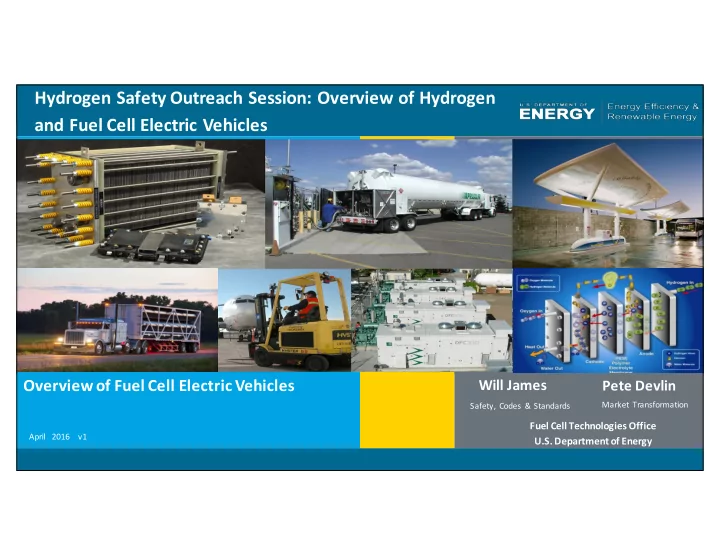
Hydrogen Safety Outreach Session: Overview of Hydrogen and Fuel Cell Electric Vehicles

Overview of Fuel Cell Electric Vehicles

Will James

April 2016 v1 Safety, Codes & Standards

Pete Devlin

Market Transformation

Fuel Cell Technologies Office U.S. Department of Energy

slide-2
SLIDE 2

Fuel Cell Technologies Office | 2

  • 1. The 8 State MOU
  • 2. Benefits of FCEV Technology
  • 3. FCEVs and Automotive Players
  • 4. Hydrogen Infrastructure (global and domestic)
  • 5. Market Growth Potential Beyond FCEVs
  • 6. Purpose and Agenda for today’s meeting

Outline

slide-3
SLIDE 3

Fuel Cell Technologies Office | 3

A Collective Target of 3.3 million ZEVs by 2025

  • 2. MEASURABLE GOALS

Consistent with program requirements, the initial Signatory States agree to a collective target of having at least 3.3 million zero emission vehicles

  • n the road in our states by 2025 and to work

together to establish a fueling infrastructure that will adequately support this number of vehicles. On an annual basis, each Signatory State will report, within available capabilities, on the number of ZEVs registered in its jurisdiction, the number of electric/hydrogen fueling stations open to the public and available information regarding workplace fueling for ZEVs.

The Northeast 8-State ZEV MOU*

* http://www.arb.ca.gov/newsrel/2013/8s_zev_mou.pdf

slide-4
SLIDE 4

Fuel Cell Technologies Office | 4

What are the benefits of FCEV technology?

slide-5
SLIDE 5

Fuel Cell Technologies Office | 5

What is a fuel cell electric vehicle (FCEV)?

5 April 15, 2016

slide-6
SLIDE 6

Fuel Cell Technologies Office | 6

FCEVs are on U.S. Roads Now!

OEMs bringing fuel cells vehicles to showrooms and driveways. Toyota, Hyundai, Honda, GM, Daimler, Ford, Nissan, BMW, VW, and others!

Now Leasing… Coming soon… Recently Announced Publicly Available for commercial sale in the US

Toyota Mirai Fuel Cell Vehicle Hyundai Tucson Fuel Cell SUV

~10 public retail H2 stations 100 stations planned in CA Plans underway in Northeast, Hawaii

Honda Clarity Fuel Cell Vehicle 2016 World Green Car Award Winner!

slide-7
SLIDE 7

Fuel Cell Technologies Office | 7

FCEV System Layout

Cooling System

Typically, slightly larger radiators than conventional

Electric Motor

Electrical component; drives vehicle by electricity

Power Electronics

Electrical component; distributes electricity

Fuel Cell

Electrical component; generates electricity from hydrogen

Hydrogen Tanks

Compressed, gaseous fuel; vehicle fueled with hydrogen

High Voltage Battery

Electrical component; captures regen braking, supports acceleration

Source: California Fuel Cell Partnership

slide-8
SLIDE 8

Fuel Cell Technologies Office | 8

More FCEVs Are Coming:

Audi Ø TBD model full-sized SUV BMW, Research Collaboration with Toyota Ø 2020 model sedan or SUV Daimler-Benz, Research Collaboration with Ford and Nissan Ø 2017 model SUV Ø Bus development in Europe General Motors, Research Collaboration with Honda Ø 2020 model vehicle

Based on Press Releases or Public Statements by Company Executives

Hyundai Ø 2017 next-generation SUV Ø Bus development in South Korea Ø 2020 model intro for Kia Nissan, Research Collaboration with Ford and Daimler-Benz Ø Renault involvement in LD BEV vans with fuel cell range extenders in France Toyota, Research Collaboration with BMW Ø TBD model SUV and Lexus sedan Ø Bus and forklift truck (Japan)

slide-9
SLIDE 9

Fuel Cell Technologies Office | 9

Examples of Hydrogen Infrastructure

slide-10
SLIDE 10

Fuel Cell Technologies Office | 10

Many Countries Are Building H2 Fueling Networks

International partnerships established to accelerate hydrogen infrastructure

  • Europe and Asian countries

are supporting infrastructure development.

  • Japan: 40,000 light-duty FCEVs

by 2020 and 800,000 by 2030; about 80 hydrogen fueling stations either in operation or slated to be deployed near- term, increasing to > 150 stations by 2020.

(http://www.autoblog.com/2016/03/18/japan- wants-to-boost-fuel-cell-numbers-100x-by-2020/)

  • South Korea: Government-Hyundai partnership to replace about 26,000 CNG buses with fuel cell buses

(about 2,000 vehicles/year); about 200 hydrogen stations will be deployed.

(http://ngtnews.com/south-korea-to-replace-cng-buses-with-hydrogen-fuel-cells/)

slide-11
SLIDE 11

Fuel Cell Technologies Office | 11

International partnerships and Refueling Station Plans

Countries have established partnerships to accelerate hydrogen infrastructure

Hydrogen Supply/Utilization Technology (HySUT) H2 Mobility Germany H2 Mobility UK Scandinavian H2 Highway Partnership (SHHP)

  • Japan plans to

implement 100 refueling stations

slide-12
SLIDE 12

Fuel Cell Technologies Office | 12

Hydrogen Fueling Projections for FCEVs

  • California*:

AB8 Expected Scenario (2016-20 ) NREL Expected Scenario (2021-25)

Year

2016 2017 2018 2019 2020 2021 2022 2023 2024 2025

H2 Stations 51 59 71 86 100 168 206 287 497 813 Kg/day H2 (000)

  • Total

9.2 10.9 13.2 15.9 18.3 36.2 46.4 68.2 124.5 209.3

  • 33% RH2

3.1 3.6 4.4 5.3 6.1 12.1 15.5 22.7 41.5 69.8

* Joint CEC-CARB Report (December 2015) http://www.energy.ca.gov/2015publications/CEC-600-2015-016/CEC-600-2015-016.pdf

12

Northeast Region Massachusetts Greater Boston

slide-13
SLIDE 13

Fuel Cell Technologies Office | 13

Market Growth Potential Beyond FCEVs

13 April 15, 2016

Fuel cells have a broad range of applications:

  • Transportation

§ Light and medium duty § Heavy duty and transit § Auxiliary power for refrigeration trailers and trucks § Forklifts § Maritime

  • Stationary power

§ Backup power for cell tower sites § Combined heat and power § Data centers, etc.

  • Portable power

Photo: Nuvera Photo: Cellcom

slide-14
SLIDE 14

Fuel Cell Technologies Office | 14 4/15/16

“Clustering” FCEVs Can Drive H2 Demand in Large Urban Centers

Representative Port-Based Industrial Complex with Hydrogen Cost < $6/kg

Class 8 Drayage Truck

Inbound Outbound

Terminal Tractor

Perimeter H2 Fueling Station (Public Access)

Fuel Cell Bus Refrigerated Truck with APU FCEV FC MHE MD FC Hybrid Cargo Tugger Containerized FC Generator

slide-15
SLIDE 15

Fuel Cell Technologies Office | 15 4/15/16

MD and HD Motive Technologies Under Development

Examples of innovative fuel cell vehicle technologies include…

Full-size buses Waste Hauling Trucks Drayage Trucks Heavy Duty Vehicles Medium Duty Vehicles Shuttle buses Baggage Tow Tractors Delivery Vehicles

These H2-fueled vehicles can replace diesel engines

slide-16
SLIDE 16

Fuel Cell Technologies Office | 16 4/15/16

Refrigerated Semi Trucks Refrigerated Box Trucks

These H2-fueled fuel cell power systems can replace diesel engines

Auxiliary Power Units (APUs) Mobile Specialty Products

Mobile Light Towers Portable Generators

Other Motive Technologies Under Development

slide-17
SLIDE 17

Fuel Cell Technologies Office | 17 4/15/16

Thank You

Will James, Safety, Codes & Standards Manager Pete Devlin, Market Transformation Manager Fuel Cell Technologies Office Will.James@ee.doe.gov Peter.Devlin@ee.doe.gov

hydrogenandfuelcells.energy.gov

slide-18
SLIDE 18

Fuel Cell Technologies Office | 18 4/15/16

The meeting will provide you with an opportunity to participate in a discussion on safety, codes, and standards issues, and impediments to the timely deployment of hydrogen and fuel cell technologies. Background

  • Representatives from DOE National Laboratories and the automotive industry will speak about the basic

safety requirements for hydrogen fueling stations and auto dealership servicing and repair facilities.

  • Discussion topics will include codes & standards and permitting, information about fuel cell electric vehicles

and hydrogen fueling infrastructure, safety information resources available from DOE, and open and interactive discussion on potential impacts from incidents involving hydrogen.

Focus of This Meeting

  • This meeting will allow you to ask questions and share your experiences and needs regarding safety-

related deployment barriers, as well as to provide a pathway for future dialogue.

Outcome of This Meeting

  • The discussion will also assist us to better align hydrogen safety & outreach activities and resources to

meet those needs.

Meeting Purpose

18

slide-19
SLIDE 19

Fuel Cell Technologies Office | 19 4/15/16

1. DOE Safety and Requirements Presentation (Carl Rivkin, Nick Barilo)

a. Why Hydrogen? b. What is a Hydrogen Fueling Station? c. Basic Code Requirements for Hydrogen Fueling Stations & Repair Garages d. Hydrogen Fueling Station Incidents and Impacts e. Information Resources

2. Q&A 3. Lunch & Viewing of Toyota Mirai Vehicle 4. Air Liquide Presentation: Station Deployment & Fueling Facilities (Jason Mitchell) 5. Toyota Mirai Presentation: Repair Garage Design & Safety (Mark Saxonberg) 6. Q&A and Discussion of Next Steps

Agenda