
SLIDE 1
1
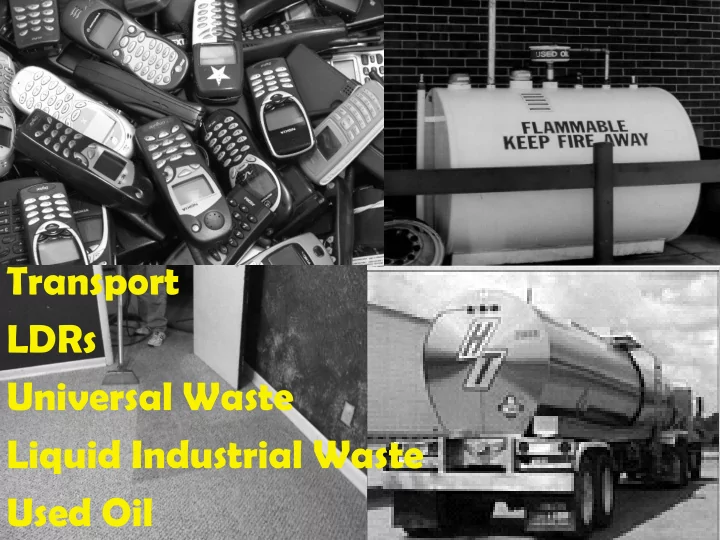
Transport LDRs Universal Waste Liquid Industrial Waste Used Oil - - PowerPoint PPT Presentation
Transport LDRs Universal Waste Liquid Industrial Waste Used Oil 1 Michigan Environmental Michigan Environmental Compliance Conference Compliance Conference Christine Grossman Christine Grossman Compliance Assistance Specialist
1
2
Christine Grossman Christine Grossman Compliance Assistance Specialist Compliance Assistance Specialist Waste Regulations Waste Regulations grossmanc@michigan.gov grossmanc@michigan.gov 517-373-0590 517-373-0590
3
(EAC) (EAC)
Phone: Phone:
1-800-NO2-WASTE 1-800-NO2-WASTE
(1-800-662-9278) Hours: Hours: 8:00 a.m. to 5:00 p.m. Monday through Friday Technical Assistance Services Include: Technical Assistance Services Include: Air Shoreline Development Waste Brownfield Redevelopment Water Site Remediation Wetlands Storage Tanks
4
Transportation Land Disposal Restrictions Universal Waste Used Oil Liquid Industrial Waste
5
6
Act 451, Michigan Natural Resource and
Part 111, Hazardous Waste
Part 121, Liquid Industrial Waste
Act 138,
7
Substances (products & wastes) listed in
Hazardous Materials Table found in 49 CFR, 172.101
Materials exhibiting a hazard during transport Hazardous waste is a US DOT hazardous
material
Includes only
industrial waste
8
Michigan State Police, Traffic Safety
9
DNRE implements Act 138 and
10
Act 138 Contacts
Barbara Stevens – 586-753-3850 Jeanette Noechel – 586-753-3846 EAC – 1-800-662-9278
Act 138 Web Information
Go to www.michigan.gov/dnre, select
11
US DOT Contacts
Michigan State Police, Traffic Safety
Division – 517-336-6580
Intrastate U.S DOT Number Information –
888-464-8736
Michigan Center from Truck Safety –
1-800-682-4682
US DOT web information
www.phmsa.dot.gov/hazmat/regs
12
Permit (3 yr) & Registration (1 yr) required
Hazardous waste transport Liquid industrial waste transport Hazardous and liquid industrial waste transport Fleet liability coverage must be maintained for
accidental occurrences (no less than $1,000,000 per occurrence for hazardous wastes and $750,000 or $300,000 per occurrence for liquid industrial waste)
13
Approval of Act 138
Approval of Act 138 permit & registration permit & registration result in issuance of result in issuance of “Credential” “Credential” at left at left
Credential must be
Credential must be carried at all times by carried at all times by transporter & presented transporter & presented upon inspection upon inspection
Credential lists effective
Credential lists effective period period
14
Self transportation:
Applies only
Applies only
liquid industrial waste generated on or from property or equipment in which he or she
15
Governmental transportation of liquid
On-site (not on public roadway)
16
(Rule 305) (Rule 305)
Package, label, and mark each hazardous
waste package in accordance with US DOT regulations AND
Mark each container of ≤119 gallons with:
“HAZARDOUS WASTE – Federal Law Prohibits
Improper Disposal. If found, contact the nearest police or public safety authority or the US Environmental Protection Agency.”
Generator name and address Generator Site Identification Number Manifest Tracking Number Hazardous waste codes identifying the waste
17
SQG shipping > 1000 lbs
& LQG must have US DOT placards available for transporters.
Call Michigan State
Police, Traffic Safety Division at 517-336-6580 for more info about placards.
18
Employ only Act 138 permitted & registered
transporters to transport hazardous and/or liquid industrial waste by public roadway
Verify Act 138 transporter credential
information by going to
(Rule 403 & Section 12103) (Rule 403 & Section 12103)
www.michigan.gov/dnre, “Waste,” “Hazardous and Liquid Industrial Waste Transporters,” and “Participating Transporters”
19
Self transportation of hazardous waste requires
Act 138 permit, registration, & fleet liability coverage unless government employee transporting government waste in government vehicle
Self transportation
waste may be exempt from Act 138 permit & registration, but is subject to having fleet liability coverage
20
Self transport of CESQG waste to HHW
Self transport < 55 gallons without a
21
Generators transporting own liquid industrial waste in volumes < 55 gallons does not require manifest if:
Waste is accompanied by record showing the
source & quantity of the waste and the designated facility where the waste is being shipped
Generator obtains signature from the designated
facility acknowledging receipt of the waste and provides a copy of the record of shipment to the designated facility
Generator retains a copy of the shipment record
for 3 years from the date of shipment
(Section 12103(4)) (Section 12103(4))
22
23
(Rule 311 and 40 CFR 268) (Rule 311 and 40 CFR 268)
Applies to listed & characteristic hazardous
wastes from SQGs & LQGs
Requires generator characterize, provide LDR
notice to TSD, and maintain records 3 years
Requires treatment before land disposal for
most wastes
Determine if treatment required by reviewing if
waste codes for each waste stream meets the standards in 40 CFR 268.40, 268.45 (debris),
24
Land disposal includes any disposal on land
(landfill, land treatment, injection well, salt caverns, etc)
Notification required even for shipment to
non-land based TSDs (e.g. incinerator)
New LDR notification must be sent when there
is a waste or facility change
Notice sent to each TSD for each waste stating
waste meets or does not meet LDR standards
(Rule 311 and 40 CFR 268) (Rule 311 and 40 CFR 268)
25
Generators treating a prohibited waste to meet
the standards in 40 CFR 268.48 must have a written waste analysis plan describing the activities they perform to meet the treatment standards
All generator LDR records are required to be
maintained for 3 years from the last date of shipment or on-site treatment and/or disposal, whichever is later
26
27
(Rule 228) (Rule 228)
Definition: Definition: A set of streamlined standards for managing hazardous waste that are intended to help facilitate easier, less expensive disposal and/or development of recycling markets
Electric Lamps Electric Lamps Batteries Batteries Pesticides Pesticides Consumer Electronics Consumer Electronics Mercury Containing Devices Mercury Containing Devices Pharmaceuticals Pharmaceuticals Antifreeze Antifreeze
See DNRE E Publication Center Univers rsal Waste Guidance
28
See DNRE Publication Center Electric Lamp Guidance
29
30
On-site bulb crushers are On-site bulb crushers are NOT RECOMMENDED NOT RECOMMENDED due to possible mercury due to possible mercury emissions emissions Discuss r Discuss requirements with equirements with WHMD, AQD, and MIOSHA WHMD, AQD, and MIOSHA An air use permit to install is An air use permit to install is required required Crushed bulbs must be Crushed bulbs must be counted toward generator counted toward generator status status
See DNRE Publication Center Bulb Crusher Guidance
31
Thermostats, automoti Thermostats, automotive ve mercury switches, mercury switches, sphygmomanometers, & sphygmomanometers, & thermometers thermometers
32
MDA Clean Sweep Collections
(www.michigan.gov/deqmercuryp2)
Local Household Hazardous Waste
Collections
End of Life Vehicle Solutions Collections
(elvsolutions.org)
Michigan Energy Options (www.mec.org)
33
Devices with circuit boards or Devices with circuit boards or liquid crystal/plasma displays liquid crystal/plasma displays common to homes and offices common to homes and offices and the same devices found in and the same devices found in
cell phones, televisions, cell phones, televisions, stereos, PDAs, DVD players, stereos, PDAs, DVD players, etc.) etc.)
See DNRE E Publication Center Electronic Equipment Guidance
34
Drugs only Does not include medical waste Medical waste is infectious or
potentially infectious (e.g. sharps/needles, vaccines with live viruses, body tissue, etc.)
Do not mix medical waste with pharmaceuticals
unless disposing of the waste at a permitted & licensed hazardous waste incinerator authorized to incinerate mixed medical waste
See DNRE Publication
Center Mixed ed Medical l Waste e Guidan ance
35
Volume not included when determining
generator status
Can be accumulated up to 1 year (much longer
than LQG 90 days and SQG 180 days)
Less labeling No hazardous waste manifest required, but if
liquid requires liquid industrial waste manifest
Credentialed hazardous waste transporter not
required, but if liquid requires credentialed liquid industrial waste transporter
36
Cannot dispose of universal waste Cannot treat universal waste except when: Responding to a release Performing treatment exempt from
hazardous waste permitting/licensing or authorized under universal waste handler regulations
Manage wastes in a way to avoid releases Can accumulate universal waste for up to one
year
37
Send or take universal waste to another
handler, destination facility, or foreign destination
Inform employees about proper handling and
emergency procedure for the waste
If mixing universal waste with other
non-hazardous wastes, managing mixture according to the universal waste standards
Make prior arrangement for shipment to
another universal waste handler
38
Label each item or container holding items:
Universal waste “item name” OR Waste “item name” OR Used “item name”
(e.g. “Universal Waste Pharmaceutical”
Pharmaceuticals”)
Meet liquid industrial waste manifesting
Meet US DOT regulations for all shipments
39
Meet other state’s requirements if shipping
If other state does not recognize the waste
Meet exportation requirements if shipping
40
Small Quantity Universal Waste
No Site Identification Form
Handles < 11,000 pounds (total all
41
Large Quantity Universal Waste
Site Identification Form required Handles ≥ 11,000 pounds (total all
42
43
Used oil Used oil is “any oil which has been refined from crude oil, or any synthetic oil, which has been used and as a result of use, is contaminated with physical or chemical impurities” and includes:
Used Motor Oils Used Hydraulic Oils Used Transmission & Brake Fluids All Synthetic Oils Spent Quench Oils Spent Gear Oils Non-PCB Transformer Oils Oil-Water Mixtures if sufficient oil exists for
legitimate recycling
See DNRE E Publication Center Used Oil Guidance
44
Used oil Used oil does NOT include petroleum based products that were not designed to function as lubricating agents or other protective applications Used oil Used oil does NOT include:
Fuels (Gasoline, Diesel, Fuel Oils) PCB Oils (TSCA) Mineral Spirits Certain Test/ Calibration Fluids Animal Fat or Vegetable Based Oil
45
Used oil is subject to waste regulation under
Part 111 and 121 establish hazardous waste
Part 167 requires that the used oil be
46
Used oil
Used oil with > 1000 PPM halogens is a
47
“Rebutting the presumption” is
Total halogens are usually tested using
48
If used oil contains > 1000 PPM halogens, it is
presumed to have been mixed with listed halogenated hazardous waste unless rebutted
Can also use knowledge of waste to
characterize, if feasible, but adequate documentation is required
Transporter usually tests oil prior to pick-up to
verify liquid industrial waste regulatory status and generators should request and maintain copies of relevant test on file
49
If > 1000 PPM halogens present, additional,
costly testing is required to “rebut” whether used oil was mixed with hazardous waste:
Analyze for all halogenated Appendix VIII
Analyze for all halogenated Appendix VIII constituent constituent
If > 100 PPM used oil fails and must be
If > 100 PPM used oil fails and must be managed as a hazardous waste managed as a hazardous waste
Conclusion: Do not mix used oil with other
wastes to facilitate required recycling and avoid being required to manage the mixture as a hazardous waste
50
See DNRE Publication Center Release Requirements in
51
See DNRE E Pu Publication Liquid Waste Genera rator Guidance
52
Characterize wastes and maintain records
Keep records of all liquid industrial waste
Keep records of hazardous waste generator
(includes most Used Oil) (includes most Used Oil)
53
Obtain and utilize Site Identification Number
Container or tank accumulation only Label containers/tanks with words “Used
(includes most Used Oil) (includes most Used Oil)
54
Containers/tanks must be compatible
Protect waste from weather, physical
Accumulation conducted to prevent
(includes most Used Oil) (includes most Used Oil)
55
Report releases that could threaten health,
Respond to releases to stop, contain, and
Manifest off-site shipments unless
(includes most Used Oil) (includes most Used Oil)
56
Use Act 138 permitted & registered
Ship waste only to a designated facility
S e e D N R E P u b l i c a t i
L i q u i d W a s t e G e n e r a t
G u i d a n c e
(includes most Used Oil) (includes most Used Oil)
57
If disposing of liquid industrial waste on-site
Manage in accordance with EPA Spill Control
(includes most Used Oil) (includes most Used Oil)
58
59
Follow exemption requirements Maintain required records (characterization,
Minimize waste to minimize regulatory
Notify DNRE of reportable releases
60
Train staff to handle hazardous waste and
Confirm questionable exemptions with DNRE
Utilize universal waste standard where
Institute measures to prevent releases
61
Document correction of observed violations
Review waste characterization at the time of
Routinely dispose of wastes Ship hazardous waste using manifest & via
62
Preventing repeat violations during
Keeping waste characterizations
Ensure YOU understand the regulations
63
Store greater than 90/180 days (SQG/LQG) Overlook re-characterizing and/or illegally
Install hazardous waste tanks without
64
Operate as a SQG or LQG without required
Rely solely on your vendor to ensure
Transport hazardous waste and/or liquid
65
Go to www.michigan.gov/dnrewaste Contact the DNRE EAC at 1-800-662-
Search the DNRE Publication Center Contact DNRE district waste inspection
Contact hazardous waste vendors Contact waste consultants