Hydrodynamic simulation of galaxy formation P . Monaco, University - - PowerPoint PPT Presentation

hydrodynamic simulation of galaxy formation
SMART_READER_LITE
LIVE PREVIEW

Hydrodynamic simulation of galaxy formation P . Monaco, University - - PowerPoint PPT Presentation

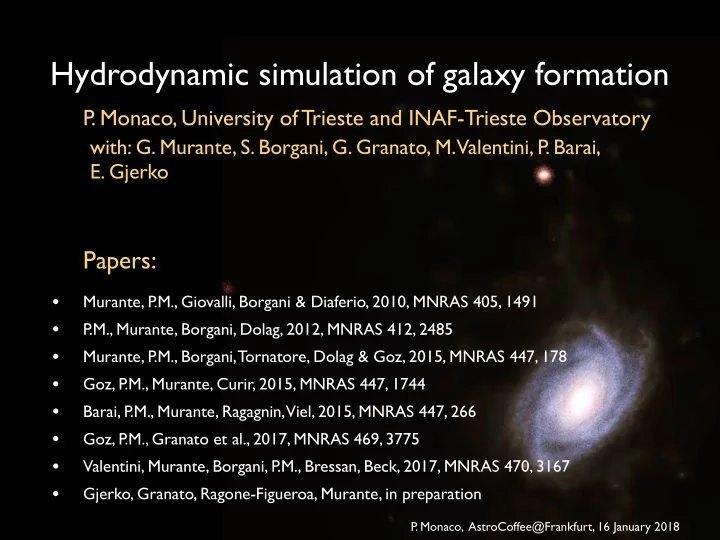
Hydrodynamic simulation of galaxy formation P . Monaco, University of Trieste and INAF-Trieste Observatory with: G. Murante, S. Borgani, G. Granato, M. Valentini, P . Barai, E. Gjerko Papers: Murante, P .M., Giovalli, Borgani &


slide-1
SLIDE 1

P . Monaco, AstroCoffee@Frankfurt, 16 January 2018

Hydrodynamic simulation of galaxy formation

P . Monaco, University of Trieste and INAF-Trieste Observatory

with: G. Murante, S. Borgani, G. Granato, M. Valentini, P . Barai,

  • E. Gjerko

Papers:

  • Murante, P

.M., Giovalli, Borgani & Diaferio, 2010, MNRAS 405, 1491

  • P

.M., Murante, Borgani, Dolag, 2012, MNRAS 412, 2485

  • Murante, P

.M., Borgani, Tornatore, Dolag & Goz, 2015, MNRAS 447, 178

  • Goz, P

.M., Murante, Curir, 2015, MNRAS 447, 1744

  • Barai, P

.M., Murante, Ragagnin, Viel, 2015, MNRAS 447, 266

  • Goz, P

.M., Granato et al., 2017, MNRAS 469, 3775

  • Valentini, Murante, Borgani, P

.M., Bressan, Beck, 2017, MNRAS 470, 3167

  • Gjerko, Granato, Ragone-Figueroa, Murante, in preparation
slide-2
SLIDE 2

P . Monaco, AstroCoffee@Frankfurt, 16 January 2018

  • 1. The context
slide-3
SLIDE 3

P . Monaco, AstroCoffee@Frankfurt, 16 January 2018

Cosmology (ΛCDM)

gravitational evolution

Galaxies

baryon physics

Dark matter

slide-4
SLIDE 4

P . Monaco, AstroCoffee@Frankfurt, 16 January 2018

Cosmology (ΛCDM)

gravitational evolution

Galaxies

baryon physics

Dark matter

slide-5
SLIDE 5

P . Monaco, AstroCoffee@Frankfurt, 16 January 2018

dark matter

slide-6
SLIDE 6

P . Monaco, AstroCoffee@Frankfurt, 16 January 2018

Silk & Mamon (2012)

Galaxy formation efficiency must be a strong function of halo mass

slide-7
SLIDE 7

P . Monaco, AstroCoffee@Frankfurt, 16 January 2018

A problem of resolution

> 1 kpc 1 pc - 1 kpc < 1 pc

galaxy formation feedback star formation physics that can be resolved in cosmological simulations physics that can be addressed with stellar evolution and an assumption on the IMF Formation of star-forming (molecular) clouds Emergence of energy through shock waves (and radiation pressure, cosmic rays, magnetic fields...)

slide-8
SLIDE 8

P . Monaco, AstroCoffee@Frankfurt, 16 January 2018

Massive and dying stars

Physical process: SN explosions Ionising radiation Stellar winds Radiation pressure Energy budget: 1051 erg each >8 Msun star + type Ia SNe up to 1050 erg each >10 Msun star up to 1050 erg each >10 Msun star ~1052 erg for a ~10 Msun star

slide-9
SLIDE 9

P . Monaco, AstroCoffee@Frankfurt, 16 January 2018

Efficiency of feedback

adiabatic stage snowplough stage momentum-driven stage Monaco (2004), Lagos et al. (2013)

  • Stars are born in clouds / clusters
  • SNII explode when the cloud has

almost being destroyed by massive stars

  • Correlated type II SNe create an

expanding super-bubble (SB)

  • SBs expand in the hottest phases
  • SBs heat the ISM in the adiabatic stage
  • SBs cool the ISM in the snowplough

stage

  • SBs end by pressure confinement or

by blowing out of the disc

  • Feedback efficiency is set by the stage

in which the SB ends

slide-10
SLIDE 10

P . Monaco, AstroCoffee@Frankfurt, 16 January 2018

Schmidt-Kennicutt law: Σsfr∝Σgas1.4 star formation with a given IMF cosmological inflow

(cooling of hot gas or cold flow)

angular momentum is conserved: gas disc galaxy wind /

  • utflow

galaxy wind / fountain SBs blow out while adiabatic

slide-11
SLIDE 11

P . Monaco, AstroCoffee@Frankfurt, 16 January 2018

strong inflow, or disk instability, or galaxy merger angular momentum is not conserved: compact star-forming clump massive

  • utflow

Schmidt-Kennicutt law starburst with a given IMF SBs confined?

slide-12
SLIDE 12

P . Monaco, AstroCoffee@Frankfurt, 16 January 2018

M82

slide-13
SLIDE 13

P . Monaco, AstroCoffee@Frankfurt, 16 January 2018

  • 2. Simulating galaxy formation
slide-14
SLIDE 14

P . Monaco, AstroCoffee@Frankfurt, 16 January 2018

Burkert & D’Onghia 2004

slide-15
SLIDE 15

P . Monaco, AstroCoffee@Frankfurt, 16 January 2018

slide-16
SLIDE 16

P . Monaco, AstroCoffee@Frankfurt, 16 January 2018

Rotation curves

slide-17
SLIDE 17

P . Monaco, AstroCoffee@Frankfurt, 16 January 2018

Aq-C5 with our code, two years later

Rendering by G. Skora

slide-18
SLIDE 18

P . Monaco, AstroCoffee@Frankfurt, 16 January 2018

Aq-C5 with our code, two years later

Rendering by G. Skora

slide-19
SLIDE 19

P . Monaco, AstroCoffee@Frankfurt, 16 January 2018

stars dark matter gas

slide-20
SLIDE 20

P . Monaco, AstroCoffee@Frankfurt, 16 January 2018

Volgesberger+ 2014 2014 2014 Murante+ 2015 Hopkins+ 2014 Marinacci+ 2014 Keller+ 2015 Stinson+ 2013 Schaye+ 2015 Christensen+ 2014

slide-21
SLIDE 21

P . Monaco, AstroCoffee@Frankfurt, 16 January 2018

Sub-resolution SF&FB in simulations

  • Kinetic winds to improve efficiency (Navarro & Steinmetz 00)
  • Effective model (Springel & Hernquist 03)
  • Blastwave feedback (Stinson+ 06)
  • Momentum-driven winds (Oppenheimer & Dave` 06)
  • Sticky particles (Booth+ 07)
  • Hypernovae (Kobayashi+ 07)
  • Effective equation of state (Schaye & Dalla

Vecchia 08)

  • Scaling with halo circular velocity (Tescari+ 09, Okamoto+ 10, Oser+ 10)
  • Density estimation of hot gas (Scannapieco+ 10)
  • Multi-Phase Particle integrator (Murante+ 10)
  • Early feedback (Stinson+ 13)
  • Heating to a critical temperature (Schaye & Della

Vecchia 13)

  • Accelerating wind (Barai+ 2013)
  • Resolving feedback (Ceverino & Klypin 09, Gnedin & Kravtsov 12)
  • Radiation pressure (Hopkins+ 14)
  • Superbubble feedback (Keller+ 2015)
slide-22
SLIDE 22

P . Monaco, AstroCoffee@Frankfurt, 16 January 2018

  • 3. MUlti-Phase Particle Integrator
slide-23
SLIDE 23

P . Monaco, AstroCoffee@Frankfurt, 16 January 2018

MUlti-Phase Particle Integrator (MUPPI): a sub-resolution model for star formation and feedback in SPH simulations with Gadget-3

Murante, PM et al (2010, 2015); loosely following PM (2004, MNRAS 352, 181)

gas in multi-phase particles is composed by two phases in thermal pressure equilibrium, plus a stellar component; gas molecular fraction is scaled with pressure; the evolution of the multi-phase ISM is described by a system of ODEs; the system of ODEs is numerically integrated within the SPH time-step (NO equilibrium solutions); energy from SNe is injected into the hot diluted phase; SPH hydro is done on this phase ...entrainment of the cold phase... particles respond immediately to energy injection

slide-24
SLIDE 24

P . Monaco, AstroCoffee@Frankfurt, 16 January 2018

atomic hydrogen molecular hydrogen

Cold gas

e v a p

  • r

a t i

  • n

c

  • l

i n g star formation restoration

Hot gas Stars

Ṁcold=Ṁcool-Ṁ*-Ṁevap Ṁstar=Ṁ*-Ṁrest Ṁhot=-Ṁcool+Ṁrest+Ṁevap Ṁcool = Mhot/tcool Ṁ* = f* fmol Mcold/tdyn Ṁevap = fevap Ṁ* Ṁrest = frest Ṁ*

fmol = 1/(1+P0/P)

slide-25
SLIDE 25

P . Monaco, AstroCoffee@Frankfurt, 16 January 2018

atomic hydrogen molecular hydrogen

Cold gas

e v a p

  • r

a t i

  • n

c

  • l

i n g star formation restoration

Hot gas Stars

Ṁcold=Ṁcool-Ṁ*-Ṁevap Ṁstar=Ṁ*-Ṁrest Ṁhot=-Ṁcool+Ṁrest+Ṁevap Ṁcool = Mhot/tcool Ṁ* = f* fmol Mcold/tdyn Ṁevap = fevap Ṁ* Ṁrest = frest Ṁ*

fmol = 1/(1+P0/P)

slide-26
SLIDE 26

P . Monaco, AstroCoffee@Frankfurt, 16 January 2018

Molecular fraction fmol

Inspired by Blitz & Rosolowsky, we scale the molecular fraction with SPH pressure - NOT the same quantity the

  • bservers use!

Leroy et al. (2009)

fmol = 1/(1+P0/P)

slide-27
SLIDE 27

P . Monaco, AstroCoffee@Frankfurt, 16 January 2018

atomic hydrogen molecular hydrogen

Cold gas

e v a p

  • r

a t i

  • n

c

  • l

i n g star formation restoration

Hot gas Stars

Ṁcold=Ṁcool-Ṁ*-Ṁevap Ṁstar=Ṁ*-Ṁrest Ṁhot=-Ṁcool+Ṁrest+Ṁevap Ṁcool = Mhot/tcool Ṁ* = f* fmol Mcold/tdyn Ṁevap = fevap Ṁ* Ṁrest = frest Ṁ*

computed on the hot phase computed on the cold phase

slide-28
SLIDE 28

P . Monaco, AstroCoffee@Frankfurt, 16 January 2018

Star formation starts Energy from SNe increases pressure Pressure increases fmol fmol increases star formation star formation runaway, up to fmol~1 NO EQUILIBRIUM SOLUTIONS

slide-29
SLIDE 29

P . Monaco, AstroCoffee@Frankfurt, 16 January 2018

Ėhot = -Ėcool+Ėsn+Ėhydro

Multi-Phase particle

Δt, ΔS, Δρ Ėhydro = Δ[S/(γ-1)ρ(γ-1)]/Δt

SPH

new ΔS etc...

SPH interaction with surrounding particles halts the runaway

slide-30
SLIDE 30

P . Monaco, AstroCoffee@Frankfurt, 16 January 2018

AqC5 50 kpc

slide-31
SLIDE 31

P . Monaco, AstroCoffee@Frankfurt, 16 January 2018

z=2.48 z=2.02 z=1.50 z=1.01 z=0.49

Aq-C5

slide-32
SLIDE 32

P . Monaco, AstroCoffee@Frankfurt, 16 January 2018

slide-33
SLIDE 33

P . Monaco, AstroCoffee@Frankfurt, 16 January 2018

GA2 Aq-C5 Circularity of stellar orbits versus stellar birth date

slide-34
SLIDE 34

P . Monaco, AstroCoffee@Frankfurt, 16 January 2018

Detailed chemical evolution broadly matches the MW

Ongoing analysis of AqC4 simulation with the GAIA group in Torino (Spagna, Lattanzi, Giammaria, Crosta, Curir) Test of metallicity gradients using various feedback schemes from Valentini et al. (2017)

slide-35
SLIDE 35

P . Monaco, AstroCoffee@Frankfurt, 16 January 2018

Barred galaxies

(Goz et al. 2015) bar kinematics bar strength bar

  • rigin
slide-36
SLIDE 36

P . Monaco, AstroCoffee@Frankfurt, 16 January 2018

Outflows

(Barai et al. 2015) Dependence of vout with redshift Dependence of mass load with redshift

slide-37
SLIDE 37

P . Monaco, AstroCoffee@Frankfurt, 16 January 2018

Panchromatic SEDs

(Goz et al. 2017)

Grasil3D for radiative tranfer

  • a cooler component due to

diffuse cirrus,

  • a warmer component due to

unresolved MCs

slide-38
SLIDE 38

P . Monaco, AstroCoffee@Frankfurt, 16 January 2018

  • Dust is made up of carbonaceous and silicate

spherical grains, + PAH

  • Optica properties as in Laor & Draine (1993)
  • Dust mixture as in Weingartner & Draine (2001)
  • PAH ionization fraction as in Li & Draine (2001)
  • Size distribution as in Silva et al. (1998)
  • Parameters calibrated on a set of observations
  • Dust temperature is computed self-consistently

Model of dust in GRASIL (+3D) Treatment of dust

slide-39
SLIDE 39

P . Monaco, AstroCoffee@Frankfurt, 16 January 2018

  • Dust is made up of carbonaceous and silicate

spherical grains, + PAH

  • Optica properties as in Laor & Draine (1993)
  • Dust mixture as in Weingartner & Draine (2001)
  • PAH ionization fraction as in Li & Draine (2001)
  • Size distribution as in Silva et al. (1998)
  • Parameters calibrated on a set of observations
  • Dust temperature is computed self-consistently

Model of dust in GRASIL (+3D) Treatment of dust

slide-40
SLIDE 40
  • Evolution of “gas” particles over

code time-steps with SAM methods;

  • We predict abundances of small

and large, carbon and silicate dust grains (2x2=4 dust abundances)

Multicomponent “gas” particle

slide-41
SLIDE 41

P . Monaco, AstroCoffee@Frankfurt, 16 January 2018

Conclusions

Brute force is impossible in forming galaxies: simulating disc galaxies requires suitable modeling of sub-grid physics Our key ingredients for a successful simulation:

  • strong feedback able to generate massive outflows
  • a model of sub-resolution physics that makes gas particles very

reactive to energy injection

  • a good radiative transfer code to extend predictions to all

wavelengths Toward a theory of galaxy formation, are our models predictive?