
SLIDE 1
W3: Talent Acquisition in a Full Employment
Economy
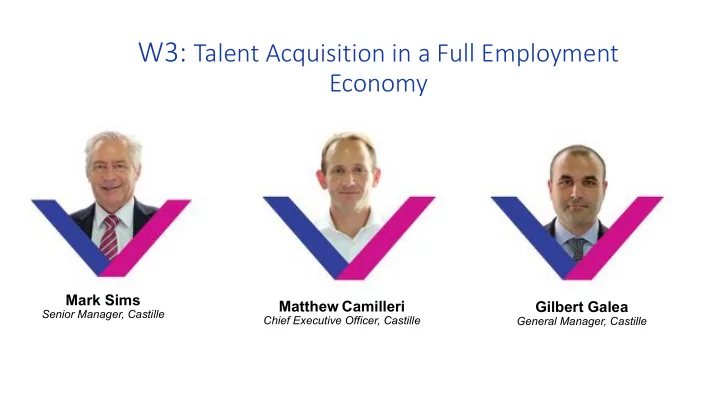
Mark Sims
Senior Manager, Castille
Matthew Camilleri
Chief Executive Officer, Castille
Gilbert Galea
General Manager, Castille
#HrChallenge #CompetitiveAdvantage TALENT ACQUISITION FOR - - PowerPoint PPT Presentation
W3: Talent Acquisition in a Full Employment Economy Mark Sims Matthew Camilleri Gilbert Galea Senior Manager, Castille Chief Executive Officer, Castille General Manager, Castille Talent Acquisition in a full employment economy
Mark Sims
Senior Manager, Castille
Matthew Camilleri
Chief Executive Officer, Castille
Gilbert Galea
General Manager, Castille
Talent Acquisition in a full employment economy ____________________________________
Matthew Camilleri
Key Market Conditions
Global Trending in supply for professionals with specialist skills:
skills in particular.
catch up – likely to be the case for the next 50 years according to many studies.
remote working to partnerships – all in the name of securing best talent.
HAYS Index 2018, creating widening skills premiums.
find Digital talent.
extremely concerned about the availability of Digital skills in country, increasing to 49% in SA, 51% in China and 59% in Brazil.
country about $20 billion in potential economic opportunities.
vacancies in Germany.
to its lowest level since 1975. Hospitality, Finance and IT workers are the most in-demand.
Despite mixed picture on wage inflation – candidates in areas of skills which are in high demand are receiving multiple job offers and counter offers driving wage inflation.
Key Market Conditions
Mitigating factors:
3.3% in 2017 and interestingly these migrants are increasingly well educated. Problem is these high skilled migrants tend to be concentrated in a small number of countries such as the UK, US, Canada and Australia mainly attracted to clusters such as Silicon Valley and the City of London.
mobile bandwidth and social networking sites.
and in the EU such roles having grown 400% more than permanent ones in the last 5 years.
Key Market Conditions
Drivers for the shortages:
as the global workforce ages. This trend will accelerate as Baby boomers begin retiring from 2020 and due to low birth rates will not be replaced in
in the labour market in 2017 compared to 2016. Smaller falls estimated in Poland, Germany and Italy.
mismatch across most markets. Driven by the speed at which the world is going digital and complexity.
replace some jobs, others (higher skilled) will be created as a result of these new technologies whilst tech also increases productivity which in turn generates more jobs.
Key Market Conditions
Matthew Camilleri
Employer Branding
What distinguishes your company culture and employment from your competitors? 1
The company’s own website and social media accounts need to carefully reflect which values stand at the brand’s heart. Employer branding portals that specifically tailor to niche segments, for example Tech & Finance candidates, might prove to be the differentiating factor between two similar organizations. 2
Employer Branding
While most employees will, in good faith, do their best to promote a good service, this goes beyond and requires of them soft skills related to problem solving, communication and follow-up techniques.
Top 10 marketing priorities by employers3
Key Observation:
Trending: Employer Branding
Key Observations:
candidates would check ads.
explaining low CR.
Trending: Employer Branding
Are employers choosing the right channels to target candidates? 3
Generational differences among candidates media trends. 3
Trending: Candidate behaviours Key Points:
industry publications and Millenials purely digital medias.
Key considerations on opportunities:3
Trending: Employer Branding Key observation – widest gap in employer/candidate consideration:
new technologies.
What do candidates care most about – generational differences? 3
Millennials were more likely to focus on building a personal brand in their industry.
Trending: Employer Branding
employer’s brand before applying for a job.
process is like for a position they are after, but they can find salary ranges for their location.
than Gen-Xers to perform research beyond a prospective employer’s website.
actual company culture. Videos tend to be the best representation of how a company operates, especially when those videos are testimonials from their employees.
Trending: Employer Branding
make the workplace more productive for people their age.
can expect flex time and telecommuting to become a common workplace practice rather than a special privilege.
done away with the 9-to-5 workday entirely.
Trending: Employer Branding
Matthew Camilleri “Fundamental shift required from a reactive recruitment process which is totally ill suited to current market conditions to one which is pro-active and focused on engaging employer brand and talent pipelining. This necessitates overhaul of strategic focus, planning and execution when it comes to resourcing”. Castille brand team, 2018.
Reactive Recruitment:4
terminated/is promoted
CRM
undetermined number of weeks until proper candidate is found
now, former employer
VS Successful sports recruitment:4
may need more depth in, or may be rotating off.
coming talent by sending scouts to schools and attending combines.
finding ways to get their names
social media, and charitable giving.
Castille Guidance on best practise
Developing specific networks of candidates:
is crucial at a time when candidates have less time for engagement.
Castille Guidance on best practise
Mark Sims
How difficult & frustrating is it to actually find good candidates in today's market? How often do you find good candidates but fail to hire them?
Managing the selection process in a faster market
When was the last time that you stood back and took a helicopter view
your hiring process and asked yourself the question why are we failing to hire?
recruitment process where it breaks down?
Managing the selection process in a faster market
One underlying reason we are seeing more and more for a breakdown in the hiring process is pace. As the market gets tougher, it gets
Managing the selection process in a faster market
Things to consider:
Speed to Market
the applicants Be Ready to Hire Quickly Steps in the Hiring Process
Timelines for each step in the process
Managing the selection process in a faster market
Types of Assessment
Communication is key
Closing the deal
Managing the selection process in a faster market
Limitations that some clients currently face
Managing the selection process in a faster market
Matthew Brincat
Legal practicalities of on-boarding hires
Gilbert Galea
Globally organisations are increasingly looking at alternative and innovative collaboration models with external providers to:
Cloud (93% in 2018)2 and Robotic Process Automation (72% in 2018)2
hybrid onshore/offshore4 teams
79% of businesses partner with external providers to access talent1 2016 Global Outsourcing Trends 3 An average of 25% of
Europe provided through nearshore and
2013 4
Alternative Resourcing Models
Talent shortage has been driving organisations into exploring talent outsourcing
non-core business!
An average of 38% of outsourced services in the mature European markets represent core business activity4. 88% of organisations in Europe either outsource services as-is or first outsource then transform through the
Alternative Resourcing Models
Alternative strategies for talent acquisition
consultants working on-premise or remotely.
and 40% of their workforce5
responsibility of results.
typically at lower salary and responsibility levels.”7 Other reasons include lower cost per hire, consolidation of suppliers and SLAs.
Alternative Resourcing Models
Alternative strategies for talent provision
Your
Expert Talent Advisory Continuous filtered Talent Flow Bi-directional knowledge distribution Local partner as escalation path Client- abstracted management
Alternative Resourcing Models
driven by generational differences are important.
recruitment processes a lot less effective.
secure a flow of the right calibre of candidates.
transform core business through specialist skills.
business continuity and scalability of that talent.
you need to think beyond “bums on seats” and open up for more innovative collaborative talent delivery models particularly ones providing hybrid teams made up of on-shore and remote working teams within managed nearshore infrastructures.
Slide 4-20
Slide 30-34
References