
SLIDE 1
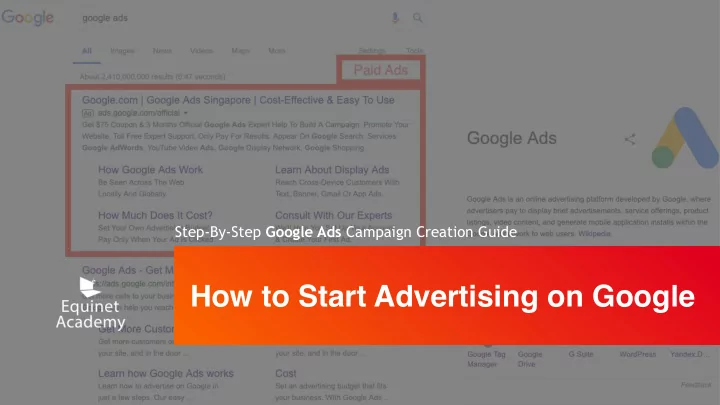
How to Start Advertising on Google
Step-By-Step Google Ads Campaign Creation Guide
How to Start Advertising on Google 2 Outline Modules we will be - - PowerPoint PPT Presentation
Step-By-Step Google Ads Campaign Creation Guide How to Start Advertising on Google 2 Outline Modules we will be covering 1.Fundamentals of Google Ads 2.Campaign Setup - Search and Display Campaigns 3.Measure Google Ads campaign performance
Step-By-Step Google Ads Campaign Creation Guide
2
1.Fundamentals of Google Ads 2.Campaign Setup - Search and Display Campaigns 3.Measure Google Ads campaign performance
Modules we will be covering
4
Ever wondered how to show up right on top of the Google search results, in the paid Ads section?
5
Or the Google Display Network (GDN), where your ads appear on websites your potential customers could be browsing through? Welcome to Google Ads (formerly Google AdWords). In this guide, we’ll walk you through step by step, how to advertise on the Google Network (The term that embodies all of the places where your Google Ads ad can appear.)
6
It helps an advertiser to reach people who are likely interested in what they are advertising online. There is no minimum amount one must spend on an Ads campaign. You can choose how much to spend and only pay when someone clicks on your ad. Ads are displayed to users who are searching for a particular product or service, significantly increasing the chances of acquiring potential qualified customers. Traditional media is not always measurable, but online campaigns are highly measurable and you can analyze your click data.
7
cost-per-click (CPC) they are willing to spend
an auction with other advertisers who are bidding on the same keywords or audiences
auction may appear in the top position, or have its ad displayed in an ad unit as long as it is above the Ad Rank Threshold.
score to prevent a bidding war based solely on price.
$5.14 $2.14 $9.14
Advertiser Audience Ad Auction (Search & Display)
Note: The Quality Score and Ad Rank is calculated every time someone does a search that triggers your ad.
8
Ad Rank = Max CPC Bid x Quality Score + Expected Impact from Ad Extensions & Formats
What is Ad Rank? Ad Rank is the value used to determine whether your ad will show on the page and if so, the ad position. What is Max CPC Bid? The maximum cost-per-click (CPC) amount an advertiser is willing to pay for an ad to show. What is Quality Score? A score from 1 to 10 influenced by factors such as expected ad click through rate (CTR), landing page experience, and ad relevance to target keywords (for Search), and Ad’s CTR and quality
What is Expected Impact from Ad Extensions and Formats? Introduced in late 2018, Google describes “if two competing ads have the same bid and quality, then the ad with the more positive expected impact from extensions will generally appear in a higher position than the other.” Example Scenario (Search Advertising): Advertiser 1: $2.00 (Max CPC Bid) x 10 (Quality Score) = 20 (Ad Rank) Advertiser 2: $5.00 (Max CPC Bid) x 5 (Quality Score) = 25 (Ad Rank) How is Ad Position Determined? Generally, the higher the Ad Rank, the higher the Ad Position. In the above scenario, Advertiser 2 will rank higher than Advertiser 1
Advertiser 3: $3.00 (Max CPC Bid) x 5 (Quality Score) = 15 (Ad Rank)
9
What is Actual CPC? Actual cost-per-click (actual CPC) is the final amount you're charged for a
sometimes much less -- than your maximum cost-per-click (max. CPC) bid, which is the most you'll typically be charged for a click. How is Actual CPC Calculated? Actual CPC is calculated by taking the Ad Rank of the advertiser below (lower ad rank) divided by the quality score of the advertiser plus 1 cent. Ad Rank is influenced by factors such as the quality score and maximum CPC. Example Scenario (Continued from Previous Example): Advertiser 1 (Ranked No.1 on Paid Search Results): 20 (Ad Rank of Advertiser Below) / 10 (Quality Score of Advertiser 1) + $0.01 = $2.01 Advertiser 2 (Ranked No.2 on Paid Search Results): 15 (Ad Rank of Advertiser Below) / 5 (Quality Score of Advertiser 2) + $0.01 = $3.01 Advertiser 1 pays less than Advertiser 2 even though winning the higher ad position. This is due to a higher quality score achieved.
10
Account Account Property Listings Online Clothing Store Google Ads Manager Account / My Client Center (MCC) Account Campaign Search Campaign Display Remarketing Ad Group Ad Group Ad Group Ad Group Condo Condo Ads Landed Landed Ads Condo Condo Ads Landed Landed Ads Campaign Men’s Clothing (Search) Campaign Women’s Clothing (Search) Ad Group Ad Group Ad Group Ad Group Men’s Winter Wear Men’s Summer Wear Women’s Top Women’s Bottoms Keywords Keywords Audience 1 Audience 2 Men’s WW Ads Men’s SW Ads Women’s Top Ads Women's Bottoms Ads Keywords Keywords Keywords Keywords
11
Google Ads Manager Account / My Client Center (MCC) Account
What is a Google Ads Manager Account? A manager account is an Google Ads account that lets you easily view and manage multiple Google Ads accounts -- including other manager accounts -- from a single login and dashboard. Think of it as an umbrella account to manage multiple campaigns efficiently. It is useful for a digital agency or someone who manages multiple Google Ads accounts. Further reading: https://support.google.com/google-ads/answer/6139186?hl=en About User Access Levels for your Manager Account: https://support.google.com/google-ads/answer/7476552
12
What Can You Do at the Account Level? The account level allows you to:
Further reading: https://support.google.com/google-ads/answer/1704334
Account Account Property Listings Online Clothing Store
13
What Can You Do at the Campaign Level? You can manage ad campaign settings at this level such as:
Further reading: https://support.google.com/google-ads/answer/1704395 Pro tip: You should create campaigns based on the structure of your website and group campaigns by the types of products or services.
Campaign Search Campaign Display Remarketing Campaign Men’s Clothing (Search) Campaign Women’s Clothing (Search)
14
What Can You Do at the Ad Group Level? At the Ad Group level, you can:
Further reading: https://support.google.com/google-ads/answer/2375404
Ad Group Ad Group Ad Group Ad Group Condo Condo Ads Landed Landed Ads Condo Condo Ads Landed Landed Ads Ad Group Ad Group Ad Group Ad Group Men’s Winter Wear Men’s Summer Wear Women’s Top Women’s Bottoms Keywords Keywords Audience 1 Audience 2 Men’s WW Ads Men’s SW Ads Women’s Top Ads Women's Bottoms Ads Keywords Keywords Keywords Keywords
16
To start advertising on Google, you need to take the following steps:
17
Sign in to your Gmail account
18
Click this link
19
Click “Create an account without a campaign”
20
Click this link
21
Click Submit
22
Navigate to Campaigns
We’re going to create our very first Google search advertising campaign.
23
Click the + button
24
Click the + New Campaign
25
There are 6 campaign goals. When you select a goal, you’ll see suggested campaign settings on the following steps aimed at helping you obtain that
should be the main thing you want to achieve for your business.
phone, or in store
conversions by encouraging customers to take action
people to visit your website
Encourage people to explore your products or services
a broad audience and build awareness
and interactions for your app
26
New Campaign
Continue For the purpose of simplicity, we will create a campaign without a goal's guidance.
27
Search Icon
Continue
There are 6 campaign types. The last type (not shown) - Smart campaign is only available on certain conditions: 1.Search - Create text or call ads that show near search results of Google.com, on Google search partners sites, and more 2.Display - Create visually appealing ads that serve across the Google Display Network, on Youtube, and on mobile or in app 3.Shopping - Create Shopping ads that drive
4.Video - Create video ads that are designed to increase reach and awareness, encourage engagement, or drive conversions 5.App - Create app promotion ads that serve across the Google Search Network, the Display Network, Google Play, within other apps, and on YouTube 6.Smart - Create text and image ads that show
and take advantage of minimal hands-on ads management
28
campaign name
boxes
What are Search Partners? Sites in the Search Network that partner with Google to show ads. Search partners extend the reach of Google Search ads to hundreds of non-Google websites, as well as YouTube and
your ads can appear on search results pages,
related to a person's search. What does including the Display Network mean? A Search Network campaign with Display Expansion can help you reach people as they use Google search and visit sites across the
Display Network if it appears you’ll have remaining daily budget. This saves you time in setting up two different campaigns. However, it may be a better option to separately manage a Display campaign as you will have more control.
29
Location Options
About Location Targeting Advertisers can target and/or exclude any combination of countries, territories, or regions. How Does Google Determine the location of the user?
It is highly recommended to target only 1 location per campaign to allow maximum control over budget and bidding, as well as the most detailed level of reporting of performance. You can also target bulk locations or radius
support.google.com/google-ads/answer/ 1722043?hl=en&ref_topic=3119074
Location
30
About Advanced Location Targeting Options
targeted locations - This default and recommended option lets you reach people who are likely to be located, or who are regularly located in your targeted location, as well as people who have shown interest in your targeted location. By selecting this default setting your ad can appear to people all over the world, as long as they include the location as a keyword.
targeted locations - This option lets you show your ads to people who are likely to be located, or who are regularly located in your target area. This does not include people who searched for your target locations but whose physical location was outside the target location at the time of searching.
targeted locations - This option lets you show your ads to anyone who searches on Google for your targeted location. If a person doesn’t specify a location in their search, then the system uses their physical location for targeting.
31
About Advanced Location Targeting Options
By default, you'll exclude people located in or showing interest in your excluded locations. You have the option to change your default setting to exclude only people who are located in your excluded locations. Let's take a look at our available exclusion options, and examine how they work with some example campaigns.
interest in, your excluded locations - With this
are likely to be located in your excluded location OR who showed interest in your excluded location.
locations - This option keeps your ads from appearing to people who are likely to be located in the areas you've excluded. People who are
32
Select People in your target locations
Selecting “People in your targeted locations” ensures that your audience is physically based in your selected location. Meaning to say, someone in Malaysia will not see your ad even if she typed “property rental in singapore”. Her IP address and device location has to be based in Singapore in order to see your ad.
33
Google Ads detects languages based on:
google.cn , etc)
Setting
Display Ads)
Select the language your ads will be created in
34
Google Ads detects languages based on:
google.cn , etc)
Setting
Display Ads)
Select BROWSE
35
Demographic targeting are based
Education, Home Ownership In-market audiences are based on a user’s search and browsing history. For example, if someone is constantly searching for accommodation in New York, and looking for places to eat or visit in New York, that user will fall into the In-market audience list for Hotel & Accommodations Remarketing audiences are based
It is advisable to start with “Observation” first to understand how effective your selected audience is. Change that to “Targeting” once you have the data to inform you that it is effective.
Select Observation (recommended)
36
About Daily Budget Up to 2 times your campaign's daily budget can be used to show your ads
fluctuations in traffic — but not more than you spend on your campaigns each month. This means that as long as your budget is consistent for an entire month, you won't be charged more than your daily budget multiplied by the average number of days in a month, which is 30.4 (365 days in a year ÷ 12 months). However, you'll still only be charged up to 2 times your daily budget. For example, if your daily budget is US$10, and you've accumulated $23 in costs on a given day, you'll only be charged $20 per day. The remaining $3 is returned to you as an overdelivery credit, which you can see in your transaction history. Calculate based on your average cost-per-click You can choose a daily budget for each campaign based on your advertising goals. For example, let's say your cost-per-click is $0.10 on average, and you'd like around 500 clicks per day. You might budget $50 per day. Using this example, here's how you'd figure out your daily budget: $0.10 x 500 = $50 per day (cost-per-click x clicks per day = Daily budget) Further reading: https://support.google.com/google-ads/answer/ 2375423?hl=en
Enter your daily budget
37
Select Bid Strategy Directly
38
Select Maximise clicks
39
About Automated bid strategies
automatically sets bids to help get as many conversions as possible at the target cost-per- acquisition (CPA) you set. Some conversions may cost more or less than your target.
automatically sets bids to help get as much conversion value as possible at the target return
have a higher or lower return than your target.
Ads automatically sets your bids to help get as many clicks as possible within your budget. A maximum CPC bid limit caps each cost-per-click
sets your bids to help you get the most conversions within your budget.
share" automatically sets your bids to increase your ads' chances of appearing in the search page area you select.
Select Maximise clicks
Tip: It is recommended to select “Maximize clicks” in the early days
very little data to try other options such as “Target CPA”.
40
Click Save and Continue
41
Remember, an ad group is where you create ads and match them to keywords that will be triggered when they match search terms entered by search engine users. Let's create our first ad group!
42
group name
keyword match types
and continue
There are a few types of keyword modifiers to ensure your ad doesn’t show up when someone types something irrelevant. For example, if you bid for the keyword [pearl island condominium], your ad won’t show up if someone types in “pearl island vacation”. To understand this better, head over to https://support.google.com/ google-ads/answer/7478529
43
Final URL is the URL of the page that you want to send your visitors to. Display path are additional text that you can use to make your text more enticing - it does not alter the the Final URL that the visitors land on after they click on the ad. Headlines & Descriptions are where you enter your main ad copy. Take note! Headline 3 and Description 2 may not always show, so make sure to have the most critical information in Headlines 1 & 2, and Description 1! Want to create compelling ads that will skyrocket your click through rates? Check out this article https://www.equinetacademy.com/adwords- display-text-ads-best-practices-checklist/ and download this checklist https:// www.equinetacademy.com/resource/google- search-and-display-ads-best-practices-checklist/
44
Headlines 1, 2 & 3 (30 Characters each) Description 1 & 2 (90 Characters each) URL path (15 Characters after each / )
45
and continue
3 Simple Tips on Writing Ad Copies 1.Talk about their end goal Show them you understand them, and that you can fulfil their
your car here” or “Fetch the highest price for your car” 3.Focus on Benefits, not Features “Our product is full of Vitamins A, B1, C….” vs “Look and feel younger” 5.Don’t make em’ think! Tell your prospects exactly what you want them to do. Include a Call-to-Action such as “Learn More”, “Get Free Quote”, or “Call Now” Ad copy creation template http://bit.ly/ equinetjune2019
46
Click Continue to Campaign
47
Location Callout Sitelinks Structured Snippets Call
48
Search ad extensions make your ad standout better and increase your click through rates. Best of all, they’re free to create! Further reading: https:// support.google.com/ google-ads/answer/ 7332837
49
Click Ads & Extensions
Let’s create a Site Links Search Ads Extension!
50
Click Extensions
51
Click Here
52
Click Create Sitelink Extensions
53
extension details
54
If you sell your products through retail chains, affiliate location extensions can help you reach consumers when they are deciding what and where to buy. Affiliate location extensions help people find nearby stores that sell your products. Further reading: https://support.google.com/google-ads/answer/7178291 Location extensions can help people find your locations by showing your ads with your address, a map to your location, or the distance to your business. People can then click or tap your extension to get further details about your location on your location page, which includes the most relevant business information all in one place. Location extensions may also include a phone number or call button so that users can easily call your business. https:// support.google.com/google-ads/answer/2404182
55
Highlight specific aspects of your products and services with structured snippets extensions. Structured snippets show beneath your text ad in the form
Africa”). Further reading: https://support.google.com/google-ads/answer/6280012?hl=en Price extensions can add more value to your Search Network text ads by giving you a bigger showcase for your services and range of products, and by linking people directly to what interests them on your site. Price extensions appear below your text ad on desktop and mobile, and give you more space to tell people details about what your business offers. They show as a set of up to 8 cards that people can view to see different options and prices. From your price menu, people can go directly to the item that interests them on your site. https://support.google.com/google-ads/answer/7065415?hl=en
56
Sitelinks will show in a variety of ways, depending on device, position, and other factors. When your sitelink extension appears with one of your ads on a computer, your ad will show no fewer than 2 links due to the minimum 2-sitelink requirement to serve an ad. Your ad can have up to 6 links. Sitelinks may appear on the same line or fill up to two lines of your ad. To add more links to your ads, create sitelink extensions. Sitelinks can take people to specific pages on your site— your store hours, a specific product, or more. When someone clicks or taps on your links, they skip right to what they want to know or buy. Further reading: https://support.google.com/google-ads/ answer/2375416?hl=en
57
Promotion extensions can add more value to your Search Network text ads by highlighting your sales and promotions for people that are searching for the best deals your business has to offer. Promotion extensions show below your ad in an easy to read format that catches the eye of your potential customers. The special occasion you select, for example, "Back-to-school” or “Mother’s Day” appears as a bold label next to your promotional text. https:// support.google.com/google-ads/answer/7367521?hl=en Callouts can improve your text ads by promoting unique offers to shoppers, like free shipping or 24-hour customer service. When customers see your ads, they get detailed information about your business, products, and services. 2 to 6 callouts show in addition to the text of your ad. Ads with callout extensions can show at the top and bottom of Google search results. When callout extensions show, they appear below your ad copy. https://support.google.com/google-ads/ answer/7506719?hl=en&visit_id=637020524183830640-3939775206&rd=1
58
App extensions allow you to link to your mobile or tablet app from your text ads. People click either on your ad headline to go to your site, or on the link to your app. App extensions are a great way to provide access to your website and your app from a single ad. App extensions showcase your mobile or tablet app by showing a link to your app below your ad. Clicking this link leads you to your app’s description in the app store (Google Play or the Apple App Store). Clicking on your ad’s headline will still lead to your website. Note: If your primary goal is to drive app downloads, app promotion ads (which link to apps exclusively) might be the better option. Further reading: https://support.google.com/google-ads/answer/2402582?hl=en
59
60
Enter Keywords
61
Click Get Results You can enter more than one keyword
62
You can analyse the average monthly search volume (the amount of traffic potential the keywords), competition, and estimate cost per click bid range
To add the keywords to your ad group, click the check box
63
existing campaigns or create a new ad group
Match Types (We will discuss this next)
Keywords
Did You Know? Keyword Planner can help you build a new Search Network campaign by multiplying keyword lists together.
64
Keyword & Match Types Ads May Show For Search Terms Such As… Ads May Not Show For Search Terms Such As… Rationale Digital marketing courses
Your ads may appear as long as
matched.
+Digital +marketing +courses
transformation
course
Search terms may appear in any
immediately after the “+” sign is
appear anywhere before and after these terms.
“Digital marketing courses”
course
courses Ads won't show if a word that changes the meaning of the phrase is added in between the phrase. Close variants apply.
[digital marketing courses]
Close variants may appear in any
appear anywhere around the term as long as the meaning is not changed.
Further reading: https://support.google.com/google-ads/answer/7478529?hl=en
65
Keyword & Match Types Ads May Show For Search Terms Such As… Rationale “Digital marketing courses”
Word order will still be respected in same- meaning queries
+digital +marketing +courses
Google may be a little more liberal with interpreting the “same-meaning” as opposed to the phrase match example example
Further reading: https://searchengineland.com/google-extends-same-meaning-close-variants-to-phrase-match-broad-match-modifiers-320138
66
When an advertiser adds negative keywords into an ad group within a search campaign, the ad will not show if the negative keyword appears in the user's search query. Negative keywords can help eliminate irrelevant ad impressions and reducing the number of irrelevant clicks
67
keywords into this box
Did you know? The following keyword match types apply to negative keywords as well:
Further reading: https:// support.google.com/google-ads/ answer/2453972?hl=en
68
Click Ad Preview and Diagnosis
Let’s Preview Your Search Ad!
69
Enter any keyword that you have bid for to preview your ad.
If your ad shows, you will see a green checkbox. If for some reason your ad doesn’t show e.g. you’ve finished your daily budget, Google will provide you with the reasons why, so you can fix it.
70
Campaigns
Icon
Let’s create a Display Ads Remarketing Campaign to target users who have previously visited your website.
71
Click + New Campaign
72
Select this box
73
74
Click Continue
75
campaign name
Options
76
Select People in your target locations
maximum control over budget and bidding, as well as the most detailed level of reporting of performance.
in, searching for, or who show interest in my targeted location (recommended)” by default Tip: Make sure to only select “People in my targeted location” By selecting the default setting your ad can appear to people all over the world, as long as they include the location as a keyword.
77
For Display campaigns, Google Ads detects languages based on:
Ads)
78
Select a bid strategy directly
79
Click here
80
Click here
81
Select your bid strategy
Target CPA - With "Target CPA", Google Ads automatically sets bids to help get as many conversions as possible at the target cost-per-acquisition (CPA) you set. Some conversions may cost more or less than your target. Target ROAs - With "Target ROAS", Google Ads automatically sets bids to help get as much conversion value as possible at the target return on ad spend(ROAS) you set. Some conversions may have a higher or lower return than your target. Maximize Clicks - With "Maximize clicks", Google Ads automatically sets your bids to help get as many clicks as possible within your budget A maximum CPC bid limit caps each cost-per-click bid. This could limit the clicks on your ad. Maximize Conversions - Google Ads automatically sets your bids to help you get the most conversions within your budget. Viewable CPM - With viewable CPM, you bid on 1,000 viewable impressions and you pay for impressions that are measured as
your ad shows on screen for one second or longer for Display ads and two seconds or longer for Video ads.
82
For the month, you won't pay more than your daily budget times the average number
might spend more or less than your daily budget.
83
Choose devices to show on Set the frequency cap
The "Optimize" ad rotation setting allows the Google Ads system to automatically show the better performing ads more often. Setting a frequency cap i.e. how often your ads show to your target audience can reduce banner blindness i.e. people ignoring your ad. You can set your ad to show as infrequent as once a week or as frequent as 3 times per day. There is no magic number. The key is to test and
Select the ad rotation
84
Click Browse
85
These are the available Audience Types for Display Advertising campaigns:
and habits are
actively researching or planning
your business
interests to your site/app visitors Further reading: https://support.google.com/ google-ads/answer/2497941
86
Let’s explore Affinity and Custom Affinity Audiences! Click here
87
Affinity audiences were built for businesses currently running TV ads and want to expand the reach of that campaign with an online presence for an efficient price. Select from these audiences to reach potential customers at scale and make them aware of your business. With custom affinity audiences, advertisers can create audiences that are more tailored to their brands, compared to more broad, TV-like affinity
using a combination of:
content of the website
This doesn't mean that your ads will show on the apps you specified, but rather to users that have similar apps on their mobile devices. For example, if you enter Google Fit, Google Ads will find users that have fitness-related apps.
affinity audiences
Custom Affinity Audiences
88
For example, rather than reaching the Sports Fans affinity audience, a running shoe company may want to reach Avid Marathon Runners instead. With custom affinity audiences, the shoe company can further define this audience by:
"triathlon athlete," or "long distance runner"
training schedules, marathon nutrition, and other marathon themes
be interested in like gyms, sporting goods stores, and natural supermarkets, or
an Avid Marathon Runner may likely be interested in like Google Fit.
audience
audience
89
Let’s explore In-market and custom intent audiences! Click here
90
In-market Audiences Select from these audiences to find customers who are in the market, which means that they're researching products and are actively considering buying a service or product like
advertisers focused on getting conversions from likely buyers. In-market audiences can help drive remarketing performance and reach consumers close to completing a purchase.
in-market audiences
custom intent audience
91
Custom intent: Display Custom intent audiences allow you to define and reach the ideal audience for your Display
to segment your ad groups for a specific vertical
segments, or define your own audience by entering in-market keywords, URLs and apps related to products and services that your ideal customer is researching across sites and apps.
audience
Keywords and URLs
92
Let’s explore Remarketing and Similar Audiences! Click here
93
Select Website Visitors
94
remarketing audience lists later on)
Remarketing Remarketing is a way to connect with people who previously interacted with your website or mobile app. It allows you to strategically position your ads in front of these audiences as they browse Google or its partner websites, thus helping you increase your brand awareness or remind those audiences to make a purchase. Similar Audiences Similar audiences takes the guesswork out
automatically finding new customers similar to your existing customers. Google Ads uses machine learning to update similar audience lists in real time to compare new users to your remarketing
allows you to show ads to people who share characteristics with people on your existing remarketing lists. To avoid
automatically excluded from your similar audiences list.
95
targeted demographics
Detailed demographics enables you to reach broad segments
common traits, such as college students, homeowners, or new parents.
96
Content or Contextual targeting is one
use to get your display ads on sites, apps, and webpages that are part of the Display Network. This method of targeting uses the keywords or topics you’ve chosen to match your ads to relevant sites. Note: This only applies to keywords with “Content” selected for the keyword setting.
Click Content Targeting
97
Select Keywords
Choose terms related to your products or services to target relevant websites. Keyword targeting lets you choose words or phrases related to your products or
choose help show your ads on relevant websites, apps, and videos.
98
When your keyword (using the “Content” keyword setting) matches a webpage’s concepts or its central theme, your ad is eligible to show on that webpage (also known as an automatic placement). Whether your ad actually shows there is determined by a number of factors, including your language and location targeting.
for broader reach, or select the second option for narrower reach
99
Click Topics
Choose topics to target many webpages, apps, and videos about a certain subject. Topic targeting is a simple way to place your ads on many webpages, apps, and videos about a certain
industries or interests, such as agriculture or music. For example, by targeting the "Autos & Vehicles" topic, your ad may appear on websites, apps, or YouTube videos with content about cars or other automotive themes.
100
When your topic matches a webpage’s central theme, your ad is eligible to show on that
actually shows there is determined by a number of factors such as your language and location targeting. Example: Let's imagine again that you want to show ads about electric cars that are for sale. You could add the sub-topic Autos & Vehicles > Vehicle Shopping > Vehicle Specs, Reviews & Comparisons to your ad group. This would help you target all pages on the Display Network related to car reviews and comparisons, regardless of whether your exact keywords appear on the page.
101
Choose specific websites, videos, or apps where you'd like to show your ads. Add placements to target specific locations on the Google Display Network
On the Display Network, a placement can be an entire website, a specific page of a site, or a mobile app. On YouTube, a placement can be a channel or a video. For Video campaigns only: When you add Display Network placements, your ad may still run in all eligible locations on
placements, your ad may still run in all eligible locations across the Display Network.
Click Placements
102
Locations on the Display Network where your ad can appear. Examples include relevant websites and apps that partner with Google to show ads. A Display Network placement can refer to several things, such as an entire website, a subset of a website (such as specific pages from that site), an individual ad unit positioned on a single page, a video, a mobile phone app, and more. Show your ads on placements where your customers spend time If you know of a website that your customers visit, consider adding it as a managed
typical customer spends a lot of time on example.com and you want your ads to appear there, add it as a managed placement.
Placements
103
One of the most efficient ways to get great performance from Google Display ads is to expand your targeting reach automatically with the automatic targeting feature (previously Targeting Optimization). This lets Google find you more high-value traffic to help you drive more conversions efficiently. Automatic targeting offers better forecasting and control, making it easier for you to predict performance. With the default setting, automatic targeting more conservatively expands the reach of your Google Display ads to more relevant customers. As you maximize your settings, your reach will increase, giving you nuanced control over how broadly your Display ads are served. Think of automatic targeting as a high- impact add-on that supplements the targeting you’ve already set up. This article explains how to optimize this setting to meet your campaign goals. Further reading: https:// support.google.com/google-ads/ answer/190596?hl=en
Drag the bar to increase your reach
104
Click + Ad
105
Click + Responsive display ad
Responsive Display Ads are able to resize and rearrange ad elements dynamically based on the ad copy and image you have chosen to fit various ad sizes. You may also wish to upload your ads based on the acceptable ad sizes by the Google Display Network. Tip: There are a lot of ad sizes available
same. The following are ad sizes that are widely accepted, and have more chances of encouraging a click:
106
107
Ever wondered why those pesky little ads keep following you around the web when you’re browsing different websites? It’s known as remarketing. In this section, we’ll go through step by step how to set up remarketing ads to annoy convert your prospects.
108
Manager
First, let’s create an audience list of people who have visited your website at least once.
109
Click Set Up an Audience Source
110
Click Set Up Tag
111
continue
112
this option if you are installing the tag on your website yourself
113
script and paste it on the header
If you’re not a technical person and don’t have access to the backend of your website, choose the second option “Email the tag” to email the instructions and tag to your web developer to install the code for you.
114
Click Done
115
Click Audience Lists
116
Click the + icon
117
Click + Website Visitors
Website visitors: The standard list type for a website-based campaign. These lists track user behavior in your website and will add those users according to criteria specified by you or Google Ads, if automatically generated. These criteria can be visits, click-in source, click-out location and the various stages of a conversion. You can create this list type once the global site tag has been added to your website. Some website remarketing lists will be automatically created for you, e.g. All Visitors and All Converters. Learn more About automatically created lists. YouTube users: Users that view and/or interact with your video ads are added to YouTube lists. These remarketing lists can be created by first linking your YouTube channel to your Google Ads
App users: Users that have your app installed on their device are added to these lists and become eligible to be shown your ads while in other apps on the Google Display Network. Learn more About remarketing to App users. Customer list: Lists generated based on the Google Ads Customer Match feature. Customer lists allow you to upload contact information that your customers have shared with you, like emails
like Google Search or YouTube. Learn more About Customer Match. Custom combination: A type of list created when you manually combine two or more existing remarketing lists. For example, if you have a list of high value shoppers and a list of people who bought electronics from you, then you can reach possible buyers of your new high value electronics by combining (ANDing) the two lists. Similar audience: People that don’t precisely match but share other behaviors with people in your existing remarketing lists. For example, a footwear advertiser may find that their sandal buyers also search for pool accessories so they may want to try creating a similar audience targeting searchers of pool accessories to show ads for their summer footwear. Similar audiences are created automatically for you, once your seed list is sufficiently big.
118
name
membership duration
Audience
remarketing audience. You can try out combinations such as visitors of a page who did not visit another page to target non-converters.
the page or the referring URL that brought the visitor to your site.
prior to the set up, you will be able to include people from up to the past 30 days
consider setting the membership duration up to a maximum of 540 days Tip: Remarketing List Ideas
With this audience list created, we can now create a Display Advertising campaign to target ads to people who have visited your website at least once in the past 30 days. Do remember to update your privacy policy to inform your website visitors you are using cookie-based tracking.
audiences
120
Campaigns that are focused on brand awareness might be created by a car company that wants to create buzz for a new model, or a film company that wants to promote a new movie by offering visitors a sneak-peek. Focus on: impressions, customer engagement, reach and frequency Campaigns that are focused on increasing traffic might be created by an organization that wants to promote a new fundraising drive, or a business that would like to increase sales of a new product. Focus on: clicks, clickthrough rate, keyword performance, search terms Campaigns that are focused on increasing sales and conversions might be created by a company that wants to sell a lot of a particular product, or a non-profit
to encourage visitors to sign a petition for an important cause. Focus on: conversion data, landing pages
Increase Brand Awareness Increase Traffic Increase Conversions Increase Return on Investment
You can use an ROI calculation to compare two advertising campaigns against each
money you've made from each one. For example, a ceramics manufacturer might be able to determine that a less expensive blue vase that sells more briskly in one campaign is actually generating more profits than a more expensive green vase in a different campaign. Focus on: conversions
Further reading: https://support.google.com/google-ads/answer/1722036
121
Impression:
An impression is counted each time your ad is served. Impressions help you understand how often your ad is being seen.
Clicks:
Counts when a user clicks on an ad
Average cost-per-thousand impressions (CPM) is the average amount that you've been charged for 1,000 impressions.
CTR:
Clickthrough rate (CTR) measures how often people click your ad after it's shown to them, which can help you understand the effectiveness of your ad. CTR is calculated by dividing the number of clicks your ad receives by the number of times your ad is shown. If you have 5 clicks and 1000 impressions, then your CTR is 0.5%.
Click Share:
"Click share" is the clicks you've received on the Search Network divided by the estimated maximum number of clicks that you could have received.
Search Exact Match IS:
"Search exact match impression share (IS)" is the exact match impressions you've received divided by the estimated number of exact match impressions you were eligible to receive on the Search Network.
Search Impr. Share:
"Search impression share" is the impressions you’ve received on the Search Network divided by the estimated number of impressions you were eligible to receive.
Search Top IS:
Search top impression share (IS) is the impressions you've received in the top location on the search result page divided by the estimated number of impressions you were eligible to receive in the top
location.
Search Abs. Top IS:
"Search absolute top impression share" is the percentage of your Search ad impressions that are shown in the most prominent Search position. Absolute top impression share = absolute top impressions / total eligible top impressions
Search Lost Abs. Top IS (Rank):
Search lost absolute top impression share (Rank) estimates how often your ad wasn't the very first ad above the organic search results due to poor Ad Rank.
Search Lost IS (Rank):
"Search lost impression share (rank)" estimates how
to poor Ad Rank.
Search Lost Top IS (Rank):
Search lost top impression share (rank) estimates how
122
Search Lost IS (Budget):
"Search lost impression share (budget)" estimates how
to low budget.
Search Lost Top IS (Budget):
Search lost top impression share (Budget) estimates how often your ad didn't show anywhere above the
Search Lost Abs. Top IS (Budget):
Search lost absolute top impression share (Budget) estimates how often your ad wasn't the very first ad above the organic search results due to low budget.
Gmail Forwards:
"Gmail forwards" shows the number of times your ad was forwarded to someone else as a message.
Gmail Saves:
"Gmail saves" are the number of times someone has saved your Gmail ad to their inbox as a message.
Gmail Clicks:
"Gmail clicks" to a website indicates the number of clicks to your landing page.
View Rate:
"View rate" measures the percentage of people who watched your video after they first saw the video or
receives divided by the number of impressions, including thumbnail impressions for video discovery ads.
Views:
A view is counted when someone watches 30 seconds
seconds) or interacts with your video, whichever comes first.
Interactions:
An interaction is the main action associated with an ad format. These include clicks for text and Product Shopping ads, views for video ads, and more.
Interaction Rate:
"Interaction rate" measures how often people interact with your ad after it's shown to them. This helps measure your ad's effectiveness.
Engagements:
An engagement occurs when a consumer engages with an ad, for example, viewing or clicking a video ad
Engagements can help you understand how well your ad is performing. Relevant, highly-targeted ads with attractive content can encourage viewers to engage more deeply with your brand.
Engagement Rate:
Engagement rate is used to measure how often people engage with your ad after it's been shown to
ad is. Engagement rate is the number of engagements divided by total impressions.
123
Average cost-per-engagement (CPE) is the average amount that you've been charged for an ad
divided by the total number of ad engagements.
Average cost-per-view (avg. CPV) is the average amount you paid each time someone viewed your video ad. It equals the total cost of all views divided by the total number of views. This differs from maximum CPV, which is the most you're willing to pay for an ad view.
Video Played to: 25%, 50%, 75%, 100% (Video Only):
"Video played to" measures what percentage of viewers watched to that point in the video. For example, if "Video played to 25%" is 30%, it means that 30% of viewers watched at least one-fourth (25%) of your video.
This metric estimates the bid needed to get most of your impressions at the top of the first page of Google search results. If you're already bidding high enough, this minimum may be lower than your current bid.
Estimated first page bid shows the amount you might need to bid for your ad to be displayed on the first page of Google search results.
Estimated first position bid shows the amount you might need to bid for your ad to be displayed in the first position at the top of the first page of Google search results.
Viewable Impr.:
“Viewable impr.” shows the number of times an ad was viewable. An ad is viewable when at least 50% of its area is visible for 1 second for Display Network ads, or 2 seconds for video ads.
Non-viewable Impr.:
“Non-viewable impr.” shows the number of times your ad was considered non-viewable. An ad is non- viewable when it doesn’t have at least 50% of its area visible for at least 1 second for Display Network ads,
Measurable Impr.:
“Measurable impressions” represents the number of times your ad appeared in locations on websites or apps that could be measured for viewability. Because
viewability, this can help you understand your ad’s viewable rate.
Non-measurable Impr.:
“Non-measurable impr.” shows the number of times your ad appeared in locations that aren’t able to measure viewabiity.
Measurable Cost:
“Measurable cost” is the total cost of all impressions that appeared in locations on websites or apps that could be measured for viewability.
Measurable Rate:
“Measurable rate” represents the percentage of total impressions that appeared in locations on websites or apps that could be measured for viewability. Total impressions include both impressions that are measurable and non-measurable for viewability.
124
“Avg. viewable CPM” is the average amount you’ve been charged for 1,000 viewable impressions on Video and Display Network ads.
Viewable CTR:
“Viewable CTR” represents how often people click your ad after it becomes viewable. An ad is considered viewable when 50% of it shows on a webpage for at least one second.
Viewable Impr. Distrib.
“Viewable impression distribution” represents the percentage of your total ad impressions that were considered viewable. Total impressions include both measurable and non-measurable impressions. This differs from “viewable rate,” which only includes measurable impressions.
Non-viewable Impr. Distrib.:
“Non-viewable impression distribution” represents the percentage of your total ad impressions that were considered non-viewable. Total impressions include both measurable and non-measurable impressions. This can help you understand how many of your ad’s impressions couldn’t be viewed.
Bounce Rate:
“Bounce rate” is the percentage of single-page visits or visits in which the person left your site from the entrance (landing) page. This metric is imported from your Google Analytics accounts and is calculated based only on visits that originated from Google Ads clicks.
% New Sessions:
“% new sessions” is the percentage of first-time sessions (sessions from people who had never visited your site before). This metric is imported from your Google Analytics accounts and is calculated based
clicks.
Non-measurable Impr. Distrib.:
“Non-measurable impr. distrib.” is the percentage of your total impressions that appeared in locations that aren’t able to measure viewabiity.
Display Lost IS (Rank):
"Display lost impression share (rank)" is the estimated percentage of impressions on the Google Display Network that your ads didn't receive due to poor Ad Rank.
Display Lost IS (Budget):
Display Lost impression share (budget) estimates how
to low budget.
Display Impr. Share:
"Display impression share" is the impressions you've received on the Google Display Network divided by the estimated number of impressions you were eligible to receive.
Viewable Rate:
“Viewable rate” is the percentage of your measurable impressions that were viewable, which estimates how many impressions were actually seen by customers.
Relative CTR:
Relative CTR measures how your ads perform on Display Network sites compared to other ads on the same sites. Relative CTR is your clickthrough rate divided by the average clickthrough rate of all advertisers on the websites that show your ads.
125
View-through Conv.:
View-through conversions (“View-through conv.”) are conversions that are recorded when users view (but don’t interact with) an ad and then later convert. These conversions are counted based on a period of time called a view-through conversion window.
Pages/Session:
“Pages/session” is the average number of pages on your website viewed per session. You can use this metric to measure visitor quality. This metric is imported from your Google Analytics accounts and is calculated based only on sessions that originated from Google Ads clicks.
“Average session duration” is the total duration of all sessions (in seconds) divided by the number of
Analytics accounts and is calculated based only on sessions that originated from Google Ads clicks.
Message Impr.:
"Message impressions" shows the number of times your message extension showed with your ad and a Google forwarding number was used, allowing the conversation to be trackable.
Chats:
“Chats” shows how many people have messaged your business using a Google forwarding number.
Chat Rate:
“Chat rate” shows the number of people who initiated a conversation with your business after seeing your message extension. This is calculated by the number
impressions that showed with a Google forwarding number.
Phone Impr.:
Phone impressions are the number of times your ad either showed with a Google forwarding number or a Google forwarding number could have been shown to someone on your website.
Phone Calls:
Phone calls are the number of times people clicked on a phone number displayed in an ad on a mobile device
displayed in an ad on any device.
PTR:
Phone-through rate (PTR) is the total number of phone calls received (Phone calls) divided by the number of times your phone number was shown (Phone impressions).
The average number of times a unique cookie was exposed to your ad over a given time period.
Average view frequency per cookie is the typical number of times that someone viewed your ad from a unique browser over a given time period. Why it matters: Use this metric to better understand how frequently the same viewer is interested in your video ads.
Unique Cookies:
The number of unique cookies that were exposed to your ad over a given time period. You can use this information to estimate how many people were shown your ad (Reach)
126
Unique Viewers (Cookies):
"Unique viewers (cookies)" shows the daily number of views from a unique browser that a video ad or all of your video ads had within a certain time period.
times a unique person is shown your ad over a given time period. Use this metric to better understand how frequently a user may be exposed to your ad.
Unique Users:
Unique users shows the total number of people who saw an ad in Display or Video campaigns over a given
statistical models to measure the total reach of an ad by adjusting for cases when people may see the same ad on different devices or when multiple people share
country level.
This metric estimates the bid needed to get most of your impressions at the top of the first page of Google search results. If you're already bidding high enough, this minimum may be lower than your current bid.
Estimated first page bid shows the amount you might need to bid for your ad to be displayed on the first page of Google search results.
Estimated first position bid shows the amount you might need to bid for your ad to be displayed in the first position at the top of the first page of Google search results.
Outranking Share:
“Outranking share” is how often your ad ranked higher in the auction than another advertiser’s ad, or if your ad showed when theirs did not.
127
Gmail Clicks:
"Gmail clicks" to a website indicates the number of clicks to your landing page.
Clicks:
Counts when a user clicks on an ad
Click Share:
"Click share" is the clicks you've received on the Search Network divided by the estimated maximum number of clicks that you could have received.
Average cost-per-click (CPC) is the amount you've paid for your ad divided by its total clicks. If your ad receives 2 clicks, one costing $0.20 and one costing $0.40, your average CPC for those clicks is $0.30.
Viewable CTR:
“Viewable CTR” represents how often people click your ad after it becomes viewable. An ad is considered viewable when 50% of it shows on a webpage for at least one second.
Relative CTR:
Relative CTR measures how your ads perform on Display Network sites compared to other ads on the same sites. Relative CTR is your clickthrough rate divided by the average clickthrough rate of all advertisers on the websites that show your ads.
Pages/Session:
“Pages/session” is the average number of pages on your website viewed per session. You can use this metric to measure visitor quality. This metric is imported from your Google Analytics accounts and is calculated based only on sessions that originated from Google Ads clicks.
“Average session duration” is the total duration of all sessions (in seconds) divided by the number of
Analytics accounts and is calculated based only on sessions that originated from Google Ads clicks.
CTR:
Clickthrough rate (CTR) measures how often people click your ad after it's shown to them, which can help you understand the effectiveness of your ad. CTR is calculated by dividing the number of clicks your ad receives by the number of times your ad is shown. If you have 5 clicks and 1000 impressions, then your CTR is 0.5%.
Bounce Rate:
“Bounce rate” is the percentage of single-page visits or visits in which the person left your site from the entrance (landing) page. This metric is imported from your Google Analytics accounts and is calculated based only on visits that originated from Google Ads clicks.
% New Sessions:
“% new sessions” is the percentage of first-time sessions (sessions from people who had never visited your site before). This metric is imported from your Google Analytics accounts and is calculated based
clicks.
“Expected CTR” measures how likely it is that your ad will be clicked when shown. This score is based on the past clickthrough performance of your ads. We exclude the effects of ad position, and other factors that affect the visibility of your ad, such as extensions.
128
Conversions:
"Conversions" shows the number of conversions you received after ad interactions (such as text ad clicks or video ad views) from all actions you've included in this column.
Phone Calls:
Phone calls are the number of times people clicked on a phone number displayed in an ad on a mobile device
displayed in an ad on any device.
Cross-device Conv.:
Cross-device conversions (Cross-device conv.) are conversions that are counted when a customer interacts with an ad on one device, then converts on a different device or browser.
Landing Page Exp.:
"Landing page experience" estimates how relevant and useful your landing page is to people who click your ad. It takes into account factors such as how well your landing page content matches a person’s search term, and how easy it is for people to navigate your page.
Chats:
“Chats” shows how many people have messaged your business using a Google forwarding number.
Conversion value per click (“Conv. value/click”) is the average conversion value of your ad interactions. It’s your conversion value divided by the number of ad
interactions such as engaged views of a video ad. This metric doesn’t include clicks that couldn’t lead to conversions, such as those that happen when you aren’t using conversion tracking.
Conversion rate (“Conv. rate”) shows how often, on average, an ad interaction leads to a conversion. It’s “Conversions” divided by the interactions with your
views for video ads. This metric only includes interactions that could lead to conversions.
View-through Conv.:
View-through conversions (“View-through conv.”) are conversions that are recorded when users view (but don’t interact with) an ad and then later convert. These conversions are counted based on a period of time called a view-through conversion window.
129
Quality Score:
Quality Score is an estimate of how relevant your ads, keywords, and landing pages are to a person who sees your ad. Higher Quality Scores typically lead to lower costs and better ad positions.
Conversion value (Conv. value) is the sum of conversion values for your conversions. This metric is useful only if you entered a value for your conversion actions.
Value / Conv.:
Value per conversion ("Value/conv.") is approximately how much, on average, each of your conversions is
“Conversions.”
Cost/Conv.:
Cost per conversion (“Cost/conv.”) shows the average cost of a conversion. It’s your cost divided by your
your overall cost per conversion may be lower than the cost for each conversion action. The cost in this metric only includes ad interactions that could lead to conversions.
Conversion value per cost ("Conv. value/cost") measures your return on investment. It’s the conversion value divided by the total cost of all ad
interactions that can’t lead to conversions, such as those that happen when you aren’t using conversion tracking.
Conversion value per click (“Conv. value/click”) is the average conversion value of your ad interactions. It’s your conversion value divided by the number of ad
interactions such as engaged views of a video ad. This metric doesn’t include clicks that couldn’t lead to conversions, such as those that happen when you aren’t using conversion tracking.
Conversion rate (“Conv. rate”) shows how often, on average, an ad interaction leads to a conversion. It’s “Conversions” divided by the interactions with your
views for video ads. This metric only includes interactions that could lead to conversions.
130
Tool Tip: For each question you ask, it helps to determine which metrics to focus your analysis on, so that you know where to access the right reports and make appropriate recommendations for improvement.
Questions to ask to evaluate performance of Google Ads campaigns
131
We can see that the total unique users who had seen the ad is 66,341 and the average number of times each user had seen the ad was 1.3 times.
Campaigns
Columns - Unique Users and Avg. Impr. Freq. / user
132
The higher your impression share the more visible your brand is compared to your competitors. In this scenario, the impression share is 92.94% - meaning to say the brand’s ads showed 92.94% of all the times a search targeting their keywords was conducted.
Auction Insights
133
Run a Search Query Report
group
Depending on your match types, your ads may trigger various irrelevant keywords - thus it is very important to come back to this report periodically to make sure you’re not paying for these search terms.
134
How to view your location reports: 1.In the left page menu, click Campaigns. 2.Find the campaign whose location report you want to see, and click its name. If you don’t select a campaign, the location report will be for your entire account. 3.Click Locations in the left page menu. 4.Click More along the top of the page, and select a location report type: Geographic or User locations. Your data will be displayed by location. 5.To drill down to a different geographic level, check the box next to one or more
the Select view drop-down in the blue banner that appears along the top of the
location target types that are available for all of the selected locations. You can continue to refine your report by selecting locations and clicking the Select view drop-down.
135
segmented by device
Why is this important? If your ads aren’t performing well
increase your bids on mobile devices to maximise your budget and returns.
136
data by time segmented
Condition
137
score and mobile-friendly click rate.
138
At the keyword level, enable the quality score and landing page exp. column and check your landing page
You want to aim for Above Average in order to increase your quality score. Read further on how to improve your landing page experience: https://support.google.com/ google-ads/answer/2404197
139
Compare the clickthrough rates of your ads. Generally, the higher the clickthrough rate, the better your ads are performing. It is best practice to have at least 3 ads to rotate around and split test the effectiveness of each ad.
Navigate to Ads and Extensions
140
budget, you may need to increase your daily budget and/or increase your keyword quality scores. Increasing your keyword quality scores will lower your cost per click and may allow you to maximise your budget.
cost per conversion or target CPA, you may want to use Target CPA or Target ROAs bidding instead.
status for Limited by budget notifications
your target cost per conversion
141
Targeting the right audiences, placements, and keywords (by adding negative keywords to filter out irrelevant search terms), and increasing your quality score can help you lower your ad spend.
142
To track conversions, you need to set up conversion tracking.
various reports
across various reporting sections
143
Conversions
Settings
Conversion tracking is a free tool that shows you what happens after a customer interacts with your ads
product, signed up for your newsletter, called your business, or downloaded your app. When a customer completes an action that you've defined as valuable, these customer actions are called conversions. A conversion is an action that's counted when someone interacts with your ad (for example, clicks a text ad or views a video ad) and then takes an action that you’ve defined as valuable to your business, such as an online purchase
mobile phone.
144
Click here to define a conversion
145
Click here to define a website conversion
Different methods of tracking different types of conversions: Website - You can track website purchases, newsletter signups, button clicks, or other website actions. App - You can track customer installs your app or purchases from your app. Phone calls - You can track calls from ads, calls to a phone number
clicks on a mobile website. Import - You can track and import
visits or phone calls after your ad ran Further reading: https:// support.google.com/google-ads/ answer/1722054?hl=en
146
conversion action category.
that is closest to your conversion
leads your ads bring you, select Lead.
reference in your reports.
each conversion if you would like to switch on the Target Return on Ad Spend (ROAS) bidding strategy. You may assign a flat value, or feed a dynamic value for each conversion.
147
conversion count
business, you may count Every or One conversion only. For B2B, you will likely
because 3 form submissions from the same lead is still just one lead. For eCommerce store purchases, you will likely select Every, as every purchase will add to your overall revenue.
148
Conversion window - Conversions can happen days after a person interacts with your ad. Select the maximum time after an ad interaction that you want to count conversions View-through conversion window - A person may see your ad and not interact with it, then convert later. This is called a view-through conversion. Select the maximum time, after a person views your ad, that you want to count view-through conversions Include in Conversions - Include these conversions in your "Conversions" column. If you use Smart Bidding, your bid strategies will optimize for these conversions. Attribution model - The attribution model determines how much credit each click gets for your conversions. Further reading: https:// www.equinetacademy.com/multi-channel- attribution-models-explained/
conversion tracking settings
and Continue
149
Click here to install the tag on your website yourself
There are 3 ways to add the tag to your website.
the tag to your website code
if you don't have access to your website or are not technically savvy.
a separate platform offered by Google that allows you to manage multiple tags in one location with convenience. We will go through each way.
150
Select tag installation options
If you select the first option, you need to download the snippet below and install this tag into all your HTML pages. If you select the second or third
code again as it would have already been installed through other methods.
151
Load or Click
conversion you are tracking, you will need to add an event snippet that is either triggered on a page load (such as a thank you page) or
button) to signal to Google Ads that the user has converted. Important: If you do not add the right code to your conversion action on your website, your conversions will not count in your reports.
152
tracking method
You may choose to email the tag to your web developer who has access to your website code.
address of your web developer
153
Alternatively, you may use Google Tag Manager to install and manage your conversion tracking. https://tagmanager.google.com/
154
Top Paths shows you the most common paths your customers take to complete a conversion. It provides this information based on the ads that were shown or clicked,
see more specific reports by selecting options from the dropdown menu.
Tools & Settings
attribution
155
Navigate to reports => Predefined Reports => Basic => Paid & organic to see how often pages from your website are showing in Google’s free organic search results, and which search terms triggered those results to show on the search results page.
This resource is part of our