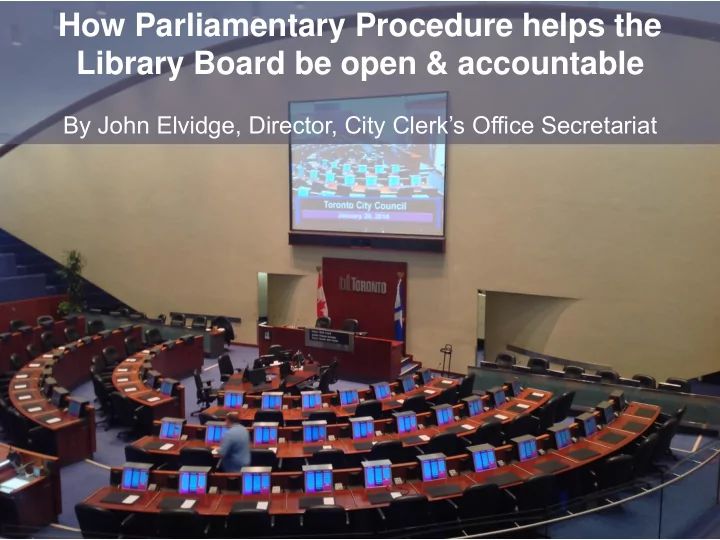
SLIDE 1
How Parliamentary Procedure helps the Library Board be open & accountable
By John Elvidge, Director, City Clerk’s Office Secretariat
SLIDE 2
Public appointees play a valuable role in the governance of City boards
Thank You!
SLIDE 3
Parliamentary procedures are often considered confusing or arcane
SLIDE 4
Modern procedures are rooted in time- honoured principles
1
SLIDE 5 John George Bourinot
- “The great principles that lie at the basis of
English parliamentary law have … been always kept steadily in view by the Canadian legislatures; these are:
- To protect the minority and restrain the
improvidence and tyranny of the majority,
- to secure the transaction of public business in
a decent and orderly manner,
- to enable every member to express his
- pinions within those limits necessary to
preserve decorum and prevent an unnecessary waste of time,
- to give full opportunity for the consideration of
every measure, and
- to prevent any legislative action being taken
heedlessly and upon sudden impulse”.
SLIDE 6 Mason’s Manual of Legislative Procedure
- Body must have authority to act
- Body must make decisions in
meetings
- Proper notice must be given to all
- Quorum must be present
- There must be a question upon which
the body can make a decision
- Must be an opportunity for debate
- Question must be decided by a vote
- Majority is required to decide a
question
- No fraud, trickery or deceptions
- Actions must be lawful and
constitutional
SLIDE 7 Principles of the City of Toronto Council Procedures
- The majority has the right to
decide
- The minority has the right be
heard
- All members have the right to
information to make decisions, unless prevented by law
- Members have the right to an
efficient meeting
- Members have the right to be
treated with respect and courtesy
- Members have equal rights,
privileges and obligations
SLIDE 8
A procedures by-law is part of a larger procedural framework
2
Statute Procedures By-Laws Parliamentary Authority Custom Rulings Policies
SLIDE 9 Statutory Provisions
- A board shall hold regular meetings once a month for at least 10
months each year and at such other times as it considers necessary
- The chair or any two members of a board may summon a
special meeting of the board by giving each member reasonable notice in writing, specifying the purpose for which the meeting is called.
- The presence of a majority of the board is necessary for the
transaction of business at a meeting.
- The chair or acting chair of a board may vote with the other
members of the board upon all questions, and any question on which there is an equality of votes shall be deemed to be negative.
- The board chair may expel any person for improper conduct at a
meeting.
SLIDE 10
Procedure by-laws are part of a larger procedural framework
Statute Procedures By-Laws Parliamentary Authority Custom Rulings Policies
SLIDE 11
Pay attention to open and closed meeting rules
3
SLIDE 12
There is growing public scrutiny of open and closed meetings
SLIDE 13 There is a narrow list of reasons that meetings can be closed
Reasons a meeting may be closed:
- the security of the property of the board;
- personal matters about an identifiable individual;
- a proposed or pending acquisition or disposition of land
by the board;
- labour relations or employee negotiations;
- litigation or potential litigation, including matters before
administrative tribunals, affecting the board;
- advice that is subject to solicitor-client privilege,
including communications necessary for that purpose;
- a matter in respect of which a board or committee of a
board may hold a closed meeting under another Act.
SLIDE 14 The Public Libraries Act imposes some conditions on closed sessions
- A meeting must be closed if the Board is exercising the powers of the
head of the institution in an MFIPPA matter
- Before holding a meeting or part of a meeting that is to be closed to the
public, a board or committee of the board shall state by resolution,
- the fact of the holding of the closed meeting; and
- the general nature of the matter to be considered at the closed
meeting.
- A meeting shall not be closed to the public during the taking of a vote.
- A meeting may be closed to the public during a vote if the vote is for
- a procedural matter or
- for giving directions or instructions to officers, employees or agents
- f the board or committee of the board or persons retained by or
under contract with the board.
SLIDE 15 Avoid some common mistakes
Pre-meeting briefings for board Board “retreats” Going for lunch
Recessing to ask staff questions or “work things out” Telephone or electronic meetings Open meetings in inaccessible locations Lengthy Closed Session; Perfunctory Open Session
SLIDE 16
The City’s confidential document protocol maximizes disclosure of public information
SLIDE 17
“The democratic legitimacy of municipal decisions does not spring solely from periodic elections, but also from a decision-making process that is transparent, accessible to the public, and mandated by law. When a municipal government improperly acts with secrecy, this undermines the democratic legitimacy of its decision, and such decisions, even when intra vires, are less worthy of deference.” Supreme Court of Canada RSJ Holdings v. City of London
SLIDE 18
Public appointees play a valuable role in the governance of City boards
Thank You!