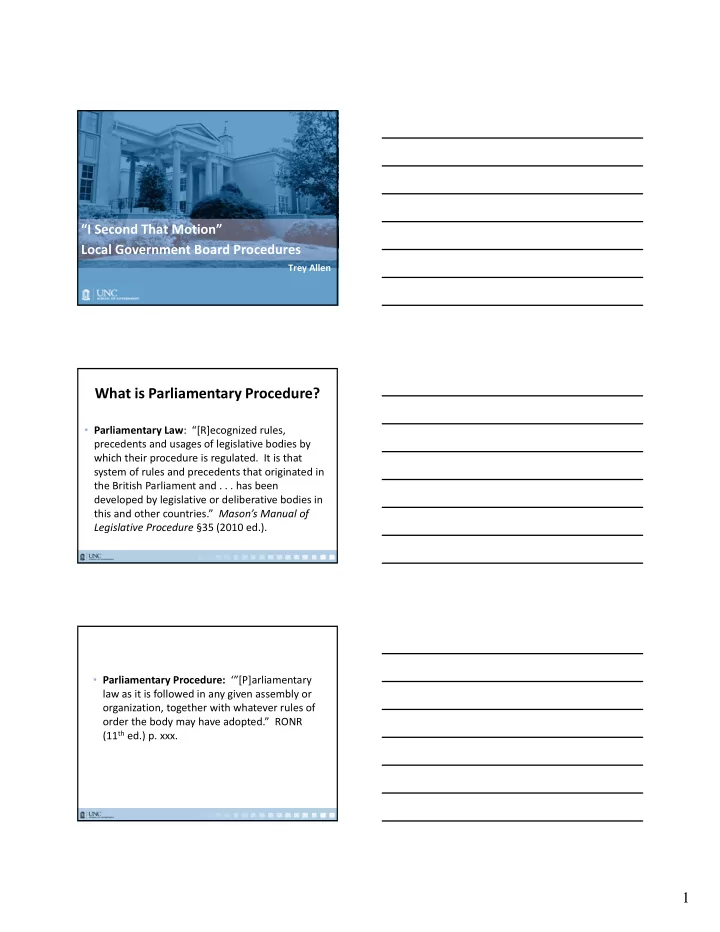
What is Parliamentary Procedure? Parliamentary Law : [R]ecognized - - PDF document

what is parliamentary procedure
SMART_READER_LITE
LIVE PREVIEW

What is Parliamentary Procedure? Parliamentary Law : [R]ecognized - - PDF document

I Second That Motion Local Government Board Procedures Trey Allen What is Parliamentary Procedure? Parliamentary Law : [R]ecognized rules, precedents and usages of legislative bodies by which their procedure is regulated. It is that


slide-1
SLIDE 1

1

“I Second That Motion” Local Government Board Procedures

Trey Allen

What is Parliamentary Procedure?

  • Parliamentary Law: “[R]ecognized rules,

precedents and usages of legislative bodies by which their procedure is regulated. It is that system of rules and precedents that originated in the British Parliament and . . . has been developed by legislative or deliberative bodies in this and other countries.” Mason’s Manual of Legislative Procedure §35 (2010 ed.).

  • Parliamentary Procedure: ‘”[P]arliamentary

law as it is followed in any given assembly or

  • rganization, together with whatever rules of
  • rder the body may have adopted.” RONR

(11th ed.) p. xxx.

slide-2
SLIDE 2

2

Is This Your Board? Purposes of Parliamentary Procedure?

  • To allow the will of the majority to be

determined in an orderly and efficient manner.

  • To protect the rights of individual members

and minorities, particularly their right to participate in the group’s deliberations.

  • Mason’s, § 1.

Sources of Rules

slide-3
SLIDE 3

3

Local Rules

City Charters Ordinances Local Acts

Statutes “Fall-back” Resources

Local Rules

G.S. 160A‐71(e): The council may adopt its own rules of procedure, not inconsistent with the city charter, general law, or generally accepted principles of parliamentary procedure. G.S. 153A‐41: The board of commissioners may adopt its own rules of procedure, in keeping with the size and nature of the board and in the spirit of generally accepted principles of parliamentary procedure.

7 Basic Principles

1. The board’s authority is defined and limited by state law. 2. The board must act as a body. 3. A quorum is necessary for the board to act. 4. The board must act by majority vote. 5. Every member has an equal right to participate. 6. There must be an

  • pportunity for

debate. 7. Meetings should be characterized by fairness and good faith.

slide-4
SLIDE 4

4

8 Common Problem Areas

  • 1. Setting the Agenda
  • 2. Quorum
  • 3. Considering Motions
  • 4. Handling Debate
  • 5. Voting
  • 6. Postponing / Reviving Matters
  • 7. Adjusting for Type of Meeting
  • 8. Managing Public Input
  • 1. Setting the Agenda
  • The board is ultimately

responsible for its own meeting agendas

  • Preparing a preliminary agenda

may be delegated

  • A majority of the board can

always amend the agenda

  • Is there a legal restriction on the

subject‐matter of the meeting (regular, special, etc.)?

slide-5
SLIDE 5

5

  • 2. Quorum
  • Quorum = number of members who must be

present for body to conduct business.

  • For small bodies, quorum is usually defined as

more than half of a body’s members.

  • What about vacant seats?

Counting Quorums ‐ Cities

Total Seats Mayor Vacant Seats

X

Quorum = more than ½ of X

Counting Quorums ‐ Counties

Quorum

More than ½

  • f total seats
slide-6
SLIDE 6

6

Quorum Math

Cities Counties

Vacancies DO NOT count DO count Mayor/Chairman Counts Counts Member steps

  • ut unexcused

Still counts Still counts Member steps

  • ut excused

No longer counts No longer counts

  • What if a member

steps out of a meeting?

  • 3. Considering Motions
  • Only one substantive (main)

motion may be pending

  • Multiple procedural motions may

be pending

  • Motion before discussion, or vice

versa?

  • Are seconds to motions always

needed?

  • When is a motion out of order?
slide-7
SLIDE 7

7

Motion to approve

  • rdinance

Motion to amend

  • rdinance

Motion to postpone 1st motion: Substantive (main) motion 2nd motion: Procedural to substantive motion 3rd motion: Procedural to 2nd motion Motion to call the question 4th motion: Procedural to 3rd motion

Precedence of Motions (RONR)

Privileged Motions

  • Adjourn
  • Recess
  • Question of Privilege

Subsidiary Motions

  • Table
  • Close Debate
  • Postpone to a Certain Time
  • Refer to Committee
  • Amend
  • Postpone Indefinitely

Main Motions

  • Original Main & Incidental Main

(e.g., motion to adopt committee recommendations, motion to limit debate to three minutes)

  • Appeal chair’s ruling
  • Suspend the Rules
  • Consider Informally
  • Point of Order
  • Parliamentary Inquiry
  • Withdrawal of a Motion
  • Division of a Question

Incidental Motions Motion to Bring Matter Back

  • Take from table
  • Rescind
  • Reconsider

Precedence of Procedural Motions (Suggested Rules)

Alter board proceedings

  • Adjourn
  • Recess
  • Follow Agenda
  • Suspend Rules
  • Divide Question

Stop debate

  • Defer Consideration (Table)
  • Call the Previous Question
  • Postpone
  • Refer to Committee

Modify a matter

  • Amend

Revisit a decision

  • Revive Consideration (Remove from table)
  • Reconsider
  • Rescind or Repeal
  • Prevent Reconsideration (Clincher)
slide-8
SLIDE 8

8

  • 4. Handling Debate
  • All members should have

a similar opportunity to speak

  • The presiding officer may

wish to step aside if actively involved

  • Extend courtesy to each
  • ther and the public in

the debate

  • “Calling the previous

question” cuts off debate – requires a vote of the board

– Debate?

  • 5. Voting
  • Member may be excused from

voting only if matter involves the member’s financial interest or

  • fficial conduct or member is

prohibited from voting under

  • 14‐234 (direct benefit in contracting)
  • 160A‐381(d)/153A‐340(g) (legislative

zoning decisions)

  • 160A‐388(e)(2) (quasi‐judicial

decisions)

  • What if unexcused failure to vote?
  • Usually only a simple majority is

required

  • Does the Mayor or Chair vote?
  • Record votes in the minutes
  • Voting by ballot
slide-9
SLIDE 9

9

Cities

  • Special voting requirements in some instances
  • Approve ordinance, (or amendment to ordinance),
  • r contract
  • Majority of all members not excused from voting

(including mayor if equal division)

  • Adopt ordinance on date of introduction
  • 2/3 actual membership – vacant seats
  • Mayor included only if she has right to vote on all

questions

Counties

  • Special voting requirements in some instances
  • Approve ordinance or action having effect of
  • rdinance on date of introduction
  • Approval of ALL members of BOC
  • Exceptions
  • Approve ordinance or action having effect of
  • rdinance at subsequent meeting
  • Majority of votes cast, a quorum being present

Problem 1

  • Council has 7 seats, but 2 are vacant. Mayor may

vote on all questions. On DOI council votes 4 to 2 in favor of proposed ordinance amendment. Result?

slide-10
SLIDE 10

10

Problem 2

  • Council has 6 seats, no vacancies. Mayor

votes only in case of a tie. With 1 member excused from voting, council votes 3 to 2 in favor of ordinance to restrict discharge of firearms within city limits. Vote doesn’t occur

  • n DOI. Result?

Problem 3

  • Board of County Commissioners has 8 seats, one of

which is vacant. With one 1 excused from voting, the board votes 6‐0 in favor of adopting a noise ordinance on the DOI. Result?

Problem 4

  • Same 8‐member board votes 2‐1 to adopt a

proposed pet ordinance, with 3 members absent and 2 excused from voting. The vote occurs at the 1st regular meeting following the DOI. Result?

slide-11
SLIDE 11

11

  • 6. Postponing / Reviving Matters

Procedural Options:

  • Defer consideration (Table)
  • Revive consideration (Take from table)
  • Prevent reintroduction (‘Clincher’)
  • Postpone to a certain date
  • Reconsider
  • Rescind or repeal
  • 7. Adjusting for Type of Meeting
  • Notice, procedural requirements, and what can be

considered may vary depending on type of meeting

  • Regular meeting
  • Special / emergency meeting
  • Quasi‐judicial meeting
  • Recessed / adjourned meeting
  • Workshop
  • Always check state law for specific requirements!
  • 8. Managing Public Input
  • Establish rules for

speakers to ensure fairness and maintain

  • rder
  • Announce rules before

comment period/hearing

  • Provide rules in writing
  • Apply rules consistently

to all speakers

  • Determine subject matter

limitations – if any – in advance (be careful not to trample 1st Amendment)

slide-12
SLIDE 12

12

Public Comment Rules: Tips & Suggestions

 Time limit for speakers (timekeeper?)  Representative to speak for large group  Remove disruptive individuals  Limits signs and displays  Sign‐up sheet  No personal attacks, profanity, etc.  Receiving written comments, handouts, etc.

RONR for Small Boards

  • Member may raise hand instead of standing when

seeking to obtain the floor and may remain seated while speaking.

  • Motions need not be seconded
  • There is no limit to number of times members may

speak to debatable question.

  • Informal discussion of subject is permitted while

no motion pending.

  • When proposal is perfectly clear to all present,

vote may occur without a motion.

  • Presiding officer need not rise while putting

questions to a vote.

  • If presiding officer is a member, she may,

without leaving the chair, speak in informal discussions and in debate, and vote on all questions.

  • RONR (11th ed.), pp. 487‐88.
slide-13
SLIDE 13

13

Bottom Line: KEEP IT SIMPLE! Resources

SOG Publications: www.sog.unc.edu