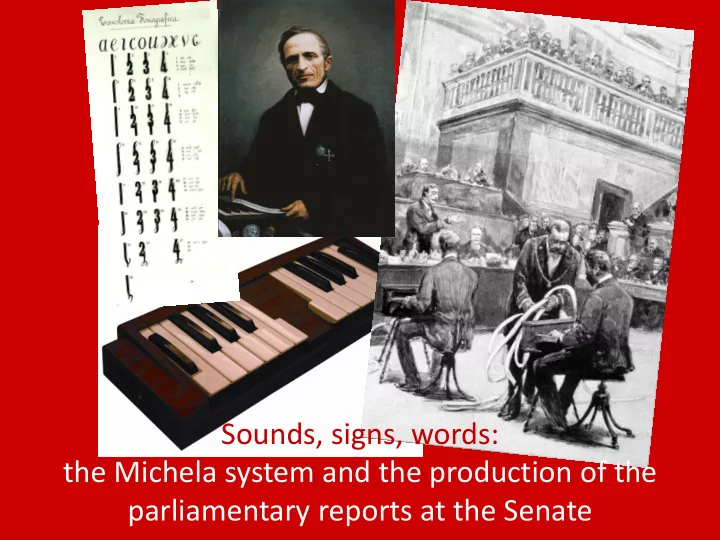
SLIDE 1
Sounds, signs, words: the Michela system and the production of the parliamentary reports at the Senate
SLIDE 2 The birth of parliamentary reporting in Italy
- In the Subalpine Parliament the reporting office was organized by Cavour
(Turin 1848-1861)
- Pen shorthand writing was used
- Then also at the Senate of the Italian Kingdom
(Turin 1861-1865; Florence 1865-1871; Rome 1871-1946)
- From 1880 the Michela stenotyping system has been introduced at the Senate
for verbatim reports
- From 1882 summary report has been introduced, too
SLIDE 3
Garibaldi’s letter
SLIDE 4 The reporting instrument at the Senate from 1880: The Michela keyboard italiana
The ancient model, set on a wood tripod, was used for over a century. It could be easily moved and produced a stripe of paper with symbols.
SLIDE 5
The Michela keyboard as a witness of history: The Floor of the House during the Italian Kingdom (1871-1946)
SLIDE 6 The Senate as a High court of Justice in 1908
The position of the reporters
SLIDE 7 During Mussolini dicatorship in 1929: the Lateran Pact
The shift turns
SLIDE 8
The proclamation of the empire in 1936
SLIDE 9 Inauguration speech
- f the President of the Senate Bonomi
may 8th, 1948
SLIDE 10
Tambroni Government in 1960
SLIDE 11
The Nineties: the Vergoni mechanical keyboard
SLIDE 12
In the 4th Committee
SLIDE 13 The inventor of the Michela keyboard:
Antonio Michela Zucco (1815 – 1886)
A school TEACHER keen on drawing, music and anatomy he studied the human vocal apparatus and classified all the sounds that it could produce Searching a UNIVERSAL ALPHABET to make all men brothers and sisters (like IPA) He invented:
- A PEN PHONETIC WRITING SYSTEM
- A MACHINE PHONETIC WRITING SYSTEM
That were both universal (to write and reread, even after a long time and without knowing them, all the languages of the world)
SLIDE 14 The recent adaptation for arabic language
f s sh h h emphatic s emphatic j z ' t th voiced k b d k emphatic written "q" gh m n th d emphatic kh r l i, y t emphatic th voiced emphatic u, w
SLIDE 15 SOUNDS, SIGNS, WORDS: The phonographic palette
Elements of the articulations Organs that generate the articulations LIPS (Bilabial/labiodental) TONGUE FRONT (Alveolar) CENTRAL (Postalveolar) BACK (Velar) BLOW (Fricative) PURE (Voiceless) 1 - F [f] Voiceless labiodental fricative 2- S [s] Voiceless labiodental fricative 3- Sc [ʃ] Voiceless postalveolar fricative 4- H [x] Voiceless velar fricative MIXED (Voiced) 5 - V [v] Voiced labiodental fricative 6 - s [z] Voiced labiodental fricative 7 - Ge [ʒ] Voiced postalveolar fricative 8 - H [ɣ] Voiced velar fricative MODIFICATION (Plosive / affricate) HARD (Voiceless) 9 - P [p] Voiceless bilabial plosive 10 - T [t] Voiceless dental plosive 11 - C [ʧ] Voiceless postalveolar affricate 12 - CK [k] Voiceless velar plosive SOFT (Voiced) 13 - B [b] Voiced bilabial plosive 14 - D [d] Voiced dental plosive 15 - G [ʤ] Voiced postalveolar affricate 16 - G [g] Voiced velar plosive VOICE NASAL 17 - M [m] Bilabial nasal 18 - N [n] Labiodental nasal 19 - Gn [ɲ] Palatal nasal 20 - n [ɳ] Velar nasal ORAL (Semiconsonant, approximant, liquid) 21 - U [u] / [w] Back close vowel / Velar semiconsonant 22 - R [r] Liquid labiodental trill 23 - L [l] Liquid lateral alveolar approximant 24 j [j] Central close vowel / Palatal semiconson ant 25 (tedesco) ch [χ] Voiceless uvular fricative 26 (inglese) th [θ] / [ð] Voiceless / Voiced dental fricative
SLIDE 16
The correspondence between phonemes, numbers, symbols and keys on the keyboard
SLIDE 17 The distribution of the sounds on the keyboard:
The Michela writing system is phonetic and syllabic
The parts of the syllables and the position of the hands
1 2 3 6 9 18 The original symbols and the numbers
SLIDE 18 The internal mechanics
The silver medal at the 1878 Paris Universal EXPO The stenotelegraph by Cassagnes
SLIDE 19
- The Michela system has been originally
conceived as a help for visually impaired
- The paper stripe was punched in relief
- Today we adapted it to Braille alphabet
SLIDE 20
The volution of the keyboard, from the mechanical, to the electric, electronic and digital version
SLIDE 21 Nowadays: digital stenotyping and the real time text, the perfect interaction bewtween man and machine
SLIDE 22 The on line publication timing of the real time drafts, during the session itself in 30 minutes (from 2001)
The need to be fast in catching up whatever they say and whatever they do
SLIDE 23
The forced alignment
SLIDE 24 The organization of the workflow
- The TRANSCRIPT in the plenary (5 minutes)
- The EDITING phase (30 minutes):
Passage from words to text, queries of names and legislative provisions, describing physical events (physiology, in italics and round brackets), inputting formulaic phrases of procedural steps and of tags (hypertext marks)
- The first CORRECTION level (by revisors, who spend
40 minutes in the plenary) and then final revision (harmonization with annexes + indexing)
- Final ON LINE PUBLICATION before the following day
and ARCHIVING in the databases
SLIDE 25 The staff
- 28 people: 15 stenotypists and 13 reporters
(for both Plenary and Committees)
- Transcript + editing in the plenary (9-12)
- Plenary revisors (4) – Commitee revisors (2)
- Final harmonization in Plenary (1)
- On line Publication of Plenary (2)
- Annex to the Plenary session (2)
- Plenary Session Communiqué (1)
SLIDE 26 Accessibility
- f the Michela writing system:
- Youtube tutorials to adapt a music keyboard
as a Michela keyboard
THE MICHELA STENOTYPE SYSTEM CHANNEL
SLIDE 27 Test and occasional Michela workshops for students and schools at the Senate Library:
Michela stenotyping system theory and dictionaries available on line for free: https://github.com/benoit-pierre/plover_michela Open source free softweare Plover
SLIDE 28 Disability
- Digital stenotyping and real time close captioning for
hearing-impaired
- Michela system with Braille alphabet and vocalizer
for visually impaired (International Braille day)
SLIDE 29 To play a Michela keyboard like a piano:
- The italian-australian artist Angelica Mesiti
- presented her project «Assembly» during the
2019 Venezia BIennale
- Where we wrote the poem «To be written in
another tongue» of the australian David Malouf with a Michela keyboard linked to a music software (like a pianola)
- So we played the text and listened to its music
SLIDE 30
SLIDE 31
The Venice 2019 Biennale The old Parliament House in Canberra Museum of Australian Democracy
SLIDE 32
Latest experimentations: The DIY LEGO Michela machine as a game for passionates and children