UNIVERSITY SENATE November 7, 2016 Minutes The University Senate - - PDF document

university senate november 7 2016 minutes the university
SMART_READER_LITE
LIVE PREVIEW

UNIVERSITY SENATE November 7, 2016 Minutes The University Senate - - PDF document

University Senate, November 21, 2016 Agenda Item 2.a/Attachment A UNIVERSITY SENATE November 7, 2016 Minutes The University Senate was called to order at 3:35 p.m., in Room 102, Benton Hall, Oxford Campus, on Monday, November 7, 2016. Members


slide-1
SLIDE 1

University Senate, November 21, 2016 Agenda Item 2.a/Attachment A

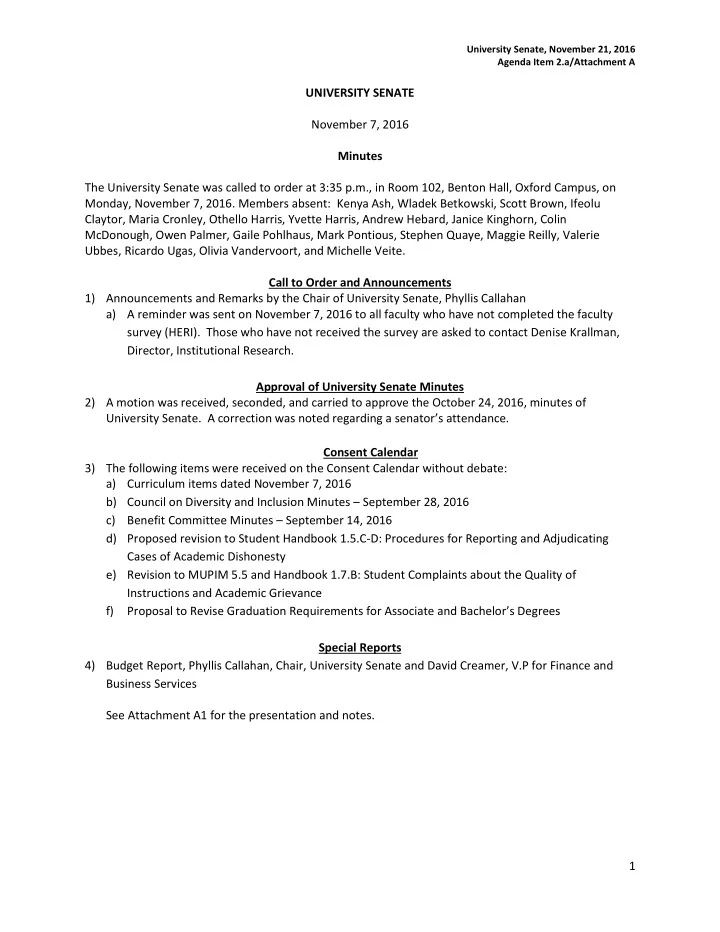
1 UNIVERSITY SENATE November 7, 2016 Minutes The University Senate was called to order at 3:35 p.m., in Room 102, Benton Hall, Oxford Campus, on Monday, November 7, 2016. Members absent: Kenya Ash, Wladek Betkowski, Scott Brown, Ifeolu Claytor, Maria Cronley, Othello Harris, Yvette Harris, Andrew Hebard, Janice Kinghorn, Colin McDonough, Owen Palmer, Gaile Pohlhaus, Mark Pontious, Stephen Quaye, Maggie Reilly, Valerie Ubbes, Ricardo Ugas, Olivia Vandervoort, and Michelle Veite. Call to Order and Announcements 1) Announcements and Remarks by the Chair of University Senate, Phyllis Callahan a) A reminder was sent on November 7, 2016 to all faculty who have not completed the faculty survey (HERI). Those who have not received the survey are asked to contact Denise Krallman, Director, Institutional Research. Approval of University Senate Minutes 2) A motion was received, seconded, and carried to approve the October 24, 2016, minutes of University Senate. A correction was noted regarding a senator’s attendance. Consent Calendar 3) The following items were received on the Consent Calendar without debate: a) Curriculum items dated November 7, 2016 b) Council on Diversity and Inclusion Minutes – September 28, 2016 c) Benefit Committee Minutes – September 14, 2016 d) Proposed revision to Student Handbook 1.5.C-D: Procedures for Reporting and Adjudicating Cases of Academic Dishonesty e) Revision to MUPIM 5.5 and Handbook 1.7.B: Student Complaints about the Quality of Instructions and Academic Grievance f) Proposal to Revise Graduation Requirements for Associate and Bachelor’s Degrees Special Reports 4) Budget Report, Phyllis Callahan, Chair, University Senate and David Creamer, V.P for Finance and Business Services See Attachment A1 for the presentation and notes.

slide-2
SLIDE 2

Attachment AI University Senate: Budget Symposium November 7, 2016 2

1

University sity Senate te

Budget Symposium November 7, 2016 Phyllis Callahan, Provost and David Creamer, Senior Vice - President

2

slide-3
SLIDE 3

Attachment AI University Senate: Budget Symposium November 7, 2016 3

E&G Unrestricted $455,351,560 66% Auxiliary $188,895,522 27% Restricted $47,200,000 7%

Fig 1. Miami University - Oxford Campus Why are there 3 distinct budgets?

E&G includes unrestricted and designated funds.

3

Fig 1. There are 3 distinct budgets: General Operating (E&G Unrestricted); Restricted; and, Auxiliary

  • Education and General (E&G) Operating Budget: includes unrestricted as well as

designated funds, i.e. course/program fees that are retained by the department or program, e.g. lab or art fees.

  • Auxiliary Budget: Business operations, which includes residence and dining halls and

Intercollegiate Athletics. They generate their own revenue and/or may receive general fee support and they must plan how to manage the use and costs of their facilities.

  • Restricted: these funds include sponsored grants, endowments, and other funds that

are restricted by the donor or grantor.

slide-4
SLIDE 4

Attachment AI University Senate: Budget Symposium November 7, 2016 4

Restricted $46 M 7% Auxiliary $22.5 M 4% E & G $27.9 M 4% Appropriation $1.2 M 0%

Appropriation

$65.6 M 10% Auxiliary $118.9 M 19% E & G $361.9 M 56%

Fig 2. 85% of Revenues in the FY17 Budget are Enrollment Dependent

(Includes Tuition Discounts)

Total Enrollment Dependent Revenue $546.4 M Other Revenue

4

Fig 2. Miami is fairly unique in that 85% of our revenues are enrollment dependent, which drives sources of funding. E&G $361.9 M 56% Auxiliaries $118.9M 19% State Appropriation* $ 65.6M 10% TOTAL $546.4M 85% *The state appropriation is determined by a formula that takes our enrollment and graduations into account. Only 1 or 2 other public institutions have a greater dependence on enrollment. Even many private colleges and universities are less enrollment dependent than Miami.

slide-5
SLIDE 5

Attachment AI University Senate: Budget Symposium November 7, 2016 5

Personnel $256.6 M 71%

Support Costs $77.7 M 22% Other Transfers $18.8 M 5% Debt Service $7.9 M 2%

Fig 3. FY 2017 E&G Budget by Expense Category How is the Unrestricted E&G Budget Spent?

(Excludes scholarships, fellowship waivers & general fee)

5

Total = $361 M

Spend of enrollment dependent E&G revenue

Fig 3. Another important characteristic of our unrestricted E&G budget is that we are highly human resource driven - a large portion of our expenses (71%) are in personnel costs, i.e. salary and benefits. Anything that is done to improve compensation drives the University’s budget. NB: Scholarships, which are not shown in this figure, are another major driver of spending.

6

slide-6
SLIDE 6

Attachment AI University Senate: Budget Symposium November 7, 2016 6

Table 1. FY2017 Key Budget Assumptions Oxford Campus

Budget / Actual

Fall Class – First Time Students 3,700 / 3,799 Enrollment Mix - Non-Resident (first year) 45 % / 44 % Tuition Increase – Undergraduate & Graduate Resident 0 % Tuition Increase – Undergraduate & Graduate Non Resident 2 % Tuition Increase – Tuition Promise Resident 2.9 % Tuition Increase – Tuition Promise Non Resident 4.9 % State Share of Instruction - Change from FY16 Actuals 8.6 % Salary Increment Pool 3 % Strategic Priorities Initiatives New Revenue $6,734,435 Productivity Improvements ($2,635,199)

7

Table 1: The Board of Trustees approved the projected budget [denoted Budget in blue text on lines 1 & 2] in June 2016. The actual budget is shown in black text (lines 1 & 2). For the second year in a row, there was not a tuition increase for Ohio residents (line 3), but there was a 2% increase for non-residents (line 4). Also, this is the first year for the Tuition Promise, so tuition did increase by 2.9% for first-year students who are Ohio residents and by 4.9% increase for non-residents. The reason for the difference in the rate increase for resident students versus non-resident students is that the tuition freeze was assumed in setting the initial Tuition Promise rate for Ohio residents. This rate is locked for 4 years starting in AY 2016- 17. The State Share of Instruction had its largest increase in several years and the Oxford Campus had a disproportionate share in the proposed gain from the state, which was 4% overall in the state. In addition to the salary increment pool of 3%, there was an additional 1% market adjustment awarded to faculty.

slide-7
SLIDE 7

Attachment AI University Senate: Budget Symposium November 7, 2016 7 Commitments: Salary & Benefit Commitments $ 11,235,056 New Investments: New Academic Investments $ 3,508,759 Regulatory, Communications & IT Security $ 624,360 Sexual Assault & Crisis Services Student Investments $ 559,377 Student Financial Aid $ 14,100,000 FY17 Program Improvements $ 30,027,552

Table 2. FY 2017 Program Improvements

Oxford Unrestricted E & G Budget

8

Table 2: This is how the program improvements portion of the E&G budget were spent. There were additional salary demands beyond the normal increment, market adjustments, and promotion increases for faculty because we needed to meet FLSA requirements. Those new requirements have necessitated adjustments in overtime compensation for the University to be in compliance.

Unrestricted E & G Revenue Source Growth Needed to Exclusively Fund Tuition Increase 7.35% Increase State Appropriation Increase 46.1% Increase New Endowment $677.8 M in New Endowment

Table 3. Revenue Growth Necessary for Sustaining Annual Spending Increase (Including Financial Aid)

  • f $30.5 Million

9

Table 3. This represents what it would take to cover the additional spending increase of $30.5

  • M. We do not anticipate any of these occurring.
slide-8
SLIDE 8

Attachment AI University Senate: Budget Symposium November 7, 2016 8

E&G Net Tuition & Fees $361.9 80%

State Appropriation $65.6 M 14% E&G Other Designated $14.6 M 3% E&G Sales, Grants & Contracts $4.0 M 1% E&G Investment, Endowment & Gifts $9.2 M 2%

  • Fig. 4 FY 2017 E & G Unrestricted Revenue Budget

10

Fig 4. Within the Unrestricted area of the Education and General (E&G) Fund, 80% comes from tuition and fees. The remaining 20% come from other sources that are relatively minor except for the state appropriation.

Instruction & Other Academic Activities $225.1 M 59%

Budgeted Scholarships & Fellowships $17.7M

Student Services $24.6M 6% Institutional Support $78.3M 20% Plant O&M $31.5M 8% Debt Service $7.8M 2% Total Education & General Expenditure Budget=$384.2 M

5%

  • Fig. 5 How is the budget allocated across major university functions?

11

Fig 5. The expenditures from the E&G budget. The majority of the expenditure (59%) is for instruction and other academic activities (blue portion of the pie chart). The debt service charged to the E&G portion of the budget is $7.8M. The total annual debt service is approximately $52M, but most of that is charged to auxiliary budgets, primarily from room and board (remember auxiliaries generate their own revenue and they must plan how to manage the use and costs of those facilities).

slide-9
SLIDE 9

Attachment AI University Senate: Budget Symposium November 7, 2016 9

Table 4. FY 2017 Divisional Budgets

Revenue/Expense Description College of Arts & Science College of Education, Health & Society Farmer School

  • f Business

College of Engineering & Computing College of Creative Arts Total Oxford Total Revenue Sources $ 169,713,123 $ 47,262,659 $ 70,132,993 $ 22,927,271 $ 21,094,612 $ 331,130,659 Total Expenses and Transfers $ 163,959,064 $ 43,814,570 $ 65,148,523 $ 19,182,470 $ 25,487,261 $ 317,591,888 Balance Before Subvention $ 5,754,060 $ 3,448,089 $ 4,984,470 $ 3,744,801 $ (4,392,649) $ 13,538,771 Subvention $ (2,983,044) $ (839,248) $ (959,220) $ - $ 4,781,513 $ 0 Ending Balance After Subvention $ 2,771,016 $ 2,608,841 $ 4,025,250 $ 3,744,801 $ 388,864 $ 13,538,771

12

Table 4. Following our RCM model, the non-committed budgetary spending, i.e. the “Ending Balance After Subvention” is distributed to each of the five academic divisions as shown. Subvention is held constant and covers the added cost of teaching in CCA.

$- $20 $40 $60 $80 $100 $120

Residence & Dining Halls Shriver Center Intercollegiate Athletics Recreational Sports Center Goggin Ice Center Student Health Services Transportation Services Student Activities Marcum Conference Center Aviation Services Armstrong Student Center Millet Hall-Student Facilities Millions

  • Fig. 6 FY17 Expenditure Budget

Oxford Campus Auxiliary Operations and Student Activities

General Fee Scholarships and Student Support Services Funded by General Fee Auxiliary Funded Activities

13

Fig 6. Tuition includes an instructional fee and a general fee (blue bar). The general fee covers the cost of student-related activities, including Intercollegiate Athletics. Intercollegiate Athletics is the largest beneficiary of the non-scholarship portion of the general fee and they also generate their own revenue sources as do the auxiliaries (red bars).

slide-10
SLIDE 10

Attachment AI University Senate: Budget Symposium November 7, 2016 10

NB: A portion of the general fee that is allocated to ICA is to fund scholarships (blue hatched bar). No general fee is allocated to the residence and dining halls. All of their revenue is from room and board fees or sales and services.

FY16 FY15 FY14 FY13 FY12 FY11 FY10 FY09 Revenues 99,675,905 95,379,311 88,831,459 81,287,838 78,756,210 76,033,181 73,504,118 68,559,447 Expenses Salaries & Benefits 20,457,009 19,779,250 19,282,892 19,143,162 20,522,868 21,083,130 26,154,177 29,185,462 Operating Expenses and Food Purchases 39,857,601 37,262,741 34,963,967 31,912,746 32,959,940 31,815,715 26,335,723 27,819,033 Total Expenses 60,314,610 57,041,991 54,246,859 51,055,908 53,482,808 52,898,845 52,489,900 57,004,495 Net Income Before Debt Service and Transfers 39,361,294 38,337,320 34,584,600 30,231,930 25,273,402 23,134,336 21,014,218 11,554,952 Befort Debt Service and Transfers Debt Service and Transfers Debt Service (33,873,421) (30,866,290) (22,303,542) (19,882,993) (11,906,810) (5,816,005) (3,760,628) (3,796,186) Transfers for Future Capital Projects (5,487,287) (7,463,613) (11,845,020) (10,305,050) (13,339,934) (17,216,813) (17,089,500) (7,708,962) Total Facility Investment (39,360,708) (38,329,903) (34,148,562) (30,188,043) (25,246,744) (23,032,818) (20,850,128) (11,505,148) Net Increase in fund balance for fiscal Year 586 7,417 436,038 43,887 26,658 101,518 164,090 49,804

Table 5. Residence and Dining Halls Net Increase for Fiscal Year Fiscal Year 2016 - 2009

Preliminary and Unaudited

14

Table 5. The debt service for Residence and Dining halls has increased from FY 2009 ($3.796M) to FY 2016 ($33.873M). They have made adjustments in spending to offset this increased debt. The housing and dining master plan is 65% complete. Excluding Heritage Commons Housing, the average age of housing facilities was 61 years when the plan was initiated in 2010. To update

  • ur facilities, the cost estimate was originally $900M, but we were able to reduce that to $700M
  • $750M. We can only meet this need through new debt.

15

slide-11
SLIDE 11

Attachment AI University Senate: Budget Symposium November 7, 2016 11

FY2016 FY2015 Change Central Funds (201,047,239) (191,858,921) (9,188,318) Academic Affairs 163,490,661 137,523,593 25,967,068 Administrative Units 30,702,598 27,538,865 3,163,733 Auxiliary Enterprises 95,050,505 109,827,563 (14,777,059) Quasi-Endowments 86,037,700 74,891,377 11,146,323 Capital Projects Funded But Not Expended 79,083,876 52,791,669 26,292,207 Total Unrestricted Net Position 253,318,100 210,714,146 42,603,955 Summary

Table 6. Unrestricted Net Position

Preliminary and Unaudited

16

Table 6. The unrestricted net position is sometimes referred to as ‘reserves.’ There are two primary areas: Academic Affairs and Capital Projects. NB: There are projects that are planned and dollars that have been allocated to those capital projects, but the money has not been spent yet (line 6 in the table).

slide-12
SLIDE 12

Attachment AI University Senate: Budget Symposium November 7, 2016 12

Preliminary & Unaudited FY2016 FY2015 Change Unallocated Fund Balance $5,365,265 $3,908,946 $1,456,319 Reserve for Future Budgets 12,744,512 12,744,512 Reserve for Investment Fluctuations 14,879,475 23,874,823 (8,995,348) Reserve for Health Care Stabilization 15,000,000 15,000,000 Reserve for Financial Aid 6,735,262 6,485,129 250,133 Renewals and Replacement Funds (Not Committed) 8,001,205 10,035,313 (2,034,109) Encumbrances/Purchase Orders for Prior Years 3,994,395 3,559,330 435,065 Miscellaneous Reserves 1,547,953 1,547,953 Central Carryforward and Designated Funds 8,793,289 7,140,021 1,653,268 Subtotal Central Funds 77,061,356 84,296,028 (7,234,672) Ohio Pension Liability (278,108,595) (276,154,949) (1,953,646) Total Central Funds (deficit) ($201,047,239) ($191,858,921) ($9,188,318) Miami University Unrestricted Net Position Central Funds

17

Table 7 – Unrestricted Net Position

Ohio Pension Liability represents Miami’s contribution to cover STRS and PERS pension funds that are not currently fully funded by the state system. Accounting standards require that the liability be shared proportionally by all schools that participate in the plan. This amount does not include any shortfall in healthcare. A 30-year window is what is expected to be funded when calculating the amount needed to fund future demands on the retirement systems. Please note: STRS and PERS primarily offer defined benefit plans. This does not apply to the ARP, which is a defined contribution plan – once the employer contributes, their responsibility is met. General Assembly directed the retirement systems to achieve certain goals because the retirement system in OH faces a similar situation that Social Security faces nationally, i.e. a likely short fall in the funds needed to meet the benefits expected.

slide-13
SLIDE 13

Attachment AI University Senate: Budget Symposium November 7, 2016 13

18

10.1% 8.6% 1.6% 6.0% 1.4% 0.5% 8.7%

0% 5% 10%

1977-1990 1990-2006 2006-2017 2016-2017

Fig 7. Budget Changes over Last 40 Years

Annualized Rates of Change in Historic Revenue Sources

Resident Tuition State Appropriation Expenses

19

Fig 7. The annualized rate of change in tuition between 1977-1990 was slightly more than 10% and the state appropriation increased by 6%. Between 1990-2006, the annualized rate of tuition increases was 8.6% while state appropriation was only 1.4% - a reduction from the previous

  • period. Between 2006-2017, tuition has only increased by 1.6% on an annualized basis and the

state subsidy only increased by 0.5%. At the same time, our annual expenses for just one year increased by 8.7%. This creates a challenging environment.

slide-14
SLIDE 14

Attachment AI University Senate: Budget Symposium November 7, 2016 14

$50.9 $53.7 $70.9 $58.8 $71.1 $67.7 $66.6 $54.9 $56.2 $56.8 $54.3 $58.5 $65.6 $0 $10 $20 $30 $40 $50 $60 $70 $80

FY 1991 FY 1996 FY 2001 FY 2007 FY 2009 FY 2010 FY 2011 FY 2012 FY 2013 FY 2014 FY 2015 FY 2016 FY 2017

  • Fig. 8 Oxford Campus State Appropriation (FY1990 - FY2017)

(Millions)

20

Fig 8. There has been fluctuations in the state appropriation. While recently increased (at the same time tuition was held frozen), we expect, given the historic data, that the subsidy will continue to experience significant volatility in the future.

Personal Income Tax Medicaid (State Share) Higher Education

$0 $2,000 $4,000 $6,000 $8,000 $10,000

FY00 FY01 FY02 FY03 FY04 FY05 FY06 FY07 FY08 FY09 FY10 FY11 FY12 FY13 FY14 FY15 FY16

Fig 9. Structural Change in Ohio's GRF Budget:

Trends in Income Tax Revenue & Spending on Medicaid and SSI

21

Fig 9. There is a downward trend in the revenues generated from personal income tax and finding new revenue sources is challenging. At the same time, the Governor is asking for a 10% reduction plan for the next budget while the state’s share of Medicaid costs increase. These trends historically have led to decreased spending appropriations for higher education.

slide-15
SLIDE 15

Attachment AI University Senate: Budget Symposium November 7, 2016 15

$60.4M $82.2M $8.1M $194.1M $150.7M

$M $50M $100M $150M $200M $250M State Appropriation Resident Undergraduate Net Tuition Graduate Student Net Tuition Nonresident Undergraduate Net Tuition State Appropriation + Resident UG Net Tuition + Graduate Net Tuition

Fig 10. Oxford Campus Revenue Sources

22

Fig 10. The tuition generated from non-residents is a significant revenue source. In fact, the net tuition revenue from non-resident students ($194.1M – fourth blue bar) is greater than the combined net revenue ($150.7M – red bar) from the other sources, i.e. state appropriation ($60.4M) + Resident UG Net Tuition ($82.2M) + Graduate Net Tuition ($8.1M) = $150.7M. Our more national and international recruitment strategies have helped improve the budget, while also increasing the quality and the diversity of our class.

slide-16
SLIDE 16

Attachment AI University Senate: Budget Symposium November 7, 2016 16

8.9 11.1 12.8 17.7 16.8 20.1 24.0 26.8 28.2 29.2 30.2 31.3 32.4 33.5 34.7 9.9 9.4 17.1 22.9 26.9 34.6 40.0 47.7 54.3 63.6 70.3 76.0 79.7 82.7 83.7 85.8

$M $20M $40M $60M $80M $100M $120M $140M FY10 FY11 FY12 FY13 FY14 FY15 FY16 FY17 FY18 FY19 FY20 FY21 FY22 FY23 FY24 FY25

  • Fig. 11 Undergraduate Cohort-Based Financial Aid

Total Incoming Cohort Total Continuing Cohort

23

  • Fig. 11. The commitment of financial aid that is offered each year is only ¼ of the cost of a 4-

year class, so we track the costs associated with the incoming class (blue portion of the bar) and the portion we need to cover the entire 4 years of financial aid (red portion of the bars). Miami does not reduce the amount of financial aid a student is offered when admitted unless, criteria set by that award are not met, e.g. maintaining a certain GPA. Additionally, with the implementation of the Tuition Promise, students know their tuition and fees will not change

  • ver a 4-year period. As we see more pressure to attract talented students, we will need to

continue to provide financial aid. It is also important to remember that the state has disinvested financial aid.

slide-17
SLIDE 17

Attachment AI University Senate: Budget Symposium November 7, 2016 17

5 10 15 20 25 30

13,000 13,500 14,000 14,500 15,000 15,500 16,000 16,500 17,000 17,500

1990 1991 1992 1993 1994 1995 1996 1997 1998 1999 2000 2001 2002 2003 2004 2005 2006 2007 2008 2009 2010 2011 2012 2013 2014 2015 2016 Average ACT Enrollment Fig 12. Total Undergraduate 15th Day Enrollment and Average ACT Fall 1990 to Fall 2015 Change in pricing strategy - non-resident price for all students Return to resident and non-resident tuition Total Undergraduate Average ACT

24

Fig 12. illustrates enrollment changes over time. Miami has grown the size, quality, and diversity

  • f our incoming classes. We believe Oxford has reached capacity for growth.

Student Type FY12 FY13 FY14 FY15 FY16 FY17 Incoming Nonresident Undergraduates 23,568 $ 24,201 $ 21,812 $ 24,211 $ 24,905 $ 25,141 $ Price Benchmark 24,393 $ 24,757 $ 25,252 $ 25,757 $ 27,045 $ Incoming Resident Undergraduates 10,146 $ 10,389 $ 9,928 $ 9,524 $ 9,736 $ 9,287 $ Price Benchmark 10,450 $ 10,610 $ 10,823 $ 10,823 $ 11,039 $ Graduate 1,067 $ 3,889 $ 5,392 $ 5,199 $ 6,109 $ 5,457 $ Incoming Student FTEs Incoming Nonresident Undergraduates 1,343 1,418 1,421 1,567 1,675 1,668 Incoming Resident Undergraduates 2,238 2,316 2,223 2,076 2,136 2,131 All Graduate 1,322 1,244 1,251 1,323 1,293 1,360 Impact of Changes in Discount for Incoming Students on Net Tuition

$26,769 $26,263 $26,389 $26,808 $27,018 $27,040

$11,530 $11,106 $11,519 $11,763 $11,233 $10,518

$1,067 $3,889 $5,392 $5,199 $6,109 $5,457

$- $5,000 $10,000 $15,000 $20,000 $25,000 $30,000

FY12 FY13 FY14 FY15 FY16 FY17 Annual Net Tuition Per Student All Nonresident Undergraduate All Resident Undergraduate All Graduate

25

  • Fig. 13

Fig 13. Note the leveling off of net tuition revenues from both non-resident and resident tuition.

slide-18
SLIDE 18

Attachment AI University Senate: Budget Symposium November 7, 2016 18

142.4M 146.3M 151.8M 159.2M 165.5M

27.4M 27.1M 29.0M 30.5M 31.8M 24.8M 19.2M 15.1M 16.6M 20.8M 16.2M 13.5M 10.5M 11.5M 11.1M 13.9M 13.5M 12.9M 13.2M 13.1M 30.3M 29.8M 38.4M 36.0M 43.4M

$M $50M $100M $150M $200M $250M $300M FY12 FY13 FY14 FY15 FY16

Salaries Benefits Healthcare Budgeted UG Aid Utilities Support Expenditures

26

Fig 14. Unrestricted Expenses FY12 - FY16 Fig 14. shows a breakdown of spending. The majority of spending is in salary and benefits and it has increased in FY16.

Review ew of Budget et Model

27

slide-19
SLIDE 19

Attachment AI University Senate: Budget Symposium November 7, 2016 19

Budget Model History at Miami

  • Several decades of using an incremental, government type budget model
  • In 2007 President Hodge appointed a budget review committee chaired by Steve

Wyatt that recommended adopting a responsibility based (decentralized) budget model (RCM)

  • In 2010 the Strategic Priorities Committee also recommended the adoption of RCM

for the University’s budget model

28

Budget Model History at Miami

  • In 2011 Provost Gempesaw recommends RCM and two academic committees and

the associate vice president for budget design the new budget model

  • The 2012-13 budget year was used to pilot RCM
  • RCM was fully implemented for 2013-14
  • Fiscal Priorities will review the current approach to RCM and provide its report to the

president and provost by spring break 2017

29

slide-20
SLIDE 20

Attachment AI University Senate: Budget Symposium November 7, 2016 20

30 31

slide-21
SLIDE 21

Attachment AI University Senate: Budget Symposium November 7, 2016 21

675 681 669 672 667 676 659 633 599 580 592 603 603 10 13 30 34 37 48 70 81 95 102 108 109 174 141 131 126 138 114 143 148 153 168 213 238 273

100 200 300 400 500 600 700 800 900 1000

2004 2005 2006 2007 2008 2009 2010 2011 2013 2013 2014 2015 2016 Prelim

Fig 15. Full-Time Faculty Appointments (Fall 2004-2016)

Tenured/Tenure Eligible Lecturer/Clinical Faculty Visitors

as of 10/17/16

32

18.1% *

61.2% % **

**

* % of LCPL of the T/TT Faculty ** % of T/TT Faculty of Total Faculty

72.3%

As of 10/17/2016 Source: OIR

Fig 15. Following the “great recession” in 2008-09, there was a decrease in tenure line faculty from 676 in the fall of 2009 to 659 in the fall of 2010, which is a loss of 17 positions (2.6%). That was followed by a further decrease over the next 5 years to 603 in 2015 (not changed in 2016), a decrease of 56 positions representing a 8.5 % decline (56/659 = 8.5%). When we examined the change in the number of Tenure/Tenure Track (T/TT) faculty from 2004, prior to the “great recession” to the number of T/TT faculty in 2015, there were 675 faculty in 2004 compared to 603 in 2015 and in 2016; that is a decline of 72 or 10.7% (72/675 = 10.7%). If we look at the past 11 years, we see that we had the highest number T/TT faculty in 2005. At that time, there were 681 T/TT faculty so the decline in the number of T/TT faculty from that highest level in 2005 to 2015 and 2016 was 78 or 11.5% (78/681 = 11.5%). Over this same period of time, University Senate approved the hiring of lecturers and clinical faculty (LCPL) to provide additional teaching support and to allow more flexibility and

  • pportunities for T/TT faculty to pursue research, including research leaves, course reductions,
  • etc. As of Fall, 2015, we had 108 LCPL faculty, comprising 17.9% or T/TT faculty. In fall, 2016, we

have 109 or 18.1% of the T/TT faculty. In 2015, T/TT faculty comprised 63.5% of total full time faculty (Total = T/TT + LCPL + visitors, i.e. 603 T/TT + 108 LCPL + 238 visitors = 949; 603/949 = 63.5%). Also, please note that, in Fall 2015, T/TT faculty plus LCPL were 75% of total full time faculty (603+108 = 711 and 711/949 = 74.9%). In fall, 2016, T/TT plus LCPL (603+109 = 712) were 72.3% of the 985 total, full time faculty (603 T/TT + 109 LCPL +273 VAP = 985 total; 712/985 = 72.3%) In Fall, 2010, there were 143 full time visiting faculty in Oxford. In Fall, 2015, there were 238, which is an increase of 95, i.e. a 66.4% increase (95/143 = 66.4%). In fall 2016, there were an additional 38 visiting faculty, an additional 16% increase (38/238).

slide-22
SLIDE 22

Attachment AI University Senate: Budget Symposium November 7, 2016 22

675 681 669 672 667 676 659 633 599 580 592 603 603 10 13 30 34 37 48 70 81 95 102 108 109 174 141 131 126 138 114 143 148 153 168 213 238 273 67 64 61 73 60 64 69 70 61 66 73 68

20 40 60 80 100 120 140 160 100 200 300 400 500 600 700 800 900 1000

2004 2005 2006 2007 2008 2009 2010 2011 2012 2013 2014 2015 2016 Prelim as of 10/17/16

Fig 16. Full-Time Faculty Appointments & Faculty Leaves (2004-2016)

Tenured/Tenure Eligible Lecturer/Clinical Faculty Visitors Leaves

33

Source: OIR

Fig 16. Over this same period of time, the Deans and Provost have sought to maintain the number of assigned research leaves (ARA) and faculty improvement leaves (FIL). While there have been fluctuations in the number of approved leaves, these numbers have been relatively constant. Also, please note that, with the exception in 2007 and 2009, we have consistently approved leaves for at least 10% of our T/TT faculty (Fig 17). In order to continue to meet course demands and teaching needs, chairs do seek approval of visiting faculty in some cases. To date, we have not explored the impact of reduced teaching loads for T/TT faculty on the increase in visiting and part time faculty, but we can do that to help make decisions about hiring faculty to achieve the composition that supports our research and teaching missions. Department faculty, chairs, and deans have taken a great deal of care to hire visiting faculty who are effective teachers. Visiting faculty make important contributions to the teaching mission and provide flexibility and opportunities for T/TT faculty to have teaching load reductions, ARA and/or FIL. They also allow us to adapt to the profile of an incoming class so that we meet course demands and students’

  • needs. Student learning outcomes are evaluated by department faculty, and we have multiple indicators

suggesting student learning is very high; there is no evidence of any decrease in student learning. For example, admission to graduate and professional schools are typically well above the national average. Employment opportunities remain high for our students. These outcomes are indications of student success and reflect, in part, the great care the chairs, directors, and deans take when hiring faculty, including visiting faculty.

slide-23
SLIDE 23

Attachment AI University Senate: Budget Symposium November 7, 2016 23

10% 10% 9% 11% 9% 10% 11% 12% 11% 11% 12% 11%

0% 3% 6% 9% 12% 15%

2004 2005 2006 2007 2008 2009 2010 2011 2012 2013 2014 2015 2016 Prelim as

  • f

10/17/16

Fig 17. Faculty Leaves: Percent Total T/TT Faculty

34

Fall, 2016 Source: OIR

Fig 17. With the exception of 2007 and 2009, approximately 10 % of T/TT faculty have consistently been approved for leaves (Fig 16).

slide-24
SLIDE 24

Attachment AI University Senate: Budget Symposium November 7, 2016 24

274 265 253 254 246 254 244 244 226 219 227 223 230 200 193 202 213 226 228 245 243 240 241 236 225 209 199 222 209 201 193 193 170 146 133 118 129 155 164 10 13 30 34 37 48 70 81 95 102 108 109

  • 50

100 150 200 250 300 2004 2005 2006 2007 2008 2009 2010 2011 2012 2013 2014 2015 2016 Prelim as

  • f

10/17/16

  • Fig. 18 Faculty Composition by Rank over Time

Professor Associate Professor Assistant Professor Lecturer/Clinical Faculty

35

Number of Assistant Professors declined starting after 2009 and started increasing in 2014

Source: OIR

Fig 18. Another way to examine changes in faculty composition over time is to determine the changes, by rank as shown in this figure. After the severe economic downturn in 2008/09, there were declines in T/TT hiring, resulting in fewer assistant professors (green bars); the number of associate (blue bars) and full (red bars) professors remained relatively constant, albeit with some fluctuation. It is clear that the economic downturn in 2008/09 resulted in fewer faculty at the assistant professor rank, i.e. from 201 in 2007 before the deep recession to 118 in 2013, the lowest number in the 13 year period shown in this figures. This is a reduction of 83 positions, which is a 41.3% decline (83/201 = 41.3%). To try to offset the impact of the recession, while maintaining strong teaching quality and stability, as well as preserving research productivity and

  • pportunities for T/TT faculty to have research leaves (Figs16&17), we increased the number of

the number of LCPL (yellow bars) and visiting faculty (see Figs 15&16). As we continue to recover from that deep economic recession, we are again increasing the number of assistant professors. Between 2013, when the number of assistant professors was at its lowest point until 2016, there has been an increase of 46 assistant professors for a 39% increase (46/118 = 39%).

slide-25
SLIDE 25

Attachment AI University Senate: Budget Symposium November 7, 2016 25

36

Source: OIR and Academic Personnel

20 32 42 58 45 32 55 9 23 10 12 14 14 4 7 6

10 20 30 40 50 60 70 80

2012-13 Hires 2013-14 Hires 2014-15 Hires 2015-16 Hires 2015-16 Searches 2016-17 Hires 2016-17 Searches as of 10/20/16

  • Fig. 19 Oxford Campus

Faculty - Hires and Searches

Tenured/Tenure-Track Lecturers/Clinical Faculty Cancelled Searches Failed Searches

Fig 19. In this figure, the solid bars are faculty who are already hired and the hatched bars are searches that were conducted in 2015-16 and those that have been approved for 2016-17. Note: in 2016-17, the current academic year, there were fewer new hires than planned due to the fact that there were 6 failed (yellow portion of the bar) and 7 cancelled searches (gray portion of the bar). As the economy has stabilized and we have had success in recruiting and yielding our classes, we are increasing the number of tenure track hires again (Fig 18) and this will continue to increase the number of T/TT faculty. The number of new T/TT faculty has been increasing since 2013 (Fig 15&16) and this has been intentional. As we develop hiring plans, increasing the number of T/TT faculty is a priority. NB: The number of LCPL searches approved in 2015-16 was 7, but 14 have been hired for 2016-

  • 17. These usually result from chairs requesting VAP be converted to LCPL faculty.
slide-26
SLIDE 26

Attachment AI University Senate: Budget Symposium November 7, 2016 26

44.7% 7% 28.2% 2% 11.3% 14.7% 8.8% 17.8% 8.8% 8.1% 26.5% 31.1%

0% 0% 20% 20% 40% 40% 60% 60% 80% 80% 100% 100%

Instr tructi tion

  • nal /Research /Publi

blic Servi vice Tota

  • tal

Miami mi Un Unive versity ty

Full-Time Tenured Full-Time Tenure-Track Full-Time Non-Tenure-Track Part-Time Instructional Staff Graduate Teaching Assistant

56% 42.9 %

6.4% LCPL 5.4% Instructors 6.0% VAP

35.3% 39.2%

Source for Total: "Busting the Myths: The Annual Report on the Economic Status of the Profession, 2014-15". Source for Original Data - Fall 2013 Human Resources Survey: National Center for Education Statistics , IPEDS Data Center, http://nces.ed.gov/ipeds/datacenter/.

  • Fig. 20 Percent

rcent Distribut ributio ion n of “Instructional” Staff

(Head Count)

37

Fig 20. This slide shows the configuration of Miami University “instructional” staff compared with national data. Please note: These are head counts. These data do NOT represent the % of instruction provided by a particular category. The data do show the % of individuals in each

  • category. For example, 28.2% are classified as graduate / teaching assistants, but they deliver
  • nly about 8% of our credit hours (Fig 21). Credit hour contribution by rank / category is shown

in Figs 21-31. T/TT faculty at Miami University comprise 39.2 % (31.1% tenured + 8.1% in the tenure track = 39.2%) of personnel that are categorized as “instructional” staff, which is above the national average. At MU, the “Full Time Non-Tenure Track” category include 6.4% who are LCPL faculty (NB: of the 17.8% who are identified as “Full Time Non-Tenure Track, 6.4% are LCPL). When that 6.4% is added to the % T/TT, 45.6% of our faculty are in the T/TT or LCPL categories (31.1% tenured + 8.1% Tenure Track + 6.4% LCPL); no visiting faculty are included in this percent. In contrast, the national data reported indicate there are 44.1% T/TT and FT non-tenure track faculty (26.5% Tenured + 8.8% T/T + 8.8% Full Time Non- Tenure Track) and that includes visiting faculty. The part- time faculty are above the national average. At MU, PT faculty include per credit hour faculty hired by departments as well as staff teaching courses, e.g. Student Affairs staff teaching in EDL, as well as KNH PAL courses.

slide-27
SLIDE 27

Attachment AI University Senate: Budget Symposium November 7, 2016 27

38

50,000 100,000 150,000 200,000 250,000 300,000 Total FT-Ten/TT Lect/Clin FT Instr FT VAP GA/TA PT/Other

Fig 21. Oxford (Graduate and Undergraduate)

Average Student Credit Hours by Faculty Rank

Fall 2008 – 2016

Solid Bars = Even numbered years (2008, 2010, 2012, 2014, 2016) Hatched Bars = Odd numbered years (2009, 2011, 2013, 2015)

2008 – 2016

Fig 21. This figure depicts the total number of student credit hours generated on the Oxford campus over time. To be clear, student credit hours are calculated as follows:

  • course credit hours X number of students in the class = Total student credit hours.
  • For example, a 3 credit hour course with 25 students equals 75 student credit hours.

In this figure, the solid bars show the total student credit hours taught in even numbered years between 2008-2016, i.e. 2008, 2010, 2012, 2014, and 2016, while the hatched bars show the total student credit hours taught in the odd numbered years, i.e. 2009, 2011, 2013, and 2015. Total credit hours taught by: T/TT faculty are shown in red; LCPL faculty are shown in dark blue; FT instructors are shown in green; FT Visiting Assistant Professors (VAP) are shown in purple; GA/TA are shown in brown; PT faculty are shown in light blue Total student credit hours (Black bars) have increased since 2008. The number of student credit hours taught by T/TT faculty (red bars) has declined, while the number of student credit hours taught by LCPL has increased (darker blue bars). The number of student credit hours taught by FT instructors (green bars) and GA/TA (brown bars) has remained fairly constant. The number

  • f student credit hours taught by FT VAP was fairly constant until the past 3 years, i.e. 2014 -

2016, when it increased.

slide-28
SLIDE 28

Attachment AI University Senate: Budget Symposium November 7, 2016 28

MiamiOH.edu

20,000 40,000 60,000 80,000 100,000 120,000 140,000 160,000 180,000 Total FT-Ten/TT Lect/Clin FT Instr FT VAP GA/TA PT/Other

  • Fig. 22. College of Arts and Science

Graduate and Undergraduate Average Student Credit Hours by Faculty Rank

Fall 2008 – 2016

Solid Bars = Even numbered years (2008, 2010, 2012, 2014, 2016) Hatched Bars = Odd numbered years (2009, 2011, 2013, 2015)

2008 – 2016

Fig 22. This figure and the next set of figures are organized in the same way. This figure depicts the number of student credit hours (see legend of Fig 21 for explanation of Student Credit Hours) generated by the different categories of instructional staff in the CAS on the Oxford campus over time. Solid bars show the student credit hours taught in even numbered years between 2008 – 2016, i.e. 2008, 2010, 2012, 2014, and 2016 while the hatched bars show the total student credit hours taught in the odd numbered years, i.e. 2009, 2011, 2013, and 2015. The total credit hours taught by:

  • T/TT faculty are shown in red;
  • LCPL faculty are shown in dark blue;
  • FT instructors are shown in green;
  • FT Visiting Assistant Professors (VAP) are shown in purple;
  • GA/TA are shown in brown;
  • PT faculty are shown in light blue

The total number of student credit hours taught by T/TT faculty (red bars) has decreased over time, while the number of credit hours taught by LCPL (dark blue bars) is increasing. The distribution of student credit hours across other categories is fairly consistent, with increases in credit hours taught by FT VAP in 2014 - 2016.

slide-29
SLIDE 29

Attachment AI University Senate: Budget Symposium November 7, 2016 29

195 200 200 185 187 197 172 176 172 396 434 351 350 356 342 367 340 333 376 366 505 325 352 320 313 316 316

  • 100

200 300 400 500 600

2008 2009 2010 2011 2012 2013 2014 2015 2016-prelim 10.14.16

Fall Semester

  • Fig. 23 College of Arts and Science

Average Credit Hours Per Faculty

T/TT Faculty LCPL Visiting Faculty

40

Fig 23. This slide depicts the average student credit hours taught by instructional staff

  • category. For example, average student credit hour per faculty is calculated as follows:
  • 50 T/TT faculty teach 2,000 total student credit hours (see legend of Fig 21 for

explanation of Student Credit Hours) resulting in an average of 400 student credit hours per T/TT faculty. While there is variation from year to year, the average % of student credit hours taught by T/TT faculty has declined since 2008, while the % taught by LCPL and VAP does seem to be fairly consistent, except in 2010 (increased student credit hours were taught by VAP).

slide-30
SLIDE 30

Attachment AI University Senate: Budget Symposium November 7, 2016 30

MiamiOH.edu

5,000 10,000 15,000 20,000 25,000 30,000 35,000 40,000

Total FT-Ten/TT Lect/Clin FT Instr FT VAP GA/TA PT/Other

  • Fig. 24. College of Education, Health & Society

Graduate and Undergraduate Average Student Credit Hours by Faculty Rank

Fall 2008 – 2016

Solid Bars = Even numbered years (2008, 2010, 2012, 2014, 2016) Hatched Bars = Odd numbered years (2009, 2011, 2013, 2015)

2008 – 2016

Fig 24. This figure depicts the number of student credit hours generated by the different categories of instructional staff in the EHS on the Oxford campus over time. Solid bars show the student credit hours taught in even numbered years between 2008 – 2016, i.e. 2008, 2010, 2012, 2014, and 2016 while the hatched bars show the total student credit hours taught in the odd numbered years, i.e. 2009, 2011, 2013, and 2015. The total credit hours taught by:

  • T/TT faculty are shown in red;
  • LCPL faculty are shown in dark blue;
  • FT instructors are shown in green;
  • FT Visiting Assistant Professors (VAP) are shown in purple;
  • GA/TA are shown in brown;
  • PT faculty are shown in light blue

The number of student credit hours taught by T/TT faculty (red bars) has decreased over time, while the number taught by LCPL (darker blue bars) and VAP (purple bars) has increased. Other categories have been fairly consistent. NB: PT/Other category includes PAL courses as well as the EDL and EDP courses that are traditionally taught by Student Affairs staff, GA, other administrative staff.

slide-31
SLIDE 31

Attachment AI University Senate: Budget Symposium November 7, 2016 31

42

159 172 167 181 163 165 148 150 153 239 259 277 304 344 235 262 237 197 300 396 295 370 396 352 295 276 234

  • 50

100 150 200 250 300 350 400 450

2008 2009 2010 2011 2012 2013 2014 2015 2016-prelim 10.14.16

Fall Semester

  • Fig. 25. College of Education, Health & Society

Average Credit Hours Per Faculty

T/TT Faculty LCPL Visitors

Fig 25. This slide depicts the average student credit hours taught by instructional staff category. For example, average student credit hour per faculty is calculated as follows:

  • 50 T/TT faculty teach 2,000 total student credit hours (see legend of Fig 21 for

explanation of Student Credit Hours) resulting in an average of 400 student credit hours per T/TT faculty. On average, the number of student credit hours taught by T/TT faculty has declined; the number taught by LCPL and VAP has varied.

slide-32
SLIDE 32

Attachment AI University Senate: Budget Symposium November 7, 2016 32

2,000 4,000 6,000 8,000 10,000 12,000 14,000 16,000 18,000 Total FT-Ten/TT Lect/Clin FT Instr FT VAP GA/TA PT/Other

  • Fig. 26. College of Engineering and Computing

Graduate and Undergraduate Average Student Credit Hours by Faculty Rank

Fall 2008 – 2016

Solid Bars = Even numbered years (2008, 2010, 2012, 2014, 2016) Hatched Bars = Odd numbered years (2009, 2011, 2013, 2015)

2008 – 2016

43

Fig 26. This figure depicts the number of student credit hours generated by the different categories of instructional staff in the CEC on the Oxford campus over time. In this figure, the solid bars show the student credit hours taught in even numbered years between 2008 – 2015, i.e. 2008, 2010, 2012, 2014, and 2016 while the hatched bars show the total student credit hours taught in the odd numbered years, i.e. 2009, 2011, 2013, and 2015. The total credit hours taught by:

  • T/TT faculty are shown in red;
  • LCPL faculty are shown in dark blue;
  • FT instructors are shown in green;
  • FT Visiting Assistant Professors (VAP) are shown in purple;
  • GA/TA are shown in brown;
  • PT faculty are shown in light blue

Coinciding with growth in CEC, the number of student credit hours taught by T/TT faculty, as well as by LCPL, VAP and PT faculty has increased over time as has the number of credit taught by other members of the instructional staff, except the GA/TA.

slide-33
SLIDE 33

Attachment AI University Senate: Budget Symposium November 7, 2016 33

44

99 123 129 130 142 154 143 162 168 192 177 183 360 361 503 371 316 313 272 328 213 139 151 159 270 269 288

  • 100

200 300 400 500 600

2008 2009 2010 2011 2012 2013 2014 2015 2016-prelim 10.14.16

Fall Semester

  • Fig. 27. College of Engineering and Computing

Average Credit Hours Per Faculty

T/TT Faculty LCPL Visitors

Fig 27. This slide depicts the average student credit hours taught by instructional staff category. For example, average student credit hour per faculty is calculated as follows:

  • 50 T/TT faculty teach 2,000 total student credit hours (see legend of Fig

21 for explanation of Student Credit Hours) resulting in an average of 400 student credit hours per T/TT faculty. In CEC, the number of student credit hours taught by T/TT faculty, as well as LCPL and VAP, has increased.

slide-34
SLIDE 34

Attachment AI University Senate: Budget Symposium November 7, 2016 34

5,000 10,000 15,000 20,000 25,000 30,000 35,000 40,000 45,000 50,000 Total FT-Ten/TT Lect/Clin FT Instr FT VAP GA/TA PT/Other

  • Fig. 28. Farmer School of Business

Graduate and Undergraduate Average Student Credit Hours by Faculty Rank

Fall 2008 – 2016

Solid Bars = Even numbered years (2008, 2010, 2012, 2014, 2016) Hatched Bars = Odd numbered years (2009, 2011, 2013, 2015)

2008 – 2016

45

Fig 28. This figure depicts the number of student credit hours generated by the different categories of instructional staff in the FSB on the Oxford campus over time. In this figure, the solid bars show the student credit hours taught in even numbered years between 2008 – 2015, i.e. 2008, 2010, 2012, 2014, and 2016, while the hatched bars show the total student credit hours taught in the odd numbered years, i.e. 2009, 2011, 2013, and 2015. The total credit hours taught by:

  • T/TT faculty are shown in red;
  • LCPL faculty are shown in dark blue;
  • FT instructors are shown in green;
  • FT Visiting Assistant Professors (VAP) are shown in purple;
  • GA/TA are shown in brown;
  • PT faculty are shown in light blue

The number of student credit hours taught by T/TT faculty is variable, with a decrease in 2011- 2013 and an increase starting in 2014. The number of student credit hours taught by LCPL and VAP increased since 2008.

slide-35
SLIDE 35

Attachment AI University Senate: Budget Symposium November 7, 2016 35

46

212 252 268 212 213 206 203 188 186 249 416 564 387 405 414 447 510 636 473 414 318 361 397 360 348 377 283

  • 100

200 300 400 500 600 700

2008 2009 2010 2011 2012 2013 2014 2015 2016-prelim 10.14.16

Fall Semester

  • Fig. 29. Farmer School of Business

Average Credit Hours Per Faculty

T/TT Faculty LCPL Visitors

Fig 29. This slide depicts the average student credit hours taught by instructional staff

  • category. For example, average student credit hour per faculty is calculated as follows:

 50 T/TT faculty teach 2,000 total student credit hours (see legend of Fig 21 for explanation of Student Credit Hours) resulting in an average of 400 student credit hours per T/TT faculty. The number of student credit hours taught by T/TT faculty has declined, while the number taught by LCPL has increased and the number taught by VAP had been relatively constant, but decreased overall since 2008, and especially since 2015.

slide-36
SLIDE 36

Attachment AI University Senate: Budget Symposium November 7, 2016 36

5,000 10,000 15,000 20,000 25,000 Total FT-Ten/TT Lect/Clin FT Instr FT VAP GA/TA PT/Other

  • Fig. 30. College of Creative Arts

Graduate and Undergraduate Average Student Credit Hours by Faculty Rank

Fall 2008 – 2016

Solid Bars = Even numbered years (2008, 2010, 2012, 2014, 2016) Hatched Bars = Odd numbered years (2009, 2011, 2013, 2015)

2008 – 2016

47

Fig 30. This figure depicts the number of student credit hours generated by the different categories of instructional staff in the CCA on the Oxford campus over time. In this figure, the solid bars show the student credit hours taught in even numbered years between 2008 – 2015, i.e. 2008, 2010, 2012, 2014, and 2016, while the hatched bars show the total student credit hours taught in the odd numbered years, i.e. 2009, 2011, 2013, and 2015. The total credit hours taught by:

  • T/TT faculty are shown in red;
  • LCPL faculty are shown in dark blue;
  • FT instructors are shown in green;
  • FT Visiting Assistant Professors (VAP) are shown in purple;
  • GA/TA are shown in brown;
  • PT faculty are shown in light blue

The number of credit hours taught by T/TT faculty has remained fairly constant with an increase in 2009 and 2010. The number of student credit hours taught by LCPL increased and has remained fairly constant since 2012. The student credit hours delivered by VAP has been variable.

slide-37
SLIDE 37

Attachment AI University Senate: Budget Symposium November 7, 2016 37

48

136 160 155 128 143 139 142 142 163 60 67 94 371 277 287 267 327 323 427 293 242 263 172 193 188 271 153

  • 50

100 150 200 250 300 350 400 450

2008 2009 2010 2011 2012 2013 2014 2015 2016-prelim 10.14.16

Fall Semester

  • Fig. 31. College of Creative Arts

Average Credit Hours Per Faculty

T/TT Faculty LCPL Visitors

Fig 31. This slide depicts the average student credit hours taught by instructional staff

  • category. For example, average student credit hour per faculty is calculated as follows:

 50 T/TT faculty teach 2,000 total student credit hours (see legend of Fig 21 for explanation of Student Credit Hours) resulting in an average of 400 student credit hours per T/TT faculty. The number of student credit hours taught by T/TT and LCPL faculty has been fairly constant. The number of student credit hours taught by VAP has been variable with an increase in 2015.

Facult lty Salari aries

49

slide-38
SLIDE 38

Attachment AI University Senate: Budget Symposium November 7, 2016 38

50

102,198 102,222 95,946 109,072 112,699 107,723 102,568 107,893 106,266 92,749 94,459 90,028 100,041 106,571 100,277 129,811 137,013 129,957 179,317 157,666 142,778

5.4% 8.9%

  • 0.8%

11.9% 12.2%

  • 0.7%

7.6% 8.2% 1.0% 8.1% 8.9% 3.9% 6.2% 12.3% 6.9% 11.0% 11.5% 6.4% 21.2% 12.6% 0.2%

  • 20,000

40,000 60,000 80,000 100,000 120,000 140,000 160,000 180,000

MU Pub Doc OH Pub Doc MU Pub Doc OH Pub Doc MU Pub Doc OH Pub Doc MU Pub Doc OH Pub Doc MU Pub Doc OH Pub Doc MU Pub Doc OH Pub Doc MU Pub Doc OH Pub Doc CAS-HUM CAS-NS CAS-SS CCA EHS CEC FSB

  • Fig. 32. MU Oxford vs. Public Doctoral vs. Ohio Public Doctoral (CUPA)

Average Professor Salaries - Incremental Growth Fall 2010 - 2015

Above OH Public average in all categories, EXCEPT CAS – Social Sciences and EHS ($236 less)

Fig 32. The Red bars are MU; Blue bars are national public doctorals; Green bars are OH publics; 2015 salary is shown in White text in each of these bars. The Yellow bars show the % change in salary since 2010; it is not the average increment pool. These salaries were impacted by two years in which there was no increment (AY 2009-10 and 2010-11). Since AY 2011-12, there have increments every year, including two (2) years of additional market adjustments for associate and full professors. Comparing faculty salaries using the more discipline specific CUPA data shows that, on average, Miami University professors earn salaries above the average in other OH publics EXCEPT in the Social Sciences (CAS) and in EHS (average salary is $236 less). In all cases, except in EHS, the % change (yellow bars) is greater than other OH publics. When the % change in average salary is greater than the % change in salary from other Ohio Public institutions, the % change is shown in Green text.

slide-39
SLIDE 39

Attachment AI University Senate: Budget Symposium November 7, 2016 39

51

72,576 74,792 74,078 75,398 82,314 80,726 73,070 78,457 80,072 71,364 71,642 70,991 77,954 77,749 76,345 97,061 102,672 96,866 153,441 131,523 124,423 10.1% 10.1% 6.1% 10.1% 10.6% 3.5% 9.2% 9.7% 8.2% 11.8% 9.0% 6.6% 7.0% 29.9% 6.8% 11.6% 10.6% 1.4% 27.2% 13.8% 7.1%

  • 20,000

40,000 60,000 80,000 100,000 120,000 140,000 160,000 180,000

MU Pub Doc OH Pub Doc MU Pub Doc OH Pub Doc MU Pub Doc OH Pub Doc MU Pub Doc OH Pub Doc MU Pub Doc OH Pub Doc MU Pub Doc OH Pub Doc MU Pub Doc OH Pub Doc CAS-HUM CAS-NS CAS-SS CCA EHS CEC FSB

  • Fig. 33. MU Oxford vs. Public Doctoral vs. Ohio Public Doctoral (CUPA)

Average Associate Professor Salaries - Incremental Growth Fall 2010 - 2015

5 year increment

All divisions, except CAS, are above OH Public averages

See details in the legend of Figure 28. Fig 33. Comparing faculty salaries using the more discipline specific CUPA data shows that, on average, Miami University associate professors earn salaries above the average in other OH publics EXCEPT in the CAS, even though the % change in salary in all units, on average, is greater than other OH publics. These salaries were impacted by two years in which there was no increment (AY 2009-10 and 2010-11). Since AY 2011-12, there have increments every year, including two years of additional market adjustments for associate and full professors.

slide-40
SLIDE 40

Attachment AI University Senate: Budget Symposium November 7, 2016 40

52

60,353 63,113 60,122 69,762 73,618 71,144 62,824 67,349 66,952 57,460 59,518 57,103 64,349 66,267 63,870 77,761 89,582 82,098 153,443 129,778 119,202

12.8% 12.1% 6.0% 15.7% 13.6% 8.2% 12.4% 11.6% 10.1% 6.1% 10.5% 7.6% 12.5% 12.3% 9.1% 4.5% 10.4% 4.0% 22.3% 14.3% 5.4%

  • 20,000

40,000 60,000 80,000 100,000 120,000 140,000

MU Pub Doc OH Pub Doc MU Pub Doc OH Pub Doc MU Pub Doc OH Pub Doc MU Pub Doc OH Pub Doc MU Pub Doc OH Pub Doc MU Pub Doc OH Pub Doc MU Pub Doc OH Pub Doc CAS-HUM CAS-NS CAS-SS CCA EHS CEC FSB

  • Fig. 34. MU Oxford vs. Public Doctoral vs. Ohio Public Doctoral (CUPA)

Average Assistant Professor Salaries - Incremental Growth Fall 2010 - 2015

5 year increment

Natural Science and Social Science in CAS and CEC are below OH Public averages Humanities in CAS, CCA, EHS and FSB are above OH Public Averages

See details in the legend of Figure 28. Fig 34. Comparing faculty salaries using the more discipline specific CUPA data shows that, on average, assistant professors in the Natural Science and Social Science areas in CAS as well as assistant professors in CEC are below OH Public averages, while assistant professors in the Humanities in CAS, as well as assistant professors in CCA, EHS and FSB are above OH Public Averages. These salaries were impacted by two years in which there was no increment (AY 2009-10 and 2010-11). Since AY 2011-12, there have increments every year, including two years of additional market adjustments for associate and full professors.

slide-41
SLIDE 41

Attachment AI University Senate: Budget Symposium November 7, 2016 41

53

College and University Professional Association (CUPA) for Human Resources*

Ohio Public Institutions

Bowling Green State University (Bowling Green, OH) Kent State University Main Campus (Kent, OH) Ohio University (Athens, OH) The Ohio State University Main Campus (Columbus, OH) The University of Akron, Main Campus (Akron, OH) University of Cincinnati Main Campus (Cincinnati, OH) University of Toledo (Toledo, OH) Wright State University Main Campus (Dayton, OH) Youngstown State University (Youngstown, OH) * n=93 Total Public Doctoral Participating Schools

Given the limitations associated with comparing faculty using AAUP data (see notes for Figure 25), we also analyzed salary using College and University Professional Association (CUPA) for Human Resources data. The major advantage to using CUPA data is that we can compare salaries by discipline and by cognate areas in the CAS. The major disadvantage is that fewer schools participate, although there is a very good representation of Ohio schools in this data set and these are listed in this table (Table 2). The complete list of schools that report to CUPA are presented at the end of this slide deck.

54

Adminis inistrativ trative e Support port

slide-42
SLIDE 42

Attachment AI University Senate: Budget Symposium November 7, 2016 42

20 17 15 33 38 23 32 20 9 23 25 24 68 57 29 201 195 169 121 125 149 67 78 99 131 122 102 48 46 61 49 59 101 185 206 251

141 142 164 100 116 122 163 142 111 71 71 85 117 116 130 386 401 420

  • Fig. 35. Administrative Permanent Staff

Headcount (-6% total)

2005 - 2010 - 2015 classified unclassified 16% 22%

  • 16%
  • 32%

20% 11% 9%

933 871 777 229 207 197 1,162 1,078 974

FBS PRES SA IT ADV EMSS AA

55

Fig 35. Total positions lost: 188 Finance and Business Services (FSB) 52 Information Technology (IT) 240 Total positions gained = 23 President (Pres) 22 Student Affairs (SA) 14 Advancement (ADV) 13 Enrollment Management and Student Success (EMSS) 72 in all vice-president (VP) areas EXCEPT academic affairs (AA) 34 Academic Affairs (AA) 106 including AA OVERALL: There were 168 positions of 1754 in “Central Administration”, i.e. support units that were lost, i.e. a 9.6% loss. When considering all units, there were a total of 134 positions of 2140 over entire MU - Oxford (including AA) = 6% loss in administrative positions.

slide-43
SLIDE 43

Attachment AI University Senate: Budget Symposium November 7, 2016 43

1,109 1,028 877 83 63 52 118 132 117

645 637 709 84 94 110 101 112 141 1,754 1,665 1,586 167 157 162 219 244 258 681 707 712

  • Fig. 36. Administrative Permanent Staff

Headcount Compared to Faculty

2005 – 2010 - 2015 unclassified classified

  • 10%

18%

  • 3%

5% All VP units All Provost Units Deans & Depts. Perm Faculty except AA

56

Fig 36. This slide shows the total number of positions by units. In this case, the data are

  • rganized so that all vice president (VP) units are aggregated, EXCEPT the Provost’s units, e.g.

the Graduate School, OARS, Libraries, Global Initiatives, and e-learning. Additionally, the administrative staff positions that support the Deans and Departments are also shown separately as a the number of permanent, full-time faculty (T/TT and LCPL). The growth in number of staff have occurred in the academic divisions and departments, whereas the total number of positions at the VP levels have decreased. Summary of NET new positions:  CAS: 10 new positions: mostly advisors (5), ACE (2) and Pre-Law (2), and a Director of Lab animal resources  CCA: 2 new positions (advisor position, marketing and communications position)  EHS: 5 new positions (Urban Teacher Cohort, Advisor, Dir of Planning and Analysis, Marketing and Communication)  CEC: 3 new positions (External Relations and communication, Lockheed Martin Director, and an academic advisor)  FSB: 9 NET new (development, advisors, external relations, (13 new FSB positions but

  • nly 9 if you look at movement within FSB))
slide-44
SLIDE 44

Attachment AI University Senate: Budget Symposium November 7, 2016 44

0.6 0.5 0.5 0.9 1.2 0.8 1.1 0.7 0.3 0.7 0.8 0.8 2.0 1.8 1.0 5.8 6.1 5.6 6.6 8.1 10.4 3.4 4.1 5.5 7.5 7.4 7.4 2.7 2.9 4.6 2.1 2.9 5.6 12. 14.2 18.2

7.1 8.6 10.9 4.3 5.3 6.3 8.5 8.1 7.7 3.4 3.7 5.4 4.1 4.7 6.6 17.9 20.3 23.8

  • Fig. 37 Administrative Permanent Staff

Salary Expenditures (15% total)

(Dollars are in millions)

2005 - 2010 - 2015 unclassified classified

53% 46%

  • 9%

59% 60% 33%

57

25.3 24.5 21.7 11.6 11.6 12.5 36.9 36.1 34.2

FBS

  • 7%

Fig 37. Changes in salary are shown across all Vice-Presidents’ areas, as well as from academic affairs: Both Finance and Business Services (FBS) and Information Technology (IT) had a decrease in salary expenditures over the past 10 years. This is likely due to the decrease in the number of staff. Areas that added staff, i.e. President, Student Affairs, Advancement, and EMSS had increased salary expenditure. Academic Affairs, also saw an increase in the number of positions (Fig 36) and salary

  • expenditure. This is an average increase of 4.125% because there were 2 years without

increment (33/8 = 4.125%).

slide-45
SLIDE 45

Attachment AI University Senate: Budget Symposium November 7, 2016 45

30.5 29.4 25.1 2.4 2.0 1.8 3.4 4.1 3.8 33.8 37.0 46.1 5.6 6.0 7.6 6.5 8.2 10.6

64.4 66.5 71.1 8.0 8.1 9.3 9.9 12.2 14.4 50.3 55.9 64.8

  • Fig. 38. Administrative Permanent Staff Compared to

Faculty Salary Expenditures

(Dollars in Millions) 2005 – 2010 – 2015 unclassified classified

17% 46% 11% 29%

58

All VP units All Provost Units Deans & Depts.. Perm Faculty except AA Fig 38. All VP Units (support centers), EXCLUDING Provost’s units, had an increase of 11% in salary expenditures from 2005-2015), i.e. 1.375% (from 2005-2015 is 10 years, but there was no increment in 2010 or 2011, so 11% / 8 = 1.375%).

  • The Provost’s units also increased (by 17 % / 8 years with increment = 2.125%)
  • Deans and Depts. increased by 46% / 8 years with increment = 5.75%
  • Permanent Faculty increased by 29 % / 8 years with increment = 3.625%

59

Sour urce ces: s:

  • I. Miami University Office of Institutional Research (OIR) provided all data from reporting

services:

  • 1. College and University Professional Association (CUPA) for Human Resources,

CUPA-HR salary survey of Four-Year Faculty in Higher Education, 2015-16, 2010-11

  • 2. Integrated Postsecondary Education Data System (IPEDS), FY14 and FY15 Finance

and Human Resources Surveys

  • 3. American Association of University Professors (AAUP), Academe, March-April

2015

  • II. Miami University Office of Finance and Business Services
  • III. Miami University Academic Personnel
slide-46
SLIDE 46

Attachment AI University Senate: Budget Symposium November 7, 2016 46

Acknowledgments

Denise Krallman, Director, OIR Data Trio Andrea Bakker, Associate Director, OIR Lindsay Carpenter, Assistant Provost for Budget & Analytics Scott Sportsman, Director of Research & Analysis, EMSS

  • Dr. David K. Creamer, Senior Vice – President, Finance & Business Services

David Ellis, Assoc VP/Budgeting & Analysis, Finance & Business Services Academic Personnel Celia Ellison, Director

60

Questions ?

61

slide-47
SLIDE 47

Attachment AI University Senate: Budget Symposium November 7, 2016 47

1 Arizona State University (Tempe, AZ) 2 Auburn University (Auburn, AL) 3 Ball State University (Muncie, IN) 4 Bowling Green State University (Bowling Green, OH) 5 Central Michigan University (Mount Pleasant, MI) 6 Clemson University (Clemson, SC) 7 Cleveland State University (Cleveland, OH) 8 Colorado School of Mines (Golden, CO) 9 Colorado State University (Fort Collins, CO) 10 East Carolina University (Greenville, NC) 11 East Tennessee State University (Johnson City, TN) 12 Florida Atlantic University (Boca Raton, FL) 13 Florida International University (Miami, FL) 14 George Mason University (Fairfax, VA) 15 Georgia Institute of Technology (Atlanta, GA) 16 Georgia Southern University (Statesboro, GA) 17 Georgia State University (Atlanta, GA) 18 Idaho State University (Pocatello, ID) 19 Illinois State University (Normal, IL) 20 Indiana State University (Terre Haute, IN) 21 Indiana University of Pennsylvania (Indiana, PA) 22 Kent State University Main Campus (Kent, OH) 23 Louisiana State University and Agricultural and Mechanical College - Baton Rouge (Baton Rouge, LA) 24 Louisiana Tech University (Ruston, LA) 25 Michigan Technological University (Houghton, MI) 26 Montana State University - Bozeman (Bozeman, MT) 27 New Jersey Institute of Technology (Newark, NJ) 28 North Carolina State University (Raleigh, NC) 29 North Dakota State University Main Campus (Fargo, ND) 30 Northern Arizona University (Flagstaff, AZ) 31 Northern Illinois University (De Kalb, IL) 32 Ohio University (Athens, OH) 33 Old Dominion University (Norfolk, VA) 34 Oregon State University (Corvallis, OR) 35 Portland State University (Portland, OR) 36 Rutgers the State University of New Jersey New Brunswick Campus (New Brunswick, NJ) 37 South Carolina State University (Orangeburg, SC) 38 South Dakota State University (Brookings, SD) 39 Southern Illinois University Carbondale (Carbondale, IL) 40 Temple University (Philadelphia, PA) 41 Texas A&M University - Commerce (Commerce, TX) 42 Texas Tech University (Lubbock, TX) 43 The Ohio State University Main Campus (Columbus, OH) 44 The University of Akron, Main Campus (Akron, OH) 45 The University of Arizona (Tucson, AZ) 46 The University of Memphis (Memphis, TN) 47 The University of Montana - Missoula (Missoula, MT) 48 The University of South Dakota (Vermillion, SD) 49 The University of Texas At El Paso (El Paso, TX) 50 University of Alabama (Tuscaloosa, AL)

Public Doctoral Colleges and Universities Participating in CUPA April, 2016

62

Public Doctoral Colleges and Universities Participating in CUPA April, 2016

51 University of Alabama in Huntsville (Huntsville, AL) 52 University of Alaska Fairbanks (Fairbanks, AK) 53 University of Arkansas at Little Rock (Little Rock, AR) 54 University of Arkansas Main Campus (Fayetteville, AR) 55 University of Central Florida (Orlando, FL) 56 University of Colorado Denver (Denver, CO) 57 University of Connecticut (Storrs, CT) 58 University of Georgia (Athens, GA) 59 University of Hawaii at Manoa (Honolulu, HI) 60 University of Idaho (Moscow, ID) 61 University of Illinois at Chicago (Chicago, IL) 62 University of Illinois at Urbana-Champaign (Champaign, IL) 63 University of Kentucky (Lexington, KY) 64 University of Louisiana at Lafayette (Lafayette, LA) 65 University of Louisville (Louisville, KY) 66 University of Maryland Baltimore County (Baltimore, MD) 67 University of Maryland College Park (College Park, MD) 68 University of Massachusetts (Amherst, MA) 69 University of Massachusetts Boston (Boston, MA) 70 University of Massachusetts Lowell (Lowell, MA) 71 University of Michigan-Ann Arbor (Ann Arbor, MI) 72 University of Missouri - Kansas City (Kansas City, MO) 73 University of Missouri - Saint Louis (Saint Louis, MO) 74 University of Nevada-Las Vegas (Las Vegas, NV) 75 University of Nevada, Reno (Reno, NV) 76 University of North Carolina at Charlotte (Charlotte, NC) 77 University of North Carolina at Greensboro (Greensboro, NC) 78 University of North Dakota Main Campus (Grand Forks, ND) 79 University of Northern Colorado (Greeley, CO) 80 University of North Texas (Denton, TX) 81 University of South Carolina - Columbia (Columbia, SC) 82 University of Southern Mississippi (Hattiesburg, MS) 83 University of South Florida (Tampa, FL) 84 University of Texas at Arlington (Arlington, TX) 85 University of Texas at Dallas (Richardson, TX) 86 University of Virginia (Charlottesville, VA) 87 University of West Florida (Pensacola, FL) 88 University of Wyoming (Laramie, WY) 89 Utah State University (Logan, UT) 90 Virginia Commonwealth University (Richmond, VA) 91 Wayne State University (Detroit, MI) 92 Wichita State University (Wichita, KS) 93 Wright State University Main Campus (Dayton, OH)

63