Phase Transformations & Hardenability of Steels (Jominy EndQuench - - PDF document

phase transformations hardenability
SMART_READER_LITE
LIVE PREVIEW

Phase Transformations & Hardenability of Steels (Jominy EndQuench - - PDF document

Phase Transformations / Hardenability (Jominy EndQuench) Presentation Fall '15 (2151) Experiment #7 Phase Transformations & Hardenability of Steels (Jominy EndQuench Test) Jominy End Quench Test ASTM Standard A255 Concept


slide-1
SLIDE 1

Phase Transformations / Hardenability (Jominy EndQuench) Presentation Fall '15 (2151) MECE306 Materials Science Apps Lab 1

Experiment #7

Phase Transformations & Hardenability

  • f Steels (Jominy EndQuench Test)

Jominy End Quench Test

ASTM Standard A255

Concept

Nonequilibrium phase transformations Continuous cooling transformation diagram &

Critical cooling rates

Concept of Hardenability Effect of %C & alloying on Hardenability

Objective

Compare hardenability of 1045 & 4340 steels

(very similar wt% C)

2

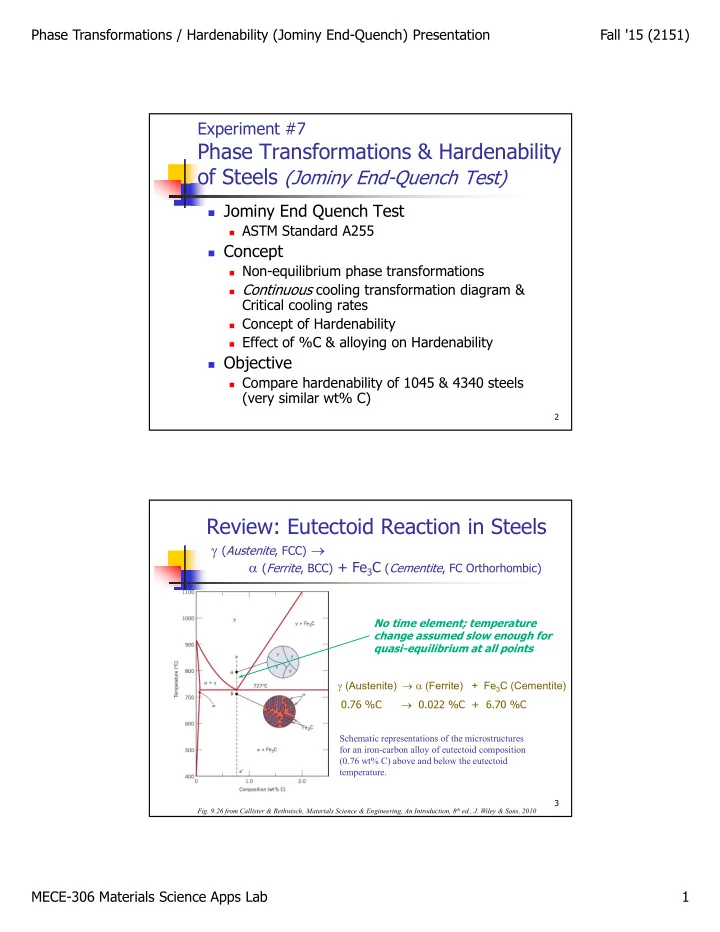
Review: Eutectoid Reaction in Steels

γ (Austenite, FCC) → α (Ferrite, BCC) + Fe3C (Cementite, FC Orthorhombic)

γ → α 0.76 %C → 0.022 %C + 6.70 %C

  • ! "#$%&%

3

slide-2
SLIDE 2

Phase Transformations / Hardenability (Jominy EndQuench) Presentation Fall '15 (2151) MECE306 Materials Science Apps Lab 2

Isothermal Transformations

  • f Eutectoid Steel – Pearlite
  • !

"

  • '(#

"!"

  • This figure is nicknamed the “TTT” plot (for

timetemperaturetransformation) Notice fast transformation creates “fine” pearlite and slow transform. creates “coarse” pearlite!

&%&) ! "#$%&%

4

Isothermal Transformations

  • f HyperEutectoid Carbon Steel
  • !$$%

& '"( " ( )"

Note differences from eutectoid TTT diagram Primary (or proeutectoid) cementite transformation start line (A+C) above & left of pearlite transformation start line (A+P) (A+C) start line extends above eutectoid temperature! Pearlite start line (A+P) shifted to the left

&%& ! "#$%&%

5

slide-3
SLIDE 3

Phase Transformations / Hardenability (Jominy EndQuench) Presentation Fall '15 (2151) MECE306 Materials Science Apps Lab 3

Isothermal Transformations

  • f Eutectoid Steels – Bainite
  • !
  • "!

'*)

  • '*+

“Nose” of TTT curve between pearlite and bainite transformations means bainite cannot be formed in slowcooled steels (temperature must drop at least 200 C in less than 1 s).

&%&! ! "#$%&%

6

Isothermal Transformations

  • f Eutectoid Steels – Martensite

, !

  • &

'"( +"( #"( )"

Martensite can only be formed with very rapid cooling rates

&% ! "#$%&%

7

slide-4
SLIDE 4

Phase Transformations / Hardenability (Jominy EndQuench) Presentation Fall '15 (2151) MECE306 Materials Science Apps Lab 4

Microstructures of Carbon Steels

Fine Bainite grain (bottom left

to top right) in Martensite (~19,000×)

Coarse Pearilte grains

(3000×)

Partially transformed Martensite grains in Austenite* (~1200×)

20µ m

Increasing hardness

* Martensite transformation “frozen” partially completed (Dark martensite “needles” in light austenite matrix)

Pearlite Bainite Martensite

8

a a c

Slow – carbon diffuses out of smaller interstitial spaces

Crystal Structures

Austenite, Ferrite & Martensite

FCC Crystal (γ – , a≈3.6nm) BCC Crystal (α – , a≈2.9nm) BCT Crystal (, a≈2.8nm, c>2.8nm) Fast – crystal structure “warps”; carbon trapped by low diffusion rate (only “metastable”) 9

a a a a a a

slide-5
SLIDE 5

Phase Transformations / Hardenability (Jominy EndQuench) Presentation Fall '15 (2151) MECE306 Materials Science Apps Lab 5

NonIsothermal Transformations of Eutectoid Steels (Continuous Cooling)

  • !

!

  • Transformations

start later and/or at lower temperature during continuous cooling Pearlite / bainite “nose” moves down & is not horizontal

&%* ! "#$%&%

10

Critical Cooling Rates for Eutectoid Steel

! !

  • !
  • Cooling rates slower

than this cooling rate form only pearlite (the diffusionbased transformation has time to complete before the martensite start temperature is reached) Cooling rates faster than the critical cooling rate form only martensite (no time for diffusionbased transformation to occur)

&%+ ! "#$%&%

11

Intermediate cooling rates form some pearlite, but the reaction stops before finishing

slide-6
SLIDE 6

Phase Transformations / Hardenability (Jominy EndQuench) Presentation Fall '15 (2151) MECE306 Materials Science Apps Lab 6

Microstructures & Hardness

Cooling Rate Microstructure Relative Hardness Fast Martensite Very Hard Medium Martensite + Pearlite Medium Hard Slow Pearlite Soft

12

Hardenability of Steels

Hardenability – ability of steel to be hardened

by formation of martensite

Low Hardenability – on quenching austenite,

martensite forms to a shallow depth only

“Shallow Hardening” Steel High critical cooling rate only allows martensite

formation near surface of part

High Hardenability – on quenching austenite,

martensite forms at surface and deep in interior

“Through Hardening” Steel (or also “Deep Hardening”) Requires lower critical cooling rate to allow martensite

formation deeper in interior of part

13

slide-7
SLIDE 7

Phase Transformations / Hardenability (Jominy EndQuench) Presentation Fall '15 (2151) MECE306 Materials Science Apps Lab 7

Carbon Content & Hardenability

Among plain carbon steels, eutectoid steel

(0.76 %C) has highest hardenability

If |0.76 %C| increases, the nose of pearlite

transformation shifts to the left

If |0.76 %C| increases, hardenability of steel

decreases

14

Alloying Elements & Hardenability

Alloying elements such as Cr, Ni, Mn, Mo, V

cause significant change in positions and shapes

  • f transformation

curves, such as:

Shift the nose of

pearlite transformation curve to the right

Cause formation

  • f a separate bainite

nose

! .%.-

&%, ! "#$%&%

15

slide-8
SLIDE 8

Phase Transformations / Hardenability (Jominy EndQuench) Presentation Fall '15 (2151) MECE306 Materials Science Apps Lab 8

4340 Alloy Steel – Continuous Cooling Transformation Diagram

Cooling rate above critical cooling rate forms only Martensite. Cooling rate in this range begins forming Bainite but transform. doesn’t finish before Martensite

  • transform. begins.

Cooling rate in this range allows time for primary phase (α) to form but not enough for Pearlite

  • transform. to get

started. Cooling rate in this range allows Pearlite

  • transform. to get

started but not to

  • finish. Then Bainite
  • transform. starts but

doesn’t finish either. Some Martensite still forms.

&%! ! "#$%&%

! !.%.

  • !

16

Hardenability Test – Jominy End Quench

!/ 0!0!

  • !0!!

Water jet cools quenched end quickly;

  • pposite end aircools more slowly

&&&& ! "#$%&%

17

slide-9
SLIDE 9

Phase Transformations / Hardenability (Jominy EndQuench) Presentation Fall '15 (2151) MECE306 Materials Science Apps Lab 9

Jominy Test on Eutectoid Steel

!

  • Cooling rate decreases with

distance from quenched end

  • Microstructure changes

with cooling rate

  • Hardness depends on

microstructure

  • Variation of hardness with

distance from quenched end reveals info. about continuous cooling transformation diagram

&&&, ! "#$%&%

18

Microstructure vs. Hardenability Curves

100% martensite Mix of martensite and pearlite 100% pearlite (fine) 100% pearlite (coarse)

19

slide-10
SLIDE 10

Phase Transformations / Hardenability (Jominy EndQuench) Presentation Fall '15 (2151) MECE306 Materials Science Apps Lab 10

Hardenability Curves by Alloy

1 " !.-

4340 alloy steel: high hardenability

(small change in hardness w/ distance)

1040 plaincarbon steel: low hardenability

(large change in hardness w/ distance)

&&&) ! "#$%&%

20

Hardenability Bands

,2. !3

  • Hardness vs.

distance from quenched end along a Jominy specimen can vary due to slight fluctuations in composition and cooling rate, giving a range of possible values

&&& ! "#$%&%

21

slide-11
SLIDE 11

Phase Transformations / Hardenability (Jominy EndQuench) Presentation Fall '15 (2151) MECE306 Materials Science Apps Lab 11

Today’s Samples

Austenitized @ 850 °C for ~40 minutes

1045 Steel: Plain Carbon, 0.45 wt% C 4340 Steel: “Low Alloy”,

0.40 wt% C, 1.85 wt% Ni, 0.80 wt% Cr, 0.70 wt% Mn, 0.25 wt% Mo

Endquenched until near room temperature

Quenching apparatus configuration specified by ASTM A255 Cooling rate varies with distance from quenched end

Flat surface machined along length RockwellC hardness measurements

Distances from quenched end similar to those specified by

ASTM A255

22

Hardenability Test Report

  • Cover Page & Abstract

Cover page & abstract on own page (remember abstract stands alone!)

  • Objective
  • Procedure

Outline format Making a Rockwell hardness measurement can be just a step in the

EndQuench procedure (How to make indent needs no detail, but use of micrometer stage does)

  • Analysis

Plot hardness vs. distance on a single plot to compare materials

  • Observations

Compare results to Fig. 11.14 from Callister textbook (on slide #20) Indicate which steel has higher hardenability & why

(what feature of the continuous cooling transformation diagram is changed by adding alloying elements in 4340 steel?).

  • Conclusion
  • References & Appendix
  • Reference “Callister” textbook for figures from presentation, not PowerPoint file

23

slide-12
SLIDE 12

Phase Transformations / Hardenability (Jominy EndQuench) Presentation Fall '15 (2151) MECE306 Materials Science Apps Lab 12

Due by midnight…

tonight

Microhardness Test Report Microhardness Quiz & Survey

next week

Hardenability (Jominy EndQuench) Test Report Hardenability Quiz & Survey 24