Transformations Composition of Transformations Congruence - - PDF document

transformations
SMART_READER_LITE
LIVE PREVIEW

Transformations Composition of Transformations Congruence - - PDF document

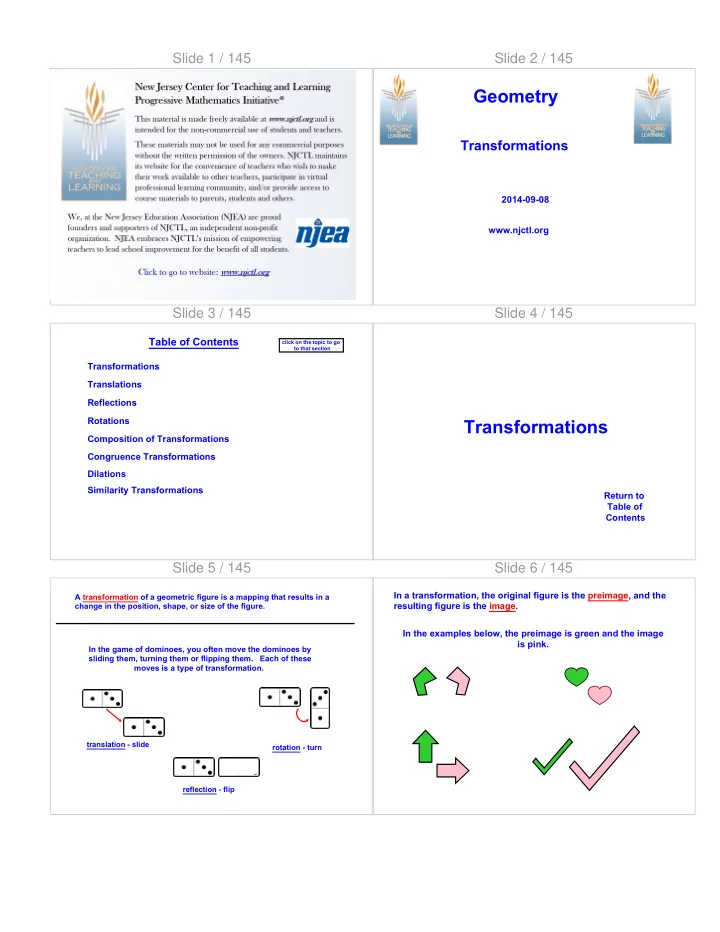
Slide 1 / 145 Slide 2 / 145 Geometry Transformations 2014-09-08 www.njctl.org Slide 3 / 145 Slide 4 / 145 Table of Contents click on the topic to go to that section Transformations Translations Reflections Rotations Transformations


slide-1
SLIDE 1

Slide 1 / 145 Slide 2 / 145

Geometry

Transformations

www.njctl.org 2014-09-08

Slide 3 / 145

Table of Contents

Reflections Translations Rotations Composition of Transformations Transformations

click on the topic to go to that section

Dilations Congruence Transformations Similarity Transformations

Slide 4 / 145

Transformations

Return to Table of Contents

Slide 5 / 145

A transformation of a geometric figure is a mapping that results in a change in the position, shape, or size of the figure. In the game of dominoes, you often move the dominoes by sliding them, turning them or flipping them. Each of these moves is a type of transformation. translation - slide rotation - turn reflection - flip

Slide 6 / 145

In a transformation, the original figure is the preimage, and the resulting figure is the image. In the examples below, the preimage is green and the image is pink.

slide-2
SLIDE 2

Slide 7 / 145

Translation- slide Rotation-turn Dilation - Size change Reflection- Flip

Some transformations (like the dominoes) preserve distance and angle measures. These transformations are called rigid motions. To preserve distance means that the distance between any two points

  • f the image is the same as the distance between the corresponding

points of the preimage. To preserve angles means that the angles of the image have the same measures as the corresponding angles in the preimage. Which of these is a rigid motion? Answer

Slide 8 / 145

A transformation maps every point of a figure onto its image and may be described using arrow notation ( ). Prime notation (' ) is sometimes used to identify image points. In the diagram below, A' is the image of A.

A C B C' B' A'

△ABC △A'B'C' △ABC maps onto △A'B'C'

Note: You list the corresponding points of the preimage and image in the same order, just as you would for corresponding points in congruent figures

  • r similar figures.

Slide 9 / 145

1 Does the transformation appear to be a rigid motion? Explain. A Yes, it preserves the distance between consecutive points. B No, it does not preserve the distance between consecutive points.

Image Preimage

Answer

Slide 10 / 145

2 Does the transformation appear to be a rigid motion? Explain. A Yes, distances are preserved. B Yes, angle measures are preserved. C Both A and B. D No, distance are not preserved.

Image Preimage

Answer

Slide 11 / 145

3 Which transformation is not a rigid motion? A Reflection B Translation C Rotation D Dilation Answer

Slide 12 / 145

4 Which transformation is demonstrated? A Reflection B Translation C Rotation D Dilation Answer

slide-3
SLIDE 3

Slide 13 / 145

5 Which translation is demonstrated? A Reflection B Translation C Rotation D Dilation Answer

Slide 14 / 145

6 Which transformation is demonstrated? A Reflection B Translation C Rotation D Dilation Answer

Slide 15 / 145

Translations

Return to Table of Contents

Slide 16 / 145

A translation is a transformation that maps all points of a figure the same distance in the same direction.

You write the translation that maps ABC onto A'B'C' as T( ABC) = A'B'C'

A translation is a rigid motion with the following properties:

  • AA' = BB' = CC'
  • AB = A'B', BC = B'C', AC = A'C'
  • m<A = m<A', m<B = m<B', m<C = m<C'

A C B C' B' A'

Slide 17 / 145

Translations in the Coordinate Plane

A B D C A' B' D' C'

Each (x, y) pair in ABCD is mapped to (x + 9, y - 4). You can use the function notation T<9, -4>(ABCD) = A'B'C'D' to describe the translation.

B is translated 9 units right and 4 units down.

Slide 18 / 145

Finding the Image of a Translation What are the vertices of T<-2, 5>( DEF)? Graph the image of DEF.

Draw DD', EE' and FF'. What relationships exist among these three segments? How do you know?

D F E

D' ( ) E' ( ) F' ( )

Answer

slide-4
SLIDE 4

Slide 19 / 145

P S Q R P' S' Q' R'

Writing a Translation Rule Write a translation rule that maps PQRS P'Q'R'S'.

Answer

Slide 20 / 145

7 In the diagram, A'B'C' is an image of ABC. Which rule describes the translation? A B C D

Answer

Slide 21 / 145

8 If (JKLM) = J'K'L'M', what translation maps J'K'L'M'

  • nto JKLM?

A B C D

Answer

Slide 22 / 145

9 RSV has coordinates R(2,1), S(3,2), and V(2,6). A translation maps point R to R' at (-4,8). What are the coordinates of S' for this translation? A (-6,-4) B (-3,2) C (-3,9) D (-4,13) E none of the above

Answer

Slide 23 / 145

Reflections

Return to Table of Contents

Reflections Activity Lab (Click for link to lab)

Slide 24 / 145

A reflection is a transformation of points over a line. This line is called the line of reflection. The result looks like the preimage was flipped

  • ver the line. The preimage and the image have opposite orientations.

A B

C A' B' C' m

Properties

  • If a point B is on line m, then the

image of B is itself (B = B').

  • If a point C is not on line m, then m

is the perpendicular bisector of CC' The reflection across m that maps ABC A'B'C' can be written as Rm( ABC) = A'B'C

The preimage C and its image C' are equidistant from the line of reflection.

slide-5
SLIDE 5

Slide 25 / 145

When reflecting a figure, reflect the vertices and then draw the sides. Reflect ABCD over line r. Label the vertices of the image.

A B C D r

Watch How!

Answer

Slide 26 / 145

Reflect WXYZ over line s. Label the vertices of the image.

s W X Y Z

HINT: Turn page so line of symmetry is vertical

Answer

Slide 27 / 145

Reflect MNP over line t. Label the vertices of the image.

t M N P

Where is the image of N? Why? Answer

Slide 28 / 145

10 Which point represents the reflection of X? A point A B point B C point C D point D E None of the above X A

B C D Answer

Slide 29 / 145

11 Which point represents the reflection of X? A point A B point B C point C D point D E none of the above X A

B C D Answer

Slide 30 / 145

12 Which point represents the reflection of X? A point A B point B C point C D point D E none of the above X A

B C D Answer

slide-6
SLIDE 6

Slide 31 / 145

13 Which point represents the reflection of D? A point A B point B C point C D point D E none of these D A

B C Answer

Slide 32 / 145

14 Is a reflection a rigid motion? Yes No

Answer

Slide 33 / 145

Reflections in the Coordinate Plane Since reflections are perpendicular to and equidistant from the line of reflection, we can find the exact image of a point or a figure in the coordinate plane.

Reflect A, B, & C over the y-axis.

A B C

Notation Ry-axis(A) = A' Ry-axis(B) = B' Ry-axis(C) = C' How do the coordinates of each point change when the point is reflected over the y-axis?

Answer

Slide 34 / 145

M J K L Reflections in the Coordinate Plane Reflect figure JKLM over the x-axis. Notation

Rx-axis(JKLM) = J'K'L'M' How do the coordinates of each point change when the point is reflected over the x-axis?

Answer

Slide 35 / 145

A B D C Reflections in the Coordinate Plane

Reflect A, B, C & D

  • ver the line y = x.

Notation

Ry=x(A) = A' Ry=x(B) = B' Ry=x(C) = C' Ry=x(D) = D' How do the coordinates of each point change when the point is reflected over the y-axis?

HINT: Count the number of diagonals from the point to the line of reflection.

Answer

Slide 36 / 145

A B C Reflections in the Coordinate Plane

Reflect ABC over x = 2. Notation

Rx=2( ABC) = A'B'C' HINT: Draw line of reflection first.

Answer

slide-7
SLIDE 7

Slide 37 / 145

M N P Q Reflections in the Coordinate Plane Reflect quadrilateral MNPQ over y = -3 Notation

Ry=-3(MNPQ) = M'N'P'Q'

Answer

Slide 38 / 145

A B C E D F

Find the coordinates of each image.

  • 1. Rx-axis(A)
  • 2. Ry-axis(B)
  • 3. Ry = 1(C)
  • 4. Rx = -1(D)
  • 5. Ry = x(E)
  • 6. Rx = -2(F)

Answer

Slide 39 / 145

15 The point (4,2) reflected over the x-axis has an image of ______. A (4,2) B (-4,-2) C (-4,2) D (4,-2)

Answer

Slide 40 / 145

16 The point (4,2) reflected over the y-axis has an image of _____. A (4,2) B (-4,-2) C (-4,2) D (4,-2)

Answer

Slide 41 / 145

17 B has coordinates (-3,0). What would be the coordinates of B' if B is reflected over the line x = 1? A (-3,0) B (4,0) C (-3,2) D (5,0)

Answer

Slide 42 / 145

18 The point (4,2) reflected over the line y=2 has an image of _____. A (4,2) B (4,1) C (2,2) D (4,-2)

Answer

slide-8
SLIDE 8

Slide 43 / 145

Line of Symmetry

A line of symmetry is a line of reflection that divides a figure into 2 congruent halves. These 2 halves reflect onto each

  • ther.

Slide 44 / 145

If lines of symmetry exist, draw all of them for the figure.

A B C D E F

Answer

Slide 45 / 145

If lines of symmetry exist, draw all of them for the figure.

M N O P Q R

Answer

Slide 46 / 145

If lines of symmetry exist, draw all of them for the figure. Answer

Slide 47 / 145

19 How many lines of symmetry does the following have? A one B two C three D none

Answer

Slide 48 / 145

20 How many lines of symmetry does the following have? A 10 B 2 C 100 D infinitely many

Answer

slide-9
SLIDE 9

Slide 49 / 145

21 How many lines of symmetry does the following have? A none B one C nine D infinitely many

Answer

Slide 50 / 145

22 How many lines of symmetry does the following have? A none B one C two D infinitely many J

Answer

Slide 51 / 145

23 How many lines of symmetry does the following have? A none B one C two D infinitely many H

Answer

Slide 52 / 145

24 How many lines of symmetry does the following have? A none B 5 C 7 D 9

Answer

Slide 53 / 145

Rotations

Return to Table of Contents

Rotations Activity Lab (Click for link to lab)

Slide 54 / 145

A rotation is a rigid motion that turns a figure about a point. The amount of turn is in degrees. The direction of turn is either clockwise or counterclockwise. The arrow was rotated 1200 counterclockwise about point P. P H The heart was rotated 1600 clockwise about H.

slide-10
SLIDE 10

Slide 55 / 145

A B C B ' A' C' P' P x°

A rotation of x°, about a point P is a transformation with the following properties:

  • The image of P is itself (P = P')
  • For any other point B, PB' = PB
  • The m <BPB' = x

The preimage B and its image B' are equidistant from the center of rotation.

Notation r(x°, P)( ABC) = A'B'C' for a rotation clockwise x°about P r(-x°, P)( ABC) = A'B'C' for a rotation counterclockwise x° about P

Slide 56 / 145

Watch How!

Drawing Rotation Images

What is the image of r(100°, C)( LOB)?

O L B C (counterclockwise)

Step 1 Draw CO. Use a protractor to draw a 100° angle with side CO and vertex C. Step 2 Use a compass or a ruler to construct CO ≅CO' Step 3 Locate L' and B' following steps 1 and 2. Step 4 Draw L'O'B'

Answer

Slide 57 / 145

Drawing Rotation Images

What is the image of r(80°, C)( LOB)?

O L B C (clockwise)

Answer

Slide 58 / 145

Rotations in the Coordinate Plane

A (3, 4) A' (4, -3) A (3, 4) A' (-3, -4)

r(90°, O)(x, y) = (y, -x) r(180°, O)(x, y) = (-x, -y)

When a figure is rotated 90°, 180°, or 270° clockwise about the origin O in the coordinate plane, you can use the following rules.

Slide 59 / 145

A (3, 4) A' (-4, 3) A' (3, 4)

r(360°, O)(x, y) = (x, y) r(270°, O)(x, y) = (-y, x)

Note: r(-90°, O)(x, y) = r(270°, O)(x, y) and r(-270°, O)(x, y) = r(90°, O)(x, y)

Rotations in the Coordinate Plane (continued)

Slide 60 / 145

PQRS has vertices P(1, 1), Q(3, 3), R(4, 1) and S(3, 0). a) What is the graph of r(90°,

O )(PQRS) = P'Q'R'S'?

b) What is the graph of r(90°,

O )(PQRS) = P''Q''R''S''?

c) What is the graph of r(270°,

O )(PQRS)= P'''Q'''R'''S'''?

Graphing Rotation Images

Answer

slide-11
SLIDE 11

Slide 61 / 145

25 Square ABCD has vertices A(3,3), B(-3,3), C(-3, -3), and D(3, -3). Which of the following images is A? A B C D

Answer

Slide 62 / 145

26 PQRS has vertices P(1,5), Q(3, -2), R(-3, -2), and S(-5, 1). What are the coordinates of Q' after ? A (-2, -3) B (2,3) C (-3, 2) D (-3, -2)

Answer

Slide 63 / 145

Identifying a Rotation Image

P A E O T N

A regular polygon has a center that is equidistant from its vertices. Segments that connect the center to the vertices divide the polygon into congruent triangles. You can use this fact to find rotation images of regular polygons. PENTA is a regular pentagon with center O. a) Name the image of E for a 72° rotation counterclockwise about O. b) Name the image of P for a 216° rotation clockwise about O. c) Name the image of AP for a 144° rotation counterclockwise about O.

Answer

Slide 64 / 145

27 MATH is a regular quadrilateral with center R. Name the image of M for a 180 rotation counterclockwise about R. A M B A C T D H

Answer

Slide 65 / 145

28 MATH is a regular quadrilateral with center R. Name the image of for a 270 rotation clockwise about R. A B C D

Answer

Slide 66 / 145

29 HEXAGO is a regular hexagon with center M. Name the image of G for a 300 rotation counterclockwise about M. A A B X C E D H E O

Answer

slide-12
SLIDE 12

Slide 67 / 145

30 HEXAGO is a regular hexagon with center M. Name the image of OH for a 240 rotation clockwise about M. A HE B AG C EX D AX E OG

Answer

Slide 68 / 145

Rotational Symmetry

A figure has rotational symmetry if there is at least one rotation less than or equal to 180 about a point so that the preimage is the image.

Think of the blades of a fan. This figure has rotational symmetry at 120 A circle has infinite rotational symmetry.

Slide 69 / 145

Do the following have rotational symmetry? If yes, what is the degree of rotation?

  • a. c.

b.

Answer

Slide 70 / 145

Do the following regular shapes have rotational symmetry? If yes, what is the degree of rotation.

In general, what is the rule that can be used to find the degree of rotation for a regular polygon?

Answer

Slide 71 / 145

31 Does the following figure have rotational symmetry? If yes, what degree? A yes, 90 B yes, 120 C yes, 180 D no

S

Answer

Slide 72 / 145

32 Does the following figure have rotational symmetry? If yes, what degree? A yes, 90 B yes, 120 C yes, 180 D no

Answer

slide-13
SLIDE 13

Slide 73 / 145

33 Does the following figure have rotational symmetry? If yes, what degree? A yes, 90 B yes, 120 C yes, 180 D no

Answer

Slide 74 / 145

34 Does the following figure have rotational symmetry? If yes, what degree? A yes, 18 B yes, 36 C yes, 72 D no

Answer

Slide 75 / 145

Composition of Transformations

Return to Table of Contents

Slide 76 / 145

An isometry is transformation that preserves distance, or length. The composition of two

  • r more isometries is an

isometry.

Translation Reflection Glide Reflection Rotation

When an image is used to as the preimage for a second transformation it is called a composition of transformations.

The transformations below are isometries.

Slide 77 / 145

Glide Reflections If two figures are congruent and have opposite orientations (but are not simply reflections of each other), then there is a translation and a reflection that will map one onto the other. A glide reflection is the composition of a glide (translation) and a reflection across a line parallel to the direction of translation. Notation for a Composition Ry = -2 o T<1, 0> (△ABC) Note: Transformations are performed right to left.

△ABC is translated 1 unit to the right and then reflected over the line y = -2.

A B C B' C' A'

Slide 78 / 145

Graph the glide reflection image of △ABC.

1.) Rx-axis o T<-2, 0> (△ABC) 2.) Ry-axis o T<0, -3> (△ABC) 3.) Ry = -1 o T<1, -1> (△ABC)

Answer

slide-14
SLIDE 14

Slide 79 / 145

Graph the glide reflection image of △ABC.

1.) Rx-axis o T<-2, 0> (△ABC) 2.) Ry-axis o T<0, -3> (△ABC) 3.) Ry = -1 o T<1, -1> (△ABC)

Answer

Slide 80 / 145

Graph the glide reflection image of △ABC.

1.) Rx-axis o T<-2, 0> (△ABC) 2.) Ry-axis o T<0, -3> (△ABC) 3.) Ry = -1 o T<1, -1> (△ABC)

Answer

Slide 81 / 145

X Y Z

Translate △XYZ by using a composition of reflections. Reflect over x = -3 then over x = 4. Label the first image △X'Y'Z' and the second △X"Y"Z". 1.) What direction did △XYZ slide? How is this related to the lines of reflection? 2.)How far did △XYZ slide? How is this related to the lines

  • f reflection?

Make a conjecture. Composition of Reflections Answer

Slide 82 / 145

35 FGHJ is translated using a composition of reflections. FGHJ is first reflected over line r then line s. How far does FGHJ slide? A 5" B 10" C 15" D 20"

r s 10" F G J H Answer

Slide 83 / 145

36 FGHJ is translated using a composition of reflections. FGHJ is first reflected over line r then line s. Which arrow shows the direction of the slide? A B C D

r s 10" F G J H A B C D Answer

Slide 84 / 145

37 FGHJ is translated using a composition of reflections. FGHJ is first reflected over line s then line r. How far does FGHJ slide? A 5" B 10" C 20" D 30"

r s 10" F G J H Answer

slide-15
SLIDE 15

Slide 85 / 145

Rotations can be done as a composition of reflections over intersecting lines.

m n A B C P C' B' A' A" C" B" 160o 80o Where the lines

  • f reflection

intersect, P, is center of rotation. The amount of rotation is twice the acute,or right, angle formed by the lines of reflection. The direction of rotation is clockwise because rotating from m to n across the acute angle is clockwise. Had the triangle reflected

  • ver n then m, the rotation would have been counterclockwise.

Slide 86 / 145

r 20o A B C D E s If ABCDE is reflected over r then s: What is the angle of rotation? What is the direction of the rotation? Answer

Slide 87 / 145

r s 20o A B C D E If ABCDE is reflected over s then r: What is the angle of rotation? What is the direction of the rotation? Answer

Slide 88 / 145

A B C D E r s 90o If ABCDE is reflected over s then r: What is the angle of rotation? What is the direction of the rotation? Answer

Slide 89 / 145

A B C D E r s 110o If ABCDE is reflected over s then r: What is the angle of rotation? What is the direction of the rotation? Answer

Slide 90 / 145

38 If the image of ABC is the composite of reflections over e then f, what is the angle of rotation? A 40 B 80 C 160 D 280

40o e f A B C Answer

slide-16
SLIDE 16

Slide 91 / 145

39 What is the direction of the rotation if the image of ABC is the composite of reflections first over e then f? A Clockwise B Counterclockwise

40o e f A B C Answer

Slide 92 / 145

40 If the image of ABC is the composite of reflections over f then e, what is the angle of rotation? A 90 B 180 C 270 D 360 e f A

B C Answer

Slide 93 / 145

41 What is the direction of rotation if the image of ABC is the composite of reflections first over f then e? A Clockwise B Counterclockwise e f A

B C Answer

Slide 94 / 145

42 If the image of ABC is the composite of reflections over e then f, what is the angle of rotation? A 40 B 80 C 140 D 160

140o e f A B C Answer

Slide 95 / 145

43 What is the direction of the rotation if the image of ABC is the composite of reflections first over e then f? A Clockwise B Counterclockwise

140o e A B C Answer

Slide 96 / 145

Congruence Transformations

Return to Table of Contents

slide-17
SLIDE 17

Slide 97 / 145

Congruent Figures Two figures are congruent if and only if there is a sequence of one

  • r more rigid motions that maps one figure onto another.

Since compositions of rigid motions preserve angle measures and distances the corresponding sides and angles have equal measures. Fill in the blanks below. AB = _____ BC = _____ AC = _____ m#A = m# ____ m#B = m# ____ m#C = m# ____

m

A B C A' B' C' D F E

The composition Rm o T<2, 3> (△ABC) = (△DEF)

Answer

Slide 98 / 145

Because compositions of rigid motions take figures to congruent figures, they are also called congruence transformations.

Identifying Congruence Transformations

What is the congruence transformation that maps △XYZ to △ABC?

X Y Z C B A

s Answer

Slide 99 / 145

Use congruence transformations to verify that △ABC # △DEF.

Answer

1. 2.

Slide 100 / 145

To show that △ABC is an equilateral triangle, what congruence transformation can you use that maps the triangle onto itself? Explain.

A B C m n p P

Answer

Slide 101 / 145

44 Which congruent transformation maps ABC to DEF? A B C D

Answer

Slide 102 / 145

45 Which congruence transformation does not map ABC to DEF? A B C D

Answer

slide-18
SLIDE 18

Slide 103 / 145

46 Which of the following best describe a congruence transformation that maps ABC to DEF? A a reflection only B a translation only C a translation followed by a reflection D a translation followed by a rotation

B A C F E D

Answer

Slide 104 / 145

47 Quadrilateral ABCD is shown below. Which of the following transformations of AEB could be used to show that AEB is congruent to DEC? A a reflection over DB B a reflection over AC C a reflection over line m D a reflection over line n

A m B E n D C

Answer

Slide 105 / 145

Dilations

Return to Table of Contents

Slide 106 / 145

Pupil Dilated Pupil A dilation is a transformation whose pre image and image are similar. Thus, a dilation is a similarity transformation. It is not, in general, a rigid motion. Every dilation has a center and a scale factor n, n > 0. The scale factor describes the size change from the original figure to the image.

Slide 107 / 145

A C B A' C' B' R' = R

A dilation with center R and scale factor n, n > 0, is a transformation with the following properties:

  • The image of R is itself (R' = R)
  • For any other point B, B' is on RB
  • RB' = n ● RB or n = RB'

RB

  • △ABC ~ △A'B'C'

Slide 108 / 145

There are 2 types of dilations.

A dilation is an enlargement if the scale factor is greater than 1. A dilation is a reduction if the scale factor is less than one, but greater than 0.

scale factor

  • f 2

scale factor

  • f 1.5

scale factor

  • f 3

scale factor

  • f 1/2

scale factor

  • f 1/4

scale factor

  • f 3/4
slide-19
SLIDE 19

Slide 109 / 145

The symbol for scale factor is n. A dilation is an enlargement if n > 1. A dilation is a reduction if 0< n < 1. What happens to a figure if n = 1?

Answer

Slide 110 / 145

  • Corresponding angles are congruent.

A B C D A' B' C' D'

  • The ratio of corresponding sides is

image = preimage which is the scale factor (n) of the dilation. 6 3 18 9 Finding the Scale Factor Answer

Slide 111 / 145

The dashed line figure is a dilation image of the solid-line figure. D is the center of dilation. Tell whether the dilation is an enlargement or a

  • reduction. Then find the scale factor of the dilation.

D 8 4 D 3 6 D 9 6 D 4 4 D 1 2 Reduction; 1/2 Reduction; 3/2 Enlargement; 8 Enlargement; 2 Enlargement; 2 ANSWER ANSWER ANSWER ANSWER ANSWER

Slide 112 / 145

48 Is a dilation a rigid motion?

Yes No Answer

Slide 113 / 145

49 Is a dilation a rigid motion? Yes No

Answer

Slide 114 / 145

50 Is the dilation an enlargement or a reduction? What is the scale factor of the dilation? A enlargement, n = 3 B enlargement, n = 1/3 C reduction, n = 3 D reduction, n = 1/3

F F' 8 24 Answer

slide-20
SLIDE 20

Slide 115 / 145

51 Is the dilation an enlargement or reduction? What is the scale factor of the dilation? A enlargement, n=3 B enlargement, n = 1/3 C reduction, n = 3 D reduction, n = 1/3

F F' 8 24 Answer

Slide 116 / 145

52 Is the dilation an enlargement or reduction? What is the scale factor of the dilation? A enlargement, n = 2 B enlargement, n = 1/2 C reduction, n = 2 D reduction, n = 1/2

H H' 2 4 Answer

Slide 117 / 145

53 Is the dilation an enlargement or reduction? What is the scale factor of the dilation? A enlargement, n = 2 B enlargement, n = 3 C enlargement, n = 6 D not a dilation

R R' 5 10 11 33 Answer

Slide 118 / 145

54 The solid-line figure is a dilation of the dashed-line figure. The labeled point is the center of dilation. Find the scale factor of dilation. A 2 B 3 C 1/2 D 1/3

Answer

Slide 119 / 145

55 A dilation maps triangle LMN to triangle L'M'N'. MN = 14

  • in. and M'N' = 9.8 in. If LN = 13 in., what is L'N' ?

A 13 in. B 14 in. C 9.1 in. D 9.8 in.

Answer

Slide 120 / 145

Draw the dilation image ΔB′C′D′. D(2, X)(ΔBCD)

Drawing Dilation Images

X B C D B' C' D' 1 in 0.5 in 2.5 in Steps

  • 1. Use a straightedge to construct

ray XB.

  • 2. Use a compass to measure XB.
  • 3. Construct XB' by constructing a

congruent segment on ray XB so that XB' is twice the distance of XB.

  • 4. Repeat steps 1- 3 with points

C and D. 5 in

Watch How!

slide-21
SLIDE 21

Slide 121 / 145

  • a. ) D(0.5, B)(ABCD) b. ) D(2, C)(ΔDEF)

A B D C

ANSWER ANSWER

Draw each dilation image.

Slide 122 / 145

Dilations in the Coordinate Plane Suppose a dilation is centered at the origin. You can find the dilation image of a point by multiplying its coordinates by the scale factor.

A' (4, 6) A(2, 3) Scale factor 2, (x, y) (2x, 2y)

Notation D2 (A) = A'

Slide 123 / 145

To dilate a figure from the origin, find the dilation images of its vertices.

Graphing Dilation Images

△HJK has vertices H(2, 0), J(-1, 0.5), and K(1, -2). What are the coordinates

  • f the vertices of the image of △HJK for a dilation with center (0, 0) and a

scale factor 3? Graph the image and the preimage.

Answer

Slide 124 / 145

Dilations NOT Centered at the Origin

In this example, the center of dilation is NOT the origin. The center of dilation D(-2, -2) is a vertex of the original figure. This is a reduction with scale factor 1/2. A B D C

A' B' D' C'

Point D and its image are the same. It is important to look at the distance from the center of dilation D, to the

  • ther points of the figure.

If AD = 6, then A'D' = 6/2 = 3. Also notice AB = 4 and A'B' = 2, etc.

Slide 125 / 145

D E F

Draw the dilation image of △DEF with the center of dilation at point D with a scale factor 3/4.

Answer

Slide 126 / 145

56 What is the y-coordinate of the image (8, -6) under a dilation centered at the origin and having a scale factor of 1.5? A -3 B -8 C -9 D -12

Answer

slide-22
SLIDE 22

Slide 127 / 145

57 What is the x-coordinate of the image (8, -6) under a dilation centered at the origin and having a scale factor of 1/2? A 4 B 8 C -6 D -3

Answer

Slide 128 / 145

58 What is the y-coordinate of the image (8, -6) under a dilation centered at the origin and having a scale factor of 1/2? A 4 B 8 C -6 D -3

Answer

Slide 129 / 145

59 What is the x-coordinate of the image of (8, -6) under a dilation centered at the origin and having a scale factor of 3? A 8 B -2 C 24 D -6

Answer

Slide 130 / 145

60 What is the x-coordinate of the image of (8, -6) under a dilation centered at the origin and having a scale factor of 1.5? A 3 B 8 C 9 D 12

Answer

Slide 131 / 145

61 What is the y-coordinate of the image of (8, -6) under a dilation centered at the origin and having a scale factor of 3? A -8 B -2 C -24 D -18

Answer

Slide 132 / 145

62 What is the x-coordinate of (4, -2) under a dilation centered at (1, 3) with a scale factor of 2? A 7 B -2 C -7 D 8

Answer

slide-23
SLIDE 23

Slide 133 / 145

63 What is the y-coordinate of (4, -2) under a dilation centered at (1, 3) with a scale factor of 2? A 7 B -2 C -7 D 8

Answer

Slide 134 / 145

Similarity Transformations

Return to Table of Contents

Slide 135 / 145

Warm Up

  • 1. Choose the correct choice to complete the sentence.

Rigid motions and dilations both preserve angle measure / distance.

  • 2. Complete the sentence by filling in the blanks.

___________preserve distance; ___________ do not preserve distance.

  • 3. Define similar polygons on the lines below.

______________________________________________________________ ______________________________________________________________ ______________________________________________________________

rigid motions dilations

Answer

Slide 136 / 145

Triangle GHI has vertices G(-4, 2), H(-3, -3) and N(-1, 1). Suppose the triangle is translated 4 units right and 2 units up and then dilated by a scale factor of 2 with the center of dilation at the origin. Sketch the resulting image of the composition of transformations.

Step 1 Draw the original figure. Step 2 T<4, 2> (△GHI)

G' ( ___, ___) H' ( ___, ___) I' ( ___, ___)

Step 3 D2(△G'H'I')

G'' ( ___, ___) H'' ( ___, ___) I'' ( ___, ___)

Drawing Transformations

Answer

Slide 137 / 145

△LMN has vertices L(0, 2), M(2, 2), and N(0, 1). For each similarity transformation, draw the image.

  • 1. D2 o Rx -axis

(△ LMN )

Answer

Slide 138 / 145

△LMN has vertices L(0, 2), M(2, 2), and N(0, 1). For each similarity transformation, draw the image.

  • 2. D2 o r(270

° , O) (△ LMN )

Answer

slide-24
SLIDE 24

Slide 139 / 145

Describing Transformations What is a composition of transformations that maps trapezoid ABCD

  • nto trapezoid MNHP?

Answer

Slide 140 / 145

For each graph, describe the composition of transformations that maps △ABC onto △FGH

A B C H F G A B C G F H 1. 2.

Answer

Slide 141 / 145

For each graph, describe the composition of transformations that maps △ABC onto △FGH

A B C H F G A B C G F H

Answer

1. 2.

Slide 142 / 145

Similar Figures Two figures are similar if and only if there is a similarity transformation that maps one figure onto the other. Rotate quadrilateral ABCD 90° counterclockwise Dilate it by a scale factor of 2/3 Translate it so that vertices A and M coincide. ABCD ~ MNPQ Rotate △LMN 180° so that the vertical angles coincide. Dilate it by some scale factor x so that MN and JK coincide. △LMN ~ △LJK Identify the similarity transformation that maps one figure onto the

  • ther and then write a similarity statement.

M N L

K J A D C B 9 in. 6 in. 6 in. 4 in. N Q

M

P

Answer Answer

Slide 143 / 145

64 Which similarity transformation maps ABC to DEF? A B C D

Answer

Slide 144 / 145

65 Which similarity transformation does not map PQR to STU? A B C D

Answer

slide-25
SLIDE 25

Slide 145 / 145

66 Which of the following best describes a similarity transformation that maps JKP to LMP? A a dilation only B a rotation followed by a dilation C a reflection followed by a dilation D a translation followed by a dilation

M

P L K J

Answer