
SLIDE 1
HOT CORROSION HOT CORROSION Metals and alloys experience accelerated - - PowerPoint PPT Presentation
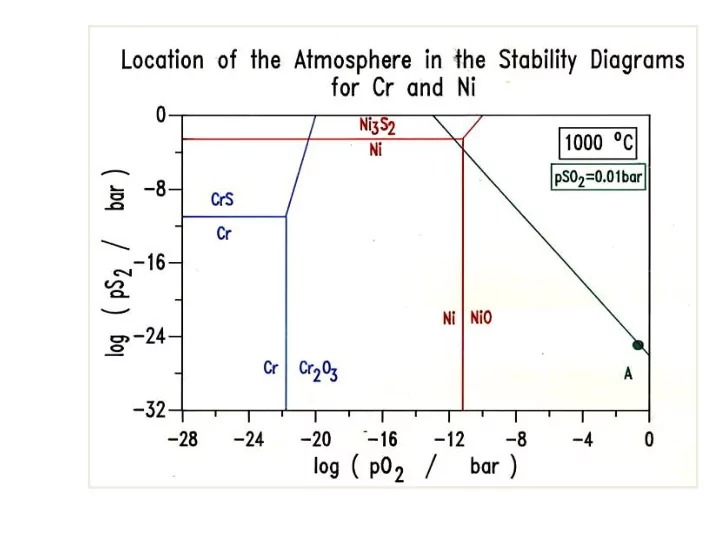
Relationship between pS 2 and pSO 2 HOT CORROSION HOT CORROSION Metals and alloys experience accelerated oxidation / sulphidation when their surfaces are covered with a thin film of fused salt in an oxidizing gas atmosphere at elevated
HOT CORROSION Metals and alloys experience accelerated oxidation / sulphidation when their surfaces are covered with a thin film of fused salt in an oxidizing gas atmosphereat elevated temperatures
accelerates
mixtures Na2SO4-NiSO4 eutectics
(g) –required
Types of Hot Corrosion
HIGH TEMPERATURE HOT CORROSION
Ref: Introduction to High Temperature Oxidation and corrosion, A.S.Khanna, IIT Bombay, ASM International, 2002
at 900 oC
LOW TEMPERATURE HOT CORROSION
Ref: Introduction to High Temperature Oxidation and corrosion, A.S.Khanna, IIT Bombay, ASM International, 2002
– corrosion reaction involves
FLUXING MECHANISM OF HOT CORROSION
Oxyanion sodium sulphate melt similar to acid-base chemistry of aqueous solutions Na2O + SO3 = Na2SO4 log K (1200 K) = -16.7 log aNa2O = melt basicity log aSO3 = melt acidity
Ref: Robert A. Rapp, Hot corrosion of materials: a fluxing mechanism? Corrosion Science 44 (2002) 209±221
Dissolution on NiO can be represented by the following equations: Basic dissolution: 2NiO + O2- (Na2O) + ½ O2 = 2NiO2- (NaNiO2) Acidic dissolution: NiO = Ni2+ + O2- Further O2- + SO3 = SO4
2- (NiSO4)
SUSTAINED ACIDIC DISSOLUTION
Basic dissolution 2MO + O2- (Na2O) + ½ O2 = 2MO2- (NaNiO2) melt gradually consumes the salt gets saturated with NaNiO2 reaction subsides Acidic dissolution MO = M2+ + O2- Further O2- + SO3 = SO4
2-
(NiSO4) molten Na2SO4 – solvent for NiSO4 which reacts with nickel migrating
continuous sulphide network Na2SO4 is not consumed and the reaction continues for extended periods
Crucible Test Schematic of Bead Test Isothermal Tests Cyclic Tets
Schematic of a Burner Rig
Hot Corrosion of Nickel
FORMATION OF EUTECTIC MIXTURE
Temperature dependence of the corrosion rate of Ni-30% Cr coated with Na2SO4 (2.5 mg/cm2) in latm. of O2 + 1% (SO2 + SO3) and Ni-20% Cr (with no salt deposit) in 1 atm. of SO2 : O2 : 1 : 1.
Na2SO4 induced hot corrosion of Ni-30% Cr and Co-30% Cr in O2 + 1% (SO2 + SO3) and O2 + 0.15% (SO2 + SO3) exposed for 24 h.
ROLE OF ALLOYING ELEMENTS
corrosion Vanadium and molybdenum
Titanium, aluminum, and niobium