Holographic quark-hadron continuity K. Bitaghsir Fadafan, F. - - PowerPoint PPT Presentation

holographic quark hadron continuity
SMART_READER_LITE
LIVE PREVIEW

Holographic quark-hadron continuity K. Bitaghsir Fadafan, F. - - PowerPoint PPT Presentation

Southampton, Mar 19, 2019 1 Andreas Schmitt Mathematical Sciences and STAG Research Centre University of Southampton Southampton SO17 1BJ, United Kingdom Holographic quark-hadron continuity K. Bitaghsir Fadafan, F. Kazemian, A. Schmitt,


slide-1
SLIDE 1

Southampton, Mar 19, 2019 1

Andreas Schmitt Mathematical Sciences and STAG Research Centre University of Southampton Southampton SO17 1BJ, United Kingdom

Holographic quark-hadron continuity

  • K. Bitaghsir Fadafan, F. Kazemian, A. Schmitt, 1811.08698 [hep-ph]
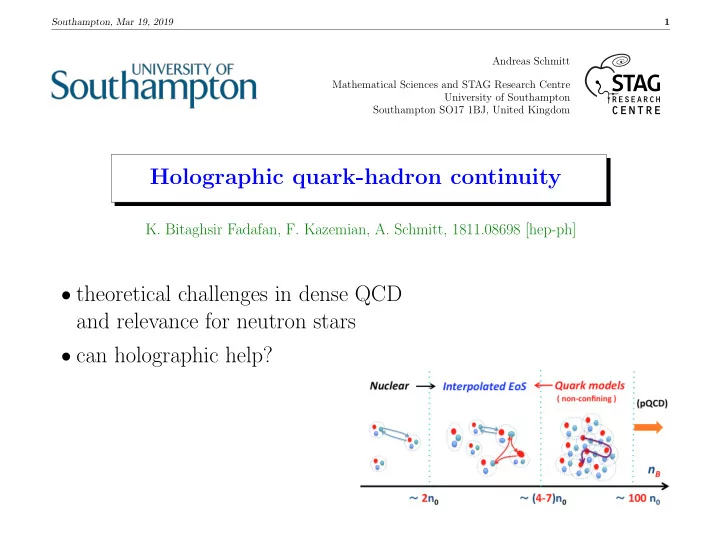
  • theoretical challenges in dense QCD

and relevance for neutron stars

  • can holographic help?
slide-2
SLIDE 2

Southampton, Mar 19, 2019 2

Dense QCD: theoretical approaches

Matte Hadrons Plasma Quark−Gluon Quark Matter r Nuclear

µ T

lattice QCD pQCD nuclear physics

  • lattice QCD: sign problem at nonzero µ (some recent progress)
  • perturbative QCD: restricted to ultra-high densities
  • “standard” nuclear physics:

restricted to densities ≲ nuclear saturation density n0

slide-3
SLIDE 3

Southampton, Mar 19, 2019 2

Dense QCD: theoretical approaches

Matte Hadrons Plasma Quark−Gluon Quark Matter r Nuclear

µ T

lattice QCD pQCD nuclear physics

neutron stars

  • lattice QCD: sign problem at nonzero µ (some recent progress)
  • perturbative QCD: restricted to ultra-high densities
  • “standard” nuclear physics:

restricted to densities ≲ nuclear saturation density n0

slide-4
SLIDE 4

Southampton, Mar 19, 2019 3

Quark-hadron continuity at high density?

  • rder parameter

Polyakov loop (confinement) chiral condensate spontaneously breaks ZNc SU(Nf) × SU(Nf) symmetry exact for pure Yang-Mills (mq = ∞) chiral limit (mq = 0) → no qualitative difference between hadronic and quark matter (ignoring Cooper pairing for now)

T quarks & gluons hadrons μ

150 MeV

  • crossover at T = 0?
  • quark matter in core
  • f compact star?

sharp interface? quark-hadron mixed phase?

slide-5
SLIDE 5

Southampton, Mar 19, 2019 3

Quark-hadron continuity at high density?

  • rder parameter

Polyakov loop (confinement) chiral condensate spontaneously breaks ZNc SU(Nf) × SU(Nf) symmetry exact for pure Yang-Mills (mq = ∞) chiral limit (mq = 0) → no qualitative difference between hadronic and quark matter (ignoring Cooper pairing for now)

T quarks & gluons hadrons μ

150 MeV

  • crossover at T = 0?
  • quark matter in core
  • f compact star?

sharp interface? quark-hadron mixed phase?

slide-6
SLIDE 6

Southampton, Mar 19, 2019 3

Quark-hadron continuity at high density?

  • rder parameter

Polyakov loop (confinement) chiral condensate spontaneously breaks ZNc SU(Nf) × SU(Nf) symmetry exact for pure Yang-Mills (mq = ∞) chiral limit (mq = 0) → no qualitative difference between hadronic and quark matter (ignoring Cooper pairing for now)

T quarks & gluons hadrons μ

150 MeV

  • crossover at T = 0?
  • quark matter in core
  • f compact star?

sharp interface? quark-hadron mixed phase?

slide-7
SLIDE 7

Southampton, Mar 19, 2019 4

Observable consequences of first-order transition?

  • qualitative difference in

mass/radius curve

  • M. G. Alford, S. Han and M. Prakash,

PRD 88, 083013 (2013)

  • sequential 1st-order

transitions?

  • M. G. Alford and A. Sedrakian, PRL

119, 161104 (2017)

εtrans ∆ε ε

trans trans

p

M R

  • different gravitational wave signal in neutron star mergers?
  • E. R. Most et al., PRL 122, 061101 (2019)
  • gravitational wave from bubble nucleation during supernova?
  • G. Cao and S. Lin, arXiv:1810.00528 [nucl-th]
slide-8
SLIDE 8

Southampton, Mar 19, 2019 5

Can holography help?

  • dual of QCD: probably exists, but currently out of reach
  • reliable strong-coupling calculation (usually infinite coupling)
  • successful (qualitative) predictions for heavy-ion collisions

(supersymmetric YM plasma instead of quark-gluon plasma)

  • Sakai-Sugimoto model
  • E. Witten, Adv. Theor. Math. Phys. 2, 505 (1998)
  • T. Sakai and S. Sugimoto, Prog. Theor. Phys. 113, 843 (2005)

– top-down approach with only 3 parameters – dual to large-Nc QCD, however in inaccessible limit – successfully applied to meson, baryon, glueball spectra

slide-9
SLIDE 9

Southampton, Mar 19, 2019 6

Phases in the Sakai-Sugimoto model

  • baryons in Sakai-Sugimoto: SU(Nf) instantons of gauge theory on D8 branes
  • approximate instanton interaction from exact flat-space 2-instanton solution
  • K. Bitaghsir Fadafan, F. Kazemian, A. Schmitt, 1811.08698 [hep-ph]
u

quark matter nuclear matter mesonic phase

D8 D8

u uc

4

x

instantons

chiral symmetry broken chirally symmetric

  • fit 5 parameters to properties of nuclear matter at saturation density
slide-10
SLIDE 10

Southampton, Mar 19, 2019 7

Holographic quark-hadron continuity?

u

c

u

T

u x 4 L u chirally broken "mesonic phase"

Z = - ∞ Z = +∞ Z

chirally broken "nuclear matter" D8 D8 chirally symmetric "quark matter"

μ Ω

slide-11
SLIDE 11

Southampton, Mar 19, 2019 8

Speed of sound

1 2 3 4 5 50 100 150

n [n0]

1/3 2/3 1

c2

S

  • c2

Conformal limit Causality: c2

S < 1

(a) (b) Neutron matter Neutron stars Perturbative QCD

sound speed ↔ stiffness of matter ↔ neutron star masses

schematic plot from I. Tews et al.,

  • Astrophys. J. 860, 149 (2018)
  • Sakai-Sugimoto: non-monotonic

speed of sound

  • K. Bitaghsir Fadafan,
  • F. Kazemian,

A. Schmitt, 1811.08698 [hep-ph]

  • see also: quarkyonic speed of sound
  • L. McLerran, S. Reddy, 1811.12503 [nucl-th]

1 100 104 106 0.0 0.1 0.2 0.3 0.4 0.5

n/n0 cs

2

slide-12
SLIDE 12

Southampton, Mar 19, 2019 9

Summary

  • location and nature of the quark-hadron transition at large baryon

densities is unknown (sign problem)

  • Sakai-Sugimoto model allows for consistent treatment of nuclear

and quark matter

  • if instanton interactions are included, nuclear and quark matter

phases are continuously connected

slide-13
SLIDE 13

Southampton, Mar 19, 2019 10

Outlook

  • include nonzero quark masses

worldsheet instantons K. Hashimoto et al., JHEP 0807, 089 (2008)

  • isospin asymmetry → from symmetric nuclear matter

to neutron star matter

  • equation of state → neutron star mass/radius, deformability

holographic quark matter C. Hoyos, et al., PRL 117, 032501 (2016)

  • N. Jokela, M. J¨

arvinen and J. Remes, arXiv:1809.07770 [hep-ph]