Holographic Picture for Heavy Vector Meson Dissociation in a Plasma - - PowerPoint PPT Presentation

holographic picture for heavy vector meson dissociation
SMART_READER_LITE
LIVE PREVIEW

Holographic Picture for Heavy Vector Meson Dissociation in a Plasma - - PowerPoint PPT Presentation

Holographic Picture for Heavy Vector Meson Dissociation in a Plasma Strong and Electroweak Matter Conference (SEWM) , Barcelona 2018. Nelson Braga Universidade Federal do Rio de Janeiro, Brazil Based in:arXiv:1802.02084 (to appear in Phys.Lett.B)


slide-1
SLIDE 1

Holographic Picture for Heavy Vector Meson Dissociation in a Plasma

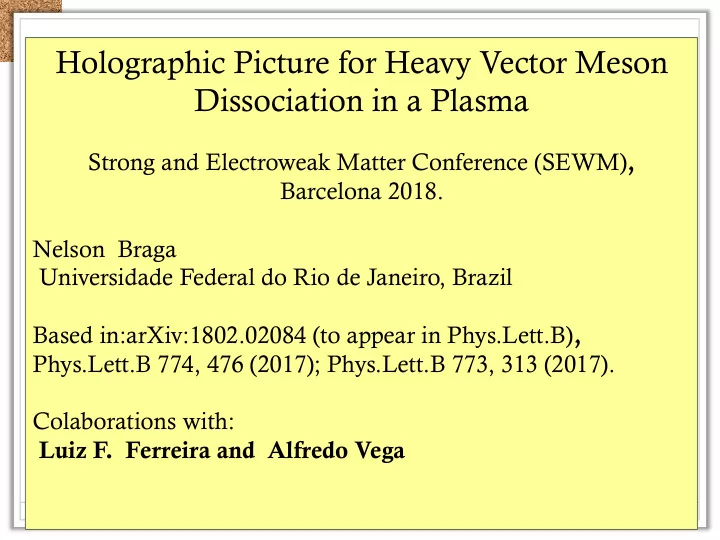
Strong and Electroweak Matter Conference (SEWM), Barcelona 2018. Nelson Braga Universidade Federal do Rio de Janeiro, Brazil Based in:arXiv:1802.02084 (to appear in Phys.Lett.B), Phys.Lett.B 774, 476 (2017); Phys.Lett.B 773, 313 (2017). Colaborations with: Luiz F. Ferreira and Alfredo Vega

slide-2
SLIDE 2

Motivation: describe the thermal dissociation of heavy vector mesons inside a quark gluon plasma using holography (AdS/QCD “botton up” model). In particular: density and magnetic field effects.

slide-3
SLIDE 3

3

Gauge/String duality at finite temperature.

Witten (1998): finite temperature version of AdS/CFT

The Hawking temperature of the black hole (B.H) is the temperature of the gauge theory. Charge of the B.H. è Density of the medium Einstein-Maxwell action è Magnetic field D'Hoker and P.Kraus, JHEP 0910, 088 (2009);1003, 095 (2010)

Black hole in anti-de Sitter space

Gauge Theory at finite temperature

slide-4
SLIDE 4

Important The holographic model must be consistent with masses and decay constants for mesons in the vacuum. Why do we have to worry about decay constants ?

slide-5
SLIDE 5

Bottomonium Spectral function

slide-6
SLIDE 6
slide-7
SLIDE 7
slide-8
SLIDE 8
slide-9
SLIDE 9
slide-10
SLIDE 10

Bottomonium Spectral function

slide-11
SLIDE 11

11

In the limit of T è 0 Quasi-states è Dirac delta peaks of the meson states Two point function at zero temperature:

Imaginary part:

slide-12
SLIDE 12

12

Data for vector mesons

cc

Relation between decay constant and eletron-positron width

c

slide-13
SLIDE 13

13

The decay constants decrease with radial excitation level.

This behavior is not reproduced by the original AdS/QCD models like: Hard wall, J. Polschinski, M.Strassler, 2002; H. Boschi-Filho, N. B. 2003. Soft wall, A.Karch, E.Katz, D.T.Son and M.A.Stephanov, 2006. D4-D8, T. Sakai, S. Sugimoto, 2005. Data for vector mesons

slide-14
SLIDE 14

14

Gauge string duality provides a tool to calculate the lefhand side of this equation.

How can one calculate decay constants and masses from holography? Correlator of gauge theory currents:

slide-15
SLIDE 15

15

Gauge string duality: vector fields in anti-de Sitter space work as sources for current correlators. Model:

3 parameters (“related to”): quark mass, string tension , large mass scale associated with the mass change in the non hadronic transition: heavy meson è leptons

slide-16
SLIDE 16

16

slide-17
SLIDE 17

17

Finite temperature and density: Finite temperature and background B field d(z) , q(z) = functions of T , B.

slide-18
SLIDE 18

18

Spectral functions. Density effect in charmonium

slide-19
SLIDE 19

19

Effect of magnetic field in Bottomonium. Magnetic field paralell to polarization

slide-20
SLIDE 20

20

Effect of magnetic field in Bottomonium. Magnetic field perpendicular to polarization

slide-21
SLIDE 21

21

Final remark: The background geometry represents just the effect of the magnetic field on the plasma. Magnetic fields could have also a direct effect of the charged constituents of the heavy mesons. Dudal and Mertens, Phys. Rev. D 91, 086002 (2015)

  • Phys. Rev. D 97, 054035 (2018).

DBI like action. Future plan: test the direct effect in this new holographic model.

slide-22
SLIDE 22

22

Thank you !!