Sustainable Practice in Underserved Settings Preventing Burnout and - - PowerPoint PPT Presentation

sustainable practice in underserved settings
SMART_READER_LITE
LIVE PREVIEW

Sustainable Practice in Underserved Settings Preventing Burnout and - - PowerPoint PPT Presentation

What is wellbeing? Sustainable Practice in Underserved Settings Preventing Burnout and Promoting Wellness Diana Coffa, MD Director, Family and Community Medicine Residency UCSF, Zuckerberg San Francisco General Many roads lead to wellbeing and


slide-1
SLIDE 1

1

Diana Coffa, MD Director, Family and Community Medicine Residency UCSF, Zuckerberg San Francisco General
Sustainable Practice in Underserved Settings

Preventing Burnout and Promoting Wellness

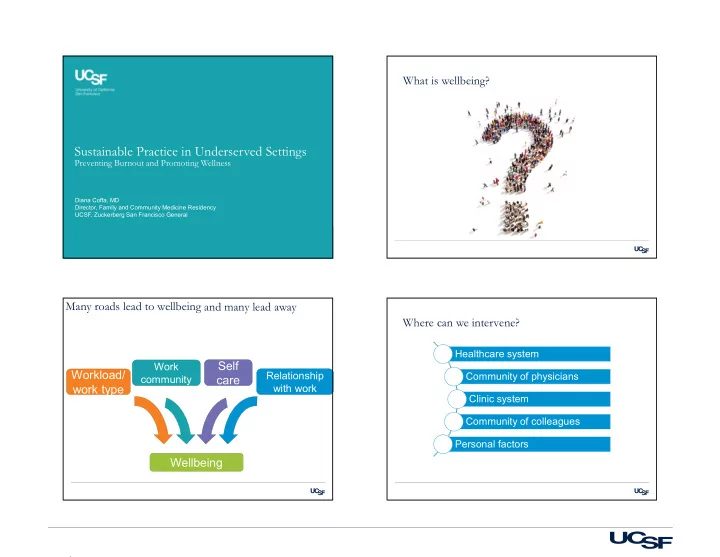
What is wellbeing? Many roads lead to wellbeing and many lead away Wellbeing Workload/ work type

Work community

Self care

Relationship with work

Where can we intervene?

Healthcare system Community of physicians Clinic system Community of colleagues Personal factors

slide-2
SLIDE 2

2

The State of the Science

500 1000 1500 2000 2500 3000 Physician Wellbeing Physician Burnout

Number of PubMed Studies

Defining Burnout

  • Cynicism and depersonalization
  • Emotional exhaustion
  • Loss of sense of efficacy

Burnout as a state of dissociation

  • Cynicism and depersonalization
  • Emotional exhaustion
  • Loss of sense of efficacy

Dissociation from others

Burnout as a state of dissociation

  • Cynicism and depersonalization
  • Emotional exhaustion
  • Loss of sense of efficacy

Dissociation from others Dissociation from emotions and self

slide-3
SLIDE 3

3

Burnout as a state of dissociation

  • Cynicism and depersonalization
  • Emotional exhaustion
  • Loss of sense of efficacy

Dissociation from others Dissociation from emotions and self Dissociation from systems and work role

Burnout as a defensive strategy

Artist: Maggie Taylor http://maggietaylor.com/

What brings us back from burnout?

Risk factors for burnout

Structural

  • Low sense of control
  • High workload
  • High ratio of non-

meaningful work

  • Conflict with co-workers
  • Conflict with patients
  • Financial strain

Personal

  • Stress at home
  • Less hobbies or enjoyable

activities

  • Less self-care
  • Temperamental factors
  • Alexithymia
slide-4
SLIDE 4

4

Alexithymia

No Read Emotions

How does Alexithymia lead to burnout?

  • Lower capacity for empathy

Lower capacity for meaningful contact and relationship

  • Lower capacity to notice, attend

to, and appropriately respond to

  • ur own emotions

Image Credit: Washington University Political Review

In Medical Language, Burnout =

Frustration Sadness Fatigue Shame Fear Grief Guilt

Hopelessness

Worry Betrayal Despair Doubt Anger Depression

What if we actually named emotions instead?

  • What is this feeling?
  • What does it need from me?
  • What information does it carry?
  • What action is called for?
slide-5
SLIDE 5

5

Clinic systems that impact wellbeing

Connection with patients Sense of meaning Supportive community Creative work/ Teaching Accomplishment Shared mission Sense of control Loss of mission integrity Discord with patients Discord with colleagues Inability to meet patient needs High workload

High ratio of “meaningless” work

18

AAFP Principles of Administrative Simplification

  • Prior Authorizations
  • Must be justified
  • Transparent
  • Eliminated for imaging, DME, and generics
  • Eliminated for effective medications for chronic conditions
  • Quality Measures
  • Standardized
  • Patient centered
  • Evidence based

AAFP Principles of Administrative Simplification

  • Certification and Documentation
  • Physician order should suffice. Multiple forms should not be

needed for PT, hospice, home health, DM supplies

  • Eliminate annual recertification of DME supplies for chronic

conditions

  • Standardize forms
  • Medical record documentation
  • Eliminate E/M leves
  • Information should be acceptable if entered by any member of the

team

  • Record should be for information sharing. Check boxes and

templates do not contribute to patient well-being

  • EHR vendors must collaborate with care providers to redesign

systems