History As Mystery Periodic Table of Puzzle It Out the Presidents - - PDF document

history as mystery
SMART_READER_LITE
LIVE PREVIEW

History As Mystery Periodic Table of Puzzle It Out the Presidents - - PDF document

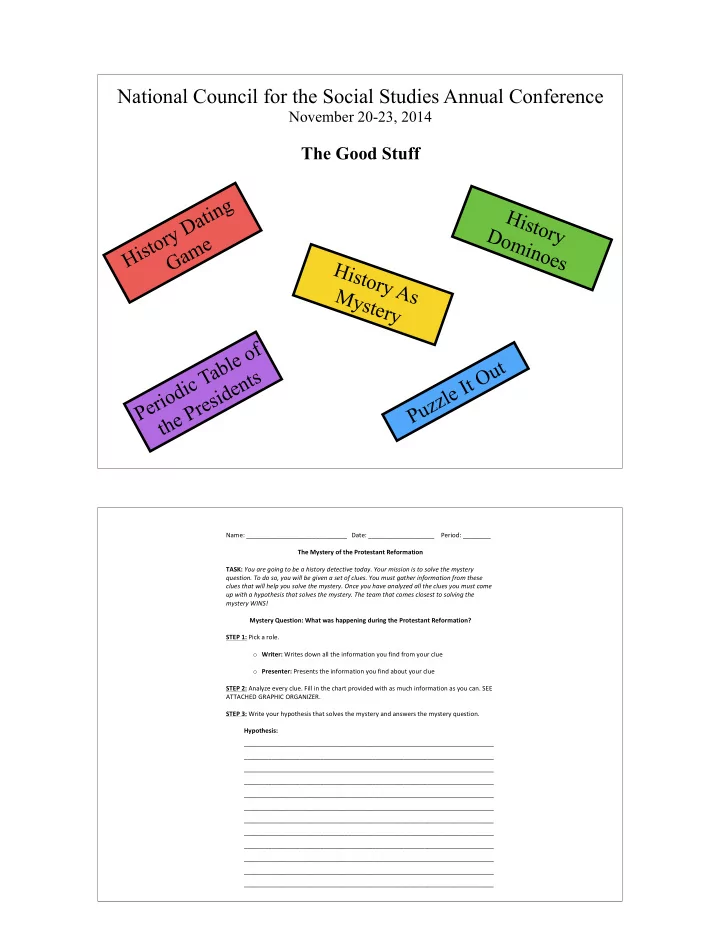
National Council for the Social Studies Annual Conference November 20-23, 2014 The Good Stuff History Dating H i s t o r D y o Game m i n o e s History As Mystery Periodic Table of Puzzle It Out the Presidents


slide-1
SLIDE 1

National Council for the Social Studies Annual Conference

November 20-23, 2014

  • The Good Stuff

History Dating Game Periodic Table of the Presidents History As Mystery Puzzle It Out H i s t

  • r

y D

  • m

i n

  • e

s

Name:&_____________________________& Date:&___________________& Period:&________& & The$Mystery$of$the$Protestant$Reformation$ & TASK:!You!are!going!to!be!a!history!detective!today.!Your!mission!is!to!solve!the!mystery! question.!To!do!so,!you!will!be!given!a!set!of!clues.!You!must!gather!information!from!these! clues!that!will!help!you!solve!the!mystery.!Once!you!have!analyzed!all!the!clues!you!must!come! up!with!a!hypothesis!that!solves!the!mystery.!The!team!that!comes!closest!to!solving!the! mystery!WINS!!! ! Mystery$Question:$What$was$happening$during$the$Protestant$Reformation?$ & STEP$1:&Pick&a&role.&& &

  • Writer:&Writes&down&all&the&information&you&find&from&your&clue&

&

  • Presenter:&Presents&the&information&you&find&about&your&clue&

& STEP$2:&Analyze&every&clue.&Fill&in&the&chart&provided&with&as&much&information&as&you&can.&SEE& ATTACHED&GRAPHIC&ORGANIZER.& & STEP$3:&Write&your&hypothesis&that&solves&the&mystery&and&answers&the&mystery&question.& & Hypothesis:& ________________________________________________________________________ ________________________________________________________________________ ________________________________________________________________________ ________________________________________________________________________ ________________________________________________________________________ ________________________________________________________________________ ________________________________________________________________________ ________________________________________________________________________ ________________________________________________________________________ ________________________________________________________________________ ________________________________________________________________________ ________________________________________________________________________&

slide-2
SLIDE 2

& CLUE$#$1:$(TITLE)$

Key$People$ (Name&&&Information&you&learn&about&them)& & Ideas$$ (What&people&may&have&been&thinking)& & Dates$$ (When&and&what&happened)& & Objects$ &(What&they&are&and&what&they&might&be&used&for)& Vocabulary/Terms$$ (Words&that&seem&important&to&know&and&what&they& mean)& & Other$$ (Any&information&that&doesn’t&fit&in&the&other& categories)&

& CLUE$#$2:$(TITLE)$

Key$People$ (Name&&&Information&you&learn&about&them)& & Ideas$$ (What&people&may&have&been&thinking)& & Dates$$ (When&and&what&happened)& & Objects$ &(What&they&are&and&what&they&might&be&used&for)& Vocabulary/Terms$$ (Words&that&seem&important&to&know&and&what&they& mean)& & Other$$ (Any&information&that&doesn’t&fit&in&the&other& categories)& & CLUE$#$3:$(TITLE)$

Key$People$ (Name&&&Information&you&learn&about&them)& & Ideas$$ (What&people&may&have&been&thinking)& & Dates$$ (When&and&what&happened)& & Objects$ &(What&they&are&and&what&they&might&be&used&for)& Vocabulary/Terms$$ (Words&that&seem&important&to&know&and&what&they& mean)& & Other$$ (Any&information&that&doesn’t&fit&in&the&other& categories)&

& CLUE$#$4:$(TITLE)$

Key$People$ (Name&&&Information&you&learn&about&them)& & Ideas$$ (What&people&may&have&been&thinking)& & Dates$$ (When&and&what&happened)& & Objects$ &(What&they&are&and&what&they&might&be&used&for)& Vocabulary/Terms$$ (Words&that&seem&important&to&know&and&what&they& mean)& & Other$$ (Any&information&that&doesn’t&fit&in&the&other& categories)&

slide-3
SLIDE 3

& CLUE$#$5:$(TITLE)$

Key$People$ (Name&&&Information&you&learn&about&them)& & Ideas$$ (What&people&may&have&been&thinking)& & Dates$$ (When&and&what&happened)& & Objects$ &(What&they&are&and&what&they&might&be&used&for)& Vocabulary/Terms$$ (Words&that&seem&important&to&know&and&what&they& mean)& & Other$$ (Any&information&that&doesn’t&fit&in&the&other& categories)&

& CLUE$#$6:$(TITLE)$

Key$People$ (Name&&&Information&you&learn&about&them)& & Ideas$$ (What&people&may&have&been&thinking)& & Dates$$ (When&and&what&happened)& & Objects$ &(What&they&are&and&what&they&might&be&used&for)& Vocabulary/Terms$$ (Words&that&seem&important&to&know&and&what&they& mean)& & Other$$ (Any&information&that&doesn’t&fit&in&the&other& categories)&

CLUE ¡#1: ¡Religions ¡in ¡Europe ¡1100-­‑1648 European ¡Religions ¡1100-­‑1200

slide-4
SLIDE 4

European ¡Religions ¡1560 European ¡Religions ¡1648

slide-5
SLIDE 5

CLUE ¡#2: ¡Erasmus, ¡The ¡Praise ¡of ¡Folly

The Praise of Folly is one of the most famous pieces of literature of the sixteenth century. Both contemporaries and later generations have appreciated "this laughing parody of every form and rank of human life." In this selection, Erasmus belittles one of his favorite objects of scorn-the monks.

  • “Those who are the closest to these [the theologians] in happiness are generally

called "the religious" or "monks," both of which are deceiving names, since for the most part they stay as far away from religion as possible and frequent every sort of place. I cannot, however, see how ally life could be more gloomy than the life of these monks if I did not assist them in many ways. Though most people detest these men so much that accidentally meeting one is considered to be bad luck, the monks themselves believe that they are magnificent creatures. One of their chief beliefs is that to be illiterate is to be of a high state of sanctity, and so they make sure that they are not able to read. Another is that when braying

  • ut their gospels in church they are making themselves very pleasing and

satisfying to God, when in fact they are uttering these psalms as a matter of repetition rather than from their hearts…they think that they are superior to all

  • ther people.”

CLUE ¡#3: ¡The ¡Buying ¡of ¡Indulgences

coffer

Translation ¡of ¡text ¡on ¡the ¡left: ¡

  • “By ¡buying ¡this ¡indulgence ¡

you ¡are ¡now ¡free ¡of ¡all ¡of ¡ your ¡sins ¡and ¡can ¡go ¡directly ¡ to ¡heaven.” ¡

slide-6
SLIDE 6

CLUE ¡#4: ¡Martin ¡Luther ¡and ¡the ¡95 ¡Theses CLUE ¡#5:

slide-7
SLIDE 7

Woodcuts ¡created ¡by ¡Martin ¡Luther ¡ and ¡spread ¡by ¡the ¡printing ¡press

CLUE ¡#6:

History Dating Game

A matching activity with a twist:

  • students are given cards with names, dates, events, definitions, etc.
  • students are instructed to find another student to “date” -

that they would have some sort of connection with

  • each pair will discuss what their connection is and share it with the class

(add one group of three if odd # of students)

  • Extensions:
  • have students line up in a certain order

(chronological, cause and effect, etc.)

  • students are now matched with another student for a subsequent activity

(rather than counting off)

  • have the students create the cards as homework or a pairs activity
slide-8
SLIDE 8

The American Revolution The Boston Massacre Lexington and Concord Battle

  • f

Bunker Hill Olive Branch Petition Boston Tea Party Declaration

  • f

Resolves Benjamin Franklin John Adams George Washington Townsend Acts Minutemen Puzzle It Out

A drawing connections activity with a twist:

  • students are given puzzle pieces that contain names, dates, events, definitions, etc.
  • each puzzle contains a central term that will be supported by the other terms
  • students will solve each puzzle, connecting the terms to the central idea

(use at least two puzzles together so they don’t just match the shapes)

  • Use:
  • as a review activity at the beginning of class
  • as a time-filler for students who may finish a test or quiz before others
  • project a blank puzzle with a list of terms

and have the students make the connections

  • as an entrance/exit slip activity
  • can be done individually, in pairs, in groups
  • have students create their own puzzles

and explain the connections between the puzzle pieces

  • extend to writing: the students write a summary explaining the connections
slide-9
SLIDE 9

!

The American Revolution The Boston Massacre Lexington and Concord Battle

  • f

Bunker Hill Olive Branch Petition Boston Tea Party Declaration

  • f

Resolves

History Dominoes

As with the Puzzles activity, this can be used:

  • as a review activity at the beginning of class
  • as a time-filler for students who may finish a test or quiz before others
  • project blank dominoes with a list of terms

and have the students make the dominoes

  • as an entrance/exit slip activity
  • can be done individually, in pairs, in groups
  • have students create their own dominoes

and explain the connections between the dominoes

  • extend to writing: the students write a summary explaining the connections

A drawing connections activity with a twist:

  • Using the same concept of playing dominoes, students use prior knowledge to make

connections with content.

  • Students will explain the connections between the pair that is matched.
slide-10
SLIDE 10

The Boston Massacre

Benjamin Franklin John Adams Lexington and Concord Minutemen Townsend Acts