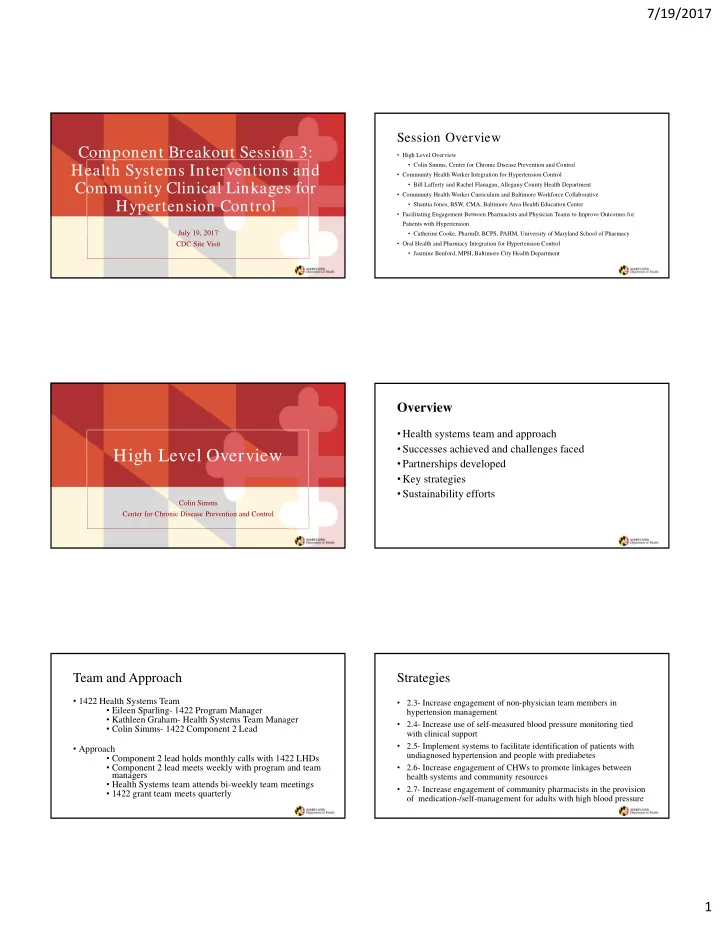
High Level Overview Partnerships developed Key strategies - - PDF document

high level overview
SMART_READER_LITE
LIVE PREVIEW

High Level Overview Partnerships developed Key strategies - - PDF document

7/19/2017 Session Overview Component Breakout Session 3: High Level Overview Colin Simms, Center for Chronic Disease Prevention and Control Health Systems Interventions and Community Health Worker Integration for Hypertension Control


slide-1
SLIDE 1

7/19/2017 1

Component Breakout Session 3: Health Systems Interventions and Community Clinical Linkages for Hypertension Control

July 19, 2017 CDC Site Visit

Session Overview

  • High Level Overview
  • Colin Simms, Center for Chronic Disease Prevention and Control
  • Community Health Worker Integration for Hypertension Control
  • Bill Lafferty and Rachel Flanagan, Allegany County Health Department
  • Community Health Worker Curriculum and Baltimore Workforce Collaborative
  • Shantia Jones, BSW, CMA, Baltimore Area Health Education Center
  • Facilitating Engagement Between Pharmacists and Physician Teams to Improve Outcomes for

Patients with Hypertension

  • Catherine Cooke, PharmD, BCPS, PAHM, University of Maryland School of Pharmacy
  • Oral Health and Pharmacy Integration for Hypertension Control
  • Jasmine Benford, MPH, Baltimore City Health Department

High Level Overview

Colin Simms Center for Chronic Disease Prevention and Control

Overview

  • Health systems team and approach
  • Successes achieved and challenges faced
  • Partnerships developed
  • Key strategies
  • Sustainability efforts

Team and Approach

  • 1422 Health Systems Team
  • Eileen Sparling- 1422 Program Manager
  • Kathleen Graham- Health Systems Team Manager
  • Colin Simms- 1422 Component 2 Lead
  • Approach
  • Component 2 lead holds monthly calls with 1422 LHDs
  • Component 2 lead meets weekly with program and team

managers

  • Health Systems team attends bi-weekly team meetings
  • 1422 grant team meets quarterly

Strategies

  • 2.3- Increase engagement of non-physician team members in

hypertension management

  • 2.4- Increase use of self-measured blood pressure monitoring tied

with clinical support

  • 2.5- Implement systems to facilitate identification of patients with

undiagnosed hypertension and people with prediabetes

  • 2.6- Increase engagement of CHWs to promote linkages between

health systems and community resources

  • 2.7- Increase engagement of community pharmacists in the provision
  • f medication-/self-management for adults with high blood pressure
slide-2
SLIDE 2

7/19/2017 2

Foundation for Health Systems Interventions

  • LHDs in the 5 communities partnered with FQHCs to implement

systems changes related to:

  • Screening for undiagnosed hypertension
  • Hypertension management
  • Targeted health system changes
  • Role of LHDs
  • Role of the Maryland Department of Health

Federally Qualified Health Centers (FQHC)

LHDs in 5 communities have partnered with 6 FQHCs to develop and implement policies.

FQHC Policies Developed Policies Drafted Policies Assessed

Chesapeake Health Care

X

Choptank Community Health

X

Family Healthcare of Hagerstown

X

Healthcare for the Homeless

X

Mountain Laurel Medical Center

X

Tri-State Community Health Center

X

Locations of Federally Qualified Health Centers partnering with 1422 communities.

Building on the Foundation

  • Increased partnerships
  • Pharmacies
  • Oral Health Practices
  • Community Health Workers
  • Local health department integration

Oral Health Practices

  • Scope of Work
  • Implement policies to provide blood pressure screening to patients
  • Provide education on hypertension and hypertension management
  • Refer identified patients to primary care
  • Successes
  • Partnerships with 19 practices
  • Process Mapping
  • Increased collaboration with the Office of Oral Health
  • Conferences
  • Challenges
  • Funding and time
  • Equipment
  • Staffing to take blood pressure screenings

Pharmacies

  • Scope of Work
  • Implement policies to provide blood pressure screening to patients
  • Provide education on hypertension and hypertension management
  • Identify any hypertension medication related issues
  • Refer identified patients to primary care
  • Successes
  • Partnerships with 15 pharmacies
  • Integration of students
  • Workforce development
  • Challenges
  • Pharmacist availability and limited screening times
  • Retail pharmacy accessibility
slide-3
SLIDE 3

7/19/2017 3

Community Health Workers (CHW)

  • Scope of Work
  • Develop and implement training on 1422 strategies within their work at

health systems

  • Promote local health department 1422 initiatives
  • Connect patients with primary care physicians
  • Successes
  • 74 CHWs, representing 24 unique health systems, received training on

hypertension [PM 18A]

  • Ongoing collaboration
  • Challenges
  • CHW Model is not supported within FQHCs
  • Financial impact of hiring CHWs

Successes and Challenges

Successes

  • Partnership development
  • Policy implementation
  • Toolkit development
  • Leveraging other funds to expand on
  • ther projects regarding hypertension
  • Creating linkages back to primary care

Challenges

  • Time and funding
  • Access to Care
  • Change in lifestyles is not seen

immediately

  • Electronic Health Systems differ
  • No legislation to support non-

physician team member efforts

Sustainability

  • Policy development, adoption, and maintenance on undiagnosed hypertension

screenings, as well as hypertension management

  • FQHCs
  • Pharmacies
  • Oral Heal Providers
  • Electronic Health Record support to better identify patients within the system
  • Partnerships with state partners that will support workforce transformation in

relation to hypertension management

  • Schools of Pharmacy
  • Maryland Dental Action Coalition

Next Steps

  • Maintain and strengthen collaborations pharmacists and oral health

providers to increase screenings

  • Develop and disseminate toolkits to support local health department

efforts

  • Local health department integration into health improvement and

wellness coalitions, promoting strategies to an increased number of health systems

Community Health Worker Integration for Hypertension Control

Bill Lafferty and Rachel Flanagan, Allegany County Health Department

ALLEGANY COUNTY MARYLAND

Overview of Allegany County’s Accomplishments and Challenges in Implementing the Chronic Disease 1422 Grant

slide-4
SLIDE 4

7/19/2017 4

Allegany County is located in the western part of the state of

  • Maryland. Cumberland is the

county seat and a gateway to the east and west. Allegany County is bordered on the west by Garrett County, MD and to the east by Washington County, MD. The state of Pennsylvania provides the northern border, while West Virginia is to the south. Each state is within 15 minute drive of the city of Cumberland.

Demographics of Allegany County , Maryland (United States Census Bureau 2015)

Allegany County Maryland Population (estimated, 2016) 72,130 6,016,447 Population change (from 2010) (3.9%) 4.2% Population male 52.1% 47.9% Population female 47.9% 52.1% Population white 88.6% 59.3% Population African American 8.1% 30.7% Education Bachelor degree + 17.4% 37.9% 18-64 years old 62.9% 63.0% 65 and over 19.5% 14.6% In work force (16 years old +) 53.3% 67.9% Per capita income $21,674 $36,897 Median household income (2015) $40,551 $74,551 Persons in poverty - percent 20.0% 9.7%

Allegany County 1422 Staff: Lynn Kane ‐ Director of Nursing and Physical Health William Lafferty – Chronic Disease Coordinator Rachel Flanagan – Chronic Disease Coordinator Tina Baird – Community Health Nurse II

  • Age‐adjusted death rate for heart disease is 243

per 100,000 (Maryland is 172)

  • Hypertension ED visits is 279 per 100,000

(Maryland is 252) Allegany County Chronic Disease Statistics (Allegany County Health Planning Coalition 2013) Strategies Increase engagement of CHWs to promote linkages between health systems and community resources for adults with high blood pressure Activities

  • Work with Community Health Workers (CHWs) to provide education on

screening undiagnosed hypertension, as well as referral to community resources and lifestyle change programs.

  • Work with Community Health Worker partners to engage FQHCs in

incorporating CHWs in their health system. Organizations/Partners

  • Allegany County Health Department
  • Western Maryland Health System
  • Maryland Area Health Education Centers (AHEC)
  • AHEC West
  • Allegany Health Right
  • Allegany College of Maryland
  • Allegany County Health Planning Coalition

Community Health Worker (CHW) Partner Activities Allegany Health Right

  • Allegany Health Right (AHR) has served as a "safety net" for low‐income
  • individuals. AHR accomplishes this by coordinating donated and deeply

discounted oral health care, making it easier for oral health providers to reduce the cost of services. AHEC West

  • AHEC West works within the 1422 grant to educate CHWs and non‐physician

team members within the community regarding chronic disease screenings and management. Western Maryland Health System

  • CHWs in the health system help patients and their families to navigate and

access community services, other resources, and adopt healthy behaviors. The CHWs works one‐on‐one with patient in home and assists each in making healthier lifestyle choices. Allegany County Health Department Successes on CHW Integration

  • Increased community collaboration of CHWs in the jurisdiction
  • Collaborated with AHEC West to provide trainings
  • Assisted in the facilitation of linkages to community resources
  • Supported efforts to detect undiagnosed hypertension
slide-5
SLIDE 5

7/19/2017 5

Challenges on CHW Integration

  • Integration within Federally Qualified Health Centers
  • Access to care across the jurisdiction

References

Allegany County Community Health Needs Assessment. Allegany County Health Planning Coalition. Retrieved from http://www.alleganyhealthplanningcoalition.com/pdf/Community%20Health%20Need s%20Assessment%20FY14%20(final).pdf.

  • QuickFacts. United States Census Bureau. Retrieved from

https://www.census.gov/quickfacts/fact/table/alleganycountymaryland/AGE295216.

Baltimore Area Health Education Center Shantia Jones, BSW CMA Community Health Training Coordinator

Maryland Area Health Education

Center (MAHEC) Program

Cecil Kent Queen Anne’s Talbot Dorchester Wicomico Somerset Worcester Car
  • line
Garrett Allegany Washington Garrett Allegany Washington

Garrett Allegany Washington

Cecil Kent Talbot Dorchester Wicomico Worcester Car
  • line

Cecil Kent Queen Anne’s Talbot Dorchester Wicomico Somerset Worcester Caroline

Carroll Howard Baltimore Balt. City Anne Arundel
  • St. Mary’s
Harford Prince George’s Charles Cal
  • vert

Frederick Carroll Howard Baltimore Anne Arundel

  • St. Mary’s

Harford Prince George’s Charles Calvert Montgomery

AHEC Center Locations

Maryland AHEC Program Office University of Maryland School of Medicine

Baltimore Area Health Education Center (BAHEC)

  • 2003 Established as Non-Profit 501 c (3)
  • 2016 Re-launched -new Leadership & Board
  • Operational support from University of Maryland

Medical Center (UMMC)

  • Focus on:
  • Clinical Education for Medical Students in Community
  • Interdisciplinary Training for Students on UMB Campus
  • Community Health Worker Training Program

Mission

The BAHEC's mission is to improve access to quality healthcare and to address the issue of health disparities in medically underserved urban areas in Baltimore City and County.

slide-6
SLIDE 6

7/19/2017 6

Maryland Area Health Education Center Community Health Worker Training Institute

  • MAHEC has a Community Health Worker Training Curriculum
  • 160 Hours as recommended by CHW State Workgroup and

aligned with the 11 state mandated competency areas

  • Field Practicum Guide to Training CHWs with employers
  • AHECs have trained CHWs working across the state in

hospitals, health departments, and within other AHEC centers

Community Health Worker Patient Navigator Outreach Worker Community Coordinator Promotor(a) de Salud Health Advisor Lay Health Advisor Family Health Advocate Street Outreach Worker Community Educator 21-1094 Community Health Representatives (CHR)

Importance of CHW Role

  • Serve as a link between patients with hypertension and the

health care team

  • Provide culturally specific basic health information
  • Support those with hypertension in their efforts to make

changes in daily routine

  • Connect individuals to primary care providers
  • Assess individuals support system
  • Provide referrals to social services for those who may face

barriers to programs

Baltimore Population Health Workforce Collaborative (BPHC)

  • 9 Baltimore City Hospitals
  • Recruit new employees in economically distressed neighborhoods
  • Focus on 3 Positions:
  • Peer Recovery Specialist
  • CHW
  • CNA
  • Baltimore Alliance Career Healthcare (BACH) Umbrella/Training
  • CBOs (Turnaround Tuesday, CFUF, Penn North)
  • Training Partners (BAHEC, CCBC, MPRT)

MAHEC & DHMH Collaboration

  • Partner on Center for Disease Control (CDC) State and Local Public Health

Action to Prevent Obesity, Heart Disease, and Stroke (1422 Grant) with Center for Chronic Disease Prevention and Control (CCDPC)

  • Increase engagement of CHWs to promote linkages between health system

and community resources for adults living with hypertension

Objectives of Training Module

  • Provide education on hypertension
  • Risk factors for hypertension
  • Preventing & managing hypertension
  • Identify CHW roles and Maryland referral programs
  • Locating community health providers
  • Education support groups
slide-7
SLIDE 7

7/19/2017 7

Accomplishments of BAHEC

  • In partnership with other AHEC centers developed training module
  • Jan – June 2017 Trained 58 CHWs face to face as part of Population Health

Workforce Collaborative

  • Partnered with Baltimore City Local Health Department on Chronic Disease
  • 2017 Community Health Workers Conference June 21st
  • 114 attendees

Outcome of Training

Training Classes Number of Students Trained Cohort 1 (January 9th thru February 17, 2017) 16 Cohort 2 (March 8th thru April 28th, 2017) 11 Cohort 3 (May 8th thru June 2nd, 2017 13 Cohort 4 (June 5th thru June 30th, 2017 12 Total Students Trained 52

Challenges

  • Empowering CHWs to understand the role of health educator
  • Limited knowledge on future employment type
  • Limited open classes on DPP/DSME in Baltimore City
  • Different knowledge levels and past experiences of trainees
  • n hypertension

Sustainability/Future Opportunities

  • Baltimore Population Health Workforce Collaborative
  • Exploring other grant funding
  • Make case for long term part of All Payer Model in

Maryland

  • Specialized CHWs in Chronic Disease
  • More Specific training on specific populations
  • Partnering with Community Colleges
  • Starting to train for other partners (LHDs, FQHCs)
  • Continue to Partner on Annual Baltimore City Community

Health Workers Conference THIS PROGRAM SUPPORTED BY STATE AND LOCAL PUBLIC HEALTH ACTIONS TO PREVENT OBESITY, DIABETES, AND HEART DISEASE AND STROKE, VIA GRANT #DP14-1422PPHF14

Break

slide-8
SLIDE 8

7/19/2017 8 Facilitating Engagement Between Pharmacists and Physician Teams to Improve Outcomes for Patients with Hypertension

Catherine E. Cooke, PharmD, BCPS, PAHM Shan Xing, PharmD

Facilit cilitatin ing Eng Engagement be between Pharm Pharmaci cists & Ph Physic icia ian Te Teams to to im improve

  • u
  • utc

tcomes

  • mes fo

for pa patien ents ts wi with th Hy Hypert pertension ension

CDC Site Visit, July 19, 2017 Catherine E. Cooke, PharmD, BCPS, PAHM Shan Xing, PharmD

Burden of Hypertension (HTN) in Maryland

  • 1. Hypertension (High Blood Pressure) in Maryland. Baltimore, MD: Maryland Department of Health, https://phpa.health.maryland.gov/ccdpc/Reports/Pages/brfss.aspx.
  • 2. Furberg CD, et al. Am J Hypertens. May 2017. doi:10.1093/ajh/hpx068.
  • 3. CDC. Maryland Priority Area: Healthy People 2020. Topic: Hypertension. Heart Disease and Stroke Objective 11: Prevalence of hypertension medication use among US adults (18+)

with hypertension (Percentage); BRFSS. Maryland 2013.

1 in 3 Maryland adults has HTN 1 Only 1 in 2 able to achieve blood pressure (BP) control1 Antihypertensive medications are an integral component of HTN control2 Only 2 of 3 Maryland adults with HTN take any antihypertensives3

Medication Adherence is a multi‐step process

Prescriber ‐ patient encounter Diagnosis and decision for treatment Rx prescribed Rx sent to pharmacy

  • r patient

drops off Rx Patient picks up Rx from pharmacy Patient takes first dose Patient continues medication Initial (primary) medication adherence Ongoing (secondary) medication adherence

Many patients never pick up their first fill

Prescriber ‐ patient encounter Diagnosis and decision for treatment Rx prescribed Rx sent to pharmacy

  • r patient

drops off Rx Patient picks up Rx from pharmacy Patient takes first dose Patient continues medication Initial (primary) medication adherence

  • 1 out of 3 patients did not fill their new antihypertensive

medication within 30 days1

  • 24% of patients never obtain the first fill of an

antihypertensive prescription; patients new to therapy are at 1.7 times higher risk2

  • 25% of antihypertensive prescriptions (new or renewed) for

African Americans remain unfilled after 30 days3

  • 1. Comer et al. Am J Manag Care. 2015;21(12):e655‐660.; 2. Cooke et al. J Fam Pract. 2011;60(6):321‐327.; 3. Lagu et al. Am J Manag Care. 2009;15:24‐30.

Can we do something about it

  • Through this grant, we will explore ways to improve engagement

between pharmacies/pharmacists and physician teams with the goal

  • f improving clinical outcomes for patients with hypertension.
  • Focus is on bidirectional communication related to initial medication

non‐adherence (IMN)

  • Can pharmacists and physician teams leverage electronic prescribing (e‐Rx) fill

status notification to communicate about initial medication non‐adherence to antihypertensives, ultimately reducing this problem?

slide-9
SLIDE 9

7/19/2017 9

Patient‐Provider encounter results in a new Rx Provider gives written Rx to patient Provider sends E‐Rx to pharmacy of patient’s choice Provider calls/faxes Rx to pharmacy of patient’s choice Patient takes Rx to pharmacy Pharmacy adjudicates Rx Patient picks up Rx fill from pharmacy Patient takes medication

Common mmon pr proc

  • cess fo

for how how a new new pre prescrip iption (R (Rx) reac reaches the the pat patient

Patient‐Provider encounter results in a new Rx Provider gives written Rx to patient Provider sends E‐Rx to pharmacy of patient’s choice Provider calls/faxes Rx to pharmacy of patient’s choice Patient takes Rx to pharmacy Pharmacy adjudicates Rx Patient picks up Rx fill from pharmacy Patient takes medication

Wh What at happens happens wi with in init itial medi medication tion non non‐adhe adherence (I (IMN)? )?

Triggers a RxFill (not filled)1 message, sent from the pharmacy to the prescriber via E‐Rx platform

Patient does not pick up medication Pharmacy must “reverse” Rx claim and return to stock

  • 1. NCPDP Work Group 11 Task Group: RxFill White Paper on Implementation Issues http://www.ncpdp.org/members/wg11/Rxfill_white_paper_on_implementation_issues.pdf

Our work will:

1) Define best practices for bidirectional communication between pharmacists and physician teams for initial medication non‐adherence 2) Identify tools used to track initial medication adherence 3) Examine the current landscape of bidirectional communication between pharmacists and physician teams in Maryland 4) Make recommendations for systems level interventions to improve patient outcomes

Grant activities

  • Systematic literature searches
  • Stakeholder Advisory Board
  • Key informant interviews
  • Visits to healthcare collaborators in Maryland
  • E.g., physician offices, pharmacies, health systems, payers

Status Update

  • Uncovered what is currently known about IMN to

antihypertensive therapy

  • Prevalence/incidence
  • Reasons
  • Patient/clinical predictors
  • Which interventions have worked and which haven’t
  • Working on more fully understanding the process of e‐Rx

and how fill status notification (e.g., RxFill) can be leveraged to enhance bi‐directional communication between pharmacists and physician teams

  • Have others used it?
  • Document the process of prescription communication
  • What do stakeholders think? (e.g., pharmacists, physicians, IT…)

Opportunities and Challenges

Opportunities Challenges

  • Enhance pharmacist‐provider

collaboration

  • Given that this is a newer topic,

may not have reliable information on facilitators and barriers

  • Engage a possibly “neglected”

patient population

  • Successful intervention may be

“trial and error”

  • Bring awareness to the problem
  • f IMN
  • Best “setting” for an intervention

unknown (community,

  • utpatient clinic?)
  • Identify future areas for practice

innovation and research

slide-10
SLIDE 10

7/19/2017 10

Oral Health and Pharmacy Integration for Hypertension Control

Jasmine Benford, MPH, Baltimore City Health Department

Catherine E. Pugh Mayor, Baltimore City Leana S. Wen, M.D., M.Sc. Commissioner of Health, Baltimore City @Bmore_Healthy @DrLeanaWen BaltimoreHealth health.baltim orecity.gov

Health System s Intervention

Jasm ine Benford Health System s Program Coordinator Jasm ine.benford@baltim orecity.gov

Catherine E. Pugh Mayor, Baltimore City Leana S. Wen, M.D., M.Sc. Commissioner of Health, Baltimore City

Cardiovascular Disease Mortality (per 100,000 residents)

2012 Rate 2012 Disp Ratio 2008 Rate 2008 Disp Ratio 2008‐2012 Disp Change 2000‐2008 Disp Change 2012 Grade Baltimore City 300.3 1.27 326.4 1.28 ‐1.04% N/A C Maryland 236.8 254.7 Black, Non‐Hispanic 322.9 0.99 329.0 0.86 15.18% N/A A White, Non‐Hispanic 326.1 382.7 Men 322.6 1.15 343.4 1.10 4.36% N/A B Women 280.5 311.5 Black Men 342.6 1.05 325.2 0.89 18.65% N/A A White Men 325.3 366.4 Black Women 298.1 1.06 303.8 0.82 28.69% N/A B White Women 281.3 368.9 Less than HS completion 759.1 4.06 845.4 5.04 ‐19.52% N/A F HS Graduate or GED 627.9 697.1 Some College or Higher 187.2 167.8

Mortality

High Blood Pressure (ever diagnosed)

2011% 2011 Disparity Ratio 2011 Grade Baltimore City 36.10% 1.13 B Maryland 32.00% Black 41.34% 1.36 C White 30.44% Men 38.18% 1.10 B Women 34.64% <HS 39.10% 1.52 D HS Grad or Equiv 76.29% College Graduate 25.72% Income <$15,000 N/A $15,000‐24,999 57.63% 2.97 D $25,000‐49,999 33.16% $50,000‐74,999 37.16% >=$75,000 19.38%

*Source: BCHD Analysis of data from the Maryland Vital Statistics Administration

Catherine E. Pugh Mayor, Baltimore City Leana S. Wen, M.D., M.Sc. Commissioner of Health, Baltimore City

Top Causes of Death in Baltim ore City

  • Heart Disease
  • 24.4 per 10,000 people
  • 24.4% of total deaths

Source: Baltimore City 2017 Neighborhood Health Profile (rev. 6/ 9/ 17) Catherine E. Pugh Mayor, Baltimore City Leana S. Wen, M.D., M.Sc. Commissioner of Health, Baltimore City

Pharm acy Collaboration

  • Partnering with the P3 Program
  • Represented by the Maryland Pharmacists

Association and University of Maryland School of Pharmacy

  • Engagement of two pharmacies
  • Role of pharmacy students in screening
  • Host 4-6 screening events throughout

the project period, ending September 30th, 2017.

  • Referrals to PCP providers

Catherine E. Pugh Mayor, Baltimore City Leana S. Wen, M.D., M.Sc. Commissioner of Health, Baltimore City

Prehypertension Process Map

Patient arrives at pharmacy and offered HTN Screening <120/80mmHg Normal BP Pharmacist to provide brochure on prevention 120/80-139/89mmHg Prehypertension Refer to PCP Pharmacist to provide brochure on prevention 140/90-159/99mmHg Stage 1 HTN Refer to PCP. If no PCP, refer to THC for immediate appointment Pharmacist to provide brochure on hypertension ≥160/100mmHg Stage 2 HTN Refer to PCP. If no PCP, refer to THC for immediate appointment Advise to go to ER if unable to schedule immediate appointment. Pharmacist to provide brochure on hypertension ≥180/110mmHg Without Symptoms Refer to PCP. If no PCP, refer to THC for immediate appointment Advise to go to ER if unable to schedule immediate appointment. Pharmacist to provide brochure on hypertension ≥180/110mmHg *With Symptoms Hypertensive Emergency Call 911 Pharmacist to provide brochure on hypertension BP taken and recorded Patient agrees to be screened Patient refuses screening

slide-11
SLIDE 11

7/19/2017 11

Catherine E. Pugh Mayor, Baltimore City Leana S. Wen, M.D., M.Sc. Commissioner of Health, Baltimore City

Oral Health Collaboration

  • Secured partnerships
  • Baltimore City Health Department Oral

Health Services serving East and West Baltimore

  • Private dental clinic, The Smile Center
  • Process maps created a referral pipeline
  • Oral Health Services can now refer non-

emergency patients to a PCP

  • The Smile Center will now refer patients to

PCP

  • BCHD is trying to partner with a local

FQHC for referrals from the BCHD clinics

Catherine E. Pugh Mayor, Baltimore City Leana S. Wen, M.D., M.Sc. Commissioner of Health, Baltimore City Catherine E. Pugh Mayor, Baltimore City Leana S. Wen, M.D., M.Sc. Commissioner of Health, Baltimore City