Henry Hyndman: making socialists In the early 1880s, at the age of - - PowerPoint PPT Presentation

henry hyndman making socialists
SMART_READER_LITE
LIVE PREVIEW

Henry Hyndman: making socialists In the early 1880s, at the age of - - PowerPoint PPT Presentation

Henry Hyndman: making socialists In the early 1880s, at the age of forty, Hyndman was converted from his Tory background to socialism through reading Marx's Capital. Founded Britain's first Marxist group, the Social Democratic


slide-1
SLIDE 1

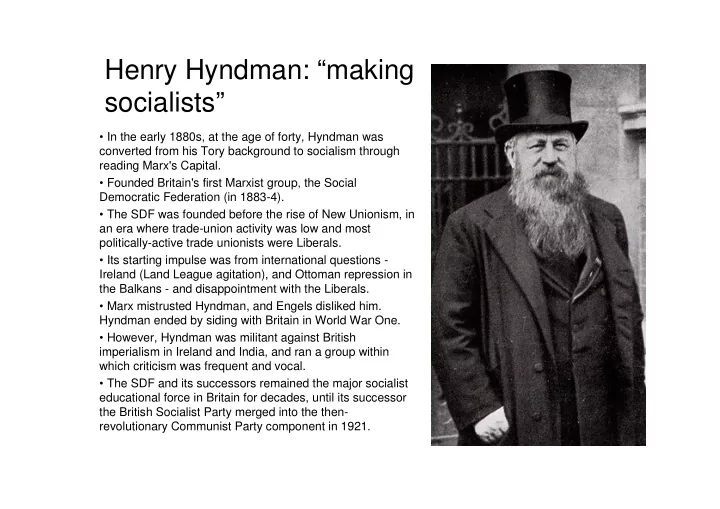
Henry Hyndman: “making socialists”

  • In the early 1880s, at the age of forty, Hyndman was

converted from his Tory background to socialism through reading Marx's Capital.

  • Founded Britain's first Marxist group, the Social

Democratic Federation (in 1883-4).

  • The SDF was founded before the rise of New Unionism, in

an era where trade-union activity was low and most politically-active trade unionists were Liberals.

  • Its starting impulse was from international questions -

Ireland (Land League agitation), and Ottoman repression in the Balkans - and disappointment with the Liberals.

  • Marx mistrusted Hyndman, and Engels disliked him.

Hyndman ended by siding with Britain in World War One.

  • However, Hyndman was militant against British

imperialism in Ireland and India, and ran a group within which criticism was frequent and vocal.

  • The SDF and its successors remained the major socialist

educational force in Britain for decades, until its successor the British Socialist Party merged into the then- revolutionary Communist Party component in 1921.

slide-2
SLIDE 2

SDF - BSP, 1881-1921

  • Left: Democratic

Federation membership card, designed by William Morris.

  • 1881: Democratic

Federation founded.

  • 1883-4: Becomes

Social Democratic Federation, launches Justice.

  • 1887: SDF gains wide

fame by organising big demonstrations of the unemployed.

  • 1889: Will Thorne, SDF

member, and Eleanor Marx, member of an SDF splinter, have leading role in gasworkers'

  • dispute. Tom Mann and

John Burns, recent ex- SDF, have leading roles in dock strike.

  • 1892-3: SDF takes part

in talks for socialist unity with other groups which never quite succeed.

  • 1899: TUC passes motion for independent labour political

representation.

  • 1900: SDF takes part in founding meeting of Labour Representation
  • Committee. SDF disaffiliates in 1902 but SDF members continue

active in local LRCs and in Labour conferences through Tus.

  • 1911: SDF merges with a left-wing group from the ILP, and

becomes British Socialist Party.

  • 1914: BSP splits over attitudes to World War One; 1916: affiliates to

Labour Party.

  • 1921: BSP merges into Communist Party.
slide-3
SLIDE 3

“Making socialists”

  • The SDF set its aim as what William Morris

(a member 1883-5, and then a sympathetic collaborator in the mid-1890s, towards the end of his life) called "making socialists".

  • Its routine: weekly meetings (initially

Wednesday evenings), with lectures;

  • ccasional bigger public meetings; street

meetings (usually Sunday mornings); and street sales of Justice.

  • The SDF never quite worked out how to

link this educational work with its members' day-to-day activity in the trade unions, but, starting from conditions of general hostility and indifference, it educated a whole generation of socialists.

slide-4
SLIDE 4

The SDF and the Labour Party

  • From early on the SDF ran candidates in elections - mostly local government, and initially

mostly for school boards, but also parliamentary elections. They won seats in local government, but not until 1906 in Parliament.

  • In 1906 SDF member Will Thorne was elected on a Labour ticket in West Ham South.

Hyndman ran with the backing of the local Labour Representation Committee in Burnley, the SDF's stronghold outside London, and missed election only by a few hundred votes. But the SDF as such was not active in the Labour Party. Picture: 29 Labour MPs were elected in 1906, and started to use the name “Labour Party”