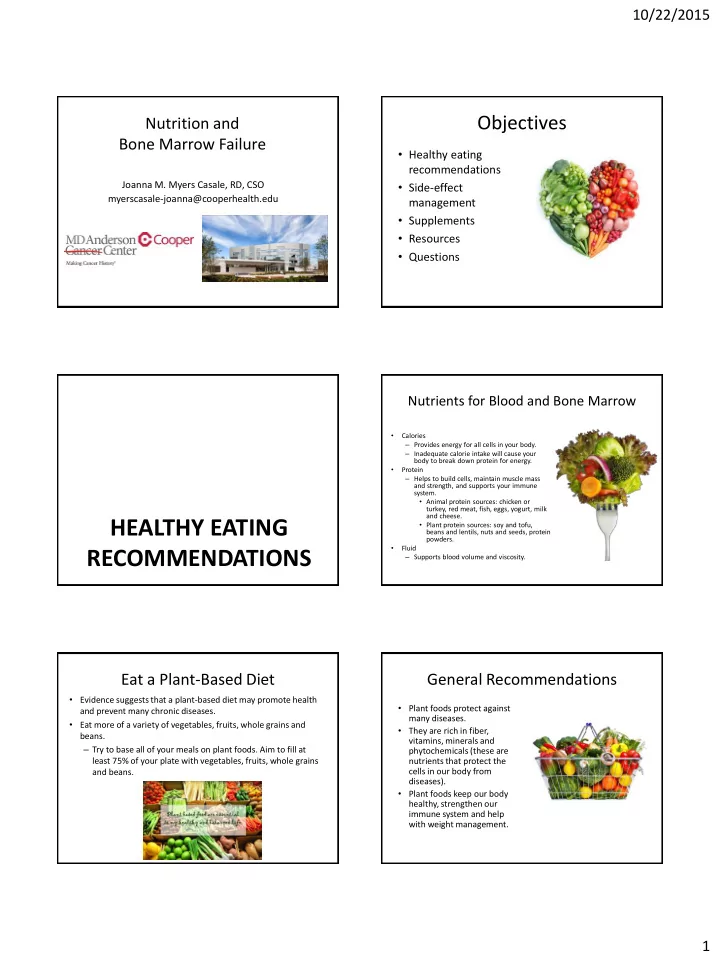
HEALTHY EATING Plant protein sources: soy and tofu, beans and - - PDF document

healthy eating
SMART_READER_LITE
LIVE PREVIEW

HEALTHY EATING Plant protein sources: soy and tofu, beans and - - PDF document

10/22/2015 Objectives Nutrition and Bone Marrow Failure Healthy eating recommendations Joanna M. Myers Casale, RD, CSO Side-effect myerscasale-joanna@cooperhealth.edu management Supplements Resources Questions Nutrients


slide-1
SLIDE 1

10/22/2015 1

Nutrition and Bone Marrow Failure

Joanna M. Myers Casale, RD, CSO myerscasale-joanna@cooperhealth.edu

Objectives

  • Healthy eating

recommendations

  • Side-effect

management

  • Supplements
  • Resources
  • Questions

HEALTHY EATING RECOMMENDATIONS

Nutrients for Blood and Bone Marrow

  • Calories

– Provides energy for all cells in your body. – Inadequate calorie intake will cause your body to break down protein for energy.

  • Protein

– Helps to build cells, maintain muscle mass and strength, and supports your immune system.

  • Animal protein sources: chicken or

turkey, red meat, fish, eggs, yogurt, milk and cheese.

  • Plant protein sources: soy and tofu,

beans and lentils, nuts and seeds, protein powders.

  • Fluid

– Supports blood volume and viscosity.

Eat a Plant-Based Diet

  • Evidence suggests that a plant-based diet may promote health

and prevent many chronic diseases.

  • Eat more of a variety of vegetables, fruits, whole grains and

beans. – Try to base all of your meals on plant foods. Aim to fill at least 75% of your plate with vegetables, fruits, whole grains and beans.

General Recommendations

  • Plant foods protect against

many diseases.

  • They are rich in fiber,

vitamins, minerals and phytochemicals (these are nutrients that protect the cells in our body from diseases).

  • Plant foods keep our body

healthy, strengthen our immune system and help with weight management.

slide-2
SLIDE 2

10/22/2015 2

General Recommendations

  • Avoid sugary drinks – soda, sweet

tea, lemonade, fruit drinks.

  • Limit intake of energy-dense foods,

such as processed foods with added sugar or fat and little nutritional value.

– Snack foods (chips), fast foods, sweets (cakes, cookies)

  • It’s okay to have them occasionally
  • r in small portions but try not to

make them the basis of your diet.

General Recommendations

  • Limit consumption of red

meats (such as beef, pork and lamb) to 18 ounces per week.

  • Avoid processed meats

(such as bacon, sausage, hot dogs, deli meats).

– Look for versions that are nitrate-free, uncured.

General Recommendations

  • If consumed at all, limit alcoholic beverages to 2 per day for

men and 1 per day for women.

– One drink is defined as: 12 ounces of beer, 1.5 ounces of spirit, 5

  • unces of wine

Organics

  • A plant-based diet has many

benefits, so eating any produce, whether organic or not, is healthier than eating none at all

  • You may try to avoid the most

heavily contaminated fruits and vegetables

  • Remember to wash all produce

thoroughly before consumption EWG Produce Pesticide Guide: www.ewg.org Dirty Dozen by Environmental Working Group – free app

The Great Plate

slide-3
SLIDE 3

10/22/2015 3 SIDE-EFFECT MANAGEMENT Symptom Management – Poor Appetite

  • Focus on small but frequent meals.

– Try to eat every 1-2 hours. – Keep favorite foods readily available. – Focus on calorie and nutrient dense foods.

  • High calorie and protein snack ideas:

– Mixed nuts or trail mix – Nuts butters on fruit, crackers or bread – Hummus with pita – Guacamole with tortilla chips – Greek yogurt with granola – Hard-boiled egg with crackers – Cheese and crackers – Shakes such as Boost, Ensure, Orgain, ENU, Svelte, Carnation Breakfast Essentials, homemade milkshakes or high calorie smoothies

Symptom Management – Nausea/Vomiting

  • Try to eat small but frequent meals.
  • Well tolerated foods include: crackers, room

temperature fruit, plain pasta, mashed potatoes, oatmeal, cream of wheat, toast, cereal, pretzels and rice.

  • Focus on bland foods.
  • Choose foods with little or no aroma. Cold foods

have a decreased smell and may be better tolerated.

  • Consume ginger: ginger tea, ginger ale, ginger

brew and ginger candies.

  • Avoid spicy and acidic foods (such as tomato

and citrus products).

  • Try Sea Bands: available at most pharmacies

and reduce nausea through acupressure.

  • Talk with your health care team about anti-

nausea medicines.

Symptom Management – Taste Changes

  • Try a variety of foods. Be open to new foods and

flavors.

  • Increase use of herbs, spices, seasonings and

marinades.

  • Use citrus to flavor foods – try lemon, lime or
  • ranges.
  • For a metallic taste try plastic utensils and avoid

canned foods.

  • Cleanse your mouth before meals with

mouthwash or a rinse of baking soda, salt and water.

  • Mint teas may help your mouth taste better

between meals.

  • Talk with your health care team about using zinc

supplementation.

Symptom Management – Taste Changes

  • Adjust flavor with FASS – fat, acid, salt and sweet

– Fat: olive oil, butter, coconut oil, sesame oil – Acid or sour: lemon, lime, vinegar, tomatoes, pickles – Salt: kosher or sea salt, tamari or soy sauce, MSG-free bouillon, fish sauce, nitrate- free bacon or ham – Sweet: maple syrup, honey, agave, fruits, caramelized onions – Aromatic: garlic, onion, shallots, citrus zest, ginger, pepper, herbs, spices – Heat: cayenne, red pepper flakes, chili powder, curry, mustard, black pepper, coriander – Too spicy? Add some sweetness or creaminess (dairy cuts heat) – Too sweet? Add some sour or heat – Too sour? Add sweet – Too bland? Add salt or some heat – Too salty? Add sour – Just needs a spark? Add acid or an aromatic or just a touch of heat – Too harsh? Try a touch of sweetness

slide-4
SLIDE 4

10/22/2015 4 Symptom Management – Sore Mouth

  • Avoid foods that are very hot, spicy, salty and acidic (tomato and citrus

foods).

  • Avoid alcohol-based mouthwashes. Try a rinse of baking soda and water or

products such as Biotene and Natural Dentist.

  • Focus on soft, bland foods such as smoothies, soups, mashed potatoes,

noodles, eggs, cottage cheese, bananas, canned peaches or pears and yogurt.

  • Honey can soothe your mouth and promote healing.
  • Talk with your health care team about using glutamine supplementation.

Symptom Management - Constipation

  • Being well-hydrated is important for preventing and treating constipation.

– Increase your intake of water, seltzers, tea, coffee and juices.

  • Increase your fiber intake by eating more fruits, vegetables, whole grains and

beans.

  • Try drinking a half cup of warm prune juice.
  • Try drinking Smooth Move Tea.
  • Snack on dates, apricots or prunes.
  • Physical activity can stimulate bowel function.
  • Talk with your health care team about stool softeners and laxatives.

Symptom Management -Diarrhea

  • Sip on fluids throughout the day.
  • Increase foods with soluble fiber such as bananas, rice,

applesauce and oatmeal.

  • Lie down for 30 minutes after a meal.
  • Avoid or limit foods that may worsen diarrhea:

– Caffeine: coffee, tea, sodas, chocolate. – Dairy: especially milk. Try Lactaid or non-dairy milks (almond, soy, etc.). – Very hot or very cold food or fluids. – High fat foods: fried, greasy and fatty foods. – Spicy or seasoned foods. – Sugar alcohols: commonly found in sugar-free gum or candies.

  • Talk with your health care team about anti-diarrhea medicines as

well as glutamine and probiotic supplements.

SUPPLEMENTS

Supplements

  • Always discuss with your health care team.
  • Supplements often interact with medications.
  • Every supplement has the potential to be

harmful.

  • Not regulated by the Food & Drug

Administration. Resources:

  • Memorial Sloan Kettering Integrative

Medicine

– http://www.mskcc.org/cancer- care/integrative-medicine/about-herbs- botanicals-other-products – About Herbs: free app

  • Find a Naturopathic Doctor

– http://www.naturopathic.org

  • Naturopathic Doctor board certified in
  • ncology

– http://www.oncanp.org/find_fabno.html

RESOURCES

slide-5
SLIDE 5

10/22/2015 5

Find a Registered Dietitian

  • Search tool available on the Academy of Nutrition and Dietetics

website – http://www.eatright.org/programs/rdfinder/ – Can specify expert in oncology/hematology or expert in pediatrics

Resources

  • Academy of Nutrition and Dietetics: www.eatright.org

– Recipes, nutrition tips, articles

  • American Institute for Cancer Research: www.aicr.org
  • Food Safety: www.foodsafety.gov

– Ask Karen from USDA – free app for food safety

Resources

MyFitnessPal – www.myfitnesspal.com or free app

  • Calorie counter, diet and exercise tracker

Map My Walk – free app

  • Map your route, track your activity

Johnson & Johnson Official 7 Minute Workout – free app

  • Designed with ease, effectiveness and fun in mind

Ask the Nutritionist: Recipes for Fighting Cancer – free app

  • Developed by the dietitians of the Dana-Farber Cancer Institute
  • To help you find recipes for staying healthy, getting you through

treatment, and living and eating healthy for the rest of your life

  • Easy recipes ranging from nutritious snacks to good-for-you main

dishes to delicious desserts

  • Offers the ability to search by common symptoms (such as nausea
  • r mouth sores)

Simple Green Smoothie

  • 1 cup spinach
  • 1 cup pineapple
  • ½ banana
  • ½ cup ice

Calories: 155 calories Protein: 2.5 grams Carbohydrates: 40 grams Fat: 0.5 grams