HDS Facility Expansion Engineering & Permitting HERITAGE - - PowerPoint PPT Presentation

hds facility expansion engineering permitting
SMART_READER_LITE
LIVE PREVIEW

HDS Facility Expansion Engineering & Permitting HERITAGE - - PowerPoint PPT Presentation

HDS Facility Expansion Engineering & Permitting HERITAGE DISPOSAL & STORAGE, LLC DWIGHT MILLER, PARAMETRIX MARK VESS, HDS May 24, 2016 PRESENTATION OUTLINE Factors considered in this presentation 1. Additional factors 2.

slide-1
SLIDE 1

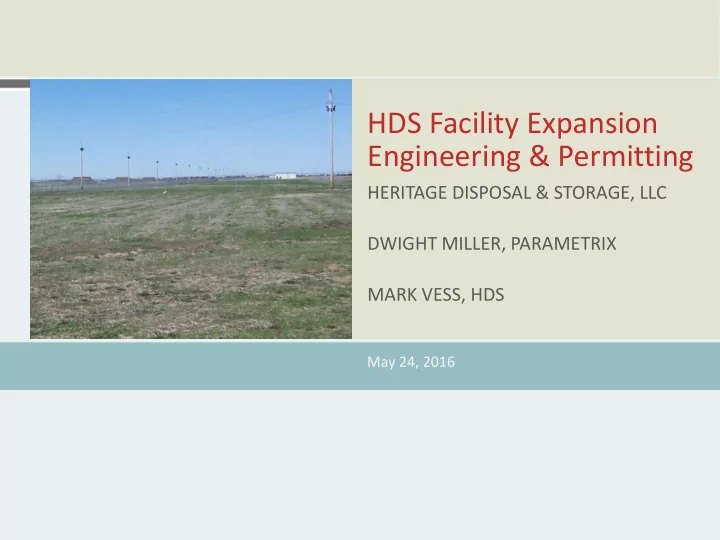
HDS Facility Expansion Engineering & Permitting

HERITAGE DISPOSAL & STORAGE, LLC DWIGHT MILLER, PARAMETRIX MARK VESS, HDS

May 24, 2016

slide-2
SLIDE 2

PRESENTATION OUTLINE

1.

Factors considered in this presentation

2.

Additional factors

3.

Permitting/approvals

4.

Project schedule

5.

Q&A

slide-3
SLIDE 3

FACTORS BEING DISCUSSED #2 The function and management of the facility #3 Technologies that will be used #5 Environmental implications Related Factors:

#4 Site characteristics #8 Enforcement and regulation

slide-4
SLIDE 4

#2 THE FUNCTION AND MANAGEMENT OF FACILITY

  • Facility management
  • Wastes to be handled
  • Relationship of treatment technology to the overall

site master plan

  • Plans for future expansion
slide-5
SLIDE 5

FACILITY MANAGEMENT

  • Owned and operated by Heritage Disposal &

Storage, LLC

  • Mark Vess - Founder and President
  • Founded in 2003 at the Former Cornhusker

Army Ammunition Plant, Alda, NE

  • Facility operations follow strict federal (Army)

requirements for safety and security

slide-6
SLIDE 6

FACILITY MANAGEMENT (CONT.)

  • Explosives materials property receipt
  • Storage (ATF / Nebraska certified facilities)
  • Inventory / accountability controls
  • Destruction / Material Documented As Safe

(MDAS) recycling certification

  • Photographic validation
slide-7
SLIDE 7

WASTES TO BE HANDLED

  • Primary: HC-Smoke (hexachloroethane)
  • Future: Related military smoke munitions

(colored)

  • Law enforcement and civilian materials
  • Each will require air quality permit

modification

slide-8
SLIDE 8

OVERALL SITE MASTER PLAN

  • 900-acre facility with controlled access
  • High security / 24-hour armed guard
  • ATF Explosive Manufactures License
  • 16 M Net Explosive Weight (NEW) storage in

60 licensed bunkers

  • Ammunition decommissioning (small arms)
  • Hydrolysis facility (fireworks)
slide-9
SLIDE 9

PLANS FOR FUTURE EXPANSION

  • Facility sized to handle 15,000 tons/yr.
  • Approximately 50% greater than Army contract
  • Facility’s business plan based on the proposed

facility capacity

  • Potential to add second thermal treatment line

using same air pollution control equipment

Provide feedstock flexibility

Does not significantly increase capacity

slide-10
SLIDE 10

#3 TECHNOLOGIES THAT WILL BE USED

  • Receiving/storage
  • Pre-processing
  • Thermal treatment
  • Air pollution control (APC)
  • Recycling and residuals disposal
  • Incorporate existing facilities and processes
slide-11
SLIDE 11

THERMAL TREATMENT AND APC

  • Rotary kiln

12-foot diameter

5 tons/hr capacity

Indirect fired

Ram feeder with air lock

  • After-burner

Sized to rotary kiln

Direct fired

  • Bottom ash removal
slide-12
SLIDE 12

AIR POLLUTION CONTROL

  • Direct-fired after-burner
  • Scrubber
  • Mist Eliminator
  • Absorption Tower
  • Stack – 120’
slide-13
SLIDE 13

RESIDUALS RECYCLING AND DISPOSAL

  • Up to 40% recyclable metals
  • Beneficial reuse – based on analytical study

Bottom ash – structural fill

Fly ash (from APC) – cement additive

  • Off-site landfill disposal

Solid waste landfill – if not hazardous

Hazardous waste landfill

  • Reuse water and pond evaporate
slide-14
SLIDE 14

#5 ENVIRONMENTAL IMPLICATIONS

  • Surface water
  • Groundwater protection
  • Air emissions
  • Meet and exceed all environmental
slide-15
SLIDE 15

SURFACE WATER

  • All active operations on paved surfaces
  • Most operations indoors/under cover
  • Process water – quench and APC
  • Treatment/evaporation of process water
  • National Pollution Discharge Elimination

Permit (NPDES)

Wastewater treatment and discharge

Surface water general permit

slide-16
SLIDE 16

GROUNDWATER PROTECTION

  • Fully paved active operations areas
  • No onsite landfilling of residuals
  • Fully lined process water and surface water

ponds

  • Active spill prevention and cleanup protocols

under NPDES

slide-17
SLIDE 17

AIR EMISSIONS

  • Permitting under NDEQ
  • Using best available control technology

(BACT)

  • Process engineering will define emissions and

identify final BACT equipment

  • Air modeling will determine air impacts
slide-18
SLIDE 18

Block Flow Diagram

slide-19
SLIDE 19

DRAFT DESIGN BASIS – THERMAL TREATMENT

Incinerator Ram feed system Semi-continuous Minimum batch size (NEW) lbs 15 Maximum batch size (NEW) lbs 25 Items per hour Feed capacity (Gross) lbs/hr Average feed, NEW lbs/hr Average feed, non-NEW lbs/hr Incinerator type Indirect-fired Drum dimensions feet 12'd x 18' Maximum operating temperature °F 2,600 Drum burner capacity MMBTU/hr 20 Incinerator residence time minutes After burner type Direct-fired Afterburner chamber size feet 12'd x 16' Afterburner capacity MMBTU/hr 5 Afterburner residence time seconds >2 Destruction and removal efficiency % 99.99 Air pollution control equipment Venturi scrubber Air pollution control equipment Mist eliminator Air pollution control equipment Absorption Tower Stack dimensions feet 8'd x 120' Draft fan CFM 26,000 Electricity requirement kW 2,500

slide-20
SLIDE 20
  • Site plan
  • General arrangement of equipment and

utilities/infrastructure

  • Process design basis
  • Performance of thermal treatment equipment
  • Process flow diagram
  • Mass and energy balance

CURRENT WORK ACTIVITIES

slide-21
SLIDE 21

PERMITTING/APPROVALS

1.

Local (Hall County)

Land-use, building, fire, electrical, flood plain 2.

State (NDEQ)

Site Review Committee Report Air Quality, NPDES, RCRA Subtitle C TSDF Permit 3.

Federal (ATF, DOD, EPA)

slide-22
SLIDE 22

NEXT STEPS

1.

Data/process modeling (determine emissions for air permitting)

2.

NDEQ air permit pre-application meeting

3.

Test facsimile material (Hazen Research)

4.

Mass and energy balance (MEB) for final process engineering and equipment specification

5.

Permit application and submittal package

6.

Piping and instrumentation diagram (P&ID), and facility and site design

slide-23
SLIDE 23

SCHEDULE

  • Site Review Committee (SRC) – 180 days from notice of

intent (April-October)

  • Hall County review/decision – Up to 180 days from SRC

Report

  • Permit package – submit 8 weeks from SRC Report
  • Final facility and site design – spring 2017
  • Construction – begin summer 2017
  • Production – begin summer/fall 2018
slide-24
SLIDE 24

Questions?

slide-25
SLIDE 25

DETAILED HDS SCHEDULE

Item Schedule Item\Month Dates

Apr-16 May-16 Jun-16 Jul-16 Aug-16 Sep-16 Oct-16 Nov-16 Dec-16 Jan-17 Feb-17 Mar-17 Apr-17 May-17 Jun-17 Jul-17 Aug-17 Sep-17 Oct-17 Nov-17 Dec-17 Jan-18 Feb-18 Mar-18 Apr-18 May-18 Jun-18 Jul-18 Aug-18

1 Contract Award 15-Jan-16 2 NDEQ Initial Meeting for RCRA Permit Nov 15-Jan 16 3 Submit Letter of Intent to NDEQ Apr 16 4 NDEQ Charters Specific Site Review Committee Apr 16 5 Fact Finding, Review, Report Apr 16-Oct 16 6 Hall County Review Oct 16 - Mar 17 7 RCRA Permit 1st Public Meeting Oct 16 8 RCRA Permit Application Preparation Aug 16-Dec 16 9 RCRA Permit App. Review by NDEQ with 1 Revision Round Jan 16-Sep 17 10 Permit Drafting by NDEQ and Public Review Jul 17-Sep 17 11 ACO Plans and Submissions Acceptance Jan-Apr 16 12 HC-Smoke Canister Samples Received for Testing TBD 13 Air Emissions Testing (third-party lab) TBD 14 Civil Design and Local Permitting May 16-Dec 16 15 Process Final Equipment Design Aug 16-Dec 16 16 Prepare NDEQ Air Permit Sep 16-Oct 16 17 Submit NDEQ Air Permit and NDEQ Review Nov 16-Apr 17 18 Equipment Manufacture Jan 17-Sep 17 19 NDEQ Air Permit Approval Apr 17 20 Heritage Site Construction - Site work and security systems Jun 17-Nov 17 21 Heritage Site Construction - Thermal Processing Unit Oct 17-May 18 22 Equipment Arrival, Installation, and Commissioning Jan 18-Jul 18 23 Stack Testing Jun 18-Jul 18 24 Training, Maint., and Safety/Security and 1st Article Approvals Sep 18-Nov 18 25 Base Period Processing (9 months) Sep 18-May 19 26 Option Period 1 Processing (9 months) Jun 19-Feb 20 27 Option Period 2 Processing (9 months) Mar 20-Nov 20 28 Complete Contract Period (Jan 15, 2016 to end) 1752 Legend: Army Contracting RCRA TSDF Permitting Air Quality Permitting Design and Equipment Fabrication Site Construction