WQCD Permitting WQCD Permitting Technology Based Effluent Limits - - PDF document

wqcd permitting wqcd permitting
SMART_READER_LITE
LIVE PREVIEW

WQCD Permitting WQCD Permitting Technology Based Effluent Limits - - PDF document

Today s Topics s Topics Today Introduction and Permitting Framework Introduction and Permitting Framework 1. 1. WQCD Permitting WQCD Permitting Technology Based Effluent Limits Technology Based Effluent Limits 2. 2. Process


slide-1
SLIDE 1

1

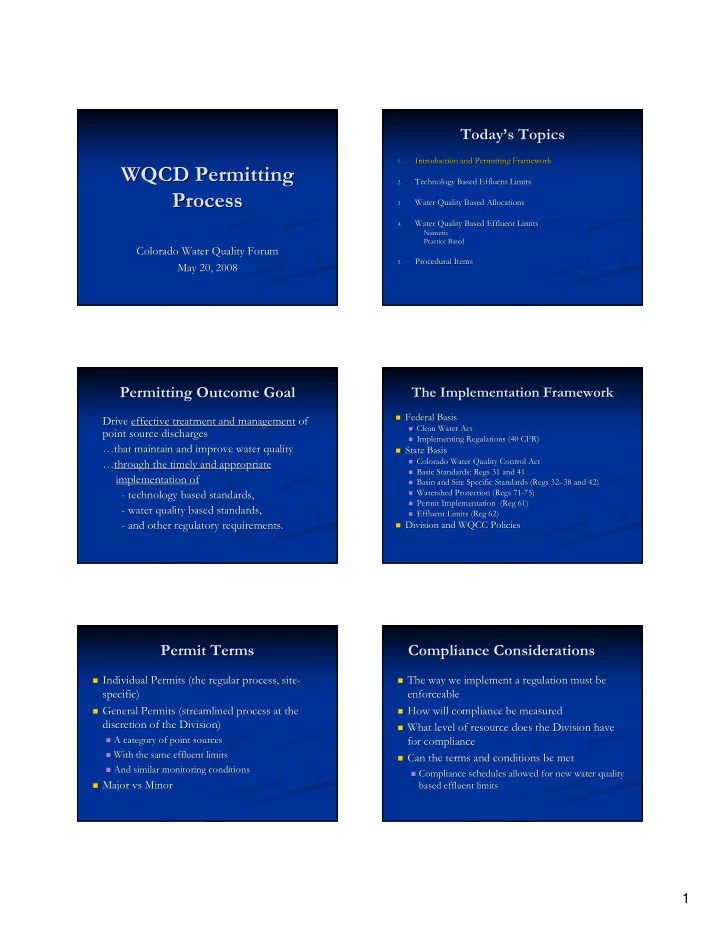
WQCD Permitting WQCD Permitting Process Process

Colorado Water Quality Forum Colorado Water Quality Forum May 20, 2008 May 20, 2008

Today Today’ ’s Topics s Topics

1. 1.

Introduction and Permitting Framework Introduction and Permitting Framework

2. 2.

Technology Based Effluent Limits Technology Based Effluent Limits

3. 3.

Water Quality Based Allocations Water Quality Based Allocations

4. 4.

Water Quality Based Effluent Limits Water Quality Based Effluent Limits

Numeric Numeric Practice Based Practice Based

5. 5.

Procedural Items Procedural Items

Permitting Outcome Goal Permitting Outcome Goal

Drive Drive effective treatment and management effective treatment and management of

  • f

point source discharges point source discharges … …that maintain and improve water quality that maintain and improve water quality … …through the timely and appropriate through the timely and appropriate implementation of implementation of

  • technology based standards,

technology based standards,

  • water quality based standards,

water quality based standards,

  • and other regulatory requirements.

and other regulatory requirements.

The Implementation Framework The Implementation Framework

  • Federal Basis

Federal Basis

  • Clean Water Act

Clean Water Act

  • Implementing Regulations (40 CFR)

Implementing Regulations (40 CFR)

  • State Basis

State Basis

  • Colorado Water Quality Control Act

Colorado Water Quality Control Act

  • Basic Standards:

Basic Standards: Regs Regs 31 and 41 31 and 41

  • Basin and Site Specific Standards (

Basin and Site Specific Standards (Regs Regs 32 32– –38 and 42) 38 and 42)

  • Watershed Protection (

Watershed Protection (Regs Regs 71 71-

  • 75)

75)

  • Permit Implementation (

Permit Implementation (Reg Reg 61) 61)

  • Effluent Limits (

Effluent Limits (Reg Reg 62) 62)

  • Division and WQCC Policies

Division and WQCC Policies

Permit Terms Permit Terms

  • Individual Permits (the regular process, site

Individual Permits (the regular process, site-

  • specific)

specific)

  • General Permits (streamlined process at the

General Permits (streamlined process at the discretion of the Division) discretion of the Division)

  • A category of point sources

A category of point sources

  • With the same effluent limits

With the same effluent limits

  • And similar monitoring conditions

And similar monitoring conditions

  • Major

Major vs vs Minor Minor

Compliance Considerations Compliance Considerations

  • The way we implement a regulation must be

The way we implement a regulation must be enforceable enforceable

  • How will compliance be measured

How will compliance be measured

  • What level of resource does the Division have

What level of resource does the Division have for compliance for compliance

  • Can the terms and conditions be met

Can the terms and conditions be met

  • Compliance schedules allowed for new water quality

Compliance schedules allowed for new water quality based effluent limits based effluent limits

slide-2
SLIDE 2

2

Today Today’ ’s Topics s Topics

1. 1.

Introduction and Permitting Framework Introduction and Permitting Framework

2. 2.

Technology Based Effluent Limits Technology Based Effluent Limits

3. 3.

Water Quality Based Allocations Water Quality Based Allocations

4. 4.

Water Quality Based Effluent Limits Water Quality Based Effluent Limits

Numeric Numeric Practice Based Practice Based

5. 5.

Procedural Items Procedural Items

  • Effluent Limitation Guidelines (

Effluent Limitation Guidelines (ELGs ELGs) )

  • National standards developed by EPA

National standards developed by EPA

  • Prescribe allowable levels of pollutant discharge

Prescribe allowable levels of pollutant discharge

  • Provides equity among dischargers within categories

Provides equity among dischargers within categories

  • ELG Development

ELG Development

  • Industries are identified based on pollutant loadings

Industries are identified based on pollutant loadings

  • Available wastewater treatment is studied

Available wastewater treatment is studied

  • Economic factors are considered

Economic factors are considered

  • EPA must review and update

EPA must review and update ELGs ELGs on a regular basis

  • n a regular basis

www.epa.gov/waterscience/guide www.epa.gov/waterscience/guide

Technology Based Standards Technology Based Standards

Subpart J—Copper, Lead, Zinc, Gold, Silver, and Molybdenum Ores Subcategory Colorado Effluent Limit Regulations Colorado Effluent Limit Regulations

  • Secondary Treatment Standards

Secondary Treatment Standards

  • Private Domestic and Industrial

Private Domestic and Industrial

Today Today’ ’s Topics s Topics

1. 1.

Introduction and Permitting Framework Introduction and Permitting Framework

2. 2.

Technology Based Effluent Limits Technology Based Effluent Limits

3. 3.

Water Quality Based Allocations Water Quality Based Allocations

4. 4.

Water Quality Based Effluent Limits Water Quality Based Effluent Limits

Numeric Numeric Practice Based Practice Based

5. 5.

Procedural Items Procedural Items

Water Quality Based Allocations Water Quality Based Allocations

  • Watershed Protection Regulation Load

Watershed Protection Regulation Load Allocations Allocations

  • Phosphours

Phosphours

  • Concentration and Loading (Annual)

Concentration and Loading (Annual)

  • Bear Creek , Cherry Creek Reservoir, Chatfield,

Bear Creek , Cherry Creek Reservoir, Chatfield, Dillon, Dillon,

  • TMDL

TMDL WLAs WLAs

  • Consistency with permit

Consistency with permit WQAs WQAs

  • TMDL expressed as pounds per day. Must

TMDL expressed as pounds per day. Must convert to mg/L or convert to mg/L or ug ug/L /L

slide-3
SLIDE 3

3 Impaired Waters w/o an approved Impaired Waters w/o an approved TMDL TMDL

Existing discharge: Existing discharge: WQS applied as WQS applied as discharge limit or discharge limit or permit may be re permit may be re-

  • issued with

issued with existing existing “ “point point source load source load” ” New discharge: New discharge: WQS applied as WQS applied as discharge limit discharge limit

Today Today’ ’s Topics s Topics

1. 1.

Introduction and Permitting Framework Introduction and Permitting Framework

2. 2.

Technology Based Effluent Limits Technology Based Effluent Limits

3. 3.

Water Quality Based Allocations Water Quality Based Allocations

4. 4.

Water Quality Based Effluent Limits Water Quality Based Effluent Limits

Numeric Numeric Practice Based Practice Based

5. 5.

Procedural Items Procedural Items

Water Quality Based Standards Water Quality Based Standards

  • Effluent limits must be included if there is

Effluent limits must be included if there is “ “reasonable potential reasonable potential to cause or to cause or contribute to an excursion of a water contribute to an excursion of a water quality standard quality standard” ”

  • Practice based effluent limits are allowed

Practice based effluent limits are allowed where numeric limits are infeasible where numeric limits are infeasible

  • Dilution/mixing is normally allowed

Dilution/mixing is normally allowed

Today Today’ ’s Topics s Topics

1. 1.

Introduction and Permitting Framework Introduction and Permitting Framework

2. 2.

Technology Based Effluent Limits Technology Based Effluent Limits

3. 3.

Water Quality Based Allocations Water Quality Based Allocations

4. 4.

Water Quality Based Effluent Limits Water Quality Based Effluent Limits

Numeric Numeric Practice Based Practice Based

5. 5.

Procedural Items Procedural Items

Water Quality Assessment Water Quality Assessment

  • Mixing Zone Considerations

Mixing Zone Considerations

  • Receiving Water Characteristics

Receiving Water Characteristics

  • Ambient Water Quality

Ambient Water Quality

  • Low Flow

Low Flow

  • Technical Analysis

Technical Analysis

  • Conservative Pollutants

Conservative Pollutants – – Mass Balance Mass Balance

  • Non

Non-

  • Conservative Pollutants

Conservative Pollutants

Mixing Zone Considerations Mixing Zone Considerations

  • Threatened and Endangered Habitat

Threatened and Endangered Habitat

  • Impaired Waters

Impaired Waters

  • Lake or Reservoir

Lake or Reservoir

  • Mixing Zone Study

Mixing Zone Study

  • Generally rapid and complete mixing is assumed for

Generally rapid and complete mixing is assumed for streams streams

  • Site specific studies are required in some cases

Site specific studies are required in some cases

slide-4
SLIDE 4

4

Receiving Water Characteristics Receiving Water Characteristics

  • Discharge Location and Stream Segment

Discharge Location and Stream Segment

  • Numeric Stream Segment Standards

Numeric Stream Segment Standards

  • TVS (metals)

TVS (metals) – – hardness based equations hardness based equations

  • Site Specific Characteristics

Site Specific Characteristics

  • 303(d) listed (WLA or no WLA)

303(d) listed (WLA or no WLA)

  • Threatened and Endangered Species (T&E)

Threatened and Endangered Species (T&E)

  • Lake or Reservoir

Lake or Reservoir

  • Mixing Zone Study

Mixing Zone Study

Ambient Water Quality Ambient Water Quality

  • Upstream data (USGS,

Upstream data (USGS, Riverwatch Riverwatch, WQCD, , WQCD, DWR, USF&W, etc.) DWR, USF&W, etc.)

  • Typically 5yrs available data

Typically 5yrs available data

  • Regulation 31.8(2)(a)(i) and 31.8(2)(b)(i)(B)

Regulation 31.8(2)(a)(i) and 31.8(2)(b)(i)(B)

  • 85

85th

th percentile

percentile – – ammonia , nitrate, dissolved metals ammonia , nitrate, dissolved metals

  • 50

50th

th percentile

percentile – – total recoverable metals total recoverable metals

  • 15

15th

th percentile

percentile – – D.O. D.O.

  • Geometric Mean

Geometric Mean – – E. coli

  • E. coli
  • Range 15

Range 15th

th-

  • 85

85th

th percentiles

percentiles -

  • pH

pH

Low Flow Low Flow

  • Upstream gage station (USGS or DWR)

Upstream gage station (USGS or DWR)

  • Daily flow

Daily flow

  • 10yrs data

10yrs data

  • EPA

EPA’ ’s DFLOW software s DFLOW software

  • Acute 1E3 (1

Acute 1E3 (1-

  • day low flow recurring in 3yr interval)

day low flow recurring in 3yr interval)

  • Chronic 30E3 (30

Chronic 30E3 (30-

  • day avg. low flow recurring in 3 yr

day avg. low flow recurring in 3 yr interval) interval)

  • Temperature

Temperature – – Chronic 7E3 Chronic 7E3

TECHNICAL ANALYSIS TECHNICAL ANALYSIS

  • Mass

Mass-

  • Balance Equation

Balance Equation

  • M

M2

2 =

= M M3

3Q

Q3

3 -

  • M

M1

1Q

Q1

1

Q Q2

2

Where, Where,

Q Q1

1 = Upstream low flow (above discharge)

= Upstream low flow (above discharge) Q Q2

2 = Average daily effluent flow (design flow)

= Average daily effluent flow (design flow) Q Q3

3 = Downstream flow (Q

= Downstream flow (Q1

1 + Q

+ Q2

2)

) M M1

1 = In

= In-

  • stream background pollutant concentration at the existing

stream background pollutant concentration at the existing quality ( quality (Ambient Water Quality Ambient Water Quality) ) M M2

2 = Calculated maximum allowable effluent pollutant concentration

= Calculated maximum allowable effluent pollutant concentration M M3

3 = Maximum allowable in

= Maximum allowable in-

  • stream pollutant concentration (WQS)

stream pollutant concentration (WQS)

TECHNICAL ANALYSIS TECHNICAL ANALYSIS

  • Pollutants Generally Evaluated

Pollutants Generally Evaluated

  • Physical & Biological

Physical & Biological

  • E. Coli,
  • E. Coli, D.O., pH

D.O., pH

  • Inorganic

Inorganic

  • Ammonia (AMMTOX Model)

Ammonia (AMMTOX Model)

  • Total Residual Chlorine

Total Residual Chlorine

  • Nitrate

Nitrate

  • Cyanide

Cyanide

  • Metals

Metals

  • Organics

Organics

  • TMDL/Segment Impaired

TMDL/Segment Impaired-

  • Specific Pollutants

Specific Pollutants

slide-5
SLIDE 5

5

TECHNICAL ANALYSIS TECHNICAL ANALYSIS

0.070 0.070 0.011 0.011 0.0 0.0 11.5 11.5 1.8 1.8 9.7 9.7

Chronic Chronic Chlorine Chlorine

0.114 0.114 0.019 0.019 0.0 0.0 10.8 10.8 1.8 1.8 9.0 9.0

Acute Acute Chlorine Chlorine M M2

2 (mg/l)

(mg/l) M M3

3 (mg/l)

(mg/l) M M1

1 (mg/l)

(mg/l) Q Q3

3 (cfs)

(cfs) Q Q2

2 (cfs)

(cfs) Q Q1

1 (cfs)

(cfs) Parameter Parameter

Table 6 Table 6 Water Quality Based Effluent Limits for Water Quality Based Effluent Limits for Total Residual Chlorine Total Residual Chlorine

TECHNICAL ANALYSIS TECHNICAL ANALYSIS

805 805 126 126 0.0 0.0 11.5 11.5 1.8 1.8 9.7 9.7

  • E. Coli.
  • E. Coli.

1,277 1,277 200 200 0.0 0.0 11.5 11.5 1.8 1.8 9.7 9.7

Fecal Fecal Coliform Coliform M M2

2 (mg/l)

(mg/l) M M3

3 (mg/l)

(mg/l) M M1

1 (mg/l)

(mg/l) Q Q3

3 (cfs)

(cfs) Q Q2

2 (cfs)

(cfs) Q Q1

1 (cfs)

(cfs) Parameter Parameter

Table 7 Table 7 Water Quality Based Effluent Limits for Water Quality Based Effluent Limits for Fecal Coliform & Fecal Coliform & E. Coli.

  • E. Coli.

TECHNICAL ANALYSIS TECHNICAL ANALYSIS

  • AMMTOX MODEL PARAMETERS

AMMTOX MODEL PARAMETERS

  • Effluent Flow (Design Flow)

Effluent Flow (Design Flow)

  • Effluent Temperature & pH

Effluent Temperature & pH

  • Acute & Chronic Low Flows

Acute & Chronic Low Flows

  • Background Water Quality Data (Ambient):

Background Water Quality Data (Ambient):

  • Temperature

Temperature

  • pH

pH

  • Total Ammonia

Total Ammonia

  • Set Point Conditions (Recursion Model)

Set Point Conditions (Recursion Model)

TECHNICAL TECHNICAL ANALYSIS

ANALYSIS

49 49 31 31 December December 43 43 29 29 November November 30 30 30 30 October October 27 27 27 27 September September 34 34 29 29 August August 31 31 33 33 July July 101 101 79 79 June June 66 66 56 56 May May 33 33 23 23 April April 25 25 20 20 March March 37 37 23 23 February February 38 38 25 25 January January

Total Ammonia Acute (mg/l) Total Ammonia Acute (mg/l) Total Ammonia Chronic (mg/l) Total Ammonia Chronic (mg/l) Month Month Table 11 Table 11 Total Ammonia Assimilative Capacities for the Arkansas River Total Ammonia Assimilative Capacities for the Arkansas River

Antidegradation Antidegradation

Review procedures that apply to Review procedures that apply to new or new or increased impacts increased impacts from regulated activities that from regulated activities that may degrade the quality of state waters may degrade the quality of state waters

  • Is the degradation significant?

Is the degradation significant?

  • Is the degradation necessary (to accommodate important

Is the degradation necessary (to accommodate important social or economic development) social or economic development)

Designations Designations

Use Protected (UP) – No Designation (i.e. Reviewable) - Outstanding Waters (OW) - Where no

degradation of water quality is allowed.

slide-6
SLIDE 6

6

  • Significance Determination Tests

Significance Determination Tests

  • Is the activity temporary?

Is the activity temporary?

  • Is there a large amount of dilution available (i.e.

Is there a large amount of dilution available (i.e. >100:1 dilution)? >100:1 dilution)?

  • Is the affect on the stream less than or equal to

Is the affect on the stream less than or equal to 10% (for 10% (for bioaccumulative bioaccumulative) or 15% (non ) or 15% (non-

  • bioaccumulative

bioaccumulative) increase in concentration above ) increase in concentration above baseline water quality (BWQ)? baseline water quality (BWQ)?

BWQ = September 30, 2000 (or alternate date set by the BWQ = September 30, 2000 (or alternate date set by the WQCC) WQCC)

AD Review Procedure AD Review Procedure

Significance Concentration Significance Concentration Threshold (SCT) Threshold (SCT)

  • SCT = 0.15*BAI + BWQ

SCT = 0.15*BAI + BWQ

2 4 6 8 1 1 2

Concentration BAI BWQ SCT WQ Standard

Reasonable Potential Reasonable Potential

  • Quantitative Analysis

Quantitative Analysis MEPC > MAPC = Reasonable Potential MEPC > MAPC = Reasonable Potential

MEPC = Maximum expected pollutant concentration MEPC = Maximum expected pollutant concentration MAPC = Maximum allowable pollutant concentration MAPC = Maximum allowable pollutant concentration

  • Qualitative Analysis

Qualitative Analysis

  • Pollutants for which treatment is in place

Pollutants for which treatment is in place

  • Practice based effluent limits

Practice based effluent limits

Quantitative Analysis = Statistics Quantitative Analysis = Statistics

  • 1. Evaluate data set – Must have at least 10 datums

Large sample size, low variability = Good Small sample size, high variability = Bad Compliance schedule option available – obtain more representative data

  • 2. Calculate the Coefficient of Variation –

Expression of variability in a data set

  • 3. Consult Multiplier Table

using CV and sample size grid EPA Technical Support Document and Division Guidance document

  • 4. Determine MEPC

Acute and Chronic

Quantitative Analysis (cont.) Quantitative Analysis (cont.)

A.

  • A. Where MEPC > MAPC

Where MEPC > MAPC

Limit in permit Limit in permit

B.

  • B. Where MEPC > 50% MAPC

Where MEPC > 50% MAPC

Monitoring Monitoring

C.

  • C. Where MEPC < 50% MAPC

Where MEPC < 50% MAPC

No limit/monitoring No limit/monitoring

slide-7
SLIDE 7

7

Quantitative Analysis Quantitative Analysis

1. 1.

Compare MEPC against MAPC Compare MEPC against MAPC

  • A. Where MEPC > MAPC
  • A. Where MEPC > MAPC –

– Limit in permit Limit in permit

  • B. Where MEPC > 50% MAPC
  • B. Where MEPC > 50% MAPC –

– Monitoring Monitoring

  • C. Where MEPC < 50% MAPC
  • C. Where MEPC < 50% MAPC –

– No limit/monitoring No limit/monitoring

Limits Table Limits Table

Example of Final Effluent Limits in Rationale Example of Final Effluent Limits in Rationale

Today Today’ ’s Topics s Topics

1. 1.

Introduction and Permitting Framework Introduction and Permitting Framework

2. 2.

Technology Based Effluent Limits Technology Based Effluent Limits

3. 3.

Water Quality Based Allocations Water Quality Based Allocations

4. 4.

Water Quality Based Effluent Limits Water Quality Based Effluent Limits

Numeric Numeric Practice Based Practice Based

5. 5.

Procedural Items Procedural Items When Numeric Effluent Limits are Infeasible Types of Practices:

Schedules of activities, prohibitions of practices,

maintenance procedures, and other management practices to prevent or reduce the pollution of "state waters".

BMPs also include treatment requirements, operating

procedures and practices to control plant site runoff, spillage or leaks, sludge or waste disposal, or drainage from raw material storage.

Practice Based Effluent Limits Practice Based Effluent Limits

  • Primary permit requirement:

Primary permit requirement:

  • Preparation and implementation of a Stormwater

Preparation and implementation of a Stormwater Management Plan (SWMP). Management Plan (SWMP).

  • SWMP requirements:

SWMP requirements:

  • Identification of pollutant sources

Identification of pollutant sources

  • Selection and

Selection and implementation of BMPs to control

  • f BMPs to control

pollutant sources pollutant sources

Stormwater permit requirements Stormwater permit requirements

slide-8
SLIDE 8

8

BMPs implemented BMPs installed correctly BMPs adequate/appropriate BMPs maintained appropriately

Compliance: BMP based permit

Today Today’ ’s Topics s Topics

1. 1.

Introduction and Permitting Framework Introduction and Permitting Framework

2. 2.

Technology Based Effluent Limits Technology Based Effluent Limits

3. 3.

Water Quality Based Allocations Water Quality Based Allocations

4. 4.

Water Quality Based Effluent Limits Water Quality Based Effluent Limits

Numeric Numeric Practice Based Practice Based

5. 5.

Procedural Items Procedural Items

  • 1. Application Received by the Division
  • 1. Application Received by the Division
  • Entered into

Entered into tracking tracking database database

  • 2. Permit Writer Assigned
  • 2. Permit Writer Assigned
  • Reviews

Reviews Application Application

  • Requests

Requests additional additional information information

Yes! More Work!

  • 3. Permit Writer Checks with Others
  • 3. Permit Writer Checks with Others
  • Engineering

Engineering Section ( Section (DEs DEs) )

  • CADM

CADM (Enforcement) (Enforcement)

  • TMDL

TMDL Workgroup Workgroup

  • Standards Unit

Standards Unit

  • HMWMD

HMWMD

  • Others

Others

  • 4A. Permit Writer Assembles Data and
  • 4A. Permit Writer Assembles Data and

Assembles the Draft Permit Package Assembles the Draft Permit Package

File Room ~6,000 permits

slide-9
SLIDE 9

9

Permit Package Permit Package

  • Water Quality

Water Quality Assessment Assessment

  • Permit Rationale

Permit Rationale

(Fact Sheet) (Fact Sheet)

  • Permit

Permit

  • 4B. May have a site visit or
  • 4B. May have a site visit or

meeting with the facility meeting with the facility

Ni Nice Lagoon

  • on!
  • 5. Draft Permit Package Review
  • 5. Draft Permit Package Review
  • All

All Permit Permit Packages are Packages are reviewed reviewed (some more (some more than others) than others) before Public before Public Notice Notice

  • 6. Pre
  • 6. Pre-
  • Public Notice Review

Public Notice Review

  • Not a Policy.

Not a Policy.

  • Courtesy to the

Courtesy to the facility. facility.

  • Look for

Look for ‘ ‘Showstoppers Showstoppers’ ’

  • 7. Public Notice
  • 8. Comments and Public Meetings
  • 8. Comments and Public Meetings

Interested persons may submit written

comments to the Division on a draft permit

Interested persons may request a public

meeting (if a public meeting is held, the period for public comment shall close sixty (60) days from the date of notice)

Division responds to public comments

in the Permit Rationale

slide-10
SLIDE 10

10

  • 9. Final Permit Appeal Rights
  • 9. Final Permit Appeal Rights

Any applicant for a renewal

permit may appeal

A hearing, with a hearing

  • fficer, will be held within 30

days

May also request a stay of the

contested terms and conditions

Standard Permit Lawyer

  • 10. Entered into EPA Database
  • 10. Entered into EPA Database
  • Currently PCS

Currently PCS

  • Division

Division converting to converting to ICIS in August ICIS in August

  • Available to the

Available to the public on EPA public on EPA website website

www.epa.gov/envirofacts www.epa.gov/envirofacts

^