Introduction to logistics and supply chain management Dr. Shibu K - - PowerPoint PPT Presentation

introduction to logistics and supply chain management
SMART_READER_LITE
LIVE PREVIEW

Introduction to logistics and supply chain management Dr. Shibu K - - PowerPoint PPT Presentation

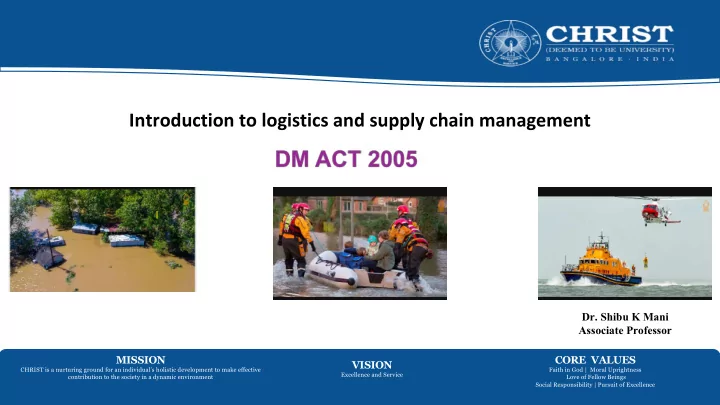
Introduction to logistics and supply chain management Dr. Shibu K Mani Associate Professor MISSION CORE VALUES VISION CHRIST is a nurturing ground for an individuals holistic development to make effective Faith in God | Moral Uprightness


slide-1
SLIDE 1

MISSION

CHRIST is a nurturing ground for an individual’s holistic development to make effective contribution to the society in a dynamic environment

VISION

Excellence and Service

CORE VALUES

Faith in God | Moral Uprightness Love of Fellow Beings Social Responsibility | Pursuit of Excellence

Introduction to logistics and supply chain management

  • Dr. Shibu K Mani

Associate Professor

slide-2
SLIDE 2

Challenged our assumptions Stretching our perceptions Extending our horizons Building Our Faith, Hope and Love ?? Good to be a part of the World Community

slide-3
SLIDE 3

Source: https://mail.google.com/mail/u/0/#inbox/FMfcgxwHNCtzTjvZMQZSBXshszMVjQbX

slide-4
SLIDE 4

Hear Understand Believe Personalize Confirm Decide and Respond

slide-5
SLIDE 5
slide-6
SLIDE 6

you can’t find what you don’t look for

  • 4. What (someone) doesn't know won't hurt them
slide-7
SLIDE 7
slide-8
SLIDE 8

RISK Hazard Exposure Vulnerability

Natural Social Biological Technological Chronological Social Economic Institutional Engineering People, Animals, Buildings, Infrastructure, land (use), Water (use), Air

CHRICTON’s RISK TRIANGLE

slide-9
SLIDE 9
slide-10
SLIDE 10

IWRA, Water International, Volume 30, Number 1, March 2005 Wolfgang Kron, Munich Reinsurance Company, Munich, Germany, Flood Risk = Hazard • Values • Vulnerability Risk Reduction Triangle

slide-11
SLIDE 11

Development

C

  • r

d i n a t i

  • n

C

  • m

m u n i c a t i

  • n

C

  • n

s u l t a t i

  • n

C

  • p

e r a t i

  • n

DM

4Cs

slide-12
SLIDE 12

HAZARD SEQUENCING OR EVENT TREE

slide-13
SLIDE 13

Strength of the chain depends on the strength of the weakest link

slide-14
SLIDE 14

Logistics in Emergencies

····

Think of it like the old axiom, “A chain is no stronger than its weakest link.” The theory of constraints works to find that link and lessen its vulnerability. That applies to processes, organizations, individual team members, whatever or whoever is a risk to the successful completion of the project.

slide-15
SLIDE 15

Logistics in Emergencies

····

15

Logistics in Emergencies

slide-16
SLIDE 16

Logistics in Emergencies

····

slide-17
SLIDE 17

Logistics in Emergencies

····

17

Key Learning Points

  • Logistics is common sense and simple maths.
  • Logistics deals with moving what is needed when it is

needed at a reasonable cost.

  • There are several simple rules of thumb that you can

use

  • Planning, Largest Truck, Avoiding Bottlenecks,

Norms, and Simplicity are the five golden rules for logistics

  • FIFO, Inspection, Records, Segregation, Tidiness,

Inventory, and Neatness are the seven rules for good storage.

slide-18
SLIDE 18

Logistics in Emergencies

····

18

What is Logistics?

Logistics is the process of planning, implementing, co-

  • rdinating, and controlling the flow and storage of goods,

services, and related information so as to deliver

  • what is needed
  • from where it is
  • to where it is needed
  • when it is needed
  • at the lowest cost
slide-19
SLIDE 19

Logistics in Emergencies

····

19

Rules of Thumb

There are basic rules of thumb for logistics planning:

  • People need 0.5kg of food per person per day
  • Family kits are equivalent to the weight of one weeks

food supply, but takes up as much space as three weeks food supply

  • It takes the same amount of transport to move people

from A to B as to move their food for 8 to 12 months

  • ver the same route
  • You need about 1m2 of storage area per 1,000 people

for each day's food stored (with a 2m stack height).

slide-20
SLIDE 20

EFFECTIVE DISTRIBUTION

slide-21
SLIDE 21

Life Cycle for Disaster Relief Operations

slide-22
SLIDE 22
slide-23
SLIDE 23

Reach Connect ed Access Timelin ess Quality Needs- Based Appropr ia- teness Locally Led Participa tory Coheren ce Principl ed Cost Effective Transpa rency Professi

  • nal

Account i- bility

Guiding Fundamentals of Response Characteristics (Adopted and Modified from UNOCHA and Hau Lee, 2004)

slide-24
SLIDE 24

Flexibility Type Definition Volume Flexibility The ability to change the output level of products produced Delivery Flexibility The ability to change planned delivery dates Mix Flexibility The ability to change the variety of products produced New Product Flexibility The ability to introduce and produce new products

slide-25
SLIDE 25

Preparedness Five building blocks Human Resources Knowledge mgmt Logistics Financial Resources Community Disaster Preparedness

+

Disaster Response Disaster Management

slide-26
SLIDE 26

Process & Products Adaptable Organization Structure Aligned Technology Agile B4

B1 B5

B2

B3

slide-27
SLIDE 27
slide-28
SLIDE 28
slide-29
SLIDE 29
slide-30
SLIDE 30

27/06/17 Dr Shibu K Mani, JTCDM (shibumanik@gmail.com) 30

slide-31
SLIDE 31
slide-32
SLIDE 32
slide-33
SLIDE 33
slide-34
SLIDE 34

MISSION

CHRIST is a nurturing ground for an individual’s holistic development to make effective contribution to the society in a dynamic environment

VISION

Excellence and Service

CORE VALUES

Faith in God | Moral Uprightness Love of Fellow Beings Social Responsibility | Pursuit of Excellence

  • Dr. Shibu K Mani