REL Data Work Group A Community Driven Project Concerns about REL - - PDF document

rel data work group a community driven project
SMART_READER_LITE
LIVE PREVIEW

REL Data Work Group A Community Driven Project Concerns about REL - - PDF document

Collecting Race, Ethnicity, and Language (REL) Data in Minnesota Health Insurance Exchange August 29, 2012 REL Data Work Group A Community Driven Project Concerns about REL data were initiated by a group of leaders of communities affected


slide-1
SLIDE 1

1

Collecting Race, Ethnicity, and Language (REL) Data in Minnesota

Health Insurance Exchange August 29, 2012

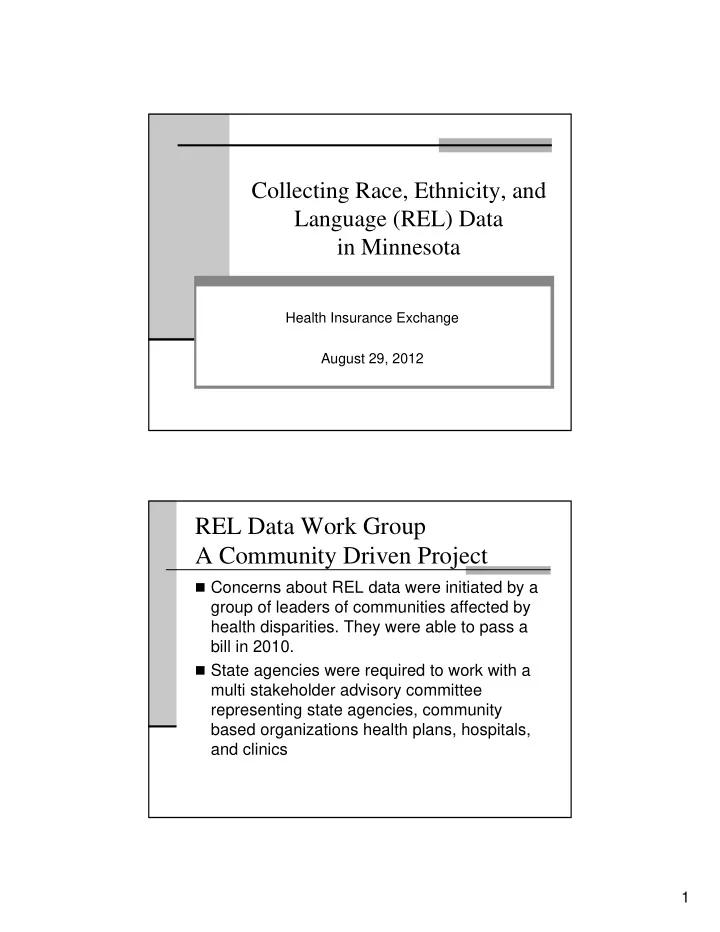
REL Data Work Group A Community Driven Project

 Concerns about REL data were initiated by a

group of leaders of communities affected by health disparities. They were able to pass a bill in 2010.

 State agencies were required to work with a

multi stakeholder advisory committee representing state agencies, community based organizations health plans, hospitals, and clinics

slide-2
SLIDE 2

2

Community REL Data Partnership

 Hospitals  Medical Association  Health Plans  Clinics  MN Community

Measurement

 Academia  Community-Based

Organizations

 ARCHé  Immigrants of Color  African American  American Indian  Latino/Hispanic  Asian

Co-Chairs MDH , DHS

Purpose

 To establish a common framework for

standardized REL data collection, for the purpose of identifying and reducing health disparities, and improving health, in the state

  • f Minnesota
slide-3
SLIDE 3

3

REL Data Collection Principles

 Data should be self-reported by the data subject.  Select more than one race/ethnicity category.  Include categories that are relevant to MN populations.  Aggregate race/ethnicity categories into existing OMB

race/ethnicity categories.

 REL category review, by a public/private collaborative to

ensure relevance to changing Minnesota demographics.

 Health care providers or health care program staff

appropriately trained on how to collect REL data in an accurate and respectful manner.

MN Health Care Reform Recommendations

 Standardized data collection  Implementation throughout the health care

system, health reform efforts

 Community REL partnership continuing work

 Data sharing, reporting and dissemination  Additional variables representing factors that

influence health (e.g. socioeconomic status)

slide-4
SLIDE 4

4

OMB standard (Race/Ethnicity)

 OMB categories, plus additional options

 Hispanic Ethnicity  Race

 Select one or more races

 follow-up question to indicate race respondent

most identifies with

Granular Ethnicity

 Granular Ethnicity & Tribal Affiliation

 Based on locally relevant choices

 Country of Birth

 Based on locally relevant choices

“Granular Ethnicity” is defined as “a person's ethnic origin or descent, 'roots,' or heritage, or the place of birth of the person or the person's parents or ancestors...” This includes American Indian tribal affiliation.

IOM (Institute of Medicine). 2009. Race, Ethnicity, and Language Data: Standardization for Health Care Quality Improvement. Washington, DC: The National Academies Press.

slide-5
SLIDE 5

5

Language

 Spoken and/or written language preferred for

health care

 Based on locally relevant choices

 Inclusion of sign language as spoken

language option

 Inclusion of Braille as written language option

A Work in Progress

 We recognize that the categories chosen are

not an exhaustive list, but are a practical starting point for collecting data by Race, Ethnicity and Language in Minnesota.

 We look forward to using this collection

platform as a basis for expanding / changing the categories, based upon the experience of the data collection process that occurs in the health care system, and the changing demographics of populations in Minnesota.

slide-6
SLIDE 6

6

Contact Information

David Stroud Center for Health Statistics Minnesota Department of Health 651-201-5954 david.stroud@state.mn.us Ginny Zawistowski Performance Measurement and Quality Improvement Minnesota Department of Human Services 651-431-2614 virginia.zawistowski@state.mn.us