Carnegie Mellon Univ. Dept. of Computer Science 15-415/615 - DB - - PDF document

carnegie mellon univ dept of computer science 15 415 615
SMART_READER_LITE
LIVE PREVIEW

Carnegie Mellon Univ. Dept. of Computer Science 15-415/615 - DB - - PDF document

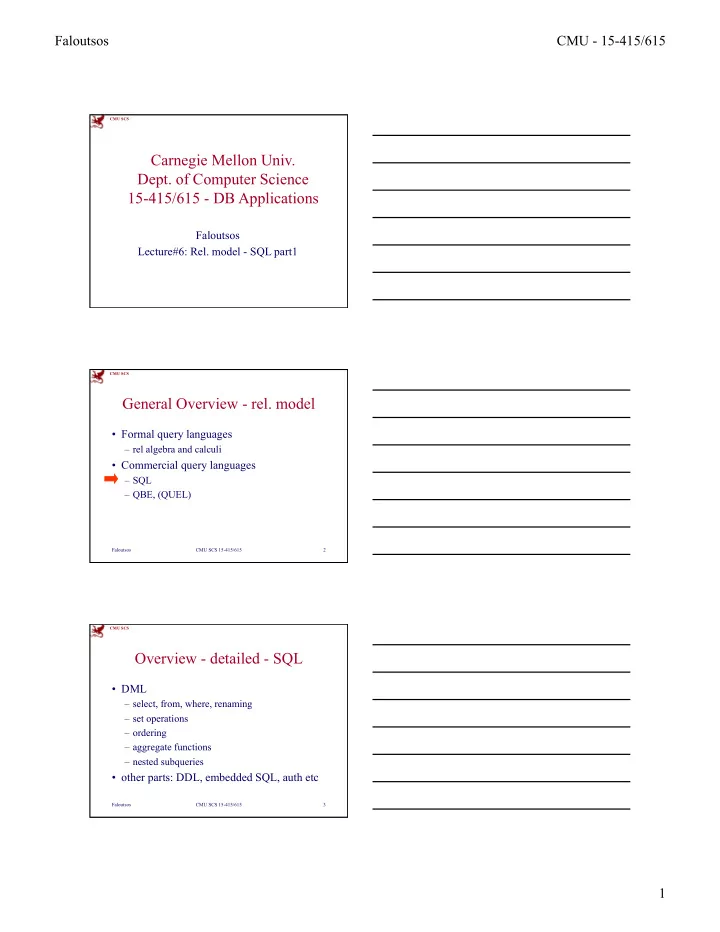
Faloutsos CMU - 15-415/615 CMU SCS Carnegie Mellon Univ. Dept. of Computer Science 15-415/615 - DB Applications Faloutsos Lecture#6: Rel. model - SQL part1 CMU SCS General Overview - rel. model Formal query languages rel algebra and


slide-1
SLIDE 1

Faloutsos CMU - 15-415/615 1

CMU SCS

Carnegie Mellon Univ.

  • Dept. of Computer Science

15-415/615 - DB Applications

Faloutsos Lecture#6: Rel. model - SQL part1

CMU SCS

Faloutsos CMU SCS 15-415/615 2

General Overview - rel. model

  • Formal query languages

– rel algebra and calculi

  • Commercial query languages

– SQL – QBE, (QUEL)

CMU SCS

Faloutsos CMU SCS 15-415/615 3

Overview - detailed - SQL

  • DML

– select, from, where, renaming – set operations – ordering – aggregate functions – nested subqueries

  • other parts: DDL, embedded SQL, auth etc
slide-2
SLIDE 2

Faloutsos CMU - 15-415/615 2

CMU SCS

Faloutsos CMU SCS 15-415/615 4

Relational Query Languages

  • A major strength of the relational model:

supports simple, powerful querying of data.

  • Two sublanguages:
  • DDL – Data Definition Language

– define and modify schema (at all 3 levels)

  • DML – Data Manipulation Language

– Queries can be written intuitively.

CMU SCS

Faloutsos CMU SCS 15-415/615 5

Relational languages

  • The DBMS is responsible for efficient

evaluation.

– Query optimizer: re-orders operations and generates query plan

CMU SCS

Faloutsos CMU SCS 15-415/615 6

The SQL Query Language

  • The most widely used relational query

language.

– Major standard is SQL-1999 (=SQL3)

  • Introduced “Object-Relational” concepts
  • SQL 2003, SQL 2008 have small extensions

– SQL92 is a basic subset

slide-3
SLIDE 3

Faloutsos CMU - 15-415/615 3

CMU SCS

Faloutsos CMU SCS 15-415/615 7

SQL (cont’d)

– PostgreSQL has some “unique” aspects (as do most systems). – XML is the next challenge for SQL.

CMU SCS

Faloutsos CMU SCS 15-415/615 8

DML

General form

select a1, a2, … an from r1, r2, … rm where P [order by ….] [group by …] [having …]

CMU SCS

Faloutsos CMU SCS 15-415/615 9

Reminder: our Mini-U db

slide-4
SLIDE 4

Faloutsos CMU - 15-415/615 4

CMU SCS

Faloutsos CMU SCS 15-415/615 10

DML - eg:

find the ssn(s) of everybody called “smith”

select ssn from student where name=“smith”

CMU SCS

Faloutsos CMU SCS 15-415/615 11

DML - observation

General form

select a1, a2, … an from r1, r2, … rm where P equivalent rel. algebra query?

CMU SCS

Faloutsos CMU SCS 15-415/615 12

DML - observation

General form

select a1, a2, … an from r1, r2, … rm where P

slide-5
SLIDE 5

Faloutsos CMU - 15-415/615 5

CMU SCS

Faloutsos CMU SCS 15-415/615 13

DML - observation

General form

select distinct a1, a2, … an from r1, r2, … rm where P

CMU SCS

Faloutsos CMU SCS 15-415/615 14

select clause

select [distinct | all ] name from student where address=“main”

CMU SCS

Faloutsos CMU SCS 15-415/615 15

where clause

find ssn(s) of all “smith”s on “main” select ssn from student where address=“main” and name = “smith”

slide-6
SLIDE 6

Faloutsos CMU - 15-415/615 6

CMU SCS

Faloutsos CMU SCS 15-415/615 16

where clause

  • boolean operators (and or not …)
  • comparison operators (<, >, =, …)
  • and more…

CMU SCS

Faloutsos CMU SCS 15-415/615 17

What about strings?

find student ssns who live on “main” (st or str

  • r street - ie., “main st” or “main str” …)

CMU SCS

Faloutsos CMU SCS 15-415/615 18

What about strings?

find student ssns who live on “main” (st or str

  • r street)

select ssn from student where address like “main%”

%: variable-length don’t care _: single-character don’t care

slide-7
SLIDE 7

Faloutsos CMU - 15-415/615 7

CMU SCS

Faloutsos CMU SCS 15-415/615 19

from clause

find names of people taking 15-415

CMU SCS

Faloutsos CMU SCS 15-415/615 20

from clause

find names of people taking 15-415

select name from student, takes where ???

CMU SCS

Faloutsos CMU SCS 15-415/615 21

from clause

find names of people taking 15-415

select name from student, takes where student.ssn = takes.ssn and takes.c-id = “15-415”

slide-8
SLIDE 8

Faloutsos CMU - 15-415/615 8

CMU SCS

Faloutsos CMU SCS 15-415/615 22

renaming - tuple variables

find names of people taking 15-415

select name from ourVeryOwnStudent, studentTakingClasses where ourVeryOwnStudent.ssn = studentTakingClasses.ssn and studentTakingClasses.c-id = “15-415”

CMU SCS

Faloutsos CMU SCS 15-415/615 23

renaming - tuple variables

find names of people taking 15-415

select name from ourVeryOwnStudent as S, studentTakingClasses as T where S.ssn =T.ssn and T.c-id = “15-415”

CMU SCS

Faloutsos CMU SCS 15-415/615 24

renaming - self-join

  • self -joins: find Tom’s grandparent(s)
slide-9
SLIDE 9

Faloutsos CMU - 15-415/615 9

CMU SCS

Faloutsos CMU SCS 15-415/615 25

renaming - self-join

find grandparents of “Tom” (PC(p-id, c-id))

select gp.p-id from PC as gp, PC where gp.c-id= PC.p-id and PC.c-id = “Tom”

CMU SCS

Faloutsos CMU SCS 15-415/615 26

renaming - theta join

find course names with more units than 15-415

CMU SCS

Faloutsos CMU SCS 15-415/615 27

renaming - theta join

find course names with more units than 15-415

select c1.c-name from class as c1, class as c2 where c1.units > c2.units and c2.c-id = “15-415”

slide-10
SLIDE 10

Faloutsos CMU - 15-415/615 10

CMU SCS

Faloutsos CMU SCS 15-415/615 28

find course names with more units than 15-415

select c1.name from class as c1, class as c2 where c1.units > c2.units and c2.c-id = “15-415”

CMU SCS

Faloutsos CMU SCS 15-415/615 29

find course names with more units than 15-415

select c2.name from class as c1, class as c2 where c2.units > c1.units and c1.c-id = “15-415”

CMU SCS

Faloutsos CMU SCS 15-415/615 30

Overview - detailed - SQL

  • DML

– select, from, where – set operations – ordering – aggregate functions – nested subqueries

  • other parts: DDL, embedded SQL, auth etc
slide-11
SLIDE 11

Faloutsos CMU - 15-415/615 11

CMU SCS

Faloutsos CMU SCS 15-415/615 31

set operations

find ssn of people taking both 15-415 and 15-413

CMU SCS

Faloutsos CMU SCS 15-415/615 32

set operations

find ssn of people taking both 15-415 and 15-413

select ssn from takes where c-id=“15-415” and c-id=“15-413”

CMU SCS

Faloutsos CMU SCS 15-415/615 33

set operations

find ssn of people taking both 15-415 and 15-413

(select ssn from takes where c-id=“15-415” ) intersect (select ssn from takes where c-id=“15-413” )

  • ther ops: union , except
slide-12
SLIDE 12

Faloutsos CMU - 15-415/615 12

CMU SCS

Faloutsos CMU SCS 15-415/615 34

Overview - detailed - SQL

  • DML

– select, from, where – set operations – ordering – aggregate functions – nested subqueries

  • other parts: DDL, embedded SQL, auth etc

CMU SCS

Faloutsos CMU SCS 15-415/615 35

Ordering

find student records, sorted in name order

select * from student where

CMU SCS

Faloutsos CMU SCS 15-415/615 36

Ordering

find student records, sorted in name order

select * from student

  • rder by name asc

asc is the default

slide-13
SLIDE 13

Faloutsos CMU - 15-415/615 13

CMU SCS

Faloutsos CMU SCS 15-415/615 37

Ordering

find student records, sorted in name order; break ties by reverse ssn

select * from student

  • rder by name, ssn desc

CMU SCS

Faloutsos CMU SCS 15-415/615 38

Overview - detailed - SQL

  • DML

– select, from, where – set operations – ordering – aggregate functions – nested subqueries

  • other parts: DDL, embedded SQL, auth etc

CMU SCS

Faloutsos CMU SCS 15-415/615 39

Aggregate functions

find avg grade, across all students

select ?? from takes

slide-14
SLIDE 14

Faloutsos CMU - 15-415/615 14

CMU SCS

Faloutsos CMU SCS 15-415/615 40

Aggregate functions

find avg grade, across all students

select avg(grade) from takes

  • result: a single number
  • Which other functions?

CMU SCS

Faloutsos CMU SCS 15-415/615 41

Aggregate functions

  • A: sum count min max (std)

CMU SCS

Faloutsos CMU SCS 15-415/615 42

Aggregate functions

find total number of enrollments

select count(*) from takes

slide-15
SLIDE 15

Faloutsos CMU - 15-415/615 15

CMU SCS

Faloutsos CMU SCS 15-415/615 43

Aggregate functions

find total number of students in 15-415

select count(*) from takes where c-id=“15-415”

CMU SCS

Faloutsos CMU SCS 15-415/615 44

Aggregate functions

find total number of students in each course

select count(*) from takes where ???

CMU SCS

Faloutsos CMU SCS 15-415/615 45

Aggregate functions

find total number of students in each course

select c-id, count(*) from takes group by c-id

slide-16
SLIDE 16

Faloutsos CMU - 15-415/615 16

CMU SCS

Faloutsos CMU SCS 15-415/615 46

Aggregate functions

find total number of students in each course

select c-id, count(*) from takes group by c-id

  • rder by c-id

CMU SCS

Faloutsos CMU SCS 15-415/615 47

Aggregate functions

find total number of students in each course, and sort by count, decreasing

select c-id, count(*) as pop from takes group by c-id

  • rder by pop desc

CMU SCS

Faloutsos CMU SCS 15-415/615 48

Aggregate functions- ‘having’

find students with GPA > 3.0

slide-17
SLIDE 17

Faloutsos CMU - 15-415/615 17

CMU SCS

Faloutsos CMU SCS 15-415/615 49

Aggregate functions- ‘having’

find students with GPA > 3.0

select ???, avg(grade) from takes group by ???

CMU SCS

Faloutsos CMU SCS 15-415/615 50

Aggregate functions- ‘having’

find students with GPA > 3.0

select ssn, avg(grade) from takes group by ssn ???

CMU SCS

Faloutsos CMU SCS 15-415/615 51

Aggregate functions- ‘having’

find students with GPA > 3.0

select ssn, avg(grade) from takes group by ssn having avg(grade)>3.0 ‘having’ <-> ‘where’ for groups

slide-18
SLIDE 18

Faloutsos CMU - 15-415/615 18

CMU SCS

Faloutsos CMU SCS 15-415/615 52

Aggregate functions- ‘having’

find students and GPA, for students with > 5 courses

select ssn, avg(grade) from takes group by ssn having count(*) > 5

CMU SCS

Faloutsos CMU SCS 15-415/615 53

Overview - detailed - SQL

  • DML

– select, from, where – set operations – ordering – aggregate functions – nested subqueries

  • other parts: DDL, embedded SQL, auth etc