Carnegie Mellon Univ. Dept. of Computer Science 15-415/615 - DB - - PDF document

carnegie mellon univ dept of computer science 15 415 615
SMART_READER_LITE
LIVE PREVIEW

Carnegie Mellon Univ. Dept. of Computer Science 15-415/615 - DB - - PDF document

Faloutsos SCS CMU 15-415/615 CMU SCS Carnegie Mellon Univ. Dept. of Computer Science 15-415/615 - DB Applications Lecture #26: Spatial Databases (R&G ch. 28) CMU SCS SAMs - Detailed outline spatial access methods problem dfn


slide-1
SLIDE 1

Faloutsos SCS CMU 15-415/615 1

CMU SCS

Carnegie Mellon Univ.

  • Dept. of Computer Science

15-415/615 - DB Applications

Lecture #26: Spatial Databases (R&G ch. 28)

CMU SCS

Faloutsos SCS CMU - 15-415/615 2

SAMs - Detailed outline

  • spatial access methods

– problem dfn – z-ordering – R-trees

CMU SCS

Faloutsos SCS CMU - 15-415/615 3

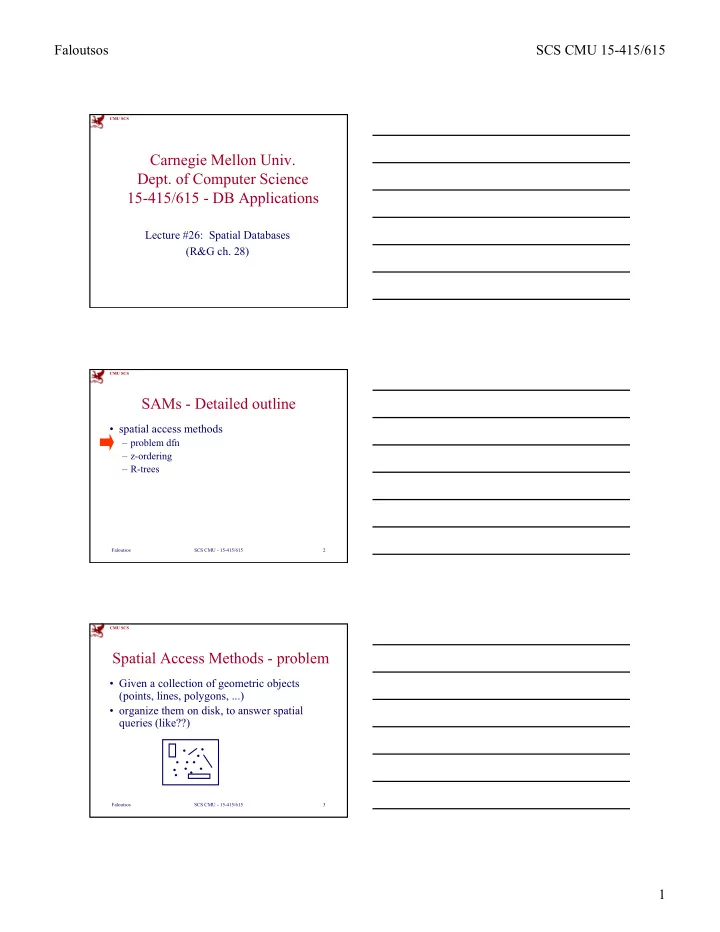
Spatial Access Methods - problem

  • Given a collection of geometric objects

(points, lines, polygons, ...)

  • organize them on disk, to answer spatial

queries (like??)

slide-2
SLIDE 2

Faloutsos SCS CMU 15-415/615 2

CMU SCS

Faloutsos SCS CMU - 15-415/615 4

Spatial Access Methods - problem

  • Given a collection of geometric objects

(points, lines, polygons, ...)

  • organize them on disk, to answer

– point queries – range queries – k-nn queries – spatial joins (‘all pairs’ queries)

CMU SCS

Faloutsos SCS CMU - 15-415/615 5

Spatial Access Methods - problem

  • Given a collection of geometric objects

(points, lines, polygons, ...)

  • organize them on disk, to answer

– point queries – range queries – k-nn queries – spatial joins (‘all pairs’ queries)

CMU SCS

Faloutsos SCS CMU - 15-415/615 6

Spatial Access Methods - problem

  • Given a collection of geometric objects

(points, lines, polygons, ...)

  • organize them on disk, to answer

– point queries – range queries – k-nn queries – spatial joins (‘all pairs’ queries)

slide-3
SLIDE 3

Faloutsos SCS CMU 15-415/615 3

CMU SCS

Faloutsos SCS CMU - 15-415/615 7

Spatial Access Methods - problem

  • Given a collection of geometric objects

(points, lines, polygons, ...)

  • organize them on disk, to answer

– point queries – range queries – k-nn queries – spatial joins (‘all pairs’ queries)

CMU SCS

Faloutsos SCS CMU - 15-415/615 8

Spatial Access Methods - problem

  • Given a collection of geometric objects

(points, lines, polygons, ...)

  • organize them on disk, to answer

– point queries – range queries – k-nn queries – spatial joins (‘all pairs’ within ε)

CMU SCS

Faloutsos SCS CMU - 15-415/615 9

SAMs - motivation

  • Q: applications?
slide-4
SLIDE 4

Faloutsos SCS CMU 15-415/615 4

CMU SCS

Faloutsos SCS CMU - 15-415/615 10

SAMs - motivation

salary age traditional DB GIS

CMU SCS

Faloutsos SCS CMU - 15-415/615 11

SAMs - motivation

salary age traditional DB GIS

CMU SCS

Faloutsos SCS CMU - 15-415/615 12

SAMs - motivation

CAD/CAM find elements too close to each other

slide-5
SLIDE 5

Faloutsos SCS CMU 15-415/615 5

CMU SCS

Faloutsos SCS CMU - 15-415/615 13

SAMs - motivation

CAD/CAM

CMU SCS

Faloutsos SCS CMU - 15-415/615 14

day 1 365 day 1 365 S1 Sn

F(S1) F(Sn)

SAMs - motivation

eg, avg eg,. std

CMU SCS

Faloutsos SCS CMU - 15-415/615 15

SAMs - Detailed outline

  • spatial access methods

– problem dfn – z-ordering – R-trees

slide-6
SLIDE 6

Faloutsos SCS CMU 15-415/615 6

CMU SCS

Faloutsos SCS CMU - 15-415/615 16

SAMs: solutions

  • z-ordering
  • R-trees

Q: how would you organize, e.g., n-dim points, on disk? (C points per disk page)

CMU SCS

Faloutsos SCS CMU - 15-415/615 17

z-ordering

Q: how would you organize, e.g., n-dim points, on disk? (C points per disk page) Hint: reduce the problem to 1-d points (!!) Q1: why? A: Q2: how?

CMU SCS

Faloutsos SCS CMU - 15-415/615 18

z-ordering

Q: how would you organize, e.g., n-dim points, on disk? (C points per disk page) Hint: reduce the problem to 1-d points (!!) Q1: why? A: B-trees! Q2: how?

slide-7
SLIDE 7

Faloutsos SCS CMU 15-415/615 7

CMU SCS

Faloutsos SCS CMU - 15-415/615 19

z-ordering

Q2: how? A: assume finite granularity; z-ordering = bit- shuffling = N-trees = Morton keys = geo- coding = ...

CMU SCS

Faloutsos SCS CMU - 15-415/615 20

z-ordering

Q2: how? A: assume finite granularity (e.g., 232x232 ; 4x4 here) Q2.1: how to map n-d cells to 1-d cells?

CMU SCS

Faloutsos SCS CMU - 15-415/615 21

z-ordering

Q2.1: how to map n-d cells to 1-d cells?

slide-8
SLIDE 8

Faloutsos SCS CMU 15-415/615 8

CMU SCS

Faloutsos SCS CMU - 15-415/615 22

z-ordering

Q2.1: how to map n-d cells to 1-d cells? A: row-wise Q: is it good?

CMU SCS

Faloutsos SCS CMU - 15-415/615 23

z-ordering

Q: is it good? A: great for ‘x’ axis; bad for ‘y’ axis

CMU SCS

Faloutsos SCS CMU - 15-415/615 24

z-ordering

Q: How about the ‘snake’ curve?

slide-9
SLIDE 9

Faloutsos SCS CMU 15-415/615 9

CMU SCS

Faloutsos SCS CMU - 15-415/615 25

z-ordering

Q: How about the ‘snake’ curve? A: still problems:

2^32 2^32

CMU SCS

Faloutsos SCS CMU - 15-415/615 26

z-ordering

Q: Why are those curves ‘bad’? A: no distance preservation (~ clustering) Q: solution?

2^32 2^32

CMU SCS

Faloutsos SCS CMU - 15-415/615 27

z-ordering

Q: solution? (w/ good clustering, and easy to compute, for 2-d and n-d?)

slide-10
SLIDE 10

Faloutsos SCS CMU 15-415/615 10

CMU SCS

Faloutsos SCS CMU - 15-415/615 28

z-ordering

Q: solution? (w/ good clustering, and easy to compute, for 2-d and n-d?) A: z-ordering/bit-shuffling/linear-quadtrees

‘looks’ better:

  • few long jumps;
  • scoops out the whole quadrant

before leaving it

  • a.k.a. space filling curves

CMU SCS

Faloutsos SCS CMU - 15-415/615 29

z-ordering

z-ordering/bit-shuffling/linear-quadtrees Q: How to generate this curve (z = f(x,y) )? A: 3 (equivalent) answers!

CMU SCS

Faloutsos SCS CMU - 15-415/615 30

z-ordering

z-ordering/bit-shuffling/linear-quadtrees Q: How to generate this curve (z = f(x,y))? A1: ‘z’ (or ‘N’) shapes, RECURSIVELY

  • rder-1 order-2

... order (n+1)

slide-11
SLIDE 11

Faloutsos SCS CMU 15-415/615 11

CMU SCS

Faloutsos SCS CMU - 15-415/615 31

z-ordering

Notice:

  • self similar (we’ll see about fractals, soon)
  • method is hard to use: z =? f(x,y)
  • rder-1 order-2

... order (n+1)

CMU SCS

Faloutsos SCS CMU - 15-415/615 32

z-ordering

z-ordering/bit-shuffling/linear-quadtrees Q: How to generate this curve (z = f(x,y) )? A: 3 (equivalent) answers!

Method #2?

CMU SCS

Faloutsos SCS CMU - 15-415/615 33

z-ordering

bit-shuffling

00 01 10 11 11 10 01 00 x y x 0 0 y 1 1 z =( 0 1 0 1 )2 = 5

slide-12
SLIDE 12

Faloutsos SCS CMU 15-415/615 12

CMU SCS

Faloutsos SCS CMU - 15-415/615 34

z-ordering

bit-shuffling

00 01 10 11 11 10 01 00 x y x 0 0 y 1 1 z =( 0 1 0 1 )2 = 5 How about the reverse: (x,y) = g(z) ?

CMU SCS

Faloutsos SCS CMU - 15-415/615 35

z-ordering

bit-shuffling

00 01 10 11 11 10 01 00 x y x 0 0 y 1 1 z =( 0 1 0 1 )2 = 5 How about n-d spaces?

CMU SCS

Faloutsos SCS CMU - 15-415/615 36

z-ordering

z-ordering/bit-shuffling/linear-quadtrees Q: How to generate this curve (z = f(x,y) )? A: 3 (equivalent) answers!

Method #3?

slide-13
SLIDE 13

Faloutsos SCS CMU 15-415/615 13

CMU SCS

Faloutsos SCS CMU - 15-415/615 37

z-ordering

linear-quadtrees : assign N->1, S->0 e.t.c.

1 1 00... 01... 10... 11... W E N S

CMU SCS

Faloutsos SCS CMU - 15-415/615 38

z-ordering

... and repeat recursively. Eg.: zblue-cell = WN;WN = (0101)2 = 5

1 1 00... 01... 10... 11... W E N S 00 11

CMU SCS

Faloutsos SCS CMU - 15-415/615 39

z-ordering

Drill: z-value of magenta cell, with the three methods?

1 1 W E N S

slide-14
SLIDE 14

Faloutsos SCS CMU 15-415/615 14

CMU SCS

Faloutsos SCS CMU - 15-415/615 40

z-ordering

Drill: z-value of magenta cell, with the three methods?

1 1 W E N S method#1: 14 method#2: shuffle(11;10)= (1110)2 = 14

CMU SCS

Faloutsos SCS CMU - 15-415/615 41

z-ordering

Drill: z-value of magenta cell, with the three methods?

1 1 W E N S method#1: 14 method#2: shuffle(11;10)= (1110)2 = 14 method#3: EN;ES = ... = 14

CMU SCS

Faloutsos SCS CMU - 15-415/615 42

z-ordering - Detailed outline

  • spatial access methods

– z-ordering

  • main idea - 3 methods
  • use w/ B-trees; algorithms (range, knn queries ...)
  • analysis; variations

– R-trees

slide-15
SLIDE 15

Faloutsos SCS CMU 15-415/615 15

CMU SCS

Faloutsos SCS CMU - 15-415/615 43

z-ordering - usage & algo’s

Q1: How to store on disk? A: Q2: How to answer range queries etc

CMU SCS

Faloutsos SCS CMU - 15-415/615 44

z-ordering - usage & algo’s

Q1: How to store on disk? A: treat z-value as primary key; feed to B-tree

SF PGH

CMU SCS

Faloutsos SCS CMU - 15-415/615 45

z-ordering - usage & algo’s

MAJOR ADVANTAGES w/ B-tree:

  • already inside commercial systems (no

coding/debugging!)

  • concurrency & recovery is ready

SF PGH

slide-16
SLIDE 16

Faloutsos SCS CMU 15-415/615 16

CMU SCS

Faloutsos SCS CMU - 15-415/615 46

z-ordering - usage & algo’s

Q2: queries? (eg.: find city at (0,3) )?

SF PGH

CMU SCS

Faloutsos SCS CMU - 15-415/615 47

z-ordering - usage & algo’s

Q2: queries? (eg.: find city at (0,3) )? A: find z-value; search B-tree

SF PGH

CMU SCS

Faloutsos SCS CMU - 15-415/615 48

z-ordering - usage & algo’s

Q2: range queries?

SF PGH

slide-17
SLIDE 17

Faloutsos SCS CMU 15-415/615 17

CMU SCS

Faloutsos SCS CMU - 15-415/615 49

z-ordering - usage & algo’s

Q2: range queries? A: compute ranges of z-values; use B-tree

SF PGH 9,11-15

CMU SCS

Faloutsos SCS CMU - 15-415/615 50

z-ordering - usage & algo’s

Q2’: range queries - how to reduce # of qualifying of ranges?

SF PGH 9,11-15

CMU SCS

Faloutsos SCS CMU - 15-415/615 51

z-ordering - usage & algo’s

Q2’: range queries - how to reduce # of qualifying of ranges? A: Augment the query!

SF PGH 9,11-15 -> 8-15

slide-18
SLIDE 18

Faloutsos SCS CMU 15-415/615 18

CMU SCS

Faloutsos SCS CMU - 15-415/615 52

z-ordering - Detailed outline

  • spatial access methods

– z-ordering

  • main idea - 3 methods
  • use w/ B-trees; algorithms (range, knn queries ...)
  • variations

– R-trees

CMU SCS

Faloutsos SCS CMU - 15-415/615 53

z-ordering - variations

Q: is z-ordering the best we can do?

CMU SCS

Faloutsos SCS CMU - 15-415/615 54

z-ordering - variations

Q: is z-ordering the best we can do? A: probably not - occasional long ‘jumps’ Q: then?

slide-19
SLIDE 19

Faloutsos SCS CMU 15-415/615 19

CMU SCS

Faloutsos SCS CMU - 15-415/615 55

z-ordering - variations

Q: is z-ordering the best we can do? A: probably not - occasional long ‘jumps’ Q: then? A1: Gray codes

CMU SCS

Faloutsos SCS CMU - 15-415/615 56

z-ordering - variations

A2: Hilbert curve! (a.k.a. Hilbert-Peano curve)

CMU SCS

Faloutsos SCS CMU - 15-415/615 57

z-ordering - variations

‘Looks’ better (never long jumps). How to derive it?

slide-20
SLIDE 20

Faloutsos SCS CMU 15-415/615 20

CMU SCS

Faloutsos SCS CMU - 15-415/615 58

z-ordering - variations

‘Looks’ better (never long jumps). How to derive it?

  • rder-1
  • rder-2

... order (n+1)

CMU SCS

Faloutsos SCS CMU - 15-415/615 59

z-ordering - variations

Q: function for the Hilbert curve ( h = f(x,y) )? A: bit-shuffling, followed by post-processing, to account for rotations. Linear on # bits. See, eg., [Jagadish, 90]

CMU SCS

Faloutsos SCS CMU - 15-415/615 60

z-ordering - variations

In general, Hilbert curve is great for preserving distances, clustering, vector quantization etc

slide-21
SLIDE 21

Faloutsos SCS CMU 15-415/615 21

CMU SCS

Faloutsos SCS CMU - 15-415/615 61

Conclusions

  • z-ordering is a great idea (n-d points -> 1-d

points; feed to B-trees)

  • used by TIGER system and (most probably)

by other GIS products

  • works great with low-dim points

CMU SCS

Faloutsos SCS CMU - 15-415/615 62

SAMs - Detailed outline

  • spatial access methods

– problem dfn – z-ordering – R-trees

CMU SCS

Faloutsos SCS CMU - 15-415/615 63

SAMs - more detailed outline

  • R-trees

– main idea; file structure – (algorithms: insertion/split) – (deletion) – search: range, (nn, spatial joins) – Variations: R*-trees, packed R-trees

slide-22
SLIDE 22

Faloutsos SCS CMU 15-415/615 22

CMU SCS

Faloutsos SCS CMU - 15-415/615 64

Reminder: problem

  • Given a collection of geometric objects

(points, lines, polygons, ...)

  • organize them on disk, to answer spatial

queries (range, nn, etc)

CMU SCS

Faloutsos SCS CMU - 15-415/615 65

R-trees

  • z-ordering: cuts regions to pieces -> dup.

elim.

  • how could we avoid that?
  • Idea: Minimum Bounding Rectangles

CMU SCS

Faloutsos SCS CMU - 15-415/615 66

R-trees

  • [Guttman 84] Main idea: allow parents to
  • verlap!

– => guaranteed 50% utilization – => easier insertion/split algorithms. – (only deal with Minimum Bounding Rectangles

  • MBRs)
slide-23
SLIDE 23

Faloutsos SCS CMU 15-415/615 23

CMU SCS

Faloutsos SCS CMU - 15-415/615 67

R-trees

  • eg., w/ fanout 4: group nearby rectangles to

parent MBRs; each group -> disk page

A B C D E F G H I J

CMU SCS

Faloutsos SCS CMU - 15-415/615 68

R-trees

  • eg., w/ fanout 4:

A B C D E F G H I J P1 P2 P3 P4

F G D E H I J A B C

CMU SCS

Faloutsos SCS CMU - 15-415/615 69

R-trees

  • eg., w/ fanout 4:

A B C D E F G H I J P1 P2 P3 P4

P1 P2 P3 P4 F G D E H I J A B C

slide-24
SLIDE 24

Faloutsos SCS CMU 15-415/615 24

CMU SCS

Faloutsos SCS CMU - 15-415/615 70

R-trees - format of nodes

  • {(MBR; obj-ptr)} for leaf nodes

P1 P2 P3 P4 A B C

x-low; x-high y-low; y-high ...

  • bj

ptr ...

CMU SCS

Faloutsos SCS CMU - 15-415/615 71

R-trees - format of nodes

  • {(MBR; node-ptr)} for non-leaf nodes

P1 P2 P3 P4 A B C

x-low; x-high y-low; y-high ... node ptr ...

CMU SCS

Faloutsos SCS CMU - 15-415/615 72

R-trees - range search?

A B C D E F G H I J P1 P2 P3 P4

P1 P2 P3 P4 F G D E H I J A B C

slide-25
SLIDE 25

Faloutsos SCS CMU 15-415/615 25

CMU SCS

Faloutsos SCS CMU - 15-415/615 73

R-trees - range search?

A B C D E F G H I J P1 P2 P3 P4

P1 P2 P3 P4 F G D E H I J A B C

CMU SCS

Faloutsos SCS CMU - 15-415/615 74

R-trees - range search

Observations:

  • every parent node completely covers its

‘children’

  • a child MBR may be covered by more than
  • ne parent - it is stored under ONLY ONE
  • f them. (ie., no need for dup. elim.)

CMU SCS

Faloutsos SCS CMU - 15-415/615 75

R-trees - range search

Observations - cont’d

  • a point query may follow multiple branches.
  • everything works for any dimensionality
slide-26
SLIDE 26

Faloutsos SCS CMU 15-415/615 26

CMU SCS

Faloutsos SCS CMU - 15-415/615 76

SAMs - more detailed outline

  • R-trees

– main idea; file structure – (algorithms: insertion/split) – (deletion) – search: range, (nn, spatial joins) – Variations: R*-trees, packed R-trees

CMU SCS

Faloutsos SCS CMU - 15-415/615 77

R-trees - insertion

  • eg., rectangle ‘X’

A B C D E F G H I J P1 P2 P3 P4

P1 P2 P3 P4 F G D E H I J A B C

X NOT IN EXAM

CMU SCS

Faloutsos SCS CMU - 15-415/615 78

R-trees - insertion

  • eg., rectangle ‘X’

A B C D E F G H I J P1 P2 P3 P4

P1 P2 P3 P4 F G D E H I J A B C

X

X

NOT IN EXAM

slide-27
SLIDE 27

Faloutsos SCS CMU 15-415/615 27

CMU SCS

Faloutsos SCS CMU - 15-415/615 79

SAMs - more detailed outline

  • R-trees

– main idea; file structure – (algorithms: insertion/split) – (deletion) – search: range, (nn, spatial joins) – Variations: R*-trees, packed R-trees

CMU SCS

Faloutsos SCS CMU - 15-415/615 80

R-trees - range search

pseudocode: check the root for each branch, if its MBR intersects the query rectangle apply range-search (or print out, if this is a leaf)

CMU SCS

Faloutsos SCS CMU - 15-415/615 81

SAMs - more detailed outline

  • R-trees

– main idea; file structure – (algorithms: insertion/split) – (deletion) – search: range, (nn, spatial joins) – Variations: R*-trees, packed R-trees

slide-28
SLIDE 28

Faloutsos SCS CMU 15-415/615 28

CMU SCS

Faloutsos SCS CMU - 15-415/615 82

R-trees - variations

Guttman’s R-trees sparked much follow-up work

  • can we do better splits?
  • what about static datasets (no ins/del/upd)?
  • what about other bounding shapes?

NOT IN EXAM

CMU SCS

Faloutsos SCS CMU - 15-415/615 83

R-trees - variations

Guttman’s R-trees sparked much follow-up work

  • can we do better splits?

– i.e, defer splits? NOT IN EXAM

CMU SCS

Faloutsos SCS CMU - 15-415/615 84

R-trees - variations

A: R*-trees [Kriegel+, SIGMOD90]

  • defer splits, by forced-reinsert, i.e.: instead
  • f splitting, temporarily delete some entries,

shrink overflowing MBR, and re-insert those entries

  • Which ones to re-insert?
  • How many?

NOT IN EXAM

slide-29
SLIDE 29

Faloutsos SCS CMU 15-415/615 29

CMU SCS

Faloutsos SCS CMU - 15-415/615 85

R-trees - variations

A: R*-trees [Kriegel+, SIGMOD90]

  • defer splits, by forced-reinsert, i.e.: instead
  • f splitting, temporarily delete some entries,

shrink overflowing MBR, and re-insert those entries

  • Which ones to re-insert?
  • How many? A: 30%

NOT IN EXAM

CMU SCS

Faloutsos SCS CMU - 15-415/615 86

R-trees - variations

R*-trees: Also try to minimize area AND perimeter, in their split. Performance: higher space utilization; faster than plain R-trees. One of the most successful R-tree variants.

NOT IN EXAM

CMU SCS

Faloutsos SCS CMU - 15-415/615 87

R-trees - variations

Guttman’s R-trees sparked much follow-up work

  • can we do better splits?
  • what about static datasets (no ins/del/upd)?

– Hilbert R-trees

  • what about other bounding shapes?

NOT IN EXAM

slide-30
SLIDE 30

Faloutsos SCS CMU 15-415/615 30

CMU SCS

Faloutsos SCS CMU - 15-415/615 88

R-trees - variations

  • what about static datasets (no ins/del/upd)?
  • Q: Best way to pack points?

NOT IN EXAM

CMU SCS

Faloutsos SCS CMU - 15-415/615 89

R-trees - variations

  • what about static datasets (no ins/del/upd)?
  • Q: Best way to pack points?
  • A1: plane-sweep

great for queries on ‘x’; terrible for ‘y’

NOT IN EXAM

CMU SCS

Faloutsos SCS CMU - 15-415/615 90

R-trees - variations

  • what about static datasets (no ins/del/upd)?
  • Q: Best way to pack points?
  • A1: plane-sweep

great for queries on ‘x’; bad for ‘y’

NOT IN EXAM

slide-31
SLIDE 31

Faloutsos SCS CMU 15-415/615 31

CMU SCS

Faloutsos SCS CMU - 15-415/615 91

R-trees - variations

  • what about static datasets (no ins/del/upd)?
  • Q: Best way to pack points?
  • A1: plane-sweep

great for queries on ‘x’; terrible for ‘y’

  • Q: how to improve?

NOT IN EXAM

CMU SCS

Faloutsos SCS CMU - 15-415/615 92

R-trees - variations

  • A: plane-sweep on HILBERT curve!

NOT IN EXAM

CMU SCS

Faloutsos SCS CMU - 15-415/615 93

R-trees - variations

  • A: plane-sweep on HILBERT curve!
  • In fact, it can be made dynamic (how?), as well

as to handle regions (how?)

  • A: [Kamel+, VLDB94]

NOT IN EXAM

slide-32
SLIDE 32

Faloutsos SCS CMU 15-415/615 32

CMU SCS

Faloutsos SCS CMU - 15-415/615 94

R-trees - variations

Guttman’s R-trees sparked much follow-up work

  • can we do better splits?
  • what about static datasets (no ins/del/upd)?
  • what about other bounding shapes?

NOT IN EXAM

CMU SCS

Faloutsos SCS CMU - 15-415/615 95

R-trees - variations

  • what about other bounding shapes? (and why?)
  • A1: arbitrary-orientation lines (cell-tree,

[Guenther]

  • A2: P-trees (polygon trees) (MB polygon: 0,

90, 45, 135 degree lines)

NOT IN EXAM

CMU SCS

Faloutsos SCS CMU - 15-415/615 96

R-trees - variations

  • A3: L-shapes; holes (hB-tree)
  • A4: TV-trees [Lin+, VLDB-Journal 1994]
  • A5: SR-trees [Katayama+, SIGMOD97] (used

in Informedia)

NOT IN EXAM

slide-33
SLIDE 33

Faloutsos SCS CMU 15-415/615 33

CMU SCS

Faloutsos SCS CMU - 15-415/615 97

R-trees - conclusions

  • Popular method; like multi-d B-trees
  • guaranteed utilization
  • good search times (for low-dim. at least)
  • R*-, Hilbert- and SR-trees: still used
  • Informix/DB2 ships DataBlade with R-trees

– Also in postgres (GiST) – and sqlite3 (separate module: R*-tree)

CMU SCS

Faloutsos SCS CMU - 15-415/615 98

Overall conclusions

  • For spatial data:

– z-ordering (maps to 1-d points) – R-trees (overlapping MBRs)

  • both have been implemented in some

commercial systems

  • both work well for low-dimensionalities

(<10 or so) - in high-d, it depends on ‘intrinsic’ dimensionality.

CMU SCS

Faloutsos SCS CMU - 15-415/615 99

References

  • Guttman, A. (June 1984). R-Trees: A Dynamic Index

Structure for Spatial Searching. Proc. ACM SIGMOD, Boston, Mass.

  • Jagadish, H. V. (May 23-25, 1990). Linear Clustering of

Objects with Multiple Attributes. ACM SIGMOD Conf., Atlantic City, NJ.

  • Norbert Beckmann, Hans-Peter Kriegel, Ralf Schneider,

Bernhard Seeger: The R*-Tree: An Efficient and Robust Access Method for Points and Rectangles. SIGMOD Conference 1990: 322-331.

slide-34
SLIDE 34

Faloutsos SCS CMU 15-415/615 34

CMU SCS

Faloutsos SCS CMU - 15-415/615 100

References, cont’d

  • Pagel, B., H. Six, et al. (May 1993). Towards an Analysis
  • f Range Query Performance. Proc. of ACM SIGACT-

SIGMOD-SIGART Symposium on Principles of Database Systems (PODS), Washington, D.C.

  • Robinson, J. T. (1981). The k-D-B-Tree: A Search

Structure for Large Multidimensional Dynamic Indexes.

  • Proc. ACM SIGMOD.
  • Roussopoulos, N., S. Kelley, et al. (May 1995). Nearest

Neighbor Queries. Proc. of ACM-SIGMOD, San Jose, CA.