15-415/615 - DB Applications Lecture #23: Alternative Concurrency - - PDF document

15 415 615 db applications lecture 23 alternative
SMART_READER_LITE
LIVE PREVIEW

15-415/615 - DB Applications Lecture #23: Alternative Concurrency - - PDF document

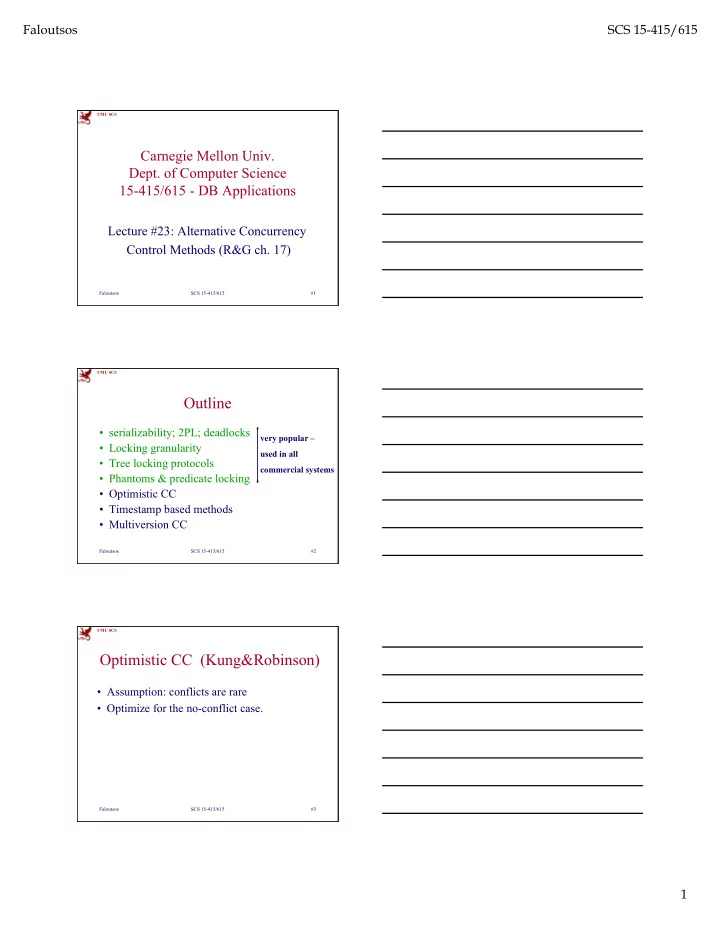
Faloutsos SCS 15-415/615 CMU SCS Carnegie Mellon Univ. Dept. of Computer Science 15-415/615 - DB Applications Lecture #23: Alternative Concurrency Control Methods (R&G ch. 17) Faloutsos SCS 15-415/615 #1 CMU SCS Outline


slide-1
SLIDE 1

Faloutsos SCS 15-415/615 1

CMU SCS

Faloutsos SCS 15-415/615 #1

Carnegie Mellon Univ.

  • Dept. of Computer Science

15-415/615 - DB Applications

Lecture #23: Alternative Concurrency Control Methods (R&G ch. 17)

CMU SCS

Faloutsos SCS 15-415/615 #2

Outline

  • serializability; 2PL; deadlocks
  • Locking granularity
  • Tree locking protocols
  • Phantoms & predicate locking
  • Optimistic CC
  • Timestamp based methods
  • Multiversion CC

very popular – used in all commercial systems

CMU SCS

Faloutsos SCS 15-415/615 #3

Optimistic CC (Kung&Robinson)

  • Assumption: conflicts are rare
  • Optimize for the no-conflict case.
slide-2
SLIDE 2

Faloutsos SCS 15-415/615 2

CMU SCS

Faloutsos SCS 15-415/615 #4

Optimistic CC (Kung&Robinson)

  • All transactions consist of three phases

– Read: all writes are to private storage. – Validation: check for no conflicts – Write: flush ‘writes’ (or abort!)

Validation Read Phase Write Phase All writes private Check for conflicts Make local writes public

CMU SCS

Faloutsos SCS 15-415/615 #5

Why Might this Make Sense?

CMU SCS

Faloutsos SCS 15-415/615 #6

Why Might this Make Sense?

  • All transactions are readers
  • Many transactions,

– each accessing/modifying few tuples – from many tuples – Low probability of conflict, so again locking is wasted

slide-3
SLIDE 3

Faloutsos SCS 15-415/615 3

CMU SCS

Faloutsos SCS 15-415/615 #7

Validation Phase

  • Goal: guarantee only serializable schedules
  • Intuitively: at validation, Tj checks its ‘elders’

for RW and WW conflicts

  • and makes sure that all conflicts go one way

(from elder to younger)

CMU SCS

Faloutsos SCS 15-415/615 #8

Validation Phase

Specifically:

  • Assign each transaction a TN (transaction

number)

  • Require TN order to be the serialization order
  • If TN(Ti) < TN(Tj) ⇒ ONE of the following

must hold:

CMU SCS

Faloutsos SCS 15-415/615 #9

Validation Phase (1)

  • 1. Ti completes W before Tj starts R

R V W

Ti

R V W

Tj

slide-4
SLIDE 4

Faloutsos SCS 15-415/615 4

CMU SCS

Faloutsos SCS 15-415/615 #10

Correctness

  • 1. Ti completes W before Tj starts R

R V W

Ti

R V W

Tj

  • k W-R
  • k W-W
  • k R-W

CMU SCS

Faloutsos SCS 15-415/615 #11

Correctness

  • In fact, this is a true serial execution

CMU SCS

Faloutsos SCS 15-415/615 #12

Validation Phase (2)

  • 2. WS(Ti) ∩ RS(Tj) = ∅ and

Ti completes W before Tj starts W

R V W

Ti

R V W

Tj

slide-5
SLIDE 5

Faloutsos SCS 15-415/615 5

CMU SCS

Faloutsos SCS 15-415/615 #13

Correctness

  • 2. WS(Ti) ∩ RS(Tj) = ∅ and

Ti completes W before Tj starts W

R V W

Ti

R V W

Tj no W-R

  • k W-W
  • k R-W

CMU SCS

Faloutsos SCS 15-415/615 #14

Validation Phase (3)

  • 3. WS(Ti) ∩ RS(Tj) = ∅ and

WS(Ti) ∩ WS(Tj) = ∅ and Ti completes its R before Tj completes its R

R V W

Ti

R V W

Tj

CMU SCS

Faloutsos SCS 15-415/615 #15

Correctness:

  • 3. WS(Ti) ∩ RS(Tj) = ∅ and

WS(Ti) ∩ WS(Tj) = ∅ and Ti completes its R before Tj completes its R

R V W

Ti

R V W

Tj no W-R no W-W

  • k R-W
slide-6
SLIDE 6

Faloutsos SCS 15-415/615 6

CMU SCS

Faloutsos SCS 15-415/615 #16

Observations

  • When to better assign TN’s?
  • at beginning of read phase: Tj has to wait...

R V W

Ti

R V W

Tj

Tj has to wait for W(Ti)

CMU SCS

Faloutsos SCS 15-415/615 #17

Observations

  • When to better assign TN’s?
  • at beginning of validation phase:

– Tj can start – condition (3): automatic!

R V W

Ti

R V W

Tj

Tj has to wait for W(Ti)

CMU SCS

Faloutsos SCS 15-415/615 #18

A Serial Validation Technique

Goal: to ensure conditions 1 and/or 2 above.

  • Requires that write phases be done serially
  • Validation + Write: in a ‘critical section’

Ti R V W tnstart tnfinish

Critical section

{all xacts that started here}

slide-7
SLIDE 7

Faloutsos SCS 15-415/615 7

CMU SCS

Faloutsos SCS 15-415/615 #19

Serial Validation Algorithm

1. Record start_tn when Xact starts (to identify active Xacts later) 2. Obtain the Xact’s real Transaction Number (TN) at the start of validation phase 3. Record read set and write set while running and write into local copy 4. Do validation and write phase inside a critical section

CMU SCS

Faloutsos SCS 15-415/615 #20

Opt CC vs. Locking

Locking:

  • order is of first lock;
  • wait
  • on deadlock, abort

Optimistic cc

  • order is of TN(i)
  • abort
  • on starvation, lock

CMU SCS

Faloutsos SCS 15-415/615 #21

Conclusions

  • Analysis [Agrawal, Carey, Livny, ‘87]:

– locking performs well

  • All vendors use locking
  • Optimistic cc: promising when resource

utilization is low.

slide-8
SLIDE 8

Faloutsos SCS 15-415/615 8

CMU SCS

Faloutsos SCS 15-415/615 #22

Outline

  • serializability; 2PL; deadlocks
  • Locking granularity
  • Tree locking protocols
  • Phantoms & predicate locking
  • Optimistic CC
  • Timestamp based methods
  • Multiversion CC

CMU SCS

Faloutsos SCS 15-415/615 #23

Timestamp based

Motivation:

  • can we avoid locks
  • AND also avoid the ‘critical section’ of
  • ptimistic CC?

CMU SCS

Faloutsos SCS 15-415/615 #24

Timestamp based

Main idea

  • each xact goes ahead reading and writing
  • if it tries to access an object ‘from the

future’, it aborts (Resembles ‘optimistic cc’, but writes go directly on the db)

slide-9
SLIDE 9

Faloutsos SCS 15-415/615 9

CMU SCS

Faloutsos SCS 15-415/615 #25

Timestamp CC:

  • each xact gets a timestamp (TS)
  • each object has

– a read-timestamp (RTS) (latest xact that read it) – and a write-timestamp (WTS) (latest xact that wrote it)

CMU SCS

Faloutsos SCS 15-415/615 #26

Timestamp CC

  • If action ai of Xact Ti conflicts with

action aj of Xact Tj, and TS(Ti) < TS (Tj), then ai must occur before aj. Otherwise, restart the offending Xact.

  • Specifically:

CMU SCS

Faloutsos SCS 15-415/615 #27

On ‘reads’:

O RTS WTS

  • bject

time T1:<1> .... R(O) ........ T2:<2> .... W(O) ........ <2>

slide-10
SLIDE 10

Faloutsos SCS 15-415/615 10

CMU SCS

Faloutsos SCS 15-415/615 #28

On ‘reads’:

O RTS WTS

  • bject

time T1:<1> .... R(O) T2:<2> .... W(O) ........ <2> T1 ABORTS!

CMU SCS

Faloutsos SCS 15-415/615 #29

Timestamp CC – Reads:

  • If TS(T) < WTS(O), this violates timestamp
  • rder of T w.r.t. writer of O.

– So, abort T and restart it (with same TS? why?)

  • Else

– Allow T to read O. – Update RTS(O) to max(RTS(O), TS(T))

CMU SCS

Faloutsos SCS 15-415/615 #30

Timestamp CC - Reads

Notice: Change to RTS(O) on reads must be written to disk! This and restarts represent

  • verheads.
slide-11
SLIDE 11

Faloutsos SCS 15-415/615 11

CMU SCS

Faloutsos SCS 15-415/615 #31

On ‘writes’: RW conflict

O RTS WTS

  • bject

time T1:<1> .... W(O) ........ T2:<2> .... R(O) ........ <2>

CMU SCS

Faloutsos SCS 15-415/615 #32

On ‘writes’: RW conflict

O RTS WTS

  • bject

time T1:<1> .... W(O) T2:<2> .... R(O) ........ <2> T1: ABORTS

CMU SCS

Faloutsos SCS 15-415/615 #33

On ‘writes’: WW conflict

O RTS WTS

  • bject

time T1:<1> .... W(O) ........ T2:<2> .... W(O) ........ <2>

slide-12
SLIDE 12

Faloutsos SCS 15-415/615 12

CMU SCS

Faloutsos SCS 15-415/615 #34

On ‘writes’: WW conflict

O RTS WTS

  • bject

time T1:<1> .... W(O) T2:<2> .... W(O) ........ <2> T1: STAYS!!! (Thomas rule: ignore the W of T1)

CMU SCS

Faloutsos SCS 15-415/615 #35

Timestamp CC: Writes

  • If TS(T) < RTS(O), abort and restart T.
  • If TS(T) < WTS(O), violates timestamp order
  • f T w.r.t. writer of O.

– Thomas Write Rule : ignore W op, and continue with T

  • Else, allow T to write O.

– and update the WTS(O)

CMU SCS

Faloutsos SCS 15-415/615 #36

Digging deeper:

  • How about

recoverability (ie, cascading aborts?)

  • Can they appear, under

timestamp CC?

T1 T2 W(A) R(A) W(A) Commit … Abort

B A D

slide-13
SLIDE 13

Faloutsos SCS 15-415/615 13

CMU SCS

Faloutsos SCS 15-415/615 #37

Digging deeper:

  • How about

recoverability (ie, cascading aborts?)

  • Can they appear, under

timestamp CC?

  • Yes!

T1 T2 W(A) R(A) W(A) Commit … Abort

B A D

CMU SCS

Faloutsos SCS 15-415/615 #38

Timestamp CC and Recoverability

 Unrecoverable schedules are

allowed by Timestamp CC !

 (Explain why?)

Recoverable schedule: xacts commit only after (and if) all xacts whose changes they read commit

T1 T2 W(A) R(A) W(A) Commit … Abort

B A D

CMU SCS

Faloutsos SCS 15-415/615 #39

Timestamp CC and Recoverability

  • Timestamp CC can be modified, to give

recoverable schedules – how?

slide-14
SLIDE 14

Faloutsos SCS 15-415/615 14

CMU SCS

Faloutsos SCS 15-415/615 #40

Timestamp CC and Recoverability

  • Timestamp CC can be modified, to give

recoverable schedules – how?

  • A:

– Buffer all writes until writer commits (but update WTS(O) when the write is allowed.) – Block readers T (where TS(T) > WTS(O)) until writer of O commits.

Similar to writers holding X locks until commit, (but not =2PL).

CMU SCS

Faloutsos SCS 15-415/615 #41

Outline

  • serializability; 2PL; deadlocks
  • Locking granularity
  • Tree locking protocols
  • Phantoms & predicate locking
  • Optimistic CC
  • Timestamp based methods
  • Multiversion CC

CMU SCS

Faloutsos SCS 15-415/615 #42

Multiversion CC

  • Readers need NO LOCKS!

– How would you do it?

slide-15
SLIDE 15

Faloutsos SCS 15-415/615 15

CMU SCS

Faloutsos SCS 15-415/615 #43

Multiversion CC

  • Readers need NO LOCKS!

– keep a history of all attribute values – give each reader the appropriate version – (abort the belated writers)

CMU SCS

Faloutsos SCS 15-415/615 #44

Multiversion Timestamp CC

  • Idea: Let writers make a “new” copy while

readers use an appropriate “old” copy:

O O’ O’’

MAIN SEGMENT (Current versions of DB objects) VERSION POOL (Older versions that may be useful for some active readers.)  Readers are always allowed to proceed.

– But may be blocked until writer commits.

CMU SCS

Faloutsos SCS 15-415/615 #45

Multiversion CC (Contd.)

  • Each Xact is classified as Reader or Writer.

– Writer may write some object; Reader never will. – Xact declares whether it is a Reader when it begins.

  • Each version of an object has its writer’s TS as its

WTS, and the TS of the Xact that most recently read this version as its RTS.

  • Versions are chained backward; we can discard

versions that are “too old to be of interest”.

slide-16
SLIDE 16

Faloutsos SCS 15-415/615 16

CMU SCS

Faloutsos SCS 15-415/615 #46

Reader Xact

  • Find newest version

with WTS < TS(T).

  • Reader Xacts are never

restarted.

– However, might block until writer

  • f the appropriate version

commits.

TS(T)

  • ld new

WTS timeline

CMU SCS

Faloutsos SCS 15-415/615 #47

Writer Xact

  • try to insert/append a new version
  • abort if there is a reader ‘from the future’, that read

an older version

  • Specifically:

CMU SCS

Faloutsos SCS 15-415/615 #48

Writer

time T1:<1> .... W(O) ........ T2:<2> .... W(O) ........ T3:<3> .... R(O) ........ T1 creates the first version V1 of object O

slide-17
SLIDE 17

Faloutsos SCS 15-415/615 17

CMU SCS

Faloutsos SCS 15-415/615 #49

Writer

time T1:<1> .... W(O) ........ T2:<2> .... W(O) ........ T3:<3> .... R(O) ........ T3 reads V1 T1 creates the first version V1 of object O

CMU SCS

Faloutsos SCS 15-415/615 #50

Writer

time T1:<1> .... W(O) ........ T2:<2> .... W(O) ........ T3:<3> .... R(O) ........ T2 is too late – and aborts T3 reads V1 T1 creates the first version V1 of object O

CMU SCS

Faloutsos SCS 15-415/615 #51

Writer Xact

  • To read an object, follows reader protocol.
  • To write an object:

– Finds newest version V s.t. WTS < TS(T). – If RTS(V) < TS(T), T makes a copy CV of V, with a pointer to V, with WTS(CV) = TS(T), RTS (CV) = TS(T). (Write is buffered until T commits; other Xacts can see TS values but can’t read version CV.) – Else, reject write. T

  • ld new

WTS

CV

V

RTS(V)

slide-18
SLIDE 18

Faloutsos SCS 15-415/615 18

CMU SCS

Faloutsos SCS 15-415/615 #52

Writer Xact

  • To read an object, follows reader protocol.
  • To write an object:

– Finds newest version V s.t. WTS < TS(T). – If RTS(V) < TS(T), T makes a copy CV of V, with a pointer to V, with WTS(CV) = TS(T), RTS (CV) = TS(T). (Write is buffered until T commits; other Xacts can see TS values but can’t read version CV.) – Else, reject write. T

  • ld new

WTS V

RTS(V)

CMU SCS

Faloutsos SCS 15-415/615 #53

Summary – optimistic CC

  • Optimistic CC (using a posteriori

“validation”) aims to minimize CC overheads in an “optimistic’’ environment in which reads are common and writes are rare.

  • Optimistic CC has its own overheads

however; most real systems use locking.

CMU SCS

Faloutsos SCS 15-415/615 #54

Summary – timestamp based

  • Timestamp CC allows some serializable

schedules that 2PL does not (although converse is also true).

  • Ensuring recoverability requires ability to

block Xacts, which is similar to locking.

slide-19
SLIDE 19

Faloutsos SCS 15-415/615 19

CMU SCS

Faloutsos SCS 15-415/615 #55

Summary - multiversion

  • read-only Xacts are never restarted; they

can always read a suitable older version.

  • Has additional overhead of version

maintenance.

– Oracle uses a flavor of multiversion CC

CMU SCS

Faloutsos SCS 15-415/615 #56

Overall summary of CC

  • Most commercial systems use

– Locking AND – with wait-for graphs for deadlock detection AND – multiple granularity locking (table, page, row)