More on wireless CSCI 466: Networks Keith Vertanen - - PowerPoint PPT Presentation

more on wireless
SMART_READER_LITE
LIVE PREVIEW

More on wireless CSCI 466: Networks Keith Vertanen - - PowerPoint PPT Presentation

More on wireless CSCI 466: Networks Keith Vertanen Fall 2011 Overview Mul.ple access networks 802.11 Collision avoidance


slide-1
SLIDE 1

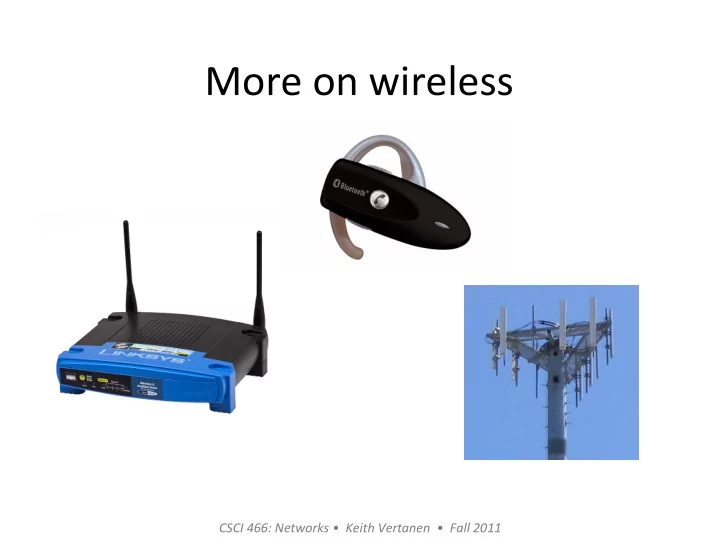
More ¡on ¡wireless ¡

CSCI ¡466: ¡Networks ¡• ¡ ¡Keith ¡Vertanen ¡ ¡• ¡ ¡Fall ¡2011 ¡
slide-2
SLIDE 2

Overview ¡

  • Mul.ple ¡access ¡networks ¡

– 802.11 ¡

  • Collision ¡avoidance ¡
  • Encryp.on ¡

– Bluetooth ¡ – Mobile ¡telephone ¡system ¡ ¡ ¡

2 ¡

slide-3
SLIDE 3

802.11 ¡Wi-­‑Fi ¡

Standard ¡ Released ¡ Max ¡bit ¡rate ¡ (shared) ¡ Frequency ¡band ¡ Indoor ¡ range ¡ 802.11 ¡ 1997 ¡ 2 ¡Mbps ¡ 2.4 ¡GHz ¡ 20 ¡m ¡ 802.11a ¡ 1999 ¡ 54 ¡Mbps ¡ 5 ¡GHz ¡ 35 ¡m ¡ 802.11b ¡ 1999 ¡ 11 ¡Mbps ¡ 2.4 ¡GHz ¡ 38 ¡m ¡ 802.11g ¡ 2003 ¡ 54 ¡Mbps ¡ 2.4 ¡GHz ¡ 38 ¡m ¡ 802.11n ¡ 2009 ¡ 600 ¡Mbps ¡ 2.4 ¡GHz ¡ 5 ¡GHz ¡ 70 ¡m ¡

3 ¡

– Operate ¡in ¡license ¡exempt ¡bands ¡ – More ¡absorp.on ¡at ¡high ¡frequencies ¡(5 ¡GHz) ¡ – All ¡support ¡lower ¡bit ¡rates ¡

  • Switch ¡between ¡modula.on ¡techniques ¡& ¡error ¡correc.on ¡codes ¡

– 802.11n, ¡mul.ple ¡antennas ¡

  • MIMO ¡(Mul.ple ¡Input ¡Mul.ple ¡Output) ¡
slide-4
SLIDE 4

Wireless ¡topology ¡

  • Base ¡sta.on ¡topology ¡

– Typically ¡all ¡clients ¡talk ¡to ¡base ¡sta.on ¡ – No ¡direct ¡communica.on ¡between ¡clients ¡

4 ¡

slide-5
SLIDE 5

802.11 ¡collision ¡avoidance ¡

  • Collision ¡avoidance ¡

– Can’t ¡transmit ¡and ¡listen ¡for ¡collision ¡

  • Transmission ¡power ¡swamps ¡receiving ¡circuit ¡
  • Collision ¡detec.on ¡(CD) ¡as ¡in ¡Ethernet ¡not ¡possible ¡

– Not ¡everyone ¡can ¡hear ¡everything ¡

  • Hidden ¡node ¡problem: ¡

5 ¡

A ¡and ¡C ¡both ¡want ¡to ¡send ¡to ¡B. ¡ ¡ ¡ ¡ A ¡and ¡C ¡can’t ¡hear ¡each ¡other ¡ so ¡can’t ¡detect ¡their ¡ transmissions ¡collided. ¡

slide-6
SLIDE 6

802.11 ¡collision ¡avoidance ¡

  • Collision ¡avoidance ¡

– Lack ¡of ¡global ¡informa.on ¡about ¡who ¡is ¡in ¡range ¡

  • f ¡who ¡
  • Exposed ¡node ¡problem: ¡

6 ¡

C ¡wants ¡to ¡send ¡to ¡D. ¡ ¡ But ¡C ¡can ¡hear ¡B ¡transmi^ng ¡to ¡A. ¡ But ¡D ¡cannot ¡hear ¡B, ¡ and ¡A ¡cannot ¡hear ¡C. ¡ ¡ So ¡C ¡could ¡safely ¡transmit ¡to ¡D. ¡

slide-7
SLIDE 7

Carrier ¡Sense, ¡Mul.ple ¡Access ¡w/ ¡Collision ¡ Avoidance ¡

  • CSMA/CA ¡

– Don’t ¡send ¡if ¡you ¡hear ¡transmission ¡ – If ¡you ¡sent ¡recently, ¡don’t ¡be ¡greedy ¡

  • Use ¡random ¡backoff ¡

– Explicit ¡ACK ¡from ¡receiver ¡to ¡sender ¡

  • Exponen.al ¡backoff ¡if ¡bad/missing ¡ACK ¡

7 ¡

slide-8
SLIDE 8

Ready ¡to ¡Send-­‑Clear ¡to ¡Send ¡

  • Ready ¡to ¡Send-­‑Clear ¡to ¡Send ¡ ¡

– Op.onal ¡RTS-­‑CTS ¡protocol: ¡

  • Exchange ¡control ¡frames ¡before ¡transmission ¡
  • Informs ¡nearby ¡nodes ¡about ¡planned ¡transmission ¡
  • Request ¡to ¡Send ¡(RTS) ¡

– Transmider: ¡“I ¡want ¡to ¡send ¡a ¡frame ¡of ¡this ¡length” ¡

  • Clear ¡to ¡Send ¡(CTS) ¡

– Receiver: ¡“Okay, ¡you’re ¡the ¡man, ¡send ¡the ¡data” ¡

  • One-­‑side ¡usually ¡an ¡access ¡point ¡ ¡

– Clients ¡can ¡hear ¡either ¡the ¡RTS ¡or ¡CTS ¡ – Other ¡clients ¡stay ¡off ¡the ¡air ¡un.l ¡ager ¡ACK ¡ ¡

8 ¡

slide-9
SLIDE 9

Ready ¡to ¡Send-­‑Clear ¡to ¡Send ¡

  • RTS-­‑CTS ¡

– Helps ¡address ¡hidden ¡node ¡problem: ¡

9 ¡

A ¡wants ¡to ¡send ¡to ¡B. ¡ ¡ A ¡issues ¡RTS. ¡ B ¡hears ¡RTS, ¡responds ¡with ¡CTS. ¡ ¡ C ¡wants ¡to ¡send ¡to ¡B. ¡ But ¡heard ¡the ¡recent ¡CTS ¡broadcast ¡from ¡B. ¡ C ¡waits ¡un.l ¡ager ¡length ¡of ¡A’s ¡ communica.on ¡(obtained ¡from ¡the ¡CTS). ¡

slide-10
SLIDE 10

Ready ¡to ¡Send-­‑Clear ¡to ¡Send ¡

  • RTS-­‑CTS ¡

– RTS ¡frames ¡can ¡collide ¡

10 ¡

A ¡wants ¡to ¡send ¡to ¡B. ¡ C ¡wants ¡to ¡send ¡to ¡B. ¡ ¡ A ¡issues ¡RTS. ¡ B ¡issues ¡RTS. ¡ ¡ RTS’s ¡are ¡mangled ¡at ¡B. ¡ B ¡doesn’t ¡send ¡anything. ¡ ¡ A ¡and ¡B ¡wait ¡and ¡resend ¡RTS ¡using ¡an ¡ exponen.al ¡backoff ¡algorithm. ¡ ¡

slide-11
SLIDE 11

Ready ¡to ¡Send-­‑Clear ¡to ¡Send ¡

  • RTS-­‑CTS ¡

– Good ¡in ¡theory, ¡not ¡used ¡much ¡in ¡prac.ce ¡ – Slows ¡down: ¡ ¡

  • Short ¡frames ¡and ¡transmissions ¡from ¡access ¡point ¡(AP) ¡

11 ¡

slide-12
SLIDE 12

802.11 ¡distribu.on ¡system ¡

12 ¡

Simple ¡distribu.on ¡system. ¡ ¡One ¡access ¡ point ¡(AP) ¡and ¡mul.ple ¡clients. ¡ Distribu.on ¡system ¡with ¡mul.ple ¡APs. ¡ ¡ Clients ¡can ¡switch ¡between ¡APs. ¡

  • Distribu.on ¡system ¡

– Opera.ng ¡at ¡same ¡link ¡layer ¡as ¡Wi-­‑Fi ¡

  • Not ¡using ¡higher ¡layer ¡protocols ¡(e.g. ¡network ¡layer) ¡

– Each ¡client ¡associates ¡with ¡one ¡AP ¡

slide-13
SLIDE 13

802.11 ¡finding ¡an ¡AP ¡

  • Ac.ve ¡scanning ¡

– Node ¡sends ¡a ¡probe ¡frame ¡ – All ¡APs ¡that ¡hear ¡probe, ¡send ¡a ¡probe ¡response ¡ – Node ¡decides ¡AP ¡it ¡likes ¡best ¡ – Node ¡sends ¡AP ¡associa.on ¡request ¡ – AP ¡sends ¡associa.on ¡response ¡

13 ¡

slide-14
SLIDE 14

802.11 ¡finding ¡an ¡AP ¡

  • Passive ¡scanning ¡

– APs ¡periodically ¡send ¡beacon ¡frame ¡

  • Adver.se ¡access ¡point’s ¡capabili.es ¡
  • Transmission ¡rate, ¡etc. ¡

– Node ¡can ¡respond ¡with ¡associa.on ¡request ¡

14 ¡

slide-15
SLIDE 15

Node ¡communica.on ¡

  • Node-­‑to-­‑node ¡communica.on ¡

– Simple ¡case: ¡

  • A ¡wants ¡to ¡talk ¡to ¡C ¡
  • Send ¡via ¡AP-­‑1 ¡

– Complex ¡case: ¡

  • A ¡wants ¡to ¡talk ¡to ¡F ¡
  • Send ¡to ¡AP-­‑1 ¡ ¡
  • Goes ¡through ¡distribu.on ¡system ¡
  • AP-­‑3 ¡sends ¡to ¡F ¡

15 ¡

slide-16
SLIDE 16

802.11 ¡frame ¡format ¡

  • Source ¡and ¡des.na.on ¡addresses ¡

– Four ¡48-­‑bit ¡MAC ¡addresses: ¡

  • Allows ¡for ¡frame ¡going ¡via ¡distribu.on ¡system: ¡

– Addr1 ¡– ¡ul.mate ¡des.na.on ¡ – Addr2 ¡– ¡immediate ¡sender, ¡AP ¡that ¡forwarded ¡to ¡ul.mate ¡ des.na.on ¡ – Addr3 ¡– ¡intermediate ¡des.na.on, ¡AP ¡that ¡accepted ¡frame ¡ from ¡sender ¡ – Addr4 ¡– ¡original ¡sender ¡ ¡

16 ¡

slide-17
SLIDE 17

802.11 ¡encryp.on ¡

  • Client ¡in ¡range ¡can ¡sniff ¡frames ¡
  • Encryp.on ¡schemes: ¡

– WEP ¡(Wired ¡Equivalent ¡Privacy) ¡

  • Encryp.on ¡in ¡original ¡802.11 ¡standard ¡(1999) ¡
  • RC4 ¡stream ¡cipher ¡
  • Shared ¡and ¡sta.c ¡40 ¡bit-­‑secret, ¡104-­‑bit ¡secret ¡"WEP2" ¡
  • Random ¡24-­‑bit ¡ini.aliza.on ¡vector ¡(IV) ¡
  • Only ¡protect ¡wireless ¡hop ¡

– 2001 ¡exploit ¡published ¡

  • Cracking ¡sogware ¡freely ¡available ¡

¡

17 ¡

slide-18
SLIDE 18

18 ¡

slide-19
SLIDE 19

802.11 ¡encryp.on ¡

  • WPA ¡(802.11i) ¡

– WPA ¡interim ¡subset ¡of ¡802.11i ¡ – WPA2 ¡(WiFi ¡Protected ¡Access ¡2) ¡

  • Ini.al ¡authen.ca.on ¡via ¡pre-­‑shared ¡key ¡ ¡
  • New ¡key ¡generated ¡for ¡a ¡par.cular ¡session ¡
  • 128-­‑bit ¡key, ¡48-­‑bit ¡IV ¡
  • Enterprise ¡version ¡using ¡802.1x ¡authen.ca.on ¡

19 ¡

hdp://xkcd.com/416/ ¡

slide-20
SLIDE 20
  • Bluetooth ¡wireless ¡

– 802.15.1 ¡ – Replace ¡wired ¡connec.ons ¡

  • Connect ¡small, ¡badery-­‑powered ¡devices ¡

– Short ¡range ¡(<10m) ¡ – Low ¡bandwidth ¡(1-­‑3 ¡Mbps) ¡ – 2.45 ¡GHz ¡license ¡exempt ¡band ¡

20 ¡

slide-21
SLIDE 21
  • Piconet ¡

– Master ¡device ¡ ¡

  • Ini.ates ¡all ¡communica.on ¡

– Slave ¡devices ¡

  • Up ¡to ¡seven ¡
  • Only ¡talk ¡to ¡master ¡
  • Can ¡be ¡parked, ¡inac.ve ¡

low-­‑power ¡state ¡

  • Up ¡to ¡255 ¡parked ¡devices ¡

21 ¡

slide-22
SLIDE 22
  • Profiles ¡

– Bluetooth ¡SIG ¡specifies ¡supported ¡applica.ons ¡as ¡ profiles ¡(currently ¡25): ¡

  • Intercom ¡-­‑ ¡two ¡telephones ¡connect ¡as ¡walkie-­‑talkies ¡
  • Headset/hands-­‑free ¡-­‑ ¡headset ¡to ¡base ¡sta.on ¡
  • Human ¡interface ¡device ¡-­‑ ¡connect ¡keyboard/mouse ¡
  • Networking ¡-­‑ ¡share ¡files ¡
  • Dial-­‑up ¡networking ¡-­‑ ¡use ¡phone ¡as ¡a ¡modem ¡
  • … ¡

– Conway's ¡law ¡in ¡ac.on? ¡

22 ¡

"organiza.on ¡which ¡design ¡ systems…are ¡constrained ¡to ¡ produce ¡designs ¡which ¡are ¡copies ¡

  • f ¡the ¡communica.on ¡structures ¡
  • f ¡these ¡organiza.on." ¡
slide-23
SLIDE 23
  • Protocol ¡architecture: ¡

23 ¡

slide-24
SLIDE 24
  • Radio ¡layer ¡

– 79 ¡bands, ¡1 ¡Mhz ¡each, ¡2402-­‑2480 ¡Mhz ¡ – Spread ¡spectrum, ¡frequency ¡hopping ¡

  • 625 ¡µs ¡per ¡slot ¡
  • Master ¡transmits ¡only ¡in ¡odd ¡.me ¡slots ¡
  • Slave ¡uses ¡even, ¡but ¡only ¡when ¡asked ¡by ¡master ¡
  • Early ¡version ¡collided ¡with ¡802.11 ¡

– Bluetooth ¡amended ¡to ¡avoid ¡channels ¡with ¡RF ¡signals ¡

– Bandwidth ¡

  • Bluetooth ¡1.0, ¡FSK ¡1-­‑bit ¡symbol, ¡1 ¡Mbps ¡
  • Bluetooth ¡2.0, ¡PSK ¡2-­‑3 ¡bits ¡symbol, ¡2-­‑3 ¡Mbps ¡

24 ¡

slide-25
SLIDE 25

Mobile ¡telephone ¡system ¡

  • Genera.ons: ¡ ¡

– 1G, ¡analog ¡voice ¡ – 2G, ¡digital ¡voice, ¡SMS ¡ – 3G, ¡digital ¡voice ¡and ¡data ¡ – 4G, ¡faster ¡data ¡

25 ¡

slide-26
SLIDE 26

1G ¡

  • Mobile ¡radiotelephones ¡

– Mari.me ¡and ¡military, ¡early ¡20th ¡century ¡ – 1946 ¡first ¡car-­‑based ¡system ¡in ¡St. ¡Louis ¡ – Single ¡channel, ¡push-­‑to-­‑talk ¡

  • Improved ¡Mobile ¡Telephone ¡System ¡(IMTS) ¡

– 1960s ¡ – One ¡channel ¡send, ¡one ¡channel ¡receive ¡ – 23 ¡channels, ¡150-­‑450 ¡Mhz ¡ – Single ¡hilltop ¡transmider ¡

26 ¡

slide-27
SLIDE 27

1G ¡

  • Advanced ¡Mobile ¡Phone ¡System ¡(AMPS) ¡

– 1980s ¡ – Divide ¡region ¡into ¡cells ¡ ¡

  • 10-­‑20 ¡km ¡
  • Different ¡frequencies ¡per ¡cell ¡
  • Increased ¡capacity ¡
  • Reduced ¡transmit ¡power ¡

– Device ¡controlled ¡by ¡single ¡cell ¡

  • Handoff ¡when ¡base ¡sta.on ¡no.ces ¡weak ¡single ¡

– Frequency ¡division ¡mul.plexing ¡

  • Around ¡45 ¡calls ¡per ¡cell ¡

27 ¡

slide-28
SLIDE 28

1G ¡

  • AMPS ¡

– Analog ¡transmission ¡ – Each ¡phone ¡

  • 32-­‑bit ¡serial ¡#, ¡10-­‑digit ¡phone ¡# ¡

– To ¡place ¡a ¡call: ¡

  • Sends ¡iden.fy ¡and ¡des.na.on ¡# ¡on ¡access ¡channel ¡
  • Base ¡sta.on ¡responds ¡with ¡allocated ¡idle ¡channel ¡

– To ¡receive ¡a ¡call: ¡

  • Base ¡sta.on ¡broadcasts ¡packet ¡on ¡paging ¡channel ¡of ¡cell ¡in ¡which ¡

phone ¡currently ¡registered ¡

  • All ¡phones ¡listen ¡on ¡paging ¡channel ¡
  • Nego.ate ¡idle ¡channel ¡via ¡access ¡channel ¡

28 ¡

slide-29
SLIDE 29

2G ¡

  • 2nd ¡genera.on ¡wireless ¡

– Digital ¡voice ¡ – 1990s ¡ – Various ¡systems: ¡

  • GSM ¡(Global ¡System ¡for ¡Mobile ¡communica.ons) ¡
  • CDMA ¡(Code ¡Division ¡Mul.ple ¡Access) ¡
  • iDEN ¡(Nextel) ¡

– Short ¡Message ¡Service ¡(SMS) ¡ – High ¡cell ¡densi.es ¡ – GSM, ¡CDMA, ¡EDGE, ¡GPRS ¡

29 ¡

slide-30
SLIDE 30

3G ¡

  • 3rd ¡genera.on ¡wireless ¡

– Digital ¡voice ¡and ¡data ¡ – Early ¡2000's ¡ – ITU's ¡IMT-­‑2000 ¡vision: ¡

  • Go ¡into ¡service ¡in ¡2000 ¡

– Reality: ¡at ¡least ¡a ¡few ¡years ¡late ¡

  • Frequency ¡of ¡2000 ¡Mhz ¡all ¡over ¡the ¡world ¡

– Reality: ¡only ¡China ¡allocated ¡spectrum ¡

  • Bandwidth ¡of ¡2000 ¡kbps ¡

– Reality: ¡peak ¡data ¡rates ¡~200 ¡kbps ¡

– UTMS, ¡CDMA2000, ¡EVDO ¡

30 ¡

slide-31
SLIDE 31

4G ¡

  • 4th ¡Genera.on ¡wireless ¡

– Fast ¡data ¡ – Long ¡term ¡evolu.on ¡(LTE) ¡

  • Verizon, ¡AT&T ¡

– 12 ¡Mbps ¡downstream, ¡5 ¡Mbps ¡upstream ¡

– HSPA+ ¡

  • T-­‑Mobile, ¡AT&T ¡

– 21 ¡Mbps ¡downstream, ¡6 ¡Mbps ¡upstream ¡

– WiMAX ¡(802.16) ¡

  • Sprint, ¡Nextel ¡

– 10 ¡Mbps ¡downstream, ¡6 ¡Mbps ¡upstream ¡

31 ¡

slide-32
SLIDE 32

Summary ¡

32 ¡

  • 802.11 ¡WiFi ¡

– Widely ¡adopted ¡short-­‑range ¡wireless ¡

  • Bluetooth ¡

– Very ¡short ¡range ¡wireless ¡ – Replacement ¡for ¡wires ¡

  • Mobile ¡telephone ¡technologies ¡

– Mul.ple ¡genera.ons ¡ – Every ¡increasing ¡speeds ¡

¡