HARVEST (Dec 2010 Jun 2016) USAID Feed The Future & Global - - PowerPoint PPT Presentation

harvest dec 2010 jun 2016
SMART_READER_LITE
LIVE PREVIEW

HARVEST (Dec 2010 Jun 2016) USAID Feed The Future & Global - - PowerPoint PPT Presentation

Cambodia HARVEST: Commercial Horticulture Richard Pluke, Ph.D September 2016 www.fintrac.com HARVEST (Dec 2010 Jun 2016) USAID Feed The Future & Global Climate Change Project Worked in 4 provinces (Battambang, Pursat, Siem Reap


slide-1
SLIDE 1

www.fintrac.com
Richard Pluke, Ph.D September 2016

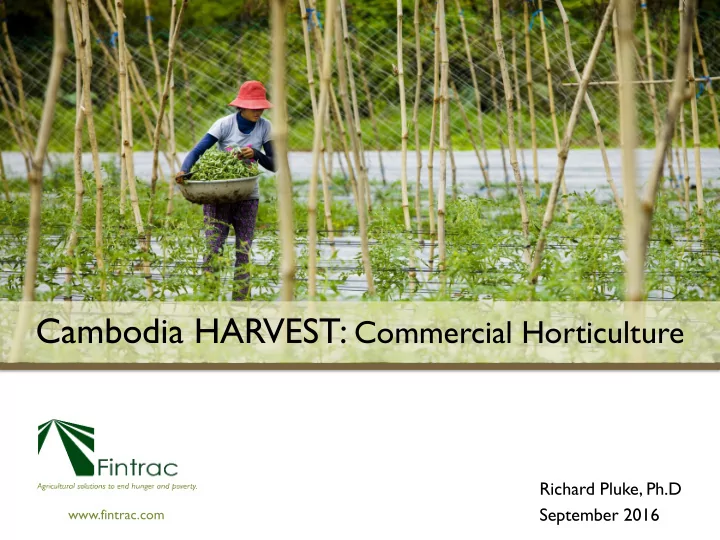
Cambodia HARVEST: Commercial Horticulture

slide-2
SLIDE 2

Agricultural solutions to end hunger and poverty

HARVEST (Dec 2010 – Jun 2016)

  • USAID Feed The Future & Global Climate Change Project
  • Worked in 4 provinces (Battambang, Pursat, Siem Reap & Kampong Thom)
  • 4 main components:
  • Increased Food Availability (improved production & access to inputs)
  • Increased Food Access Through Rural Income Diversification
  • Natural Resource Management & Improved Resilience to Climate Change
  • Increased Capacity of Public, Private & Civil Society to Address Food Security & Climate Change
  • Main Value Chains – Rice, Commercial Horticulture & Aquaculture
slide-3
SLIDE 3

Agricultural solutions to end hunger and poverty

RESULTS

  • 124,000 Beneficiary Households (of these 6,500 were in horticulture)
  • 87,600 ha under improved technologies or practices (1,000 ha in horticulture)
  • Yield increases: Rice – 45%; Horticulture – 216%
  • $40M in farm level incremental sales ($14.4M in horticulture)
  • $18M in SME incremental sales
  • $9M in private sector investment ($8.4M from ag. input suppliers)
slide-4
SLIDE 4

Agricultural solutions to end hunger and poverty

FINTRAC GLOBAL APPROACH

Leverage the impact of improved production to commercialize smallholder farmers whose success drives the development of the value chain. Key truths:

  • Better smallholder practices & technologies for better agriculture
  • Success & impact redoubles motivation and commitment – farmers & technicians
  • Improved productivity creates business opportunities
  • Cement the successes – professionalism, stewardship, resilience & scale
slide-5
SLIDE 5

Agricultural solutions to end hunger and poverty

Better Practices and Technologies

19 commercial technologies were introduced to horticulture farmers under

  • HARVEST. These included:
  • Raised beds
  • Production of seedlings using seedling trays
  • Integrated Pest Management & the use of Biologicals (e.g. Trichoderma, Bacillus)
  • Drip irrigation
  • Soluble fertilizers
  • Mulch & trellising
  • In-farm drainage
  • Postharvest practices
slide-6
SLIDE 6

Agricultural solutions to end hunger and poverty

Better Practices and Technologies

slide-7
SLIDE 7

Agricultural solutions to end hunger and poverty

Better Practices and Technologies

slide-8
SLIDE 8

Agricultural solutions to end hunger and poverty

Extension approach

Invest in the field technicians – commit to their professional development Careful choice of lead farmers and farmer groups “Seeing is Believing” – the importance of practical demonstrations Critical production points Make sure that the extension package is compatible with the host country (e.g. example of drip irrigation, plastic mulch, row covers in Cambodia) Commit quality time in the field to the farmers (18 months on HARVEST)

Better Practices and Technologies

slide-9
SLIDE 9

Agricultural solutions to end hunger and poverty

HARVEST: Better Practices and Technologies

12.3 10.6 7.5 6.6 5.5 25.1 23.5 16.2 15.2 12.3

0.0 5.0 10.0 15.0 20.0 25.0 30.0 Egg Plant Cucumber Long Beans Bitter gourd Corn

Metric ton/ha

Baseline Yield (mt/ha) per crop cycle

slide-10
SLIDE 10

Agricultural solutions to end hunger and poverty

Agriculture is not easy and there has to be the motivation to invest the time and money (farmers and extension agents). Extension agents and farmers have seen development initiatives before and inertia can set in. This is not business as usual however. Increasing yields by simple technologies and dedicated practices is transformative. The importance of early successes. Minimize risks and do not over-extend a farmer’s resources. Focus on ROI. Transformed farmers are the motor that drives agricultural development. Their successes create a platform to engage the value chain and to drive adoption &

  • scale. This is the ‘depth’ required to the market systems approach.

Success & Motivation

slide-11
SLIDE 11

Agricultural solutions to end hunger and poverty

HARVEST: Success

  • If a farmer does not succeed the first time, he/she will not likely have the money

to try again

  • Most households see vegetable farming as risky and high investment
  • Needs good extension and must avoid over extending resources.
  • Lack of or no water results in seasonal farming

Lessons/Challenges

The commercial horticulture value chain identified as the highest impact technical component was selected for scaling up in the last half of the program, with an increase of 2,000 additional demonstration clients.

slide-12
SLIDE 12

Agricultural solutions to end hunger and poverty

Volumes and quality opens up market opportunities

  • Consolidate harvested produce (as long as there is consistent quality between farmers)
  • Importance of postharvest handling, planning & communication

Success & profits gives farmers the confidence to be more proactive with the market (diversification and off-season production). Input companies respond to steady demand and improve distribution & prices (competition helps) Farmer confidence & improved production/profits creates a favorable environment for microfinancing, expansion and diversification.

Improved Productivity Creates Business Opportunities

slide-13
SLIDE 13

Agricultural solutions to end hunger and poverty

HARVEST: Markets

  • Collaborated with 377 buyers and linked them to 4,362 horticulture farmers in

the program’s four target provinces

  • Due to small size of farms, farmers had to come together to form producer

groups in order to meet buyer volume demands.

  • Implementation of farm level post-harvest practice for select vegetables destined

for high end markets increased the buying price between 15 and 30 percent

  • Price is the issue. Cambodia cannot set prices, importers set the initial prices

(they have the volume/area under production) and domestic traders adjust accordingly.

slide-14
SLIDE 14

Agricultural solutions to end hunger and poverty

HARVEST: Finance

  • Worked with 9 microfinance institutions (31 branches in ZOI).
  • Loan value totaled $16 million distributed to 14,215 agribusinesses and farmer

beneficiary households (20% to commercial horticulture farmers).

  • Farmer collateral is still a major issue (lower income households).
  • Required paper work is an issue for agribusinesses.
  • Some farmers have a bad year, low prices, low volume, and cannot meet the

payback schedule. Revert to seeking loans outside of MFIs.

  • 20% of the 6,537 horticulture farmers applied for loans.
slide-15
SLIDE 15

Agricultural solutions to end hunger and poverty

HARVEST: Input suppliers

  • Assisted 340 input suppliers through business development support, new

product introduction and technical assistance (2,011 people trained).

  • New investment value totaled $8 million (new stores & expansion,

transportation, equipment and machinery)

  • Incremental sales totals $15.9 million, 50 percent over baseline sales value.
  • Financing (for investments) is a problem for many businesses
  • Businesses do not always want to get “larger” but are happy with the small niche

they are occupying

  • Administration and accounting is extremely weak in almost all agribusinesses =>

more involvement of project staff and support

slide-16
SLIDE 16

Agricultural solutions to end hunger and poverty

A true value chain emerges with mutually beneficial interactions based on dependable performance, good communication and knowledge-based negotiations Technical services improve

  • SMEs invest in this to keep the motor running (buyers, input suppliers)
  • Independent consultants (improved employment opportunities)
  • Government (as much a Champion as an implementer)

Conserve farm’s natural resources & build resilience in the farming system – climate smart agriculture ‘Crowd-in’ of stakeholders to take the development process to scale.

Cement the Success

slide-17
SLIDE 17

Agricultural solutions to end hunger and poverty

Cement the Success: Climate Smart Agriculture

  • 1. Promote good agricultural practices to increase incomes.

Farmers adopt new practices when there is a profit incentive.

  • 2. Implement adaptation methods that reduce loss risk from extreme weather

events

Irrigation conserves water during drought and raised beds, contouring helps during floods.

  • 3. Incorporate a whole-farm integrated crop management approach

Risk reduction through diversification; adaptive management

  • 4. Support research, development, and adoption of new varieties

Identify varieties best suited for present conditions; promote propagation & sale

  • 5. Expand capacity in remote weather stations, disease modeling, and index

insurance systems.

slide-18
SLIDE 18

Agricultural solutions to end hunger and poverty

HARVEST

Adaptation Practice Vulnerability addressed Impact & Advantage to client Drainage Reduced exposure to flood Increased yield Reduced crop losses Improved quality = ensuring best possible income for farmers Drip irrigation Reduced exposure to drought (water conservation) Raised planting beds Reduced exposure to plant and soil loss / erosion from rain and flooding Mulch (plastic and straw) Trellis netting Reduced sensitivity to foliar diseases Crops & varieties selected according to season Decreased sensitivity to drought or flood

slide-19
SLIDE 19

Agricultural solutions to end hunger and poverty