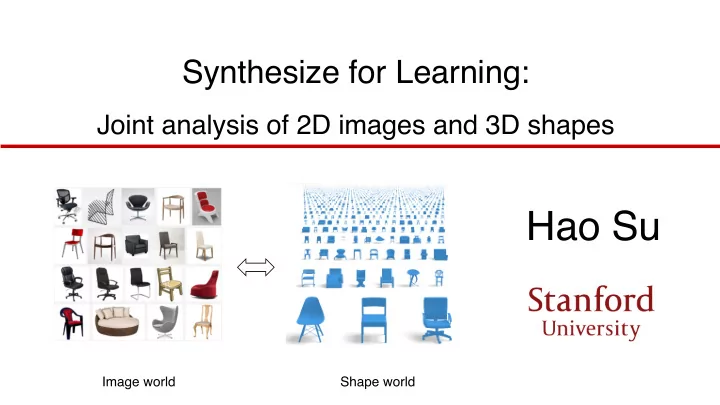
SLIDE 1 Synthesize for Learning:
Joint analysis of 2D images and 3D shapes
Hao Su
Image world Shape world
SLIDE 2
How humans represent 3D in mind?
SLIDE 3 Mental rotation
by Roger N. Shepard, National Science Medal Laurate, Stanford and Lynn Cooper, Professor at Columbia University
SLIDE 4
Shape constancy
SLIDE 5 3D Perception is important for robots
Cosimo Alfredo Pina, “The domestic robots are getting closer”
SLIDE 6
3D Perception is important for robots
SLIDE 7
3D Perception is important for robots
SLIDE 8
3D Perception is important for robots
SLIDE 9
3D Perception is important for robots
SLIDE 10 contrast color motion texture symmetry category-specific 3D knowledge part ……
2D-3D lifting by machine learning
SLIDE 11 Synthesize for learning: from virtual world to real world
Shape Database
A shape repository with rich annotation
- First build & learn in a 3D Virtual Environment,
SLIDE 12 Synthesize for learning: from virtual world to real world
Simulator
Synthetic sensory data
Shape Database
Object attributes
Class, Viewpoint, Material, Symmetry, …
A shape repository with rich annotation
- First build & learn in a 3D Virtual Environment,
…
SLIDE 13 Synthesize for learning: from virtual world to real world
Simulator
Training
Shape Database
Object attributes
Class, Viewpoint, Material, Symmetry, …
- First build & learn in a 3D Virtual Environment,
A shape repository with rich annotation
Synthetic sensory data
…
SLIDE 14 Synthesize for learning: from virtual world to real world
Object attributes
Real data Testing
- Then adapt to 2D Real World
SLIDE 15 Machine learning is data hungry
2000 2002 2008 2010 2004 2006
Caltech 101 Caltech 256 LabelMe CIFAR
10# 10$ 10% 10& 10'
ImageNet
Review: image classification dataset
SLIDE 16
Status review of 3D datasets
<= 60 models per class (average) <= 10,000 models in total <= 100 models in total
SLIDE 17 Status review of 3D datasets
2000 2002 2008 2010 2004 2006
Caltech 101 Caltech 256 LabelMe CIFAR
10# 10$ 10% 10& 10'
ImageNet
State-of-the-art 3D shape dataset
# images
Limited in
- scale
- bject classes
- diversity
SLIDE 18 My work: Build large-scale 3D datasets of objects
…
~3 million models in total ~2,000 classes Rich annotations
(in progress)
SLIDE 19 An object-centric 3D knowledge-base
Physical properties Part decomposition Symmetry Affordance Material Semantics Images
SLIDE 20 ShapeNet: a large-scale 3D datasets of objects
# models # models per classes
10( 10 10) 10# 10$ 10% 10& 10 10( 10) 10#
SHREC14 TSB PSB CCCC WMB SHREC12 MSB BAB ESB
ShapeNet
SLIDE 21 My work: Develop data-driven 3D learning algorithms
Simulator
Synthetic sensory data Training
ShapeNet
Object attributes
Class, Viewpoint, Material, Symmetry, …
A shape repository with rich annotation …
SLIDE 22 Application 1: 3D viewpoint estimation
car
3D Viewpoint Estimation
azimuth elevatio n in-plane rotation
ICCV 2015 oral: Render for CNN: Viewpoint Estimation in Images Using CNNs Trained with Rendered 3D Model Views
SLIDE 23 PASCAL3D+ dataset [Xiang et al.]
Accurate viewpoint label acquisition is expensive
Annotation takes ~1 min per object
SLIDE 24 30K images with viewpoint labels in PASCAL3D+ dataset [Xiang et al.]
High-cost Label Acquisition High-capacity Model
60M parameters. AlexNet [Krizhevsky et al.]
How to get MORE images with ACCURATE viewpoint labels?
SLIDE 25
Manual alignment by annotators Auto alignment through rendering
SLIDE 26
A “Data Engineering” journey ConvNet: Ah ha, I know! Viewpoint is just the brightness pattern!
47% on real test set L 95% on synthetic val set
SLIDE 27
A “Data Engineering” journey ConvNet: Ah ha, I know! Viewpoint is just the brightness pattern!
47% on real test set L 95% on synthetic val set
SLIDE 28 47% -> 74%
A “Data Engineering” journey
Randomize lighting
ConvNet: hmm.. viewpoint is not the brightness
- pattern. Maybe it’s the contour?
SLIDE 29 47% -> 74%
A “Data Engineering” journey
Randomize lighting
ConvNet: hmm.. viewpoint is not the brightness
- pattern. Maybe it’s the contour?
SLIDE 30
A “Data Engineering” journey
74% -> 86% Add backgrounds
ConvNet: It becomes really hard! Let me look more into the picture.
SLIDE 31
A “Data Engineering” journey
bbox crop texture 86% -> 93%
SLIDE 32
A “Data Engineering” journey
bbox crop texture
ConvNet: the mapping becomes hard. I have to learn harder to get it right!
86% -> 93%
Key Lesson: Don’t give CNN a chance to “cheat” - it’s very good
at it. When there is no way to cheat, true learning starts.
SLIDE 33 Render for CNN Image Synthesis Pipeline
3D model Rendering Add bkg Crop
Hyper-parameters estimation from real images
SLIDE 34 2.4M synthesized images for 12 categories
- High scalability
- High quality
- Overfit-resistant
- Accurate labels
SLIDE 35 Metric: viewpoint accuracy and median angle error (lower the better) Real test images from PASCAL3D+ dataset Our model trained on rendered images outperforms state-of-the-art model trained on real images in PASCAL3D+.
8 9 10 11 12 13 14 15 16 Vps&Kps (CVPR15) RenderForCNN (Ours) Viewpoint Median Error
SLIDE 36
Results
SLIDE 37 Application 2: 3D human pose estimation
3DV 2015 oral: Synthesizing Training Images for Boosting Human 3D Pose Estimation
SLIDE 38 Challenge: clothing variation
3DV 2015 oral: Synthesizing Training Images for Boosting Human 3D Pose Estimation
SLIDE 39 Automatic texture transfer from images to shapes
3DV 2015 oral: Synthesizing Training Images for Boosting Human 3D Pose Estimation
SLIDE 40
SLIDE 41
Effectiveness of texture augmentation
SLIDE 42 Texture transfer for rigid objects
SIGGRAPH Asia 16: Unsupervised Texture Transfer from Images to Model Collections
Product photos Automatically textured shapes
SLIDE 43 Domain adaptation between Virtual and Reality
Map features from real and synthetic images to the same domain 3DV 2015 oral: Synthesizing Training Images for Boosting Human 3D Pose Estimation
SLIDE 44 Adversarial learning based domain adaptation
3DV 2015 oral: Synthesizing Training Images for Boosting Human 3D Pose Estimation
SLIDE 45
Domain adaptation between Virtual and Reality
SLIDE 46
Results: 3D human pose estimation
SLIDE 47 Application 3: Attention-based object identification
SIGGRAPH Asia 2016: 3D Attention-Driven Depth Acquisition for Object Identification
SLIDE 48 Background
composited?
SLIDE 49 Background
49
Object identification
ShapeNet
SLIDE 50
Autonomous object identification
SLIDE 51 The main challenge – next-best-view problem
- Observation is partial and progressive
à View planning
- Assessing views whose observation is unknown
51
Observed view
Unobserve d views
? ? ?
How can you know which view is better without knowing its observation?
SLIDE 52 Simulate For Reinforcement learning
- Train from virtual scanned ShapeNet models using Reinforcement Learning
- Test in a real environment
SLIDE 53
The general framework
SLIDE 54 Goal Belief
Observe
Action
Recognition:
classification based on history View planning:
view based
The general framework
SLIDE 55 Attention mechanism
- Goal-oriented and stimulus-driven
55
Glimpse Task
Perform Supervision
Internal Representation
Stores the info.
Control of goal oriented and stimulus driven attention mechanisms in the brain, Nature Review Neuroscience. 2002
SLIDE 56 3D Recurrent Attention Model
ℎ(
(,)
ℎ(
(()
𝐽(/)
𝜄 , , 𝜚(,) 𝜄 ( , 𝜚(() 𝜄 ) , 𝜚())
…
𝐽(,) 𝐽(()
ℎ(
())
NBV emission NBV emission NBV emission
…
ℎ,
(,)
ℎ,
(()
ℎ,
())
Feature extraction Feature extraction Feature extraction
𝜄 / , 𝜚(/)
𝜄 , , 𝜚(,) 𝜄 ( , 𝜚(() initial view classify classify classify
Discriminative view selection View aggregation
SLIDE 57 Reinforcement learning needs LOTS of data to train!
- Simulate many many scan sequences in virtual environment
SLIDE 58
Results
SLIDE 60
Quantitative results
SLIDE 61 Reconstructed 3D scene
SIGGRAPH Asia 2016: 3D Attention-Driven Depth Acquisition for Object Identification
SLIDE 62 Summary
- Key theme: learn in a virtual environment of
3D shapes, test in real scenes of 2D RGB(D) images
- Data: build a large-scale 3D database
(ShapeNet) with rich annotations
- Synthesize training data for deep learning,
applicable for many tasks
CV CG ML
SLIDE 63
Thank you!